The T-money Card Isn’t the Only Way Koreans Pay for Transit
If you are visiting Korea, you will hear the same advice almost immediately: get a T-money card.
That advice is useful. But it can also create a slightly misleading picture of how postpaid transit cards in Korea actually work alongside prepaid T-money.
Many locally issued credit and debit cards can also work as transit cards. Instead of loading money in advance, eligible cards can record subway and bus fares and charge them later.
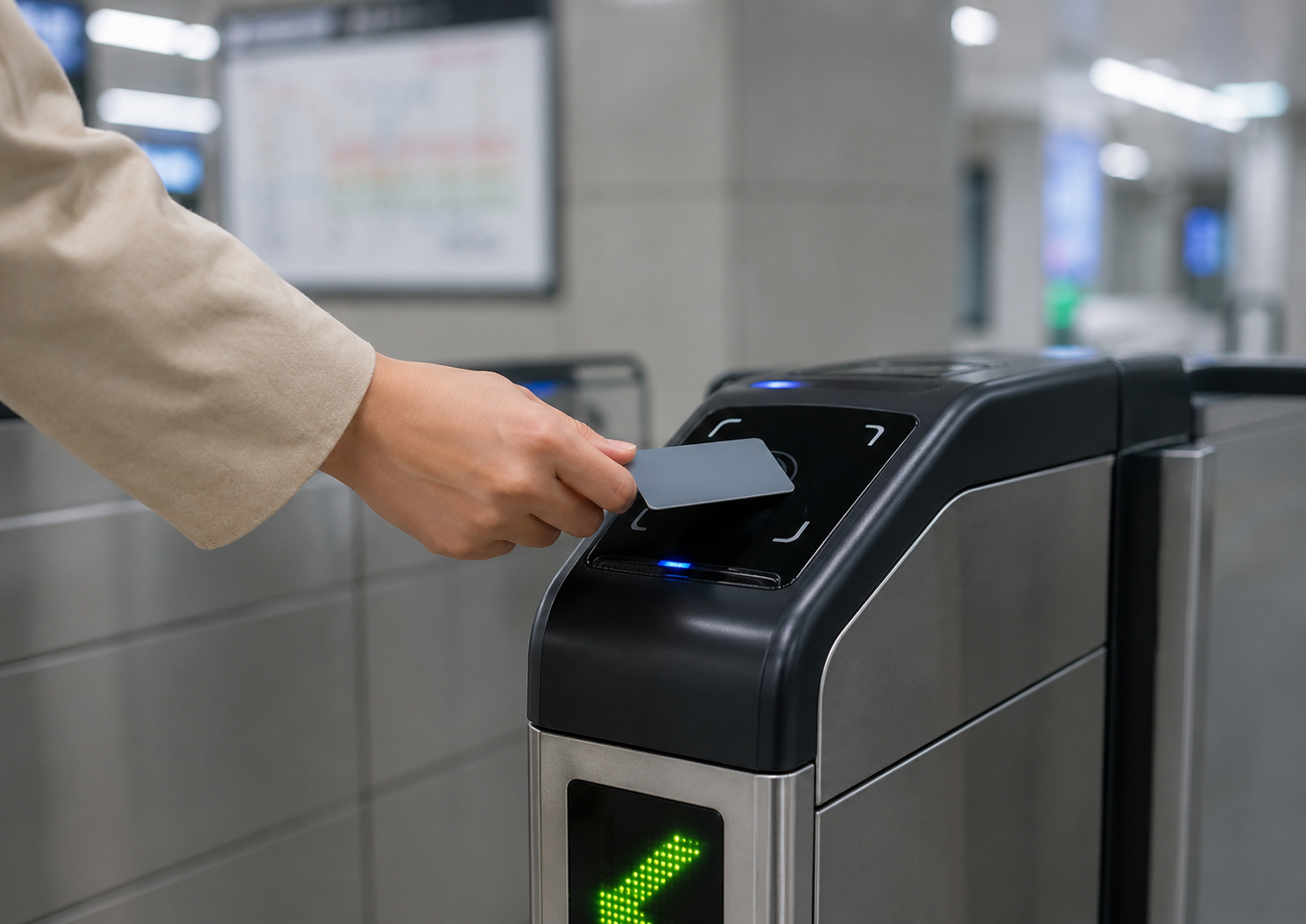
That helps explain something visitors sometimes notice: a Korean commuter may tap what looks like an ordinary bank card at the subway gate while a tourist standing next to them is using a prepaid T-money card.
T-money is not Korea’s only transit-payment system. It is simply one of the easiest options for short-term visitors because it does not require a Korean bank account or a locally issued credit or debit card.
Korean residents may instead use locally issued cards with an eligible transit function. Foreign residents may also have access to some of these options depending on their banking and card eligibility.
Prepaid T-money and postpaid transit are two different systems
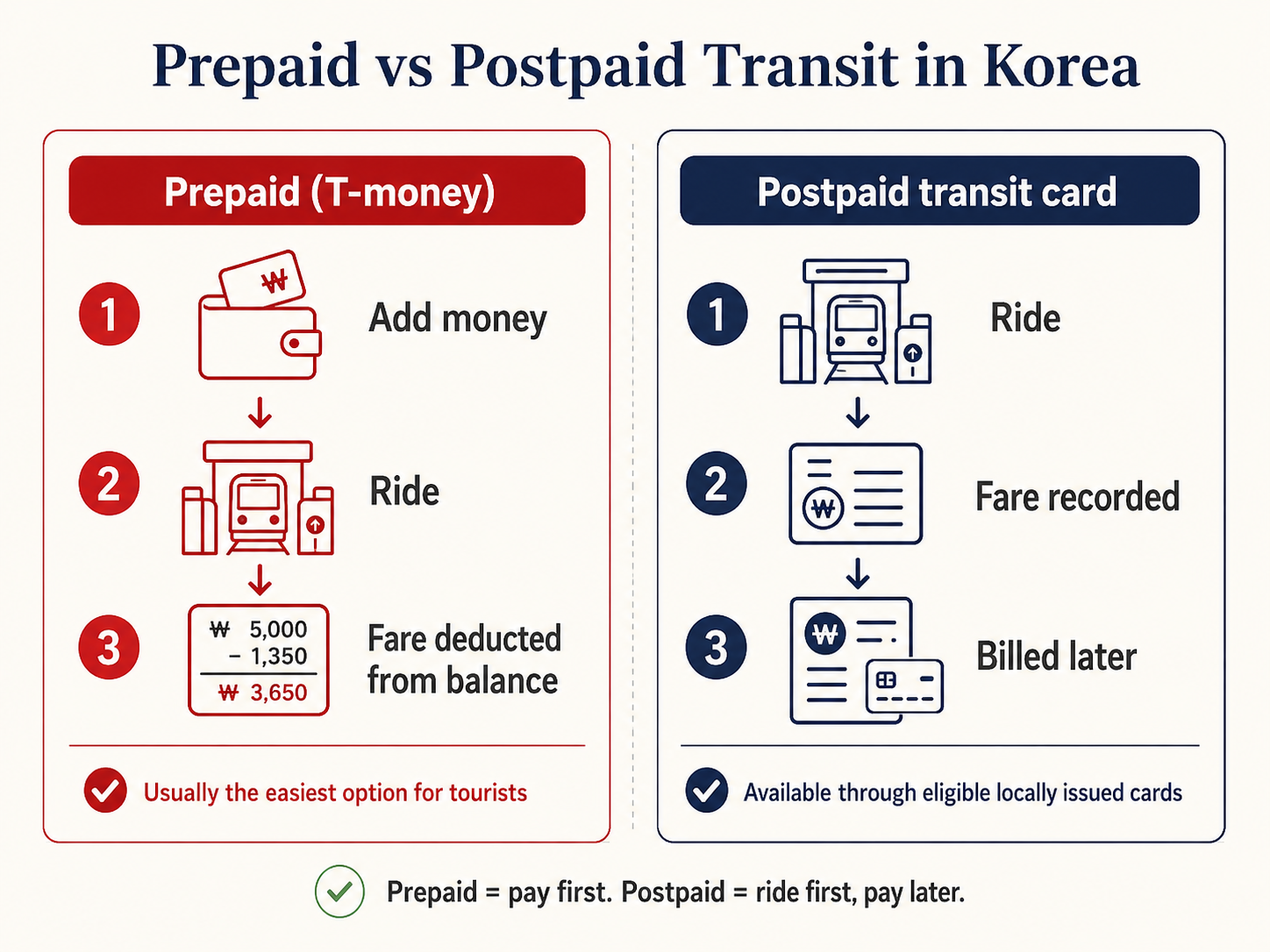
The easiest way to understand the difference is to look at when you pay.
| Payment method | How it works | Who it is practical for |
|---|---|---|
| Prepaid T-money | Add money first, then each fare is deducted from the balance | Tourists, short-term visitors, and anyone who prefers prepaid transit |
| Postpaid transit card | Transit fares are recorded first and billed later through an eligible locally issued card | Eligible Korean residents and foreign residents with suitable Korean banking and card access |
A normal prepaid T-money card is straightforward: you add money to the card and fares are deducted whenever you use public transportation.
You can read the practical side of that system in our T-money Card in Korea guide.
Postpaid transit works differently. A compatible Korean credit or debit card can include a transit function, as T-money’s own postpaid service guide explains. Instead of taking money from a prepaid balance every time you ride, the transit transactions are accumulated and settled later through the card account.
So when someone taps what looks like a normal bank card on a Seoul subway gate, that does not mean Korea has universal open-loop payment where any Visa or Mastercard can be tapped directly at the gate.
A Korean-issued bank card with an enabled transit function is different from simply tapping a foreign Visa or Mastercard at the subway gate.
Using a foreign card at a ticket machine also does not mean that same card can be tapped directly at the gate.
Both systems may involve a card that looks like a normal payment card, but they are not the same thing. Visitors mix this up constantly.
Why can a Korean credit card also be a transit card?
In Korea, transit functionality can be built into locally issued credit and debit cards.
The same physical card can therefore perform two different jobs:
- ordinary payments at shops, restaurants and other merchants, and
- transit payments on compatible buses and subway systems.
The transit side does not behave exactly like a normal credit-card purchase. Instead of asking for real-time authorization every time you tap a subway gate or bus reader, transit transactions can be recorded through the transportation-card system and settled afterward. That is one reason a transit tap may not produce the same immediate approval notification you expect when paying at a restaurant or convenience store.
From the rider’s perspective, however, it feels simple: tap the same card and ride.
But a Korean debit card does not automatically give you postpaid transit
Here is where it gets more complicated.
Having a Korean debit card does not automatically mean you can use it as a postpaid transit card.
Postpaid transit involves using the service first and settling the payment afterward. Even a debit card can carry a small credit component just for this function. For some debit cards, the issuer must separately allow that credit facility or approve a postpaid-transit function. Not every debit card supports this, and the rules can differ by card issuer and product.
A Korean debit card is not automatically a postpaid transit card.
The card itself must support the function, and additional eligibility, approval or registration may be required.
It matters especially for foreigners who move to Korea and receive their first Korean bank card. Opening a Korean bank account and receiving a debit card does not necessarily give you the same transit setup as someone using a credit card with postpaid transit already enabled.
Why tourists still use T-money
Which raises the obvious question. If locally issued cards can handle transit, why do Korea travel guides still tell visitors to buy T-money?
Because the locally issued card system usually requires something a short-term visitor does not have: a Korean banking and card relationship.
A prepaid T-money card is different. You do not need to open a Korean bank account, qualify for a Korean credit card or build a local banking history before using it. You can buy one, add value and start using public transportation. That makes prepaid transit much more practical for someone visiting Korea for a few days or weeks.
The difference is therefore better understood like this:
- Short-term visitor: prepaid T-money is usually the practical default
- Resident: locally issued bank-card transit options may become available
It is not simply a Korean-versus-foreigner distinction. Residency and banking access matter.
Foreign residents are different from tourists
A foreigner living in Korea should not be treated as if they have exactly the same financial options as a tourist.
Long-term foreign residents can open Korean bank accounts and obtain debit cards when they meet the relevant identification and banking requirements. Korea Post’s own account-opening guidance, for example, distinguishes long-term foreign residents and lists the identification documents required.
Credit cards are a separate issue. Approval can depend on the card issuer, residence status, income documentation, employment, banking history and other eligibility requirements. Postpaid transit access can therefore vary as well.
So this statement would be inaccurate:
“Foreigners cannot use postpaid transit cards.”
A better explanation is:
A short-term visitor should not assume they can simply obtain the same locally issued transit-enabled card used by Korean residents.
But foreign residents may be able to access some of the same banking and transit options depending on their card and banking eligibility.
One more twist worth knowing: even some Korean debit cards can be issued with a prepaid T-money function rather than postpaid transit. So “bank card” and “postpaid transit card” are not interchangeable terms.
What about the Climate Card?
The Climate Card is another example of how Seoul’s transit-payment system expanded beyond a simple prepaid T-money card.
Seoul introduced a postpaid version of the Climate Card on November 30, 2024, allowing eligible locally issued credit and debit cards from participating issuers to combine card payment functions with Climate Card transit benefits.
But this is now a transitioning policy, not a stable long-term recommendation.
Seoul first announced an earlier termination schedule in July 2026, then extended the existing program by one month after coordination with the central government.
Under the latest schedule, confirmed by the Seoul Metropolitan Government’s official FAQ, prepaid 30-day Climate Card recharge ends on August 31, 2026, with the final recharged passes usable through September 29, 2026.
Postpaid Climate Card benefits continue through September 30, 2026.
The change is connected to Seoul’s transition toward the K-Pass-based replacement system.
Short-duration Climate Card products are expected to continue, so travelers should not read this as the complete disappearance of every Climate Card option.
For this article, the postpaid Climate Card matters mainly because it demonstrates the broader point: Seoul has repeatedly integrated transit benefits with locally issued credit and debit cards rather than relying only on prepaid T-money.
Because this policy is changing, always check the latest Seoul Metropolitan Government information before choosing a Climate Card product.
So what should you actually use?
If you are visiting Korea
For most short-term visitors, prepaid T-money remains one of the simplest ways to use buses and subways. You do not need a Korean bank account or locally issued credit card, and you do not need to understand Korea’s postpaid card system before taking your first train.
If you are planning your overall transportation setup, start with our How to Get Around Seoul guide.
If you are living in Korea
Once you have a Korean bank account and locally issued card, check the exact transit function on your card instead of assuming it is automatically postpaid. Ask your bank or card issuer:
- Does this card support transit payments?
- Is the transit function prepaid or postpaid?
- Does postpaid transit require separate approval?
- Does a debit card require a small credit facility?
- Is any additional registration required?
The answer can differ even between cards from the same issuer.
If you commute frequently in Seoul
Do not choose a long-term transit product based on older Climate Card guides without checking the current policy. As of August 2026, the system is transitioning, so commuters should compare the latest Seoul and K-Pass-linked options rather than assuming the old 30-day Climate Card structure will continue unchanged.
If you just need to use the Seoul subway
You do not need to understand every layer of Korea’s transit-payment system. Our Seoul Subway Guide covers fares, T-money, single-use tickets, transfers and the difference between foreign-card ticket machines and direct gate payment.
The bigger picture
Tourist information about Korea simplifies the system for a good reason. Visitors need to know what works for them, not every payment mechanism available to residents. But that simplification can create the impression that everyone in Korea carries the same prepaid T-money card tourists are told to buy.
The actual transit-payment ecosystem is broader. Prepaid T-money, locally issued credit cards, eligible debit cards, mobile transit systems and policy products such as the Climate Card can all exist within overlapping parts of Korea’s transportation infrastructure.
So when a Korean commuter taps what looks like an ordinary bank card while you tap your T-money card, neither of you is doing anything unusual. You are simply accessing different layers of the same transit-payment system.