Why Gyeongbokgung Hanbok Rentals Don’t Always Look Traditional
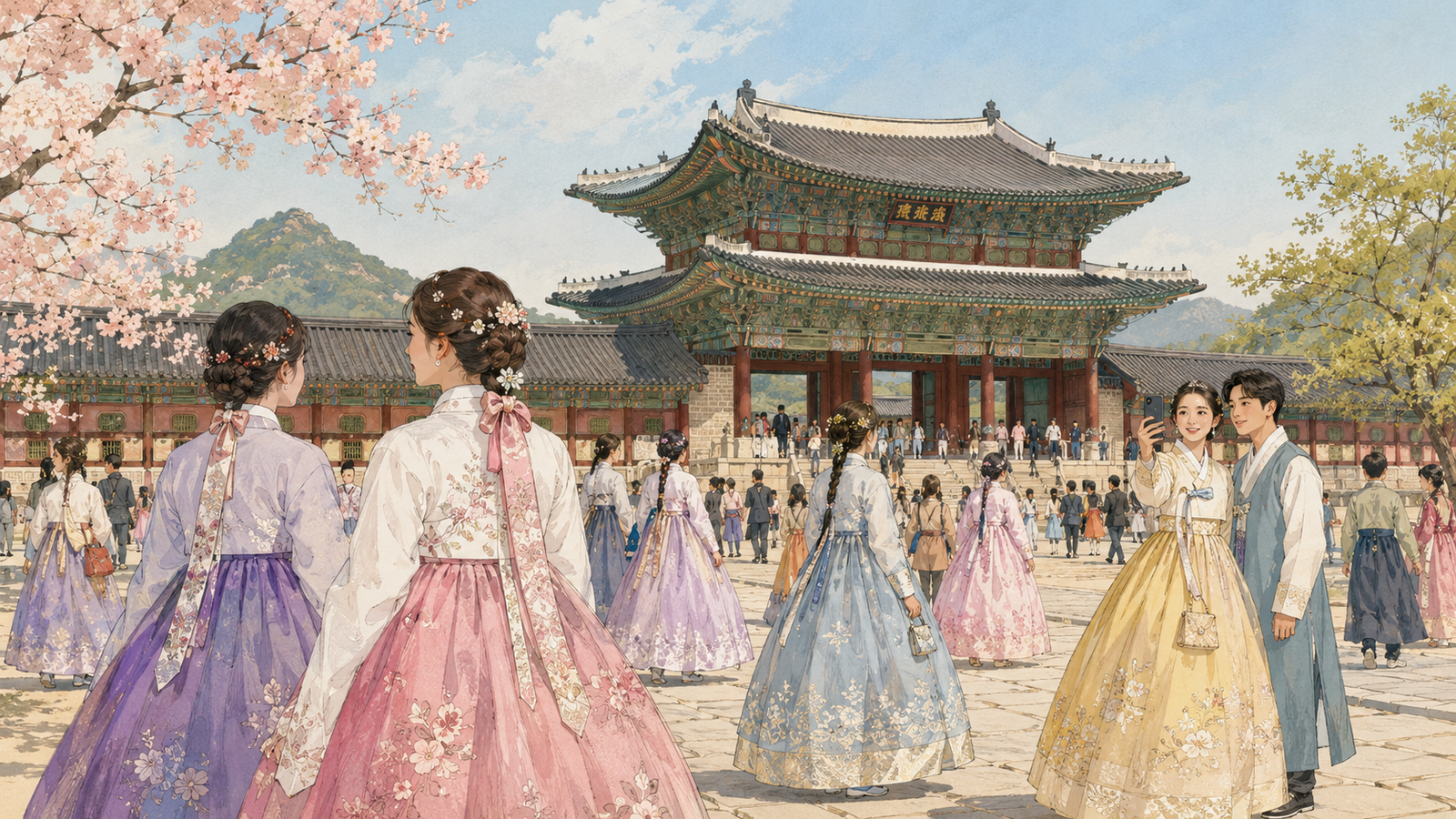
Gyeongbokgung hanbok rentals are everywhere around the palace. Bright colors, flowing skirts, people posing in front of palace walls for photos they’ll post the same day.
Walk through an ordinary Korean neighborhood, and you’ll see almost none of it.
Those two things have been moving in opposite directions for years, and the gap between them says something more interesting than simply, “some rental hanbok look fake.”
Since 2013, Korea has offered free admission to its major palaces and royal heritage sites for visitors wearing hanbok. According to the Korea Heritage Service, roughly 300,000 to 400,000 people used the benefit annually in the early years. By 2025, that number had passed two million. Yonhap’s 2026 fact-check explains the policy and its growth.
Meanwhile, the government’s 2022 Hanbok Industry Survey found that among 470 respondents who had bought traditional hanbok, 48.5% said they almost never wear it. Another 33.8% said they wear it only once or twice a year.
Hanbok has become more visible to visitors at the same time it has become less present in ordinary Korean life.
That’s our reading of two different sets of data, not a conclusion the Korean government itself has formally drawn. But put the numbers side by side, and the contrast is difficult to miss.
The hanbok at Gyeongbokgung isn’t simply “fake”
Before getting into why rental hanbok look the way they do, it’s worth clearing something up: there isn’t an official category called “real hanbok” versus “fake hanbok.”
The Korea Heritage Palaces and Tombs Administration’s official free-admission guidelines recognize both traditional hanbok (전통한복) and modernized “lifestyle” hanbok (생활한복).
The basic structure is a jeogori top with a closing front, paired with a skirt or pants. Traditional ties, or goreum (고름), are not required. A T-shirt-style top does not qualify, and neither does a one-piece reinterpretation worn without a proper jeogori.
In other words, the official palace-admission rules already recognize more than one form of hanbok.
Modernized doesn’t automatically mean fake.
That distinction matters, because it’s easy for a discussion like this to turn into judging which outfits “count.” That’s not the point here.
The more interesting question is why the version of hanbok many visitors encounter around Gyeongbokgung looks so different from traditional forms, and what happens once that version becomes the most visible one.
A free-admission policy became a tourism experience
The free-admission policy has been in place since 2013 as part of efforts to promote and popularize hanbok.
More than a decade later, over two million people a year are using it.
Measured by how many more people are wearing and encountering hanbok at Korea’s royal heritage sites, the growth has been remarkable.
For many overseas visitors, putting on hanbok and walking through Gyeongbokgung is now simply part of a Seoul trip. A 2026 Hankook Ilbo column on Korea’s changing tourism culture describes palace visits in hanbok as a shift from watching Korean culture to actually stepping into it for an afternoon.
If palaces and traditional Seoul are a big part of your trip, Jongno and Insadong are also among the most convenient areas to stay in Seoul.
But the success of hanbok rental culture also created a new kind of market.
When millions of people want to rent hanbok for a few hours, what kind of hanbok does that market produce?
Why Gyeongbokgung hanbok rentals started looking so different
This is the part most people actually came here to find out.
In comments reported by Yonhap in 2026, Korea Heritage Service officials pointed to two factors.
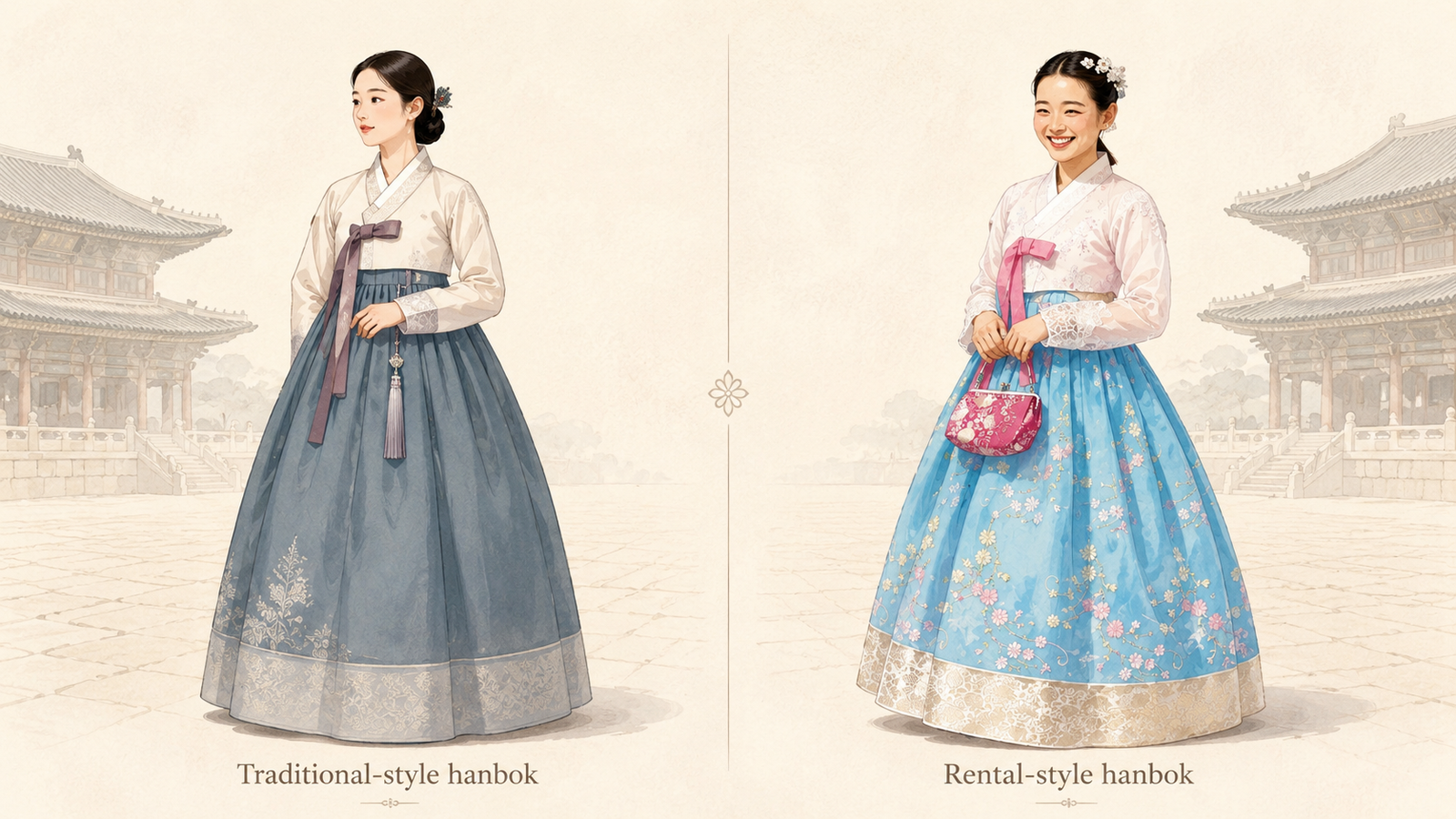
Rental shops tend to prefer materials that are easier to manage. Foreign tourists tend to prefer more colorful and elaborate designs. According to the agency, those two forces have come together in the rental market, with easier-to-manage materials meeting demand from foreign visitors for more visually striking hanbok.
That helps explain much of the aesthetic now associated with rental streets around Gyeongbokgung: bright colors, elaborate details and styles that stand out in photographs.
It’s also important not to stretch that evidence further than it goes.
We can reasonably talk about rental practicality, easier-to-manage materials and demand for eye-catching designs.
What we cannot say, based on the evidence available, is that shops chose those materials specifically to reduce laundry costs, increase daily turnover, or because the outfits are made in China.
Those explanations sometimes appear in online discussions, but we haven’t found reliable enough evidence to present them as fact.
Meanwhile, the traditional hanbok industry is shrinking
Outside the tourist zone, the picture looks very different.
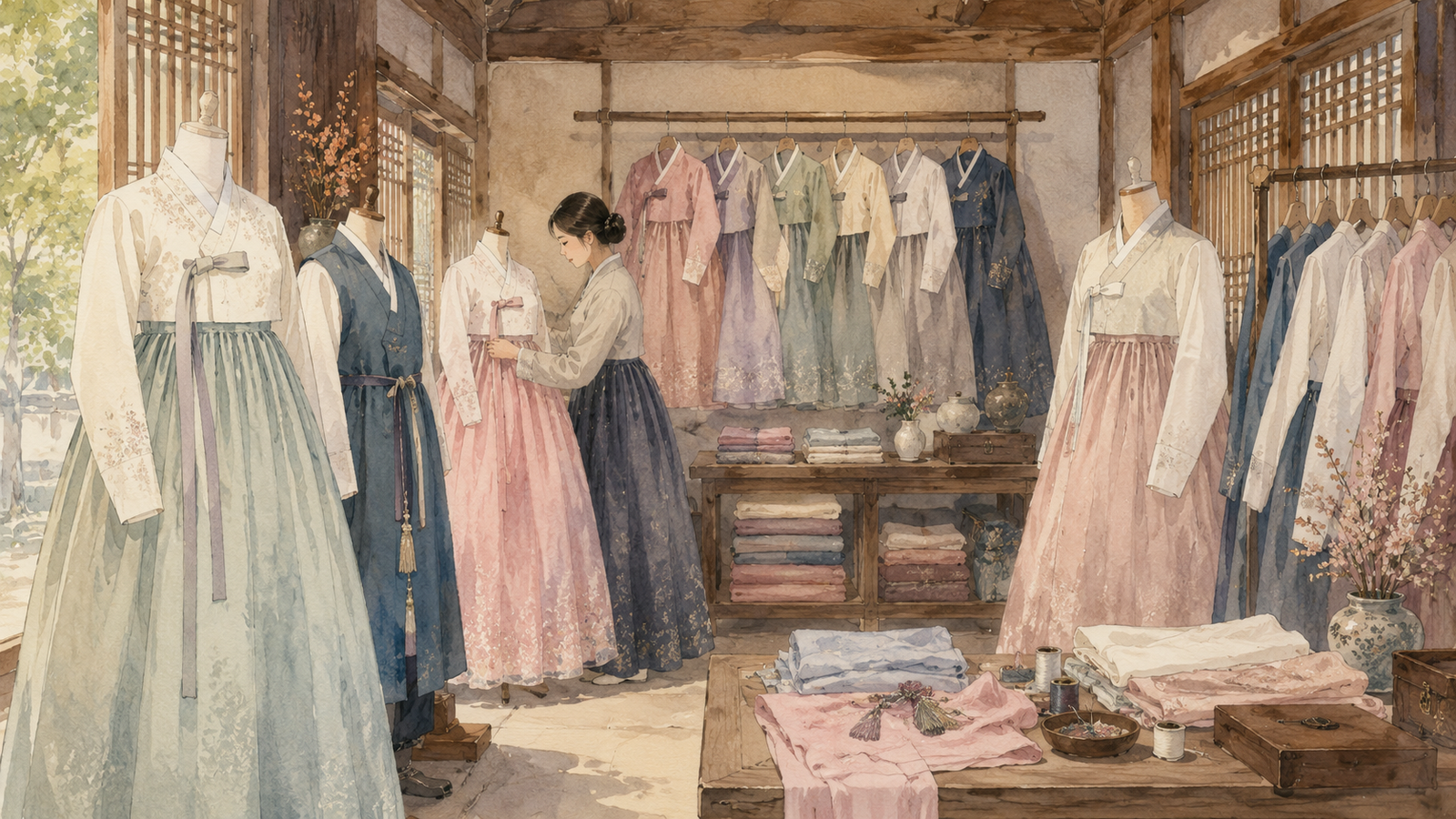
The official 2022 Hanbok Industry Survey defines the hanbok industry in this section as manufacturing plus retail combined. Across those two sectors, the number of businesses fell from 5,287 in 2010 to 3,608 in 2020, the number of workers fell from 7,550 to 4,844, and annual revenue dropped from about 258.3 billion KRW to 142.0 billion KRW.
Manufacturing alone contracted even more sharply, from 3,737 businesses in 2010 down to 2,099 in 2020. The same report says the sustained decline in manufacturing businesses was one factor behind the industry’s overall contraction.
This isn’t only a story about fewer businesses.
The consumer side tells a similar story about hanbok’s place in daily life. Among traditional-hanbok buyers in the survey, nearly half said they almost never wear it.
The industry is shrinking at the same time the clothing itself occupies a smaller place in ordinary Korean life.
For some Koreans, this shift happened within living memory
For Koreans who grew up in the 1980s and 1990s, seeing children dressed in hanbok to visit grandparents during Seollal or Chuseok was still a familiar sight.
That’s not a statistic, and it shouldn’t be treated as one. It’s a generational reference point.
Hanbok wasn’t everyday clothing then either. But it was still something many children encountered through family holidays rather than only at a palace rental shop.
The survey gives us a clearer picture of where things stand now.
Among the 470 traditional-hanbok buyers surveyed, 48.5% said they almost never wear it. Another 33.8% said they wear it just once or twice a year.
Together, more than 80% of the traditional-hanbok buyers in that survey fell into those two groups.
The real tension isn’t tradition versus fusion
This is where the issue becomes more complicated than whether a particular rental outfit looks “traditional enough.”
The Korean government itself has acknowledged the concern.
A Korea Heritage Palaces and Tombs Administration official told Yonhap that so-called “hanbok of unclear origin” (국적불명 한복) had become widespread and was causing concern.
But the same official also warned against turning that concern into excessive regulation of small businesses.
That balance matters.
The government is not simply saying “fusion hanbok is bad.” Neither should we.
The more useful question is what happens when a living tradition grows weaker at the same time its tourism-facing version grows stronger.
For this article, it helps to separate three things that often get lumped together:
- traditional hanbok;
- modern or lifestyle hanbok that adapts traditional forms;
- tourist-oriented fusion and rental styles shaped partly by the needs of the rental market.
That third category isn’t automatically fake.
But for many overseas visitors, it may be the version of hanbok they encounter most visibly during a trip to Korea.
And that creates a question of representation.
If people rarely see the tradition in ordinary life, how do they know which parts of the tourist version are a continuation of it, which are a modern reinterpretation, and which belong mostly to the rental experience itself?
One useful comparison is how The Bojagi with Seasons redesigns bojagi for everyday use. The form changes, but the original source remains visible.
What should visitors take away from this?
None of this means renting a bright, modern hanbok at Gyeongbokgung is disrespectful.
Tourists aren’t responsible for the decline of Korea’s traditional hanbok industry, and choosing a fun, photogenic outfit for an afternoon isn’t a cultural offense.
The popularity of hanbok rental has put Korean clothing in front of millions of people who might otherwise never have worn it at all.
But what you see around Gyeongbokgung is one branch of hanbok culture.
It isn’t the whole tradition.
And if you’re visiting Seoul for the first time, it’s worth seeing the palace rental experience for what it is: part heritage, part modern reinterpretation, and part tourism culture.
For practical planning around the historic center, see our guide to where to stay in Seoul or our Seoul subway guide for first-time visitors.
Preservation doesn’t have to mean freezing hanbok in the past.
But evolution means more when people can still see where it came from.