Why Are There So Many Ginkgo Trees on Korean Streets?
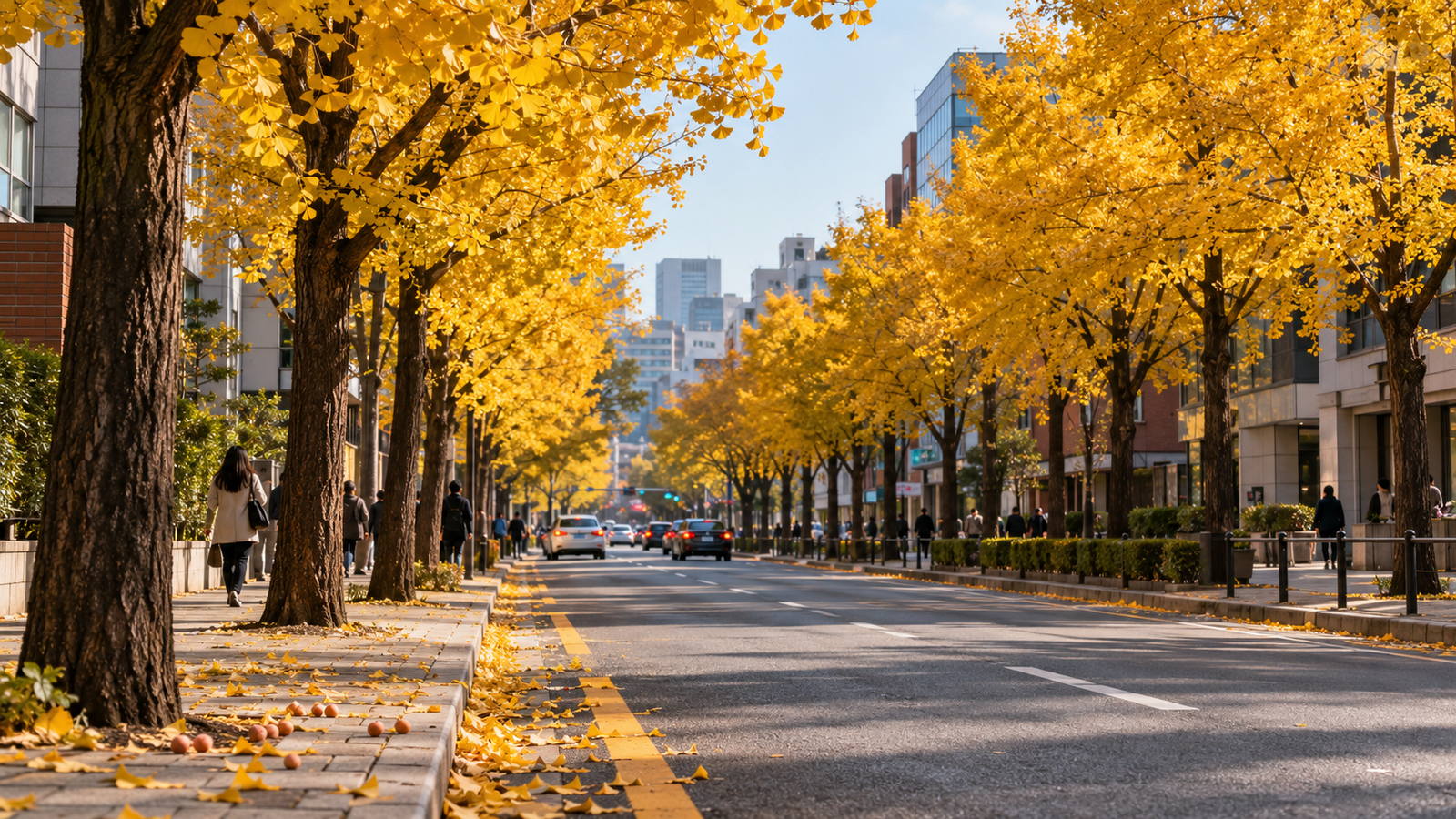
Walk through Seoul on a clear day in late October and you will understand why people photograph the streets. Whole avenues turn the same shade of yellow at once, the leaves fan-shaped and unmistakable, the light coming through them gold. It is one of the most recognizable versions of a Korean autumn.
Then you smell it.
Somewhere between the photos, a sour, rotten note drifts up from the pavement, something close to spoiled food, or worse. You look down and there they are: soft yellow-tan orbs scattered across the sidewalk, some already crushed. Now the smell is on your shoe, and it is not leaving for a while.
The tree that makes the view is making the smell.
Both come from the ginkgo, and the fact that Korean cities have so many of them is neither an accident nor a simple planning mistake.
It is the long-delayed result of a decision that made complete sense at the time.
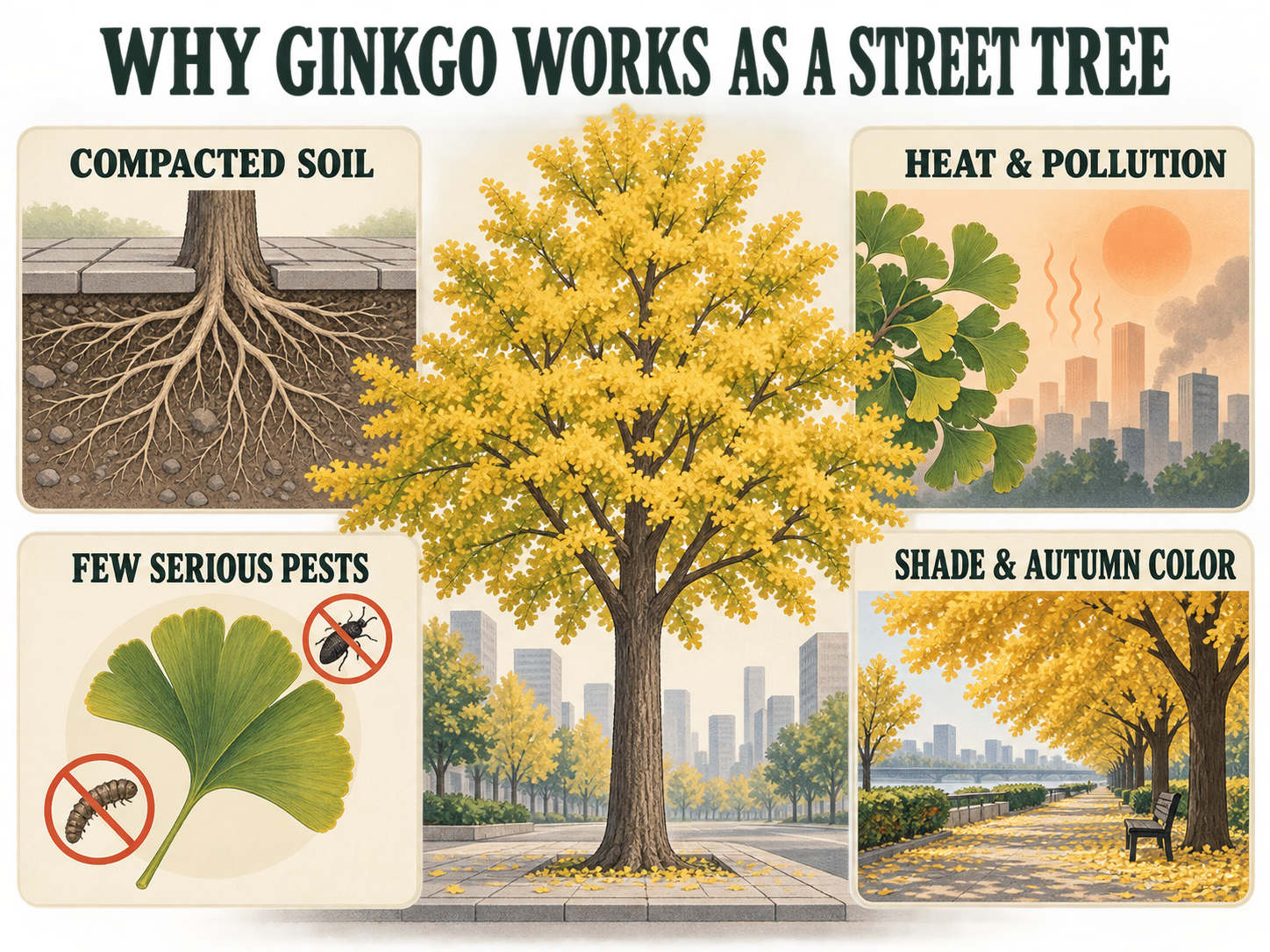
Ginkgo trees in Korea became common along urban streets because they were unusually good at surviving a fast-growing city. They tolerate pollution and difficult soil, suffer from relatively few serious pests, provide real shade and turn bright yellow in autumn.
The smell is a separate problem, and it comes from only some of those trees: the females, whose seeds are wrapped in a fleshy outer layer that ripens, falls and reeks.
For decades, cities had no practical way to tell a young female ginkgo from a young male one. Many of the trees causing today’s autumn complaints were planted before planners could verify their sex at the seedling stage.
The choiceWhy ginkgo worked so well as a street tree
A street tree has a hard job. It lives in compacted soil, breathes exhaust, gets salted in winter, bakes against asphalt in summer and rarely receives the care a garden tree would. Many species struggle under those conditions. Ginkgo handles them unusually well.
It tolerates pollution, heat, salt and compacted ground. It also has few serious insect or disease problems, which is why botanical institutions still describe it as an excellent tree for streets and other urban spaces.
It grows tall enough to throw real shade, lives for a very long time and turns a clean, bright yellow every autumn. For a city planting thousands of trees across a rapidly expanding road network, that combination was close to ideal.
It also helps to clear up one detail that is often simplified in English-language explanations. Ginkgo was not introduced to Korean streets through a single planting campaign in the 1970s. The tree had already been grown in Korea for centuries beside pavilions, Confucian academies, temples and roads. It also appears among the tree species included in Seoul street-planting records from the 1930s.
What changed in modern Seoul was the scale. According to a Seoul Institute study, the number of street trees in the city grew from around 40,000 in 1967 to more than 200,000 by 1985. As Seoul expanded, the city relied heavily on a relatively small group of hardy, dependable species.
Ginkgo was near the top of that list, and it stayed there. In Seoul’s published 2024 street-tree statistics, roughly one in three of the city’s street trees was a ginkgo. Seoul even designated the ginkgo as its official city tree in 1971, presenting its longevity and towering growth as symbols of the capital’s own future.
None of this required anyone to want the fruit. That distinction turns out to matter.
The catchOnly the female trees create the problem
Ginkgo is dioecious, which is a botanist’s way of saying the trees come in separate sexes. Male trees produce pollen. Female trees produce seeds. Only the females make the thing you stepped on.
And that thing is not technically a fruit, even though everyone, including the city, calls it one. Ginkgo belongs to an ancient lineage that predates flowering plants, so it does not produce fruit the way an apple or plum tree does.
What looks like a small yellow-orange plum is actually a seed wrapped in a thick, fleshy coat. Inside that coat is a hard shell, and inside the shell is the pale kernel that Koreans roast and eat. The street smell comes from the fleshy outer coat.
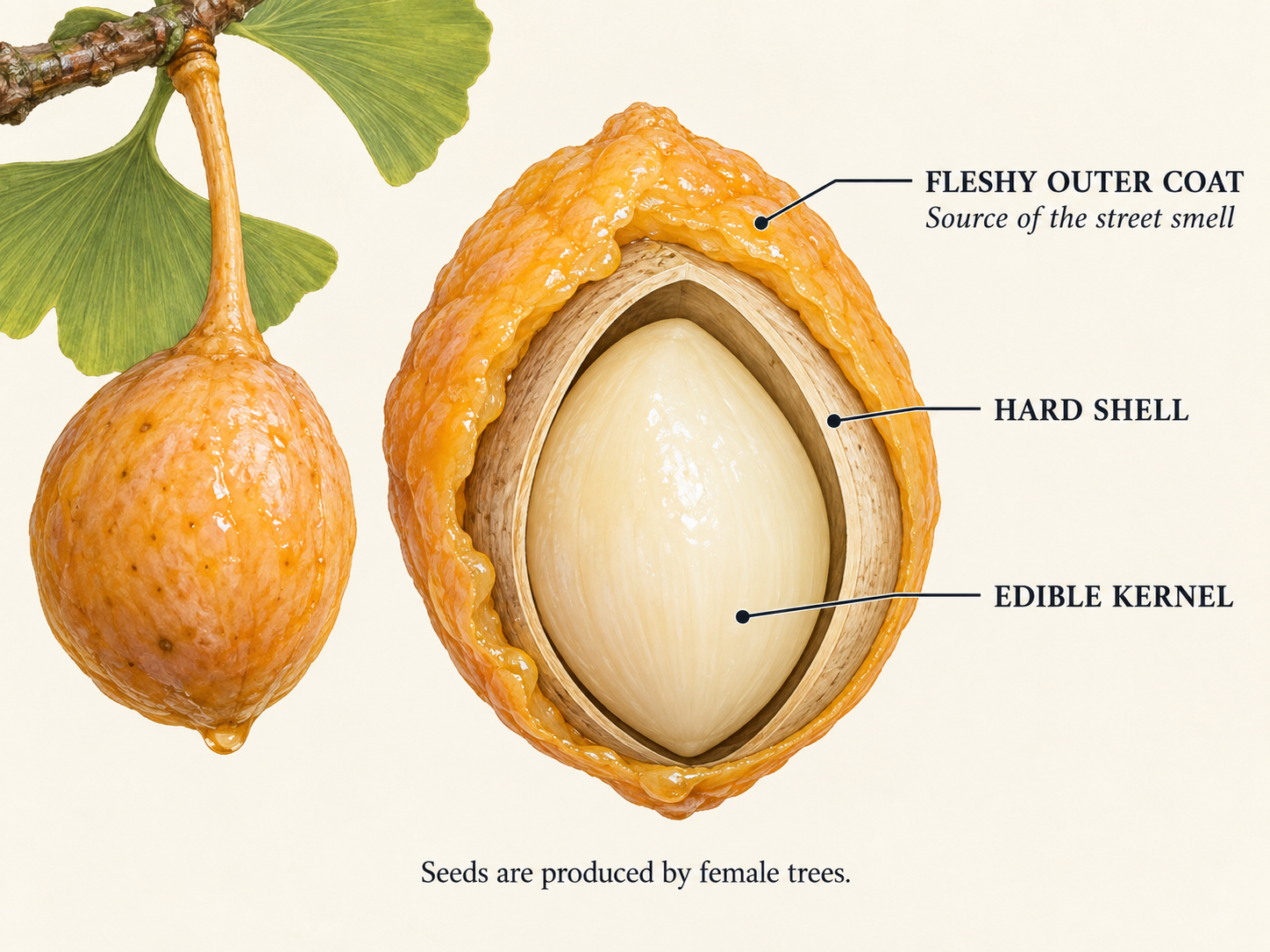
For the rest of this article, “ginkgo fruit” and “ginkgo seed” refer to the same familiar object. That is how the city and most people describe it. Botanically, though, the material being crushed on the pavement is a seed coat rather than fruit flesh.
The chemistryWhat actually causes the smell
When the fleshy coat ripens and falls, especially when it gets crushed underfoot, it releases two particularly pungent compounds: butanoic acid and hexanoic acid. Butanoic acid contributes to the smell of rancid butter and vomit. Hexanoic acid adds a sour, goat-like note. Chemical analyses of ginkgo odor have repeatedly identified high levels of butanoic and hexanoic acids as the main culprits.
You will sometimes see other chemicals blamed, including in Korean sources. Ginkgolic acid is one example. Ginkgolic acid is real and worth respecting, but it is not the main source of the street smell. Research instead identifies ginkgolic acids as important allergens that can cause allergic contact dermatitis in some people. That is a good reason to wear gloves if you ever gather the seeds. The smell and the skin reaction come from different chemicals found in the same outer layer.
The reasonWhy cities didn’t just plant male trees
If only the females stink, the obvious question is why anyone planted females at all. The answer is that, for most of the time these trees were going into the ground, planners could not reliably tell.
A ginkgo does not reveal its sex through the shape of its leaves or the appearance of a young sapling. It becomes obvious only when the tree is mature enough to reproduce, and that can take around 15 years or more.
A tree planted as a young sapling might grow beside a road for a decade and a half before it first produced seeds and finally announced, to everyone’s inconvenience, that it had been female all along.
By then, it was a large, established street tree. Removing it was a much bigger decision than choosing another sapling would have been.
This is the hinge of the whole story, and it changed relatively recently. In 2011, Korea’s National Institute of Forest Science developed a way to determine a ginkgo tree’s sex from the DNA in its leaves. The method uses a genetic marker found in male trees, allowing even young seedlings to be sorted before planting.
The technology received a Korean patent in 2014 and a Chinese patent in 2015. It was later made more widely available through technology transfers to private companies. For the first time, cities could select male seedlings before planting and prevent the problem at its source.
That technology arrived far too late for the mature trees already standing. It shapes what gets planted now, not what is fruiting today.
The responseHow Seoul handles ginkgo season now
Until newer plantings grow, cities still have to manage the trees they already have. In Seoul’s 2024 ginkgo management count, 25,127 female trees made up about a quarter of the city’s roadside ginkgos. Every autumn, the city and its 25 district offices begin working on them.
- Early harvestingCrews remove seeds before they fall, prioritizing areas with heavy foot traffic. Because the seeds on a single tree do not all ripen at once, a large tree may need to be worked two or three times in one season.
- Vibrating harvestersVehicle-mounted equipment shakes the tree or its branches so ripe seeds can be collected at once instead of falling gradually onto the sidewalk.
- NetsUmbrella-shaped nets are installed under some trees to catch the seeds before they hit the pavement and get crushed.
- Crews and lift trucksWhere machines cannot reach, workers remove the seeds by hand from raised platforms.
- Public reportingSeoul residents can request collection through the 120 Dasan Call Center or the parks department of their local district office.
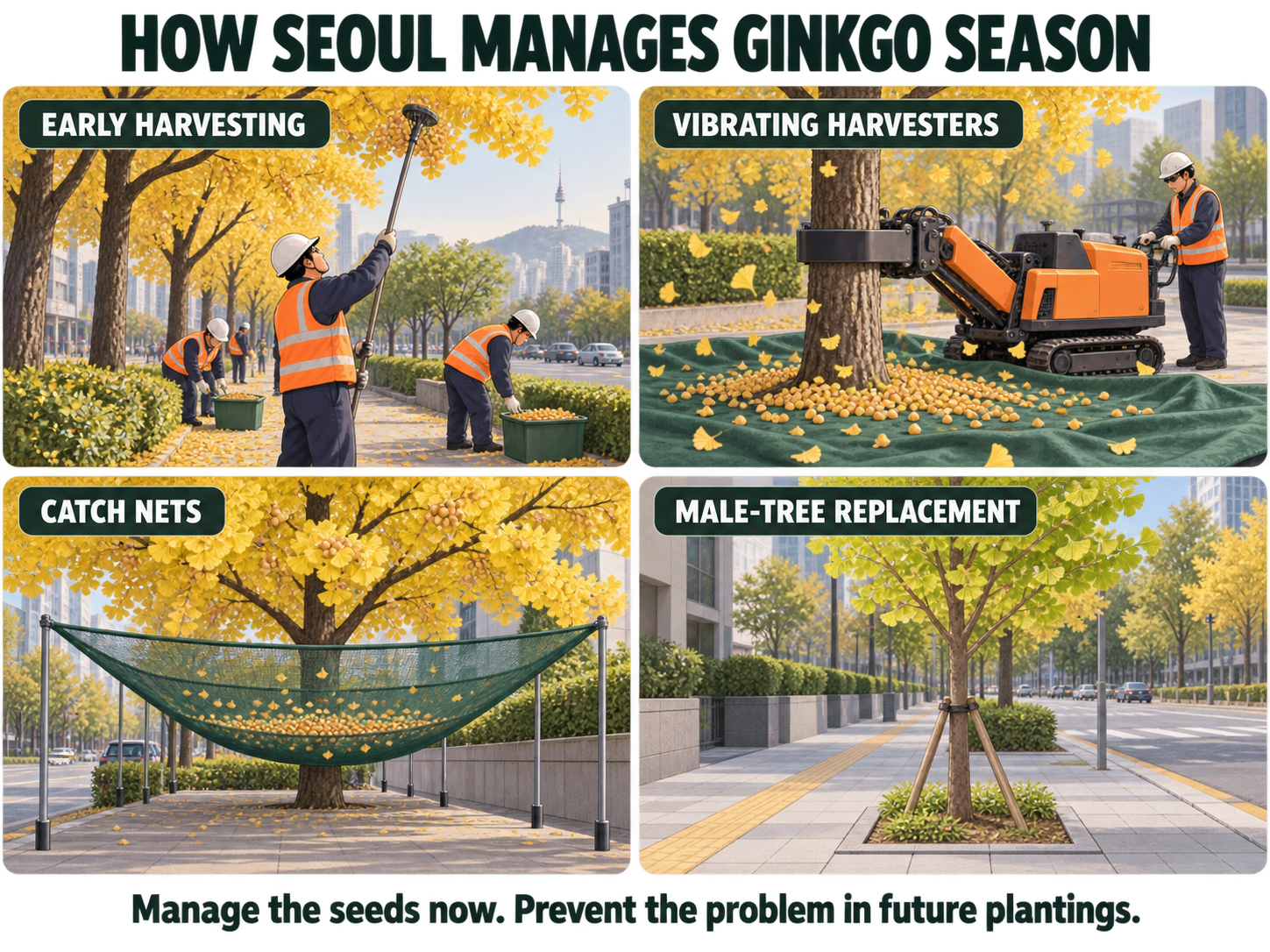
There is also a longer-term solution: replacing the tree itself. Some districts have exchanged female ginkgos for DNA-verified males. The street keeps its ginkgo trees while removing the source of the smell.
Gangbuk-gu provides one of the clearest examples. After identifying 1,053 female ginkgos along 31 roads, the district replaced 917 in 2020 and the remaining 136 in 2021, according to the Seoul Metropolitan Government’s report on the project.
The debateManage the trees, or replace them?
For a long time, the question was simply how to clean up the smell. Now it has become something bigger: whether a mature street tree should be removed at all.
In 2026, the Seoul Federation for Environmental Movement reviewed the annual street-tree plans of the city’s 25 districts. Its monitoring report found that at least 792 ginkgo trees were scheduled for replacement across ten districts.
Not all of those projects were about smell. Gwangjin-gu planned to replace 115 female ginkgos with males specifically to reduce odor complaints. Yongsan-gu’s larger figure of 254 trees was listed under improving the walking environment. Other districts cited streetscape improvement and pedestrian comfort.
The environmental group did not argue that every individual replacement was wrong. Its concern was that hundreds of mature trees were being marked for removal under broad explanations such as resolving complaints, improving the streetscape and reducing public inconvenience, without enough detail about why each tree needed to go. Mature street trees already provide shade, cooling and environmental value that new saplings cannot replace immediately.
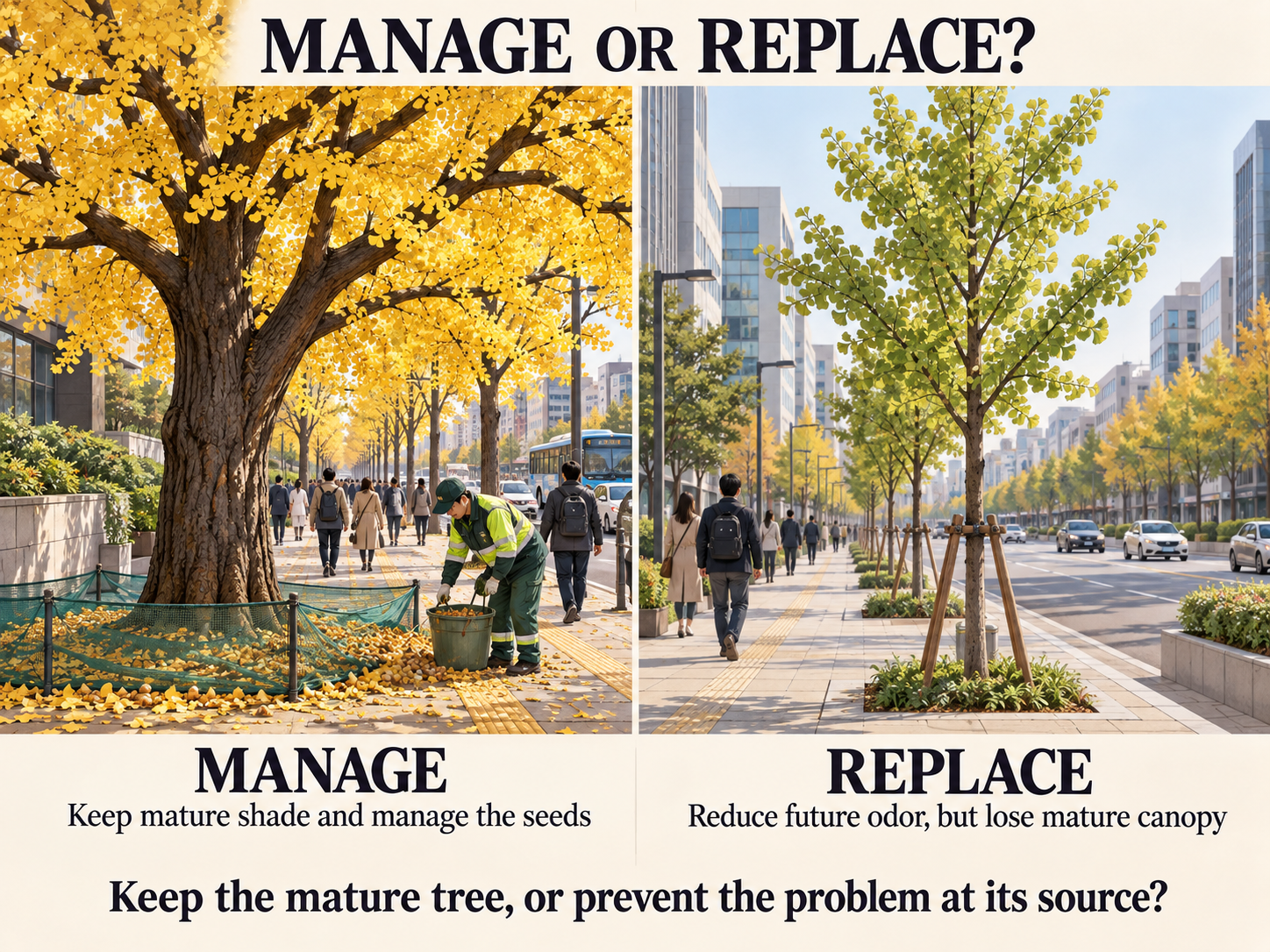
There is no single clean answer. What is clear is that the question has shifted, from how do we get rid of the smell? to when is a mature tree worth keeping, and when is it worth replacing?
That is a harder question, and Seoul is answering it one district plan at a time.
For the visitorWhat to know if you’re walking in Korea in autumn
If you are in Korea between roughly mid-September and November:
- The seeds begin dropping around mid-September and may continue into late autumn. The smell is seasonal rather than year-round.
- Watch your step on stretches where yellow seeds have collected. The smell becomes much stronger after the outer coat is crushed.
- If you step on one, the odor can cling to the sole of your shoe. Scrape it off and wash the sole sooner rather than later.
- Not every ginkgo-lined street smells. Male trees do not produce the seeds responsible for this odor.
- In Seoul, residents can report a problem tree or request collection through the 120 Dasan Call Center or their district office.
The takeawayA sensible choice, still echoing
The ginkgo was a genuinely practical choice for a growing city: hardy, long-lived, pest-resistant and spectacular in autumn. The problem arrived years later, when female trees matured and began dropping seeds onto crowded sidewalks.
Cities now have options that earlier planners did not. DNA testing can identify male seedlings before planting. Existing female trees can be harvested, managed or replaced, although removing a mature street tree creates another question of its own.
The golden avenue and the smell on your shoe come from the same tree.
Together, they show how a sensible urban decision can keep producing consequences decades after it was made.