Seoul Subway Guide for Tourists: Fares, T-money & How to Ride (2026)
Quick answer: This Seoul subway guide covers the essentials most first-time visitors need: T-money, fares, tickets, transfers and how to find the right exit. For most first-time visitors, a T-money card is the simplest way to use the Seoul subway. Add balance, tap in and out at every station, and use the same card on buses too. If you only read one section of this guide, read the foreign credit card update below: Seoul changed its subway ticket machines in 2026, but that does not mean you can simply tap your Visa or Mastercard at the gate.
Seoul Subway Guide: How the System Works
Seoul is connected by a large color-coded subway and metropolitan rail network extending into Incheon and Gyeonggi-do. Stations are named and numbered, so Gangnam Station on Line 2, for example, is also Station 222.
That number is more useful than it may seem. Station numbers appear on maps and signs and can help you confirm that you’re heading in the right direction when unfamiliar Korean and English station names start blending together.
Inside stations, signs and digital displays show the line, direction, upcoming stations, and transfer information. The system becomes straightforward quickly. Most of the confusion happens on the first few rides: choosing a payment method, finding the correct platform, and knowing which exit to use.
What Should Tourists Use: T-money, Single Ticket or Climate Card?
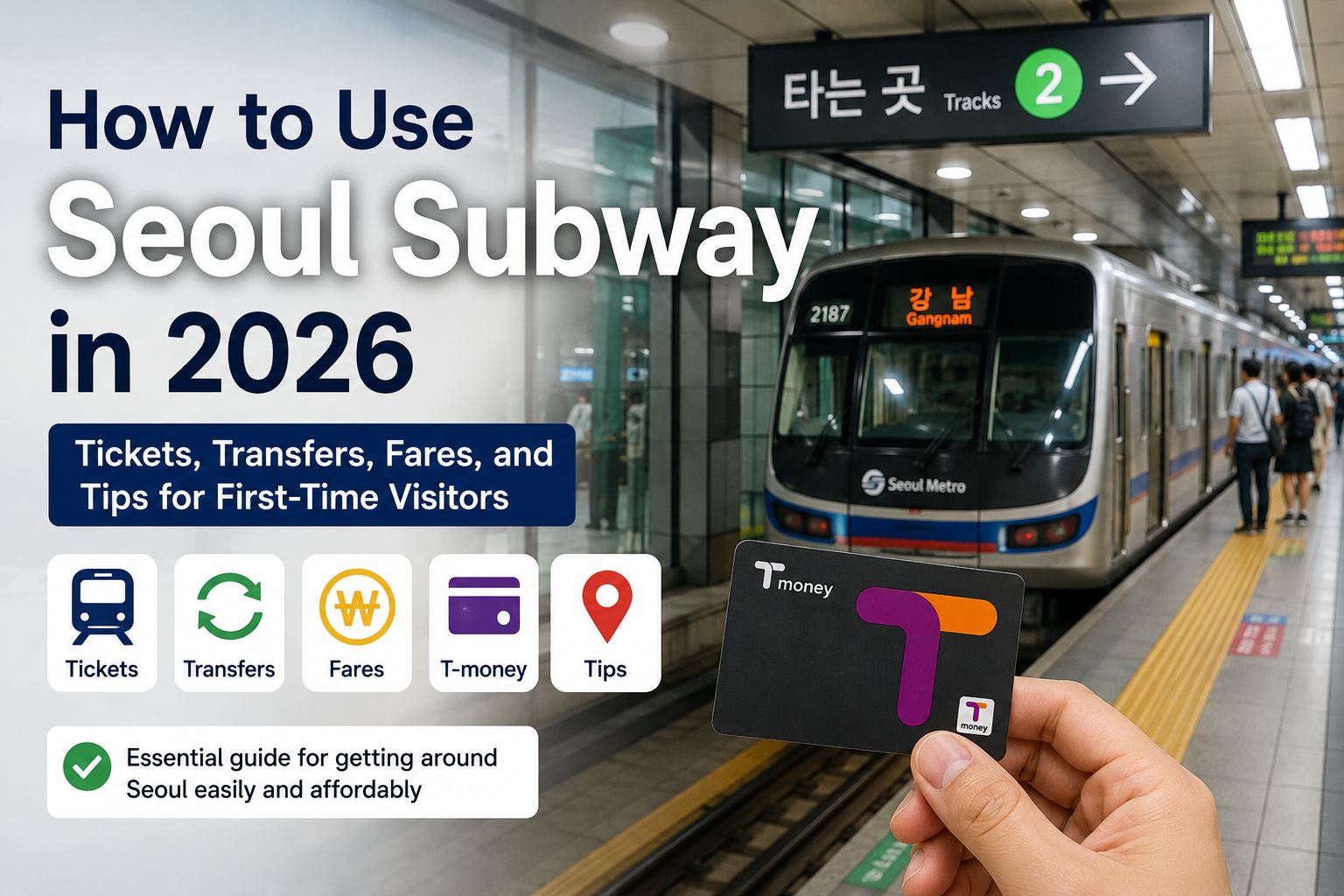
For most visitors, T-money is the safest default. It’s a rechargeable transit card that works on Seoul’s subway and buses and is widely accepted on public transportation elsewhere in Korea.
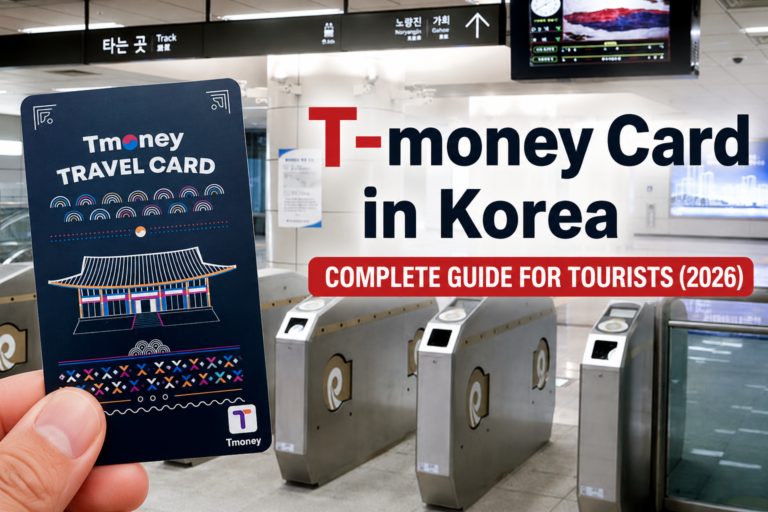
You can buy a standard T-money card at convenience stores such as CU, GS25, and 7-Eleven, as well as at information centers in many Seoul subway stations. We explain buying, loading, refunds, and usage in our T-money Card in Korea guide, so we won’t repeat the full setup here.
For subway travel, three options cover most visitors:
- T-money: Best all-around choice for most trips. You don’t need to buy a new ticket for every ride, and eligible subway-bus transfers are calculated automatically.
- Single-journey ticket: Fine if you’re taking one ride or don’t expect to use public transportation much.
- Climate Card: Worth considering if you expect to use Seoul’s subway and buses repeatedly during the same day or over several consecutive days.
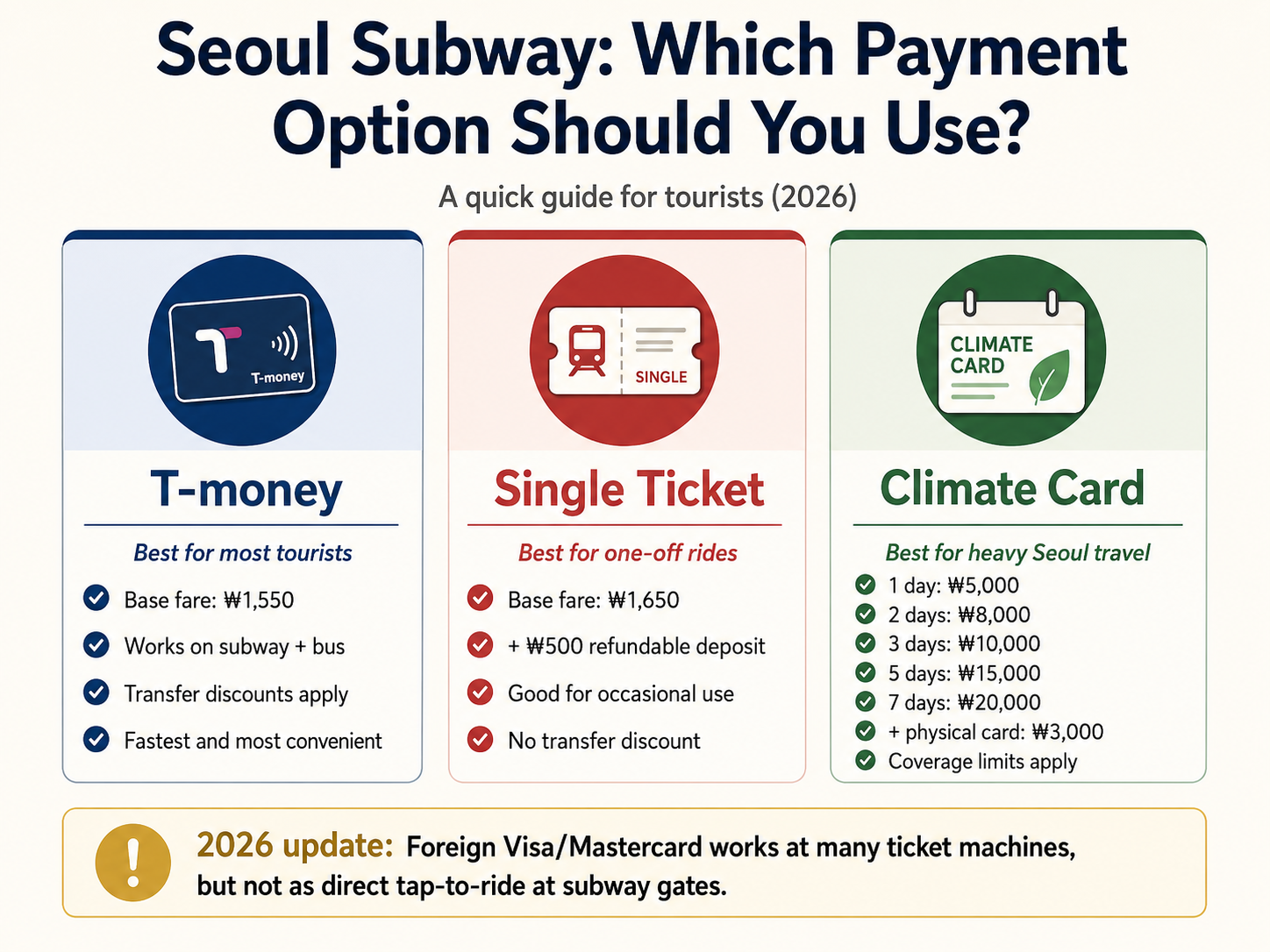
The Climate Card isn’t automatically better just because it offers unlimited rides. Its coverage is mainly focused on Seoul transportation and excludes services such as the Sinbundang Line, intercity and airport buses, and some subway sections outside Seoul. Check the official Seoul Climate Card coverage before buying one for an itinerary that extends outside the city.
Can You Use a Foreign Credit Card? — 2026 Update
Korea Reality Check: Yes, foreign credit cards became much more useful on the Seoul subway in 2026. But there’s an important distinction.
Starting March 17, 2026, Seoul began accepting internationally issued credit and debit cards such as Visa and Mastercard at 440 new transit card vending machines across 273 stations on Lines 1 through 8. These machines can be used to purchase single-journey tickets and purchase or recharge eligible short-term Climate Card passes.
You can read the details in the Seoul Metropolitan Government’s March 2026 announcement.
What you still cannot assume is that your foreign credit card works directly at the subway gate.
That is different from a Korean-issued credit or debit card with a dedicated transit function. Here’s how Korea’s postpaid transit card system actually works.
This is not yet the same open-loop system you may have used in cities such as London, where you can tap a regular bank card at the gate and ride immediately.
In Seoul, the new foreign-card functionality is currently centered on the ticket machine. Your foreign card pays for the single-journey ticket or eligible transit pass. You still use a transit card or ticket to enter the subway.
Seoul is separately working toward direct EMV bank-card payments at subway gates. The city’s rollout plan includes further terminal upgrades before broader open-loop adoption, so don’t interpret “foreign cards now work on the Seoul subway” as “tap any Visa card at the gate.” The two are different systems. Seoul explains the longer-term plan in its open-loop payment announcement.
There is one more detail worth knowing: Seoul says internationally issued credit and debit card transactions at the new machines carry an average service fee of approximately 3.7%.
On a single subway ticket, that’s not a major expense. The real benefit is convenience: if you arrive without Korean cash, one of the supported machines can now get you onto the subway without first finding an ATM or currency exchange counter.
How to Buy a Single-Journey Ticket
If you only need the subway once or twice, a single-journey ticket is still perfectly usable.
At the station ticket machine:
- Select the English language option.
- Choose your destination station.
- Check the fare shown on screen.
- Pay using an available payment method. Foreign cards are supported at the new compatible machines described above.
- Take the reusable single-journey card issued by the machine.
- Tap the card at the gate to enter.
- At your destination, tap out and look for a deposit refund machine.
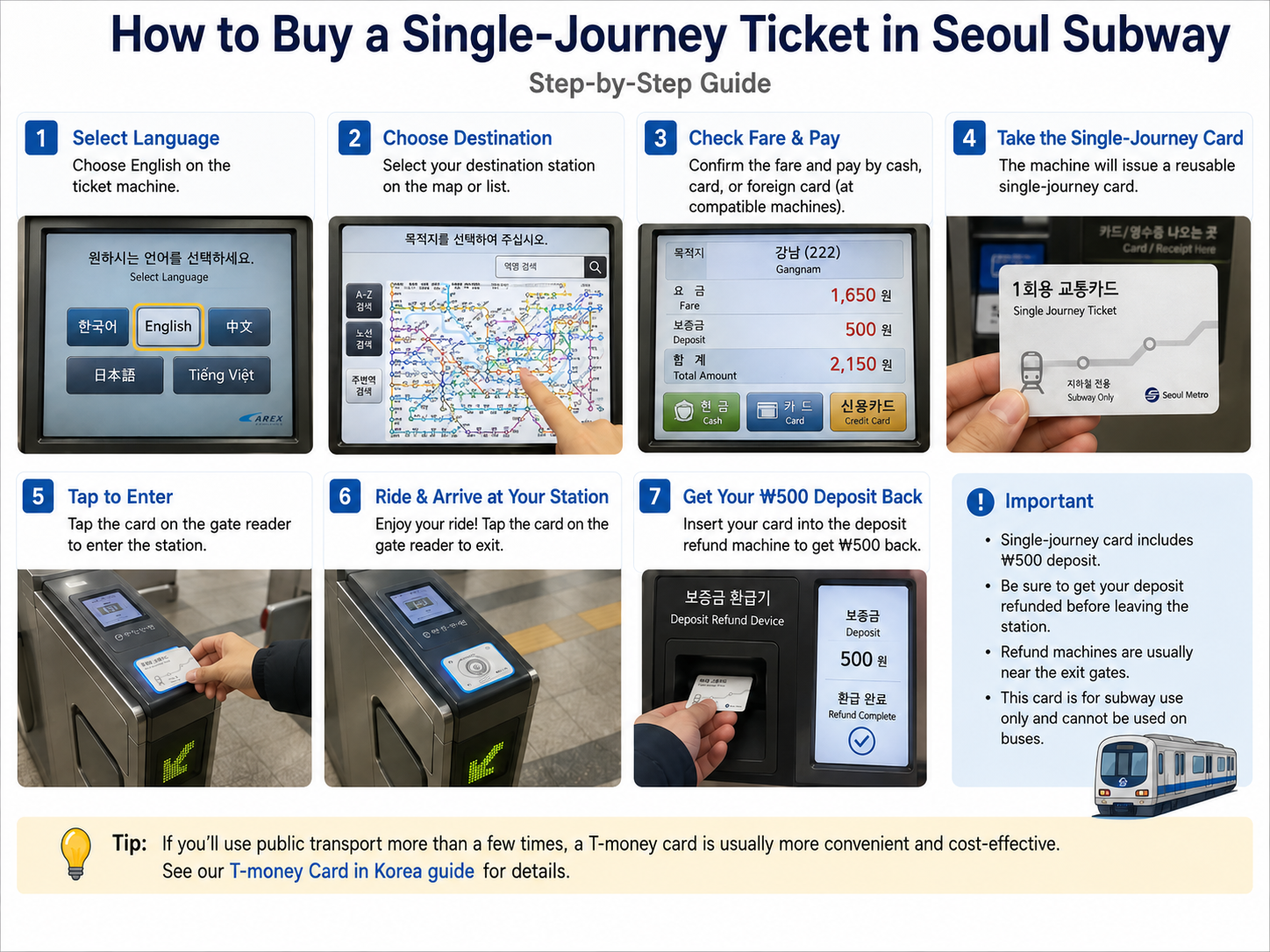
A single-journey card includes a ₩500 refundable deposit on top of the actual fare. After arriving, insert the card into the deposit refund machine and the ₩500 is returned.
This small step is easy to miss if you’ve never used Seoul’s single-journey ticket system before. Seoul’s official public transportation guide also explains the single-journey ticket and deposit process.
Seoul Subway Fares
As of 2026, the current adult base subway fares are:
- T-money or other eligible transit card: ₩1,550
- Single-journey ticket: ₩1,650 + ₩500 refundable deposit
The current fares took effect on June 28, 2025 and remain the official rates in 2026.
The base fare covers the first 10 km. Longer journeys cost more under the metropolitan integrated fare system, so your final fare can increase when traveling farther across Seoul or into the wider metropolitan area.
You can check current fares and distance rules on the Seoul Metropolitan Government transportation page.
Travelers under 18 can also receive eligible child or youth transportation discounts. According to VISITKOREA, visitors who want the discount should register their date of birth at a convenience store when setting up the transit card. See the official VISITKOREA transportation card guide for details.
Climate Card Tourist Pass Prices
If you plan to use public transportation heavily, Seoul also offers short-term Climate Card passes:
- 1 day: ₩5,000
- 2 days: ₩8,000
- 3 days: ₩10,000
- 5 days: ₩15,000
- 7 days: ₩20,000
A physical Climate Card costs extra, so include the card itself when comparing the total cost against ordinary T-money fares.
Don’t choose the Climate Card based on price alone. If you’re only making two or three transit trips in a day, normal T-money fares may be simpler. If your itinerary has you repeatedly moving around Seoul by subway and bus, the pass becomes more interesting.
The bigger issue is coverage. Climate Card coverage does not perfectly match the entire Seoul metropolitan rail network, so check your actual routes before deciding.
How to Find the Right Line and Direction
Getting onto the correct subway line is usually easy. Getting onto the correct direction is where first-time riders make mistakes.
Don’t rely only on the line color.
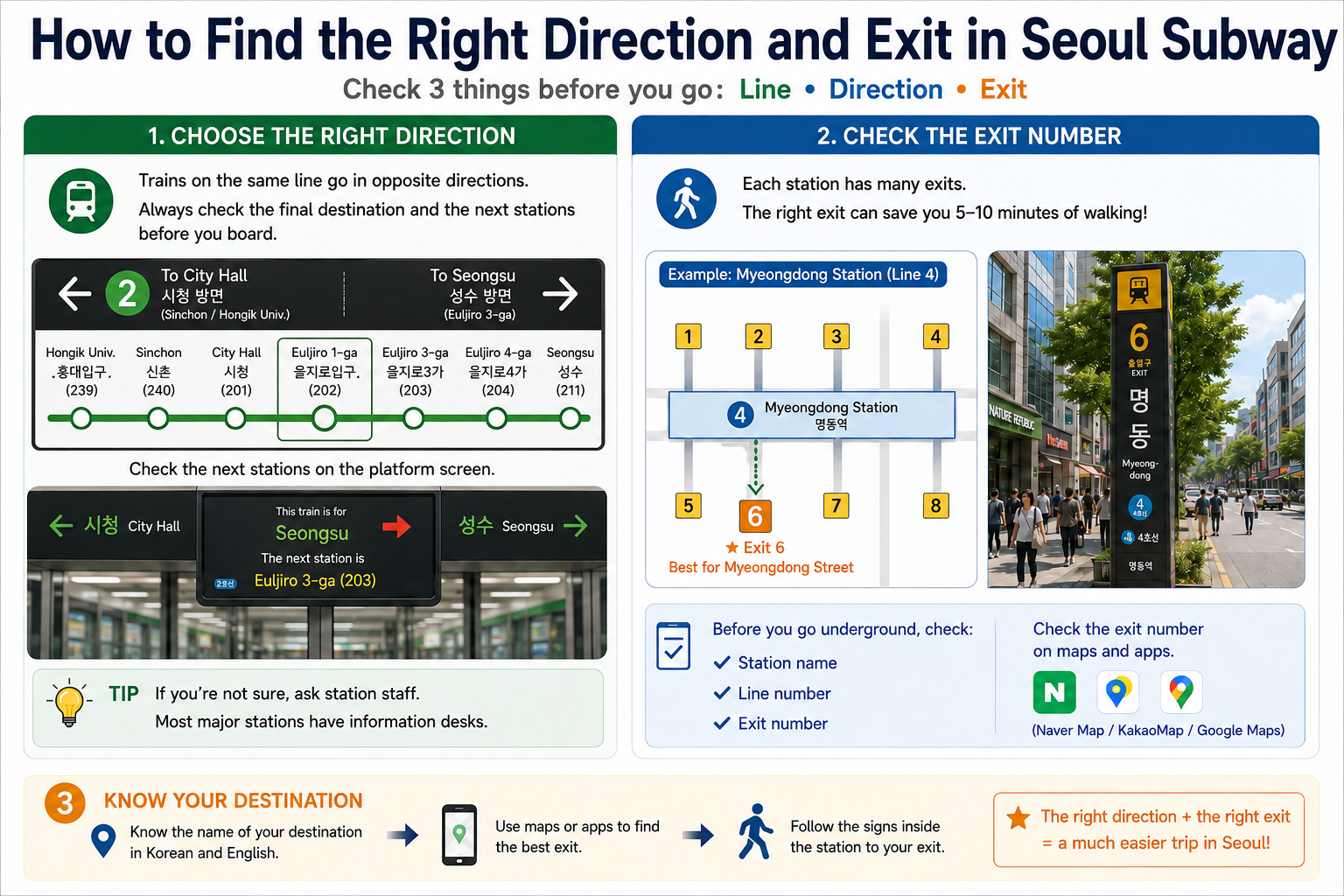
Before entering a platform, check the station names shown in the direction of travel. Signs normally show the next station or several upcoming stations, which makes it much easier to confirm whether you’re heading the right way.
For day-to-day route planning in Korea, Naver Map and KakaoMap are useful defaults. They can show your route, transfer stations, and the exit you should use at your destination.
If you’re wondering why Google Maps can feel different in Korea, read our Google Maps vs Naver Map guide. It explains the local mapping situation and which app makes more sense for different tasks.
How Transfers Work
One of the biggest advantages of using T-money is Seoul’s integrated transfer system.
Eligible journeys can include up to four transfers, for five total boardings, across combinations of public transportation. Instead of paying a completely new base fare each time, the system calculates the journey according to the integrated fare and total distance rules.
To receive the transfer discount, you generally need to board the next eligible service within 30 minutes of tagging out from the previous one.
Between 9 PM and 7 AM, that window extends to 60 minutes.
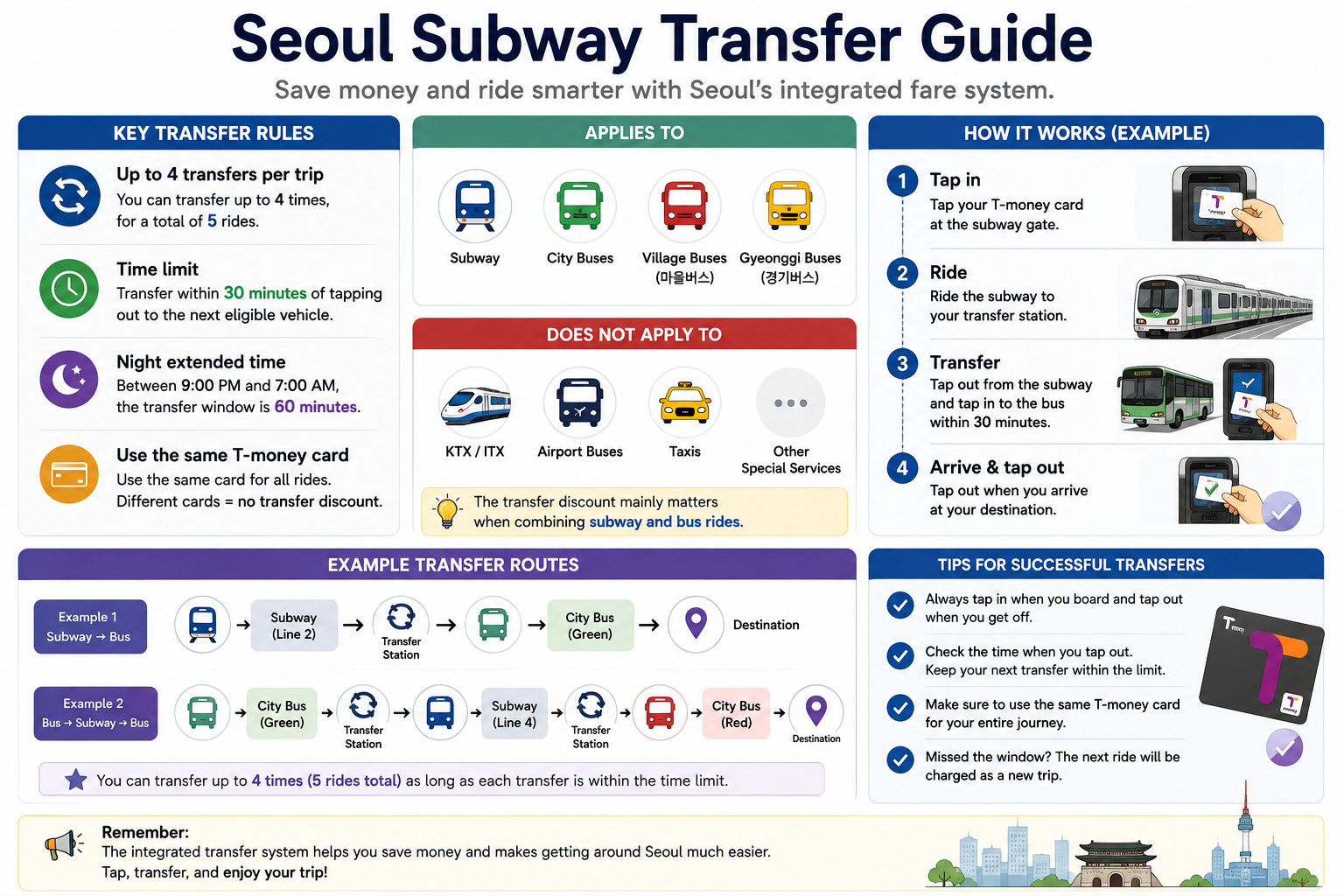
The practical rule is simple:
Always tap when you get on and when you get off.
This is particularly important when combining subway and bus rides. If you fail to tag correctly, the system may not calculate your transfer or fare properly.
The official fare and transfer rules are available on the Seoul transportation fare page.
Why Exit Numbers Matter
Finding the correct station is only half the job.
Large Seoul subway stations can have many numbered exits spread over a surprisingly wide area. Two exits from the same station can leave you several blocks apart, sometimes on opposite sides of a major road or intersection.
That’s why hotel directions, restaurant listings, and attraction guides in Seoul often say something like:
“Myeongdong Station, Exit 6”
rather than simply:
“Myeongdong Station.”
At large stations such as Gangnam or Hongik Univ., taking the wrong exit can turn a short walk into unnecessary backtracking.
Before going underground, check three things:
- Station name
- Line number
- Destination exit number
That small habit makes navigating Seoul much easier.
Common Seoul Subway Mistakes
- Choosing the right line but the wrong direction. Check the next station before entering the platform.
- Forgetting to tap out. Always tap your T-money card when entering and exiting so the fare and any transfer discount can be calculated correctly.
- Assuming foreign-card ticket machines mean direct credit-card gate payment. They don’t. The foreign card is used at a compatible machine to obtain a ticket or eligible transit pass.
- Buying single tickets throughout a multi-day trip. It works, but repeatedly buying tickets and refunding the ₩500 deposit is much less convenient than using T-money.
- Ignoring the exit number. At a large station, the wrong exit can put you much farther from your destination than expected.
- Assuming the Climate Card covers every train in the Seoul metropolitan area. It doesn’t. Check the coverage map if your itinerary includes routes outside central Seoul or services such as the Sinbundang Line.
- Missing the transfer window. If too much time passes between eligible rides, the next trip can be treated as a new journey rather than a transfer.
Subway vs Bus: Which Is Better for Tourists?
For a first trip to Seoul, the subway is usually the easier default.
Stations and lines are clearly organized, English signage is widespread, and traffic doesn’t affect journey times in the same way it affects buses and taxis.
But that doesn’t mean the subway is always fastest.
Some places that require an awkward subway transfer are much easier to reach by bus, and taxis can make more sense late at night, with heavy luggage, or when several people are traveling together.
For that bigger decision, see our How to Get Around Seoul: Subway, Bus, Taxi & T-money guide.
What I Recommend for a First Trip to Seoul
If this is your first time in Seoul, the main advice in this Seoul subway guide is to keep things simple.
Buy a T-money card, add a reasonable starting balance, and top it up when needed.
Use the subway as your default for most central Seoul trips. Check your route before entering the station, confirm the direction using the next station name, and note your exit number before you arrive.
If you only need one ride, a single-journey ticket is fine. And if you’re planning an unusually transit-heavy itinerary within the Climate Card coverage area, compare the short-term pass price against what you’d normally spend with T-money.
Most importantly, remember the 2026 payment change correctly:
A foreign Visa or Mastercard can now be used at supported subway ticket machines, but that does not yet mean you can tap the same bank card directly at every Seoul subway gate.
Once you understand that distinction, the rest of the Seoul subway system is much easier than it first appears.
Read next: