Why MBTI Became So Big in Korea — And What the Data Actually Shows
Ask most people why MBTI in Korea became such a big deal, and you’ll get a version of the same story: Koreans are a collectivist society, personality tests offer quick answers, the pandemic made everyone anxious and introspective. It’s a tidy explanation. The problem is that those explanations are often presented more confidently than the evidence allows.
What actually happened is more specific, and more interesting, than a culture-wide obsession. Korean survey data, dating platform data, and even a triple-million-certified K-pop album show a clear pattern: MBTI didn’t take over Korea simply because people believe in it. It took over because it became a fast, shareable way to introduce yourself, and Koreans have been just as quick to push back when that shorthand gets taken too seriously.
The Numbers Show How Fast MBTI Spread
MBTI was already a known quantity in Korea before 2020, but the shift in just a few years is well documented. A 2023 survey by Embrain’s Trend Monitor, covering 1,000 adults aged 19 to 59 nationwide, found that clear awareness of the MBTI test jumped from 53.9 percent in 2021 to 77.0 percent in 2023. The number of people who had been asked their MBTI type by someone else rose even faster, from 47.3 percent to 78.3 percent over the same two years.
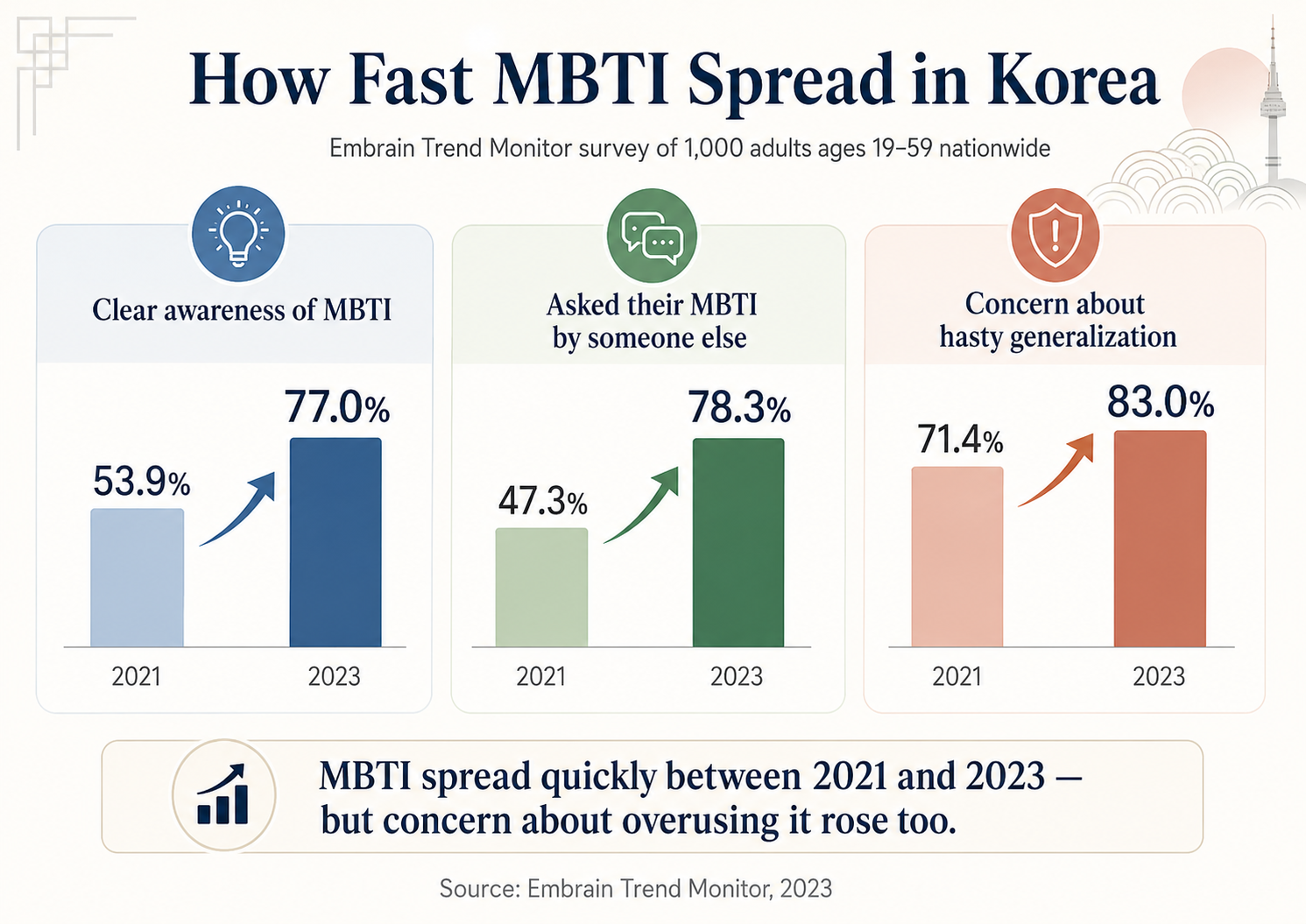
Those aren’t small movements. In roughly two years, MBTI went from something just over half of surveyed adults clearly recognized to something nearly four in five surveyed adults had personally been asked about. That’s the actual shape of the trend: not a vague sense that “everyone in Korea loves MBTI,” but a measurable jump within a specific, sourced window of time.
Four Letters Became a Social Shorthand
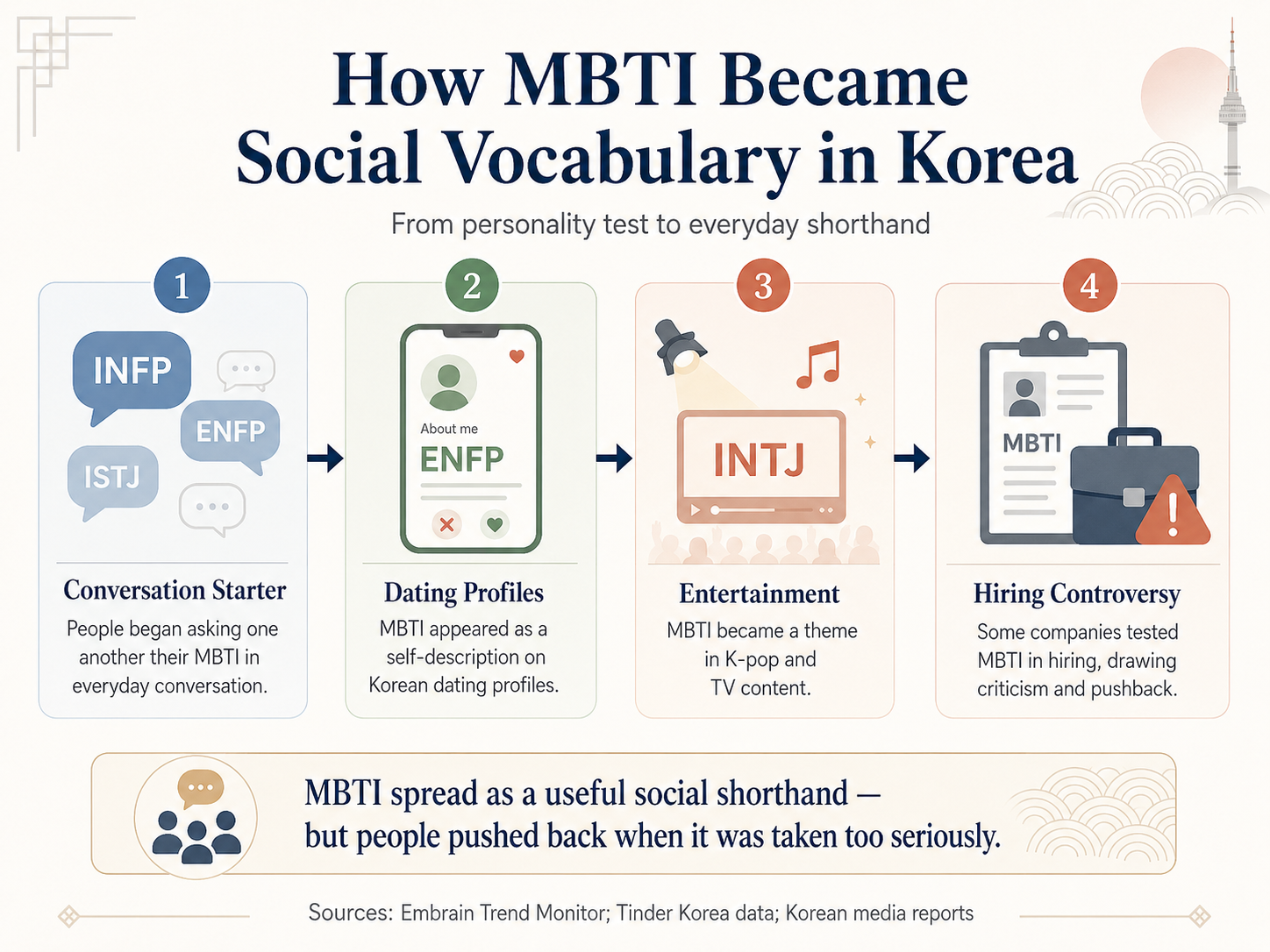
The more telling number isn’t awareness. It’s participation. The same survey found that the share of people who had asked someone else their MBTI type climbed from 28.6 percent to 48.0 percent between 2021 and 2023. People weren’t just aware MBTI existed. They were actively using it as a conversation opener.
This is where the real story lives. MBTI didn’t spread in Korea primarily as a personality assessment people trusted. It spread as a compressed way of introducing yourself, four letters instead of a longer explanation of who you are. That distinction matters, because it changes what the trend is actually about. It’s less a belief system and more a social convention, closer to asking someone their hobbies than asking them to complete a psychological evaluation.
MBTI Became Part of Online Dating — But Not a Matching Algorithm
By 2025, that shorthand had made its way onto dating profiles. In January 2026, Tinder released data on Korean user profiles and activity from January through October 2025. According to a report on the Korean data, INFP was the most frequently displayed MBTI type on Korean profiles, followed by ENFP, ENFJ, and INFJ.
It’s worth being precise about what that data does and doesn’t show. It confirms that MBTI types appear on Korean Tinder profiles as a form of self-description. What it doesn’t show is that Korean users are being matched according to MBTI. Tinder’s own public explanation of its recommendation system lists factors such as activity, distance, age and gender preferences, profile interests and lifestyle information, anonymized photo similarities, and Likes and Nopes; it does not identify MBTI type as a matching criterion. So describing Korean daters as “choosing partners by MBTI” goes well beyond what this profile data can establish.
Then MBTI Became Entertainment
MBTI’s move from private curiosity to public content is clearest in K-pop. In July 2023, NCT DREAM released their third full album with the title track named, simply, “ISTJ.” The song plays with the contrast between an ISTJ narrator and an ENFP love interest. The album later received a triple-million certification from Circle Chart.
What’s easy to miss is the song’s actual message. Rather than treating the MBTI label as the point, the group’s release materials describe “ISTJ” as a narrative about getting to know someone as a person instead of relying on MBTI types to define them. Even in one of the most visible pop-culture uses of MBTI in Korea, the content itself pushes back against taking the label too literally. That tension, using MBTI as a hook while quietly questioning it, turns out to run through the whole trend, not just this one song.
Koreans Were Already Getting Tired of MBTI Stereotypes
That pushback shows up in the survey data too. The same Embrain research found that concern about MBTI leading to hasty generalizations about other people rose from 71.4 percent in 2021 to 83.0 percent in 2023. Discomfort with being reduced to a fixed personality “type” rose as well, from 25.8 percent to 36.9 percent.
In other words, the years when MBTI awareness and everyday use were climbing fastest were the same years when skepticism about overusing it was climbing too. That isn’t a contradiction. It’s what a social shorthand actually looks like once it’s widely adopted: people keep using it because it’s convenient, while becoming more aware of its limits at the same time.
What About MBTI in Hiring?
The most-cited example of MBTI “going too far” in Korea is its brief appearance in hiring. In 2021 and early 2022, several Korean employers, including a bank and a major food company, added MBTI-related questions to job applications or interviews, while some job ads went further and specified preferred or excluded personality types. The practice drew criticism. A survey of jobseekers and workers conducted at the time found that 61.3 percent of respondents opposed factoring MBTI into hiring decisions.
It’s important to be precise about the timeline here. The documented controversy is concentrated in 2021 and 2022. There’s no current evidence that asking for MBTI in hiring became a normal or widespread practice across Korean companies. It surfaced as a handful of specific, criticized cases, not an industry standard. Articles that describe MBTI-based hiring as an ongoing feature of the Korean job market are stretching a short-lived controversy into something it was never shown to be.
Before MBTI, Korea Had Blood-Type Personalities
MBTI also didn’t arrive in a cultural vacuum. Before MBTI went viral, blood type was a familiar shorthand for describing someone’s personality in Korea. That framework sorted people into four broad categories instead of sixteen.
The two systems aren’t the same, and one didn’t cause the other. But the existence of an earlier, similar habit, reaching for a simple label to describe personality and compatibility, suggests MBTI found an audience that was already familiar with the format rather than inventing the format itself.
So, Are Koreans Really Obsessed With MBTI?
Not exactly. What the data actually shows about MBTI in Korea is narrower and more useful than “obsession.” Awareness and everyday use rose sharply between 2021 and 2023. People began using it to introduce themselves, on dating profiles and in casual conversation. Entertainment picked it up as a theme. And through the same period, a growing share of the public pushed back against reading too much into it.
The more accurate description isn’t that Korea fell in love with a personality test. It’s that four letters became a convenient piece of everyday social vocabulary, used often, taken seriously by some, and questioned by plenty of others along the way.