How to Pay in Korea as a Tourist (2026): Cards, Cash, T-money & Subway Kiosks
Quick answer
If you’re wondering how to pay in Korea as a tourist, the simplest setup is one or two Visa or Mastercard cards, a small amount of Korean won in cash, and a T-money card for transit.
You do not need to overthink this before you land. But there is one change worth knowing about before you assume your card will work everywhere it should.
The 2026 change: foreign cards now work at Seoul subway ticket machines
Here is something most guides have not caught up with yet.
Seoul has installed 440 new transit card vending machines across 273 stations on Subway Lines 1 to 8. Since March 17, 2026, these machines have accepted internationally issued credit and debit cards, including Visa and Mastercard, as well as supported mobile payments for products including single-journey transit tickets and the Climate Card.
Before this rollout, a common frustration for visitors was arriving in Korea and finding that some subway ticket or transit-card transactions still required Korean won in cash or a Korean-issued card.
That specific gap is now much smaller at the kiosk level. You can check the current details in the Seoul Metropolitan Government’s official announcement.
Reality Check: Foreign cards now work at Seoul subway ticket machines, but you still cannot simply tap your Visa or Mastercard at the subway gate itself the way you can in London or New York. Paying at a kiosk with a foreign card is not the same thing as open-loop payment, where the card itself becomes your ticket.
Kiosks are also becoming a much bigger part of everyday life outside the subway. In restaurants, they now extend from counter screens to table-order tablets and even serving robots. See why Korea has so many kiosks and how self-service is changing the way Korean restaurants work.
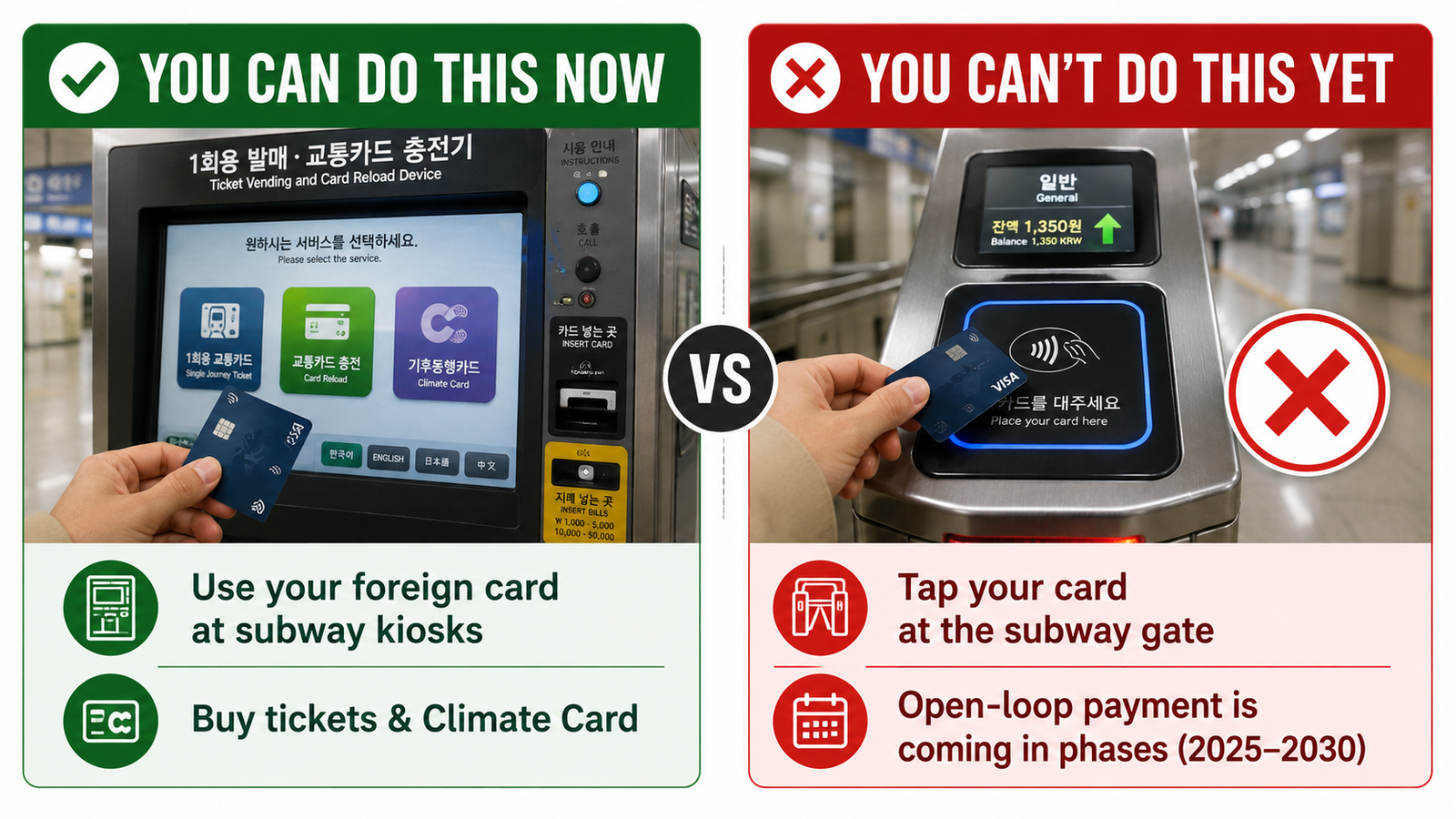
True tap-to-pay at the gate is coming, but slowly. Seoul has laid out a phased rollout for its EMV-based open-loop system. Payment infrastructure is being introduced first on buses, subway gates on Lines 1 to 8 are part of a later phase, and broader integration with local buses, private rail lines, and other transit operators is planned through 2030.
The city explains the rollout in more detail in its official open-loop payment plan.
So for now, the kiosk update makes it easier to buy certain transit products without cash or a Korean-issued card. It does not turn your foreign credit card into a Seoul transit pass yet.
If you’re planning to use the subway in Seoul, see our Seoul Subway Guide for Tourists for current fares, single-journey tickets, transfer rules, exit numbers and the 2026 foreign credit card update.
Can you use a foreign credit card in Korea?
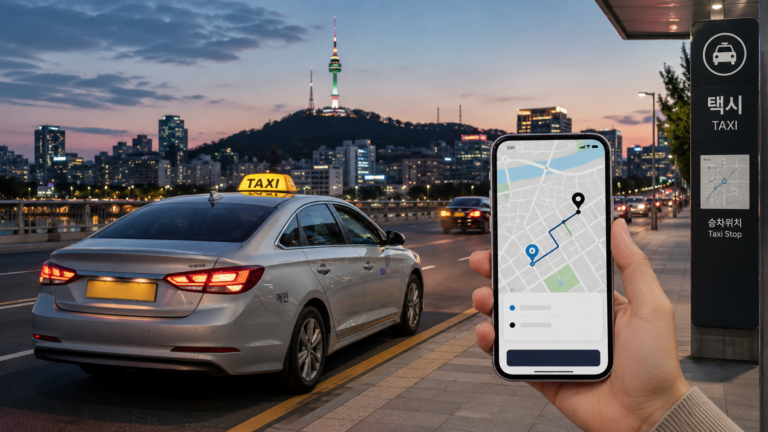
Yes, in most everyday situations. Foreign-issued Visa and Mastercard cards are widely accepted at restaurants, cafes, convenience stores, department stores, hotels, and many taxis in Korea. American Express is also accepted in many places, although not as universally.
A few situations tend to be less reliable:
- Self-service gas pumps, which can use payment or deposit processes that do not always work smoothly with foreign cards
- Government office payments, such as certain administrative fees, where foreign-issued cards may not always be accepted
- Online payments on Korean websites, where foreign cards can be blocked by the payment processor regardless of your card network
- Very small, independent vendors, where some traditional market stalls and street carts simply do not have card terminals
One habit worth building before you land: if a terminal asks whether you want to pay in your home currency or in Korean won, choose Korean won.
Choosing KRW generally lets your own card network or issuer handle the currency conversion rather than accepting the merchant’s Dynamic Currency Conversion rate, which can be less favorable.
Paying by card does not stop you from receiving a tourist tax refund. What matters is whether the store deducts the tax at checkout or gives you a refund slip. Our Korea tax refund for tourists guide explains how to tell the difference and what to do at Incheon Airport.
Do you still need cash?
You do not need to carry a large amount of cash, but keeping some Korean won on hand is still useful in a few specific situations.
Where cash tends to matter most:
- Some traditional market and street food vendors
- Some underground shopping areas
- Standard T-money top-ups, where cash remains the safest assumption
- Any moment your card gets declined and you need a fallback
There is no official “correct” amount to carry. That is not a figure any authority publishes, so treat any site that gives you a fixed number as a personal recommendation rather than a rule.
As a practical starting point for a short trip, around 30,000 to 50,000 won is a reasonable buffer: enough for a few cash-only situations or a transit-card top-up without carrying more than you are comfortable with.
T-money: your basic transit and small-payment card
T-money is Korea’s standard rechargeable transit card. It works across public transportation systems including subways and buses, and can also be used for taxis and payments at many participating retailers.
T-money’s official site lists convenience stores, shops, vending machines, public facilities, and other locations among its payment network. You can see the broader payment network on the official T-money website.
You can buy a physical T-money card at convenience stores, subway stations, or the airport, then add balance separately.
Cash remains the safest assumption when topping up a standard physical T-money card. The new Seoul subway kiosks accepting foreign cards should not be confused with universal foreign-card top-up for every standard T-money card. The officially confirmed foreign-card support applies to specific transit products, including single-journey tickets and the Climate Card.
If you are only in Korea briefly and want the simplest option, T-money alone is often enough. For buying, topping up, refunds, and how to use it on buses and subways, see our T-money Card in Korea guide.
Need the full T-money setup guide?
See our complete T-money guide for tourists, including where to buy it, how to recharge it, and how to use it on public transportation.
If you want to see how T-money fits into an actual Seoul trip, our How to Get Around Seoul guide explains when to use the subway, bus and taxi, plus transfers and late-night options.
WOWPASS: what it actually covers
WOWPASS is a prepaid card built specifically for foreign visitors, combining a rechargeable payment balance with a built-in T-money function.
What it is good for: the WOWPASS balance can be used at many places that accept standard card payments in Korea, including restaurants, cafes, taxis, convenience stores, shopping, and participating kiosks.
One detail worth knowing is that the WOWPASS payment balance and the T-money function are not something you should think of as one interchangeable pool of money. Transit use follows the T-money side of the card, so check the relevant balance and top-up method separately.
According to WOWPASS’s official website, using the WOWPASS balance for regular card payments does not add a transaction fee, while cash withdrawals from WOWPASS machines cost 1,000 won per withdrawal.
Charging WOWPASS through other methods, including foreign-card charging in the app, is a separate process. At the time of writing, we have not been able to confirm one clear, current fee percentage from an official publicly available source, so treat specific percentages quoted elsewhere with some caution and check the rate shown in the app before confirming a charge.
Apple Pay and mobile wallets: the short version
Apple Pay may work at contactless-capable terminals in Korea, but that does not mean Korea has universal Apple Pay acceptance or London-style contactless transit.
T-money inside Apple Wallet also has its own limitation for tourists. According to Apple’s official support page, a South Korea-issued credit or debit card is required to purchase or top up a T-money card directly in Apple Wallet.
That means having a foreign card already stored in Apple Pay does not automatically solve the T-money top-up problem.
Other mobile wallets can also depend on your phone, card issuer, and the terminal being used. The practical takeaway is simple: if your mobile wallet works, treat it as a convenient extra. It should not be your only payment plan in Korea.
What should you actually bring?
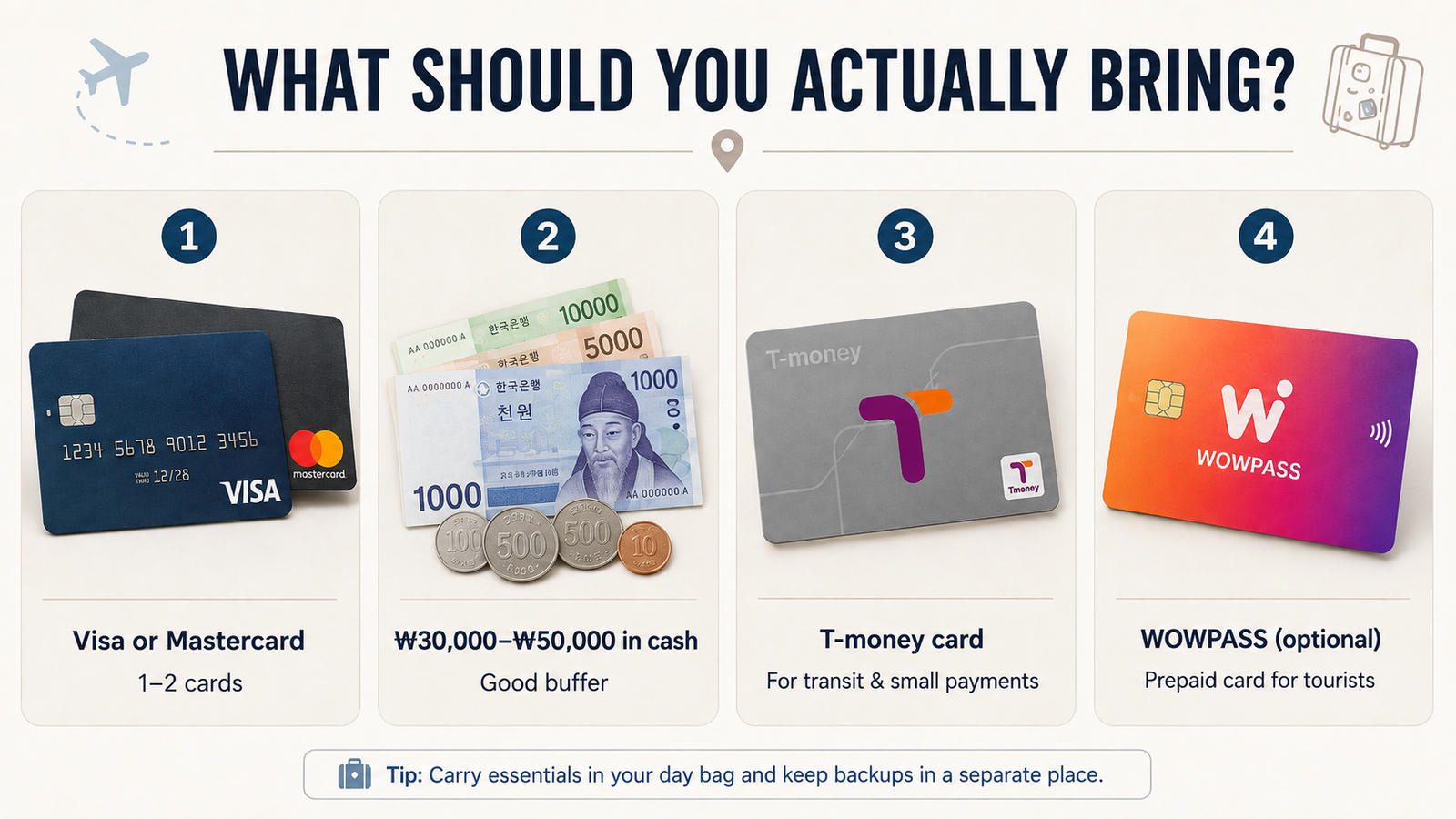
If you are still deciding how to pay in Korea, here is the short version of what to carry before you land:
- A Visa or Mastercard, ideally two from different banks, in case one gets declined or flagged for fraud review
- 30,000 to 50,000 won in cash as a practical buffer, with more only if you expect to spend heavily at traditional markets or cash-only vendors
- A T-money card for public transit and many small everyday payments
- WOWPASS, optionally, if a prepaid travel card fits the way you prefer to manage spending in Korea
What you can skip: exchanging a large amount of cash before you arrive, assuming your phone’s mobile wallet will cover everything, and worrying that Korea’s cashless reputation means you will not need any won at all.
It is mostly true. Just not entirely.