Where to Stay in Seoul: Best Areas for First-Time Visitors (2026)
Choosing where to stay in Seoul can have a bigger impact on your trip than choosing between two similar hotels.
Seoul is huge, and the neighborhood that works perfectly for nightlife may be inconvenient for palace sightseeing. The area with the easiest airport connection may not be the place where you want to spend your evenings.
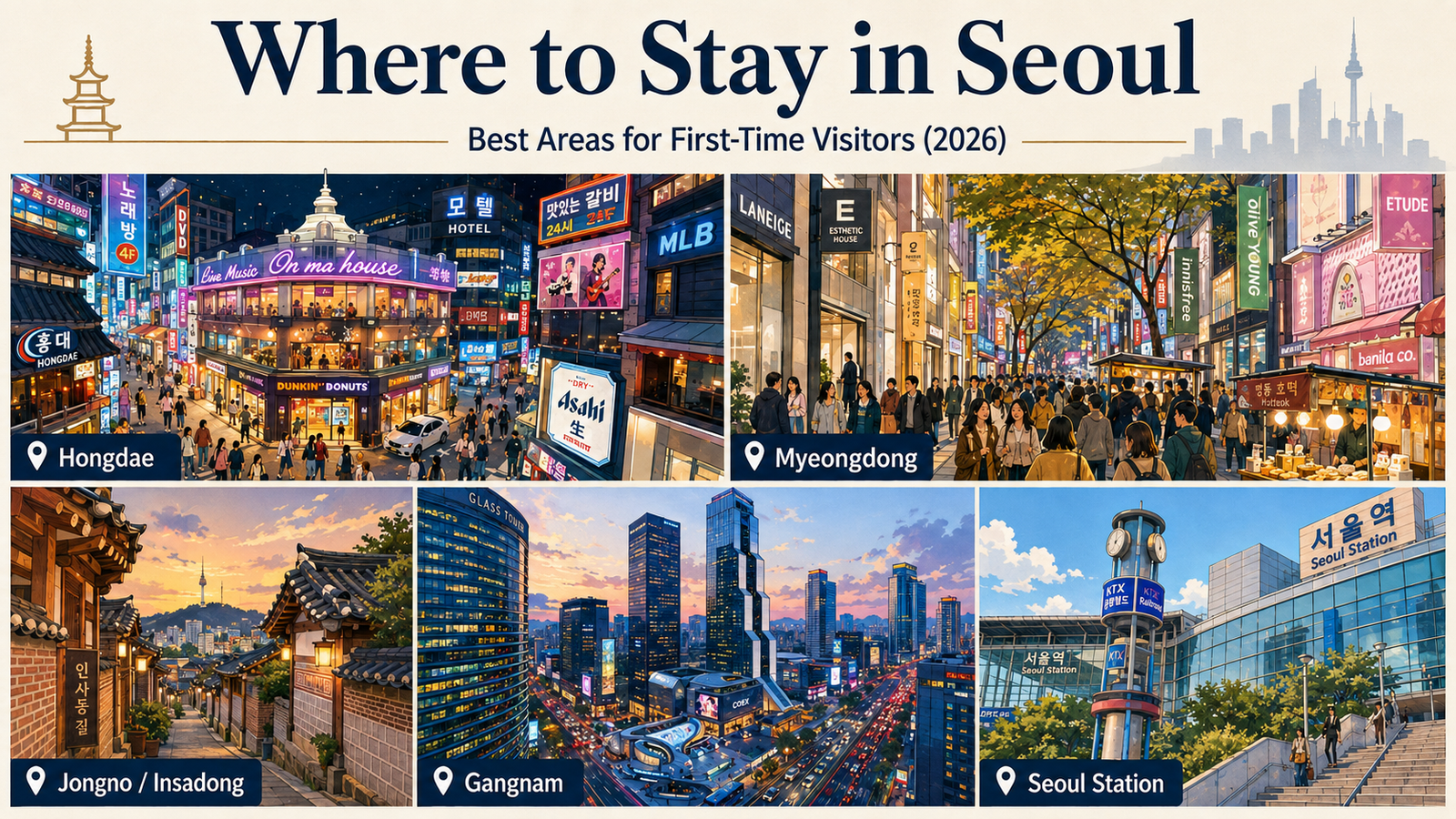
For most first-time visitors, the decision usually comes down to Hongdae, Myeongdong, Jongno/Insadong, Gangnam, or Seoul Station.
This guide compares those areas by what actually matters: airport access, sightseeing, nightlife, transport, neighborhood atmosphere, and how much time you’ll spend crossing the city.
In this guide
The Short Answer
There’s no single “best area” to stay in Seoul — it depends on what your trip actually looks like.
For most first-time visitors, Hongdae, Myeongdong, or Jongno/Insadong work well as a home base: all three are well connected, but they suit different kinds of itineraries.
If you’re arriving with heavy luggage, catching an early flight out, or connecting to KTX, Seoul Station is worth prioritizing for convenience over neighborhood atmosphere.
If your trip is built around a specific purpose — business, shopping, a particular concert or event — Gangnam can be the right call, but it’s a deliberate choice rather than a default one.
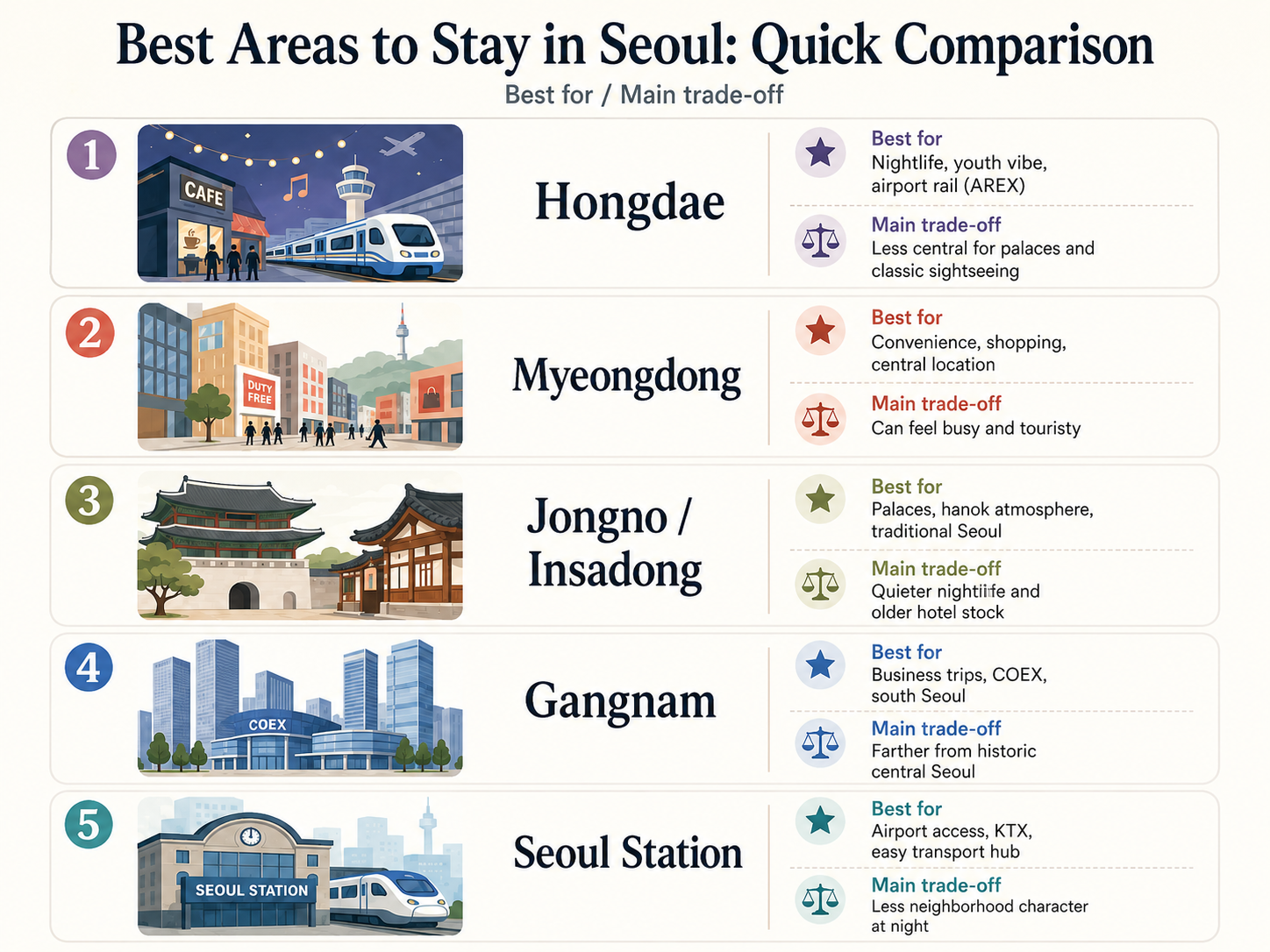
| Area | Best for | Airport convenience | Main trade-off |
|---|---|---|---|
| Hongdae | Nightlife + first-time visitors | Very good — AREX all-stop | Farther from historic Seoul |
| Myeongdong | Easy first trip + shopping | Good — airport bus or AREX transfer | Tourist-heavy atmosphere |
| Jongno / Insadong | Palaces + traditional Seoul | Good — 6011 bus or rail transfer | Quieter nightlife |
| Gangnam | Business + south Seoul plans | Direct airport buses | Longer trips to historic Seoul |
| Seoul Station | Airport + KTX convenience | Excellent — AREX Express | Less neighborhood atmosphere |
Actually: Check What Kind of Accommodation You’re Booking
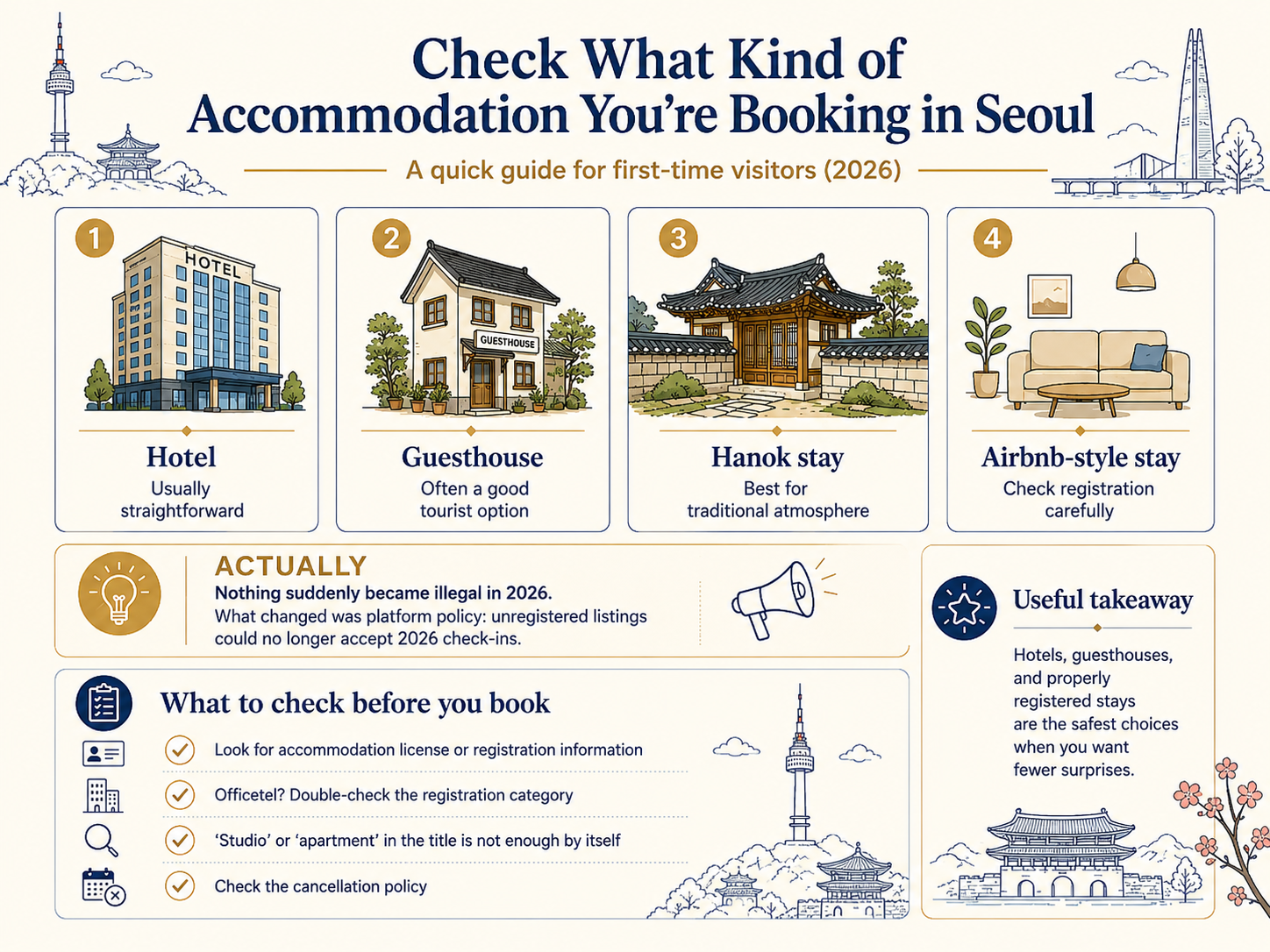
Before picking a neighborhood, there’s a more basic question worth two minutes: what kind of accommodation are you actually booking?
This matters mostly for home-sharing listings such as Airbnb rather than conventional hotels.
Airbnb changed its Korea policy recently, and a lot of older English-language travel guides were written before that change.
ACTUALLY
Nothing suddenly became illegal on January 1, 2026 — Airbnb changed what it allows to be booked on its platform.
Airbnb voluntarily introduced stricter accommodation-registration requirements in Korea. Existing listings that had not submitted the required registration information by October 16, 2025 could no longer accept Airbnb bookings for stays checking in from January 1, 2026 onward.
How we got here
Airbnb introduced the policy in stages. New listings have been required to submit accommodation-license information since October 2024, and existing listings were given until October 16, 2025 to submit the same information. Listings that missed that deadline were blocked from accepting bookings for stays beginning January 1, 2026 or later — though a listing can resume accepting bookings once it submits valid registration, so this isn’t necessarily a permanent removal.
Importantly, Airbnb itself describes this as a voluntary platform policy rather than a new legal obligation imposed on the platform by Korean law.
Read Airbnb Korea’s official announcement
See Airbnb’s current Korea hosting requirements
What “properly registered” actually means
Many home-sharing stays aimed at foreign visitors in Seoul operate under a registration category called 외국인관광 도시민박업, usually translated as a foreign tourist urban homestay business.
It is narrower than the phrase “short-term rental” might suggest.
- The accommodation must use a qualifying residential property.
- The property must generally be the operator’s actual residence.
- The qualifying residence must have a total floor area of less than 230 m².
- Officetels are not eligible for this registration category.
- The business must have a system in place to provide foreign-language guidance to guests.
- This particular accommodation category is designed for foreign tourists.
Seoul’s official Seoul Stay registration guidance specifically lists officetels among the property types that cannot be registered as foreign tourist urban homestays.
See Seoul’s official foreign tourist urban homestay registration guide
So what should a traveler check?
- Look for accommodation-license or registration information on the listing.
- If the information is unclear, ask the host what accommodation category the property is registered under.
- Treat “officetel” as a reason to double-check. Do not assume a listing is registered simply because it looks like an apartment in the photos.
- For generic words such as “studio” or “apartment,” rely on the registration information rather than the marketing title.
- Check the cancellation policy regardless of accommodation type.
None of this means Airbnb is a bad way to stay in Seoul. Properly registered listings remain available.
The useful takeaway is simply that “I found it on a booking platform” and “I understand what kind of accommodation this is” are not exactly the same thing.
How to Choose an Area in Seoul
Once the accommodation type is sorted, the neighborhood decision comes down to three practical questions.
1. How much does airport access matter to you?
If you’re arriving late, leaving early, or simply don’t want to think about transfers with luggage, staying somewhere with a direct, simple route from Incheon Airport can save real time and hassle.
If your flight times are relaxed and you’re traveling light, this matters less.
2. What do you actually want to spend your days doing?
A trip centered on palaces, hanok villages, and old Seoul favors a different base from a trip centered on nightlife, shopping, or business.
A neighborhood can be genuinely excellent and still be the wrong fit for what you’re planning to do each day.
3. How much cross-city travel are you willing to do?
Seoul’s subway system makes crossing the city manageable, but that does not make travel time disappear.
If your hotel and most of your daily plans are on opposite sides of the Han River, 30–40 minutes each way can become part of your routine.
KOREA REALITY CHECK
A famous neighborhood isn’t automatically a convenient one — for your specific trip.
Being internationally famous and being well located for your itinerary are two different things.
Hongdae
Best for: first-time visitors who want nightlife, youthful energy, and a lively neighborhood to come back to after sightseeing.
Why stay here: Hongdae is one of Seoul’s most energetic visitor districts, with cafes, nightlife, live music, restaurants, and plenty going on after dark.
It also has a broad mix of guesthouses and hotels, and Hongik University Station sits directly on the AREX all-stop line, so getting into the area from Incheon Airport does not require a subway transfer.
Downsides: The historic core of Seoul — Gyeongbokgung, Bukchon Hanok Village and Insadong — is a subway ride away, not a walk.
If your itinerary is heavily focused on palaces and traditional Seoul, you’ll be heading east most days.
The busiest parts of Hongdae can also stay noisy late into the evening, so check the exact hotel location if you’re a light sleeper.
Airport access: Hongik University Station is on AREX, but the nonstop Express Train does not stop there. Use the AREX all-stop train; expect roughly 50–60 minutes from Incheon Airport depending on terminal and service.
Key subway lines: Line 2, Gyeongui-Jungang Line, and AREX.
Choose Hongdae if: you want an easy airport arrival and would rather finish your sightseeing day somewhere lively.
Myeongdong
Best for: first-time visitors who want a straightforward sightseeing base with shopping, restaurants, and convenient transport nearby.
Why stay here: Myeongdong is one of the easiest areas for a classic first Seoul trip.
Myeongdong Cathedral, Namsan, Namdaemun, Euljiro and central Seoul attractions are nearby, while Line 4 makes it easy to reach Seoul Station, Dongdaemun and other parts of the city.
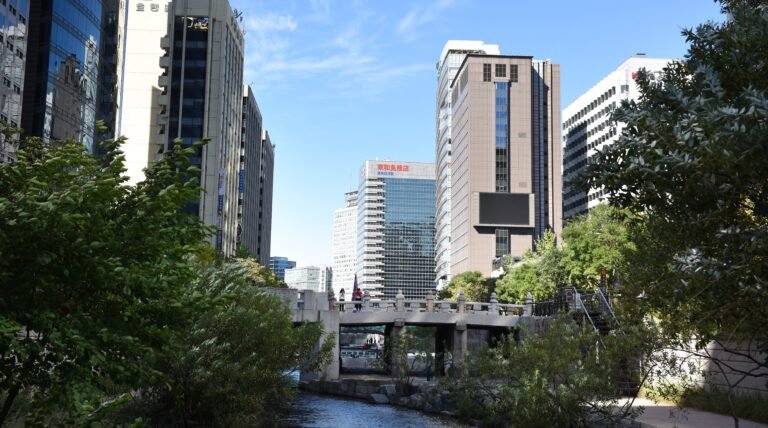
Cheonggyecheon is also within easy walking distance from the Euljiro side of Myeongdong. If you want to understand why the stream looks the way it does today, read our Cheonggyecheon explained guide.
There is also a large concentration of hotels, which makes comparing different accommodation types and budgets relatively easy.
Downsides: Myeongdong is heavily oriented toward visitors, shopping and tourism.
If you’re looking for a residential neighborhood atmosphere or late-night bar culture, Hongdae or another area may suit you better.
Airport access: Myeongdong does not have an AREX station, but there are two practical choices.
Airport Limousine Bus 6015 serves Myeongdong directly, including Myeongdong Station and several nearby hotel stops.
The rail alternative is AREX to Seoul Station followed by a short transfer to Line 4. The bus is easier with luggage, while the train is less exposed to road traffic.
Check the current Airport Limousine 6015 route
Key subway lines: Line 4, with Line 2 stations around Euljiro within walking distance depending on your hotel.
Choose Myeongdong if: you want the easiest all-round option and don’t mind staying in a tourist-heavy district.
Jongno / Insadong
Best for: a first Seoul trip focused on history, palaces, traditional neighborhoods, and exploring on foot.
Why stay here: Jongno and Insadong put you inside Seoul’s historic core.
Gyeongbokgung, Changdeokgung, Bukchon Hanok Village, Insadong and Ikseon-dong are clustered in or around this part of central Seoul, making it one of the best areas for days built around walking rather than repeatedly crossing the city.
If you plan to rent hanbok for Gyeongbokgung, it is also worth knowing why Gyeongbokgung hanbok rentals can look quite different from traditional hanbok.
It is also an area where a properly registered hanok stay can make sense if traditional accommodation is part of the experience you want.
If you book a hanok, look for a properly registered accommodation rather than assuming every traditional-looking property is licensed for tourist stays.
Downsides: Much of this area becomes quieter at night than Hongdae.
That’s good if you want calmer evenings, but less appealing if nightlife is an important part of your trip.
Airport access: There is no AREX station in Jongno or Insadong, but Airport Limousine Bus 6011 directly serves stops including Gyeongbokgung, Anguk and Changdeokgung.
Another option is AREX to Seoul Station followed by a subway or taxi connection.
Check the current Airport Limousine 6011 route
Key subway lines: Lines 1, 3 and 5, depending on the exact part of the neighborhood. Anguk is on Line 3; Jongno 3-ga connects Lines 1, 3 and 5.
Choose Jongno / Insadong if: palaces, hanok neighborhoods and old Seoul are at the top of your list.
Gangnam
Best for: travelers with a clear reason to stay south of the Han River — business, shopping, a concert, COEX, or an itinerary concentrated around Gangnam.
Why stay here: Gangnam is a major business, shopping and entertainment district.
If most of what you plan to do is around Gangnam Station, Samseong, COEX, Apgujeong, Sinsa or other southern areas, staying here can save repeated cross-city trips.
Downsides: If your itinerary is concentrated on Gyeongbokgung, Bukchon, Jongno, Insadong or other attractions north of the Han River, staying in Gangnam means crossing back and forth for most of your trip — worth weighing before you book on reputation alone.
Airport access: Gangnam does not have a direct AREX connection.
A useful option is K Airport Limousine Route 6703, which connects Incheon Airport with the Gangnam/COEX area. The operator currently publishes a bus interval of approximately 50–65 minutes.
Travel time itself depends heavily on traffic, so allow extra time during rush hour.
Check the current 6703 Gangnam / COEX airport bus
Key subway lines: Line 2 and the Shinbundang Line around Gangnam Station, with the Suin-Bundang Line serving other parts of the wider Gangnam area.
Choose Gangnam if: you already know why you need to be in Gangnam.
Seoul Station
Best for: travelers who prioritize airport, train and luggage convenience over neighborhood atmosphere.
Why stay here: Seoul Station is one of the most useful transport hubs for visitors.
It is served by the AREX Express Train, KTX intercity trains, subway Lines 1 and 4, and other rail connections.
That makes it particularly useful if:
- you’re staying in Seoul for only one or two nights
- you’re carrying heavy luggage
- you’re taking KTX to another Korean city
- you have an early airport transfer
Downsides: The immediate Seoul Station area has less neighborhood atmosphere than Hongdae, Jongno or Myeongdong. It’s a strong transport base, but the streets around the station itself aren’t the main reason most visitors come to Seoul.
Airport access: The AREX nonstop Express Train connects Incheon Airport directly with Seoul Station. From Incheon Airport Terminal 1, the trip is about 43 minutes.
Check current AREX information
Key subway and rail lines: Lines 1 and 4, Gyeongui-Jungang Line, AREX and KTX.
Choose Seoul Station if: transport efficiency matters more to you than having the most interesting streets immediately outside your hotel.
Heading to Busan after Seoul? Our guide to where to stay in Busan compares Seomyeon, Nampo, Haeundae and Gwangalli by your itinerary and where you want to spend your evenings.
Reality Check: Gangnam Is Famous — But Is It Central for Your Trip?
This is one of the easiest mistakes to make when choosing where to stay in Seoul.
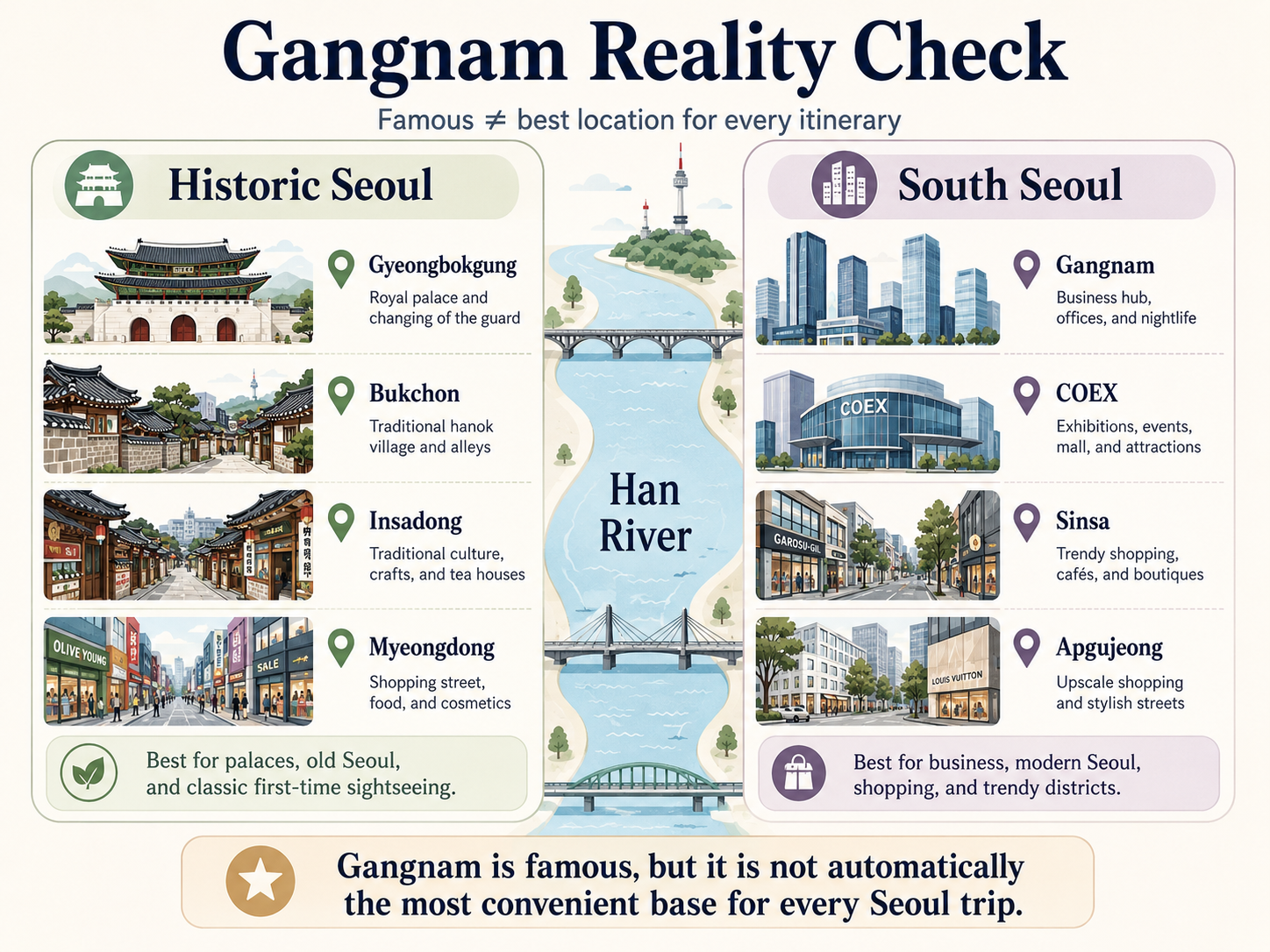
Gangnam is internationally famous, so it’s natural to assume that it must be the most convenient place to stay.
But Seoul doesn’t really have one center that works for every itinerary.
If your sightseeing list looks like this:
- Gyeongbokgung
- Bukchon Hanok Village
- Insadong
- Ikseon-dong
- Changdeokgung
- Myeongdong
then staying in Gangnam means crossing the Han River again and again.
On the other hand, if your plans revolve around COEX, Gangnam Station, Sinsa, Apgujeong, business meetings, shopping or events south of the river, staying in Jongno simply creates the opposite problem.
KOREA REALITY CHECK
Don’t choose an area because you’ve heard of it. Choose it because your itinerary is nearby.
In a city the size of Seoul, reducing repeated cross-city journeys can matter more than staying in the most famous neighborhood.
Honorable Mentions: Itaewon and Seongsu
Two other neighborhoods are worth knowing about, but we would not put either ahead of the five areas above for the average first-time Seoul visitor.
Itaewon
Consider Itaewon if: international restaurants, bars and nightlife are an important part of your trip.
Itaewon has long been one of Seoul’s most internationally oriented neighborhoods and remains useful for travelers looking for a diverse food and nightlife scene.
But for a first trip centered on palaces, major shopping areas and airport convenience, it is usually less straightforward than Myeongdong, Hongdae or Jongno.
Seongsu
Consider Seongsu if: cafes, fashion, pop-ups and contemporary Seoul trends are a major reason you’re visiting.
Seongsu has become one of the city’s most visible trend districts, with cafes, shops, brand spaces and frequent pop-ups.
It’s worth visiting regardless of where you stay.
But for many first-time travelers, staying there means trading some all-round sightseeing convenience for proximity to one particular style of Seoul experience.
Common Mistakes When Choosing Where to Stay in Seoul
Booking Gangnam just because it’s famous
Check your actual itinerary first. If most of your saved places are around Jongno, Myeongdong and Bukchon, you’re choosing a daily commute.
Assuming every Airbnb-style listing works the same way
Korea has multiple accommodation registration categories, and Airbnb introduced stricter registration-document requirements for Korean listings.
If you’re using a home-sharing platform, check the accommodation information rather than relying only on photos and reviews.
Choosing the cheapest hotel without checking the station
A hotel that looks close on a Seoul-wide map can still add a transfer or a long walk to every day of your trip.
Check the nearest subway station and exit, not just the neighborhood name.
Ignoring airport access because you’ll only use it twice
Airport transport doesn’t need to determine your entire trip, but carrying luggage through multiple transfers after a long flight is different from making the same journey with a daypack.
Expecting Myeongdong to feel like a quiet local neighborhood
Myeongdong is convenient precisely because it is one of Seoul’s major visitor districts.
If local residential atmosphere is the priority, choose accordingly.
Assuming the neighborhood name tells you the exact location
Areas such as Hongdae, Gangnam and Jongno cover more ground than their names suggest.
Two hotels marketed under the same neighborhood can have very different station access.
Before booking, check the exact location using a map app that works well in Korea.
Which Area Should You Choose?
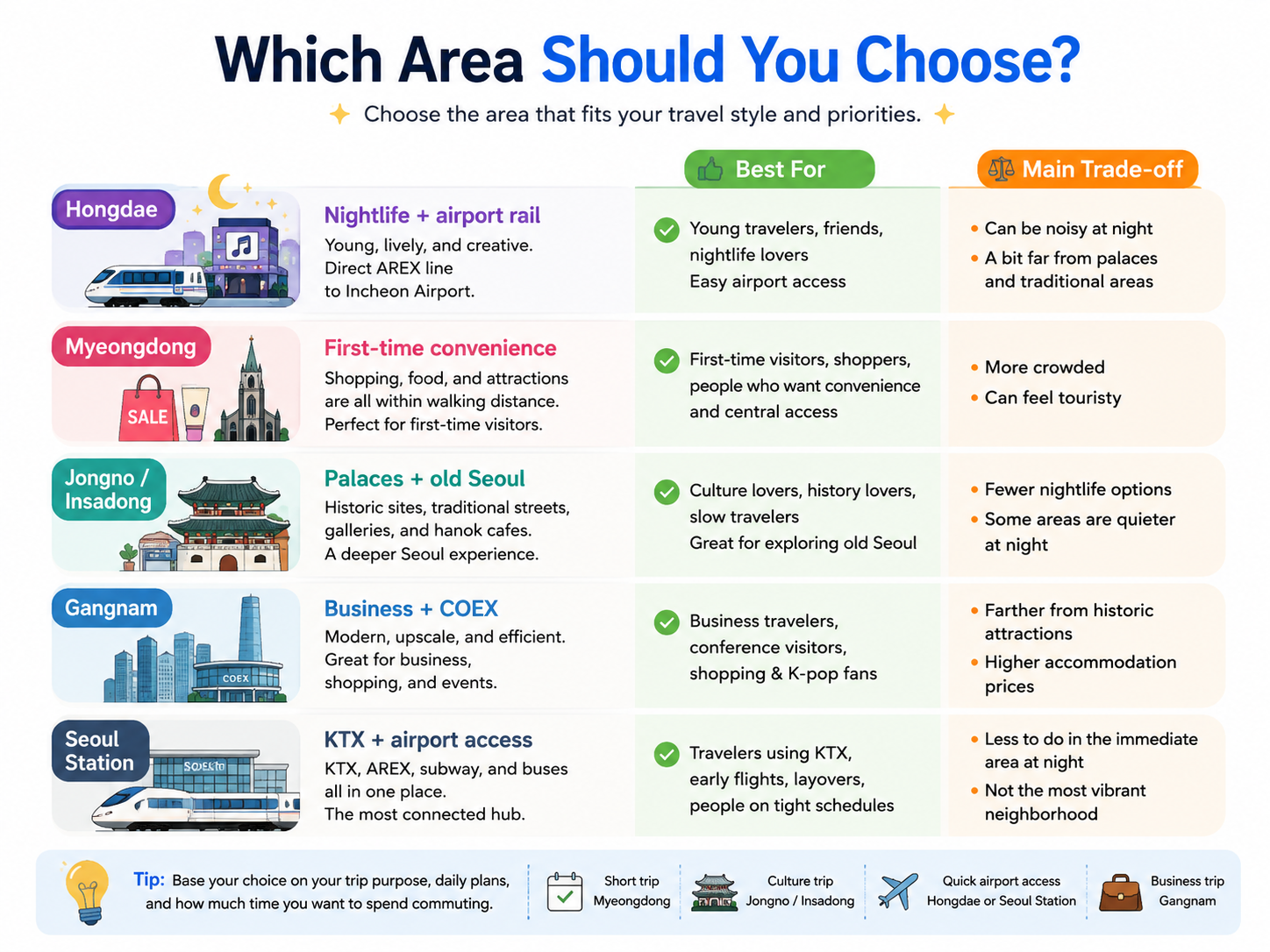
You want nightlife + direct airport rail access
→ Hongdae
You want the easiest general-purpose first-time base
→ Myeongdong
You want palaces, hanok neighborhoods and traditional Seoul
→ Jongno / Insadong
Your plans are mainly around business, COEX or south Seoul
→ Gangnam
You have heavy luggage, an early airport trip or a KTX connection
→ Seoul Station
Your trip is mainly nightlife and international dining
→ Consider Itaewon
Your priority is cafes, fashion and current Seoul trends
→ Consider Seongsu
What to Read Next
Once you’ve chosen where to stay, these guides will help with the rest of your first days in Korea:
- Incheon Airport to Seoul: AREX, Bus or Taxi? — choose the easiest way to reach your accommodation.
- Korea eSIM & SIM Card Guide — get connected before relying on transport and map apps.
- T-money Card in Korea — understand how to pay for Seoul’s subway and buses.
- How to Take a Taxi in Korea — Kakao T, k.ride, fares and tourist tips.
- Google Maps in Korea: What Actually Works — understand why Korean map apps matter.
- Luggage Storage in Seoul — compare T-Locker, T-Luggage and other storage options.