Why Korea Has So Many Kiosks
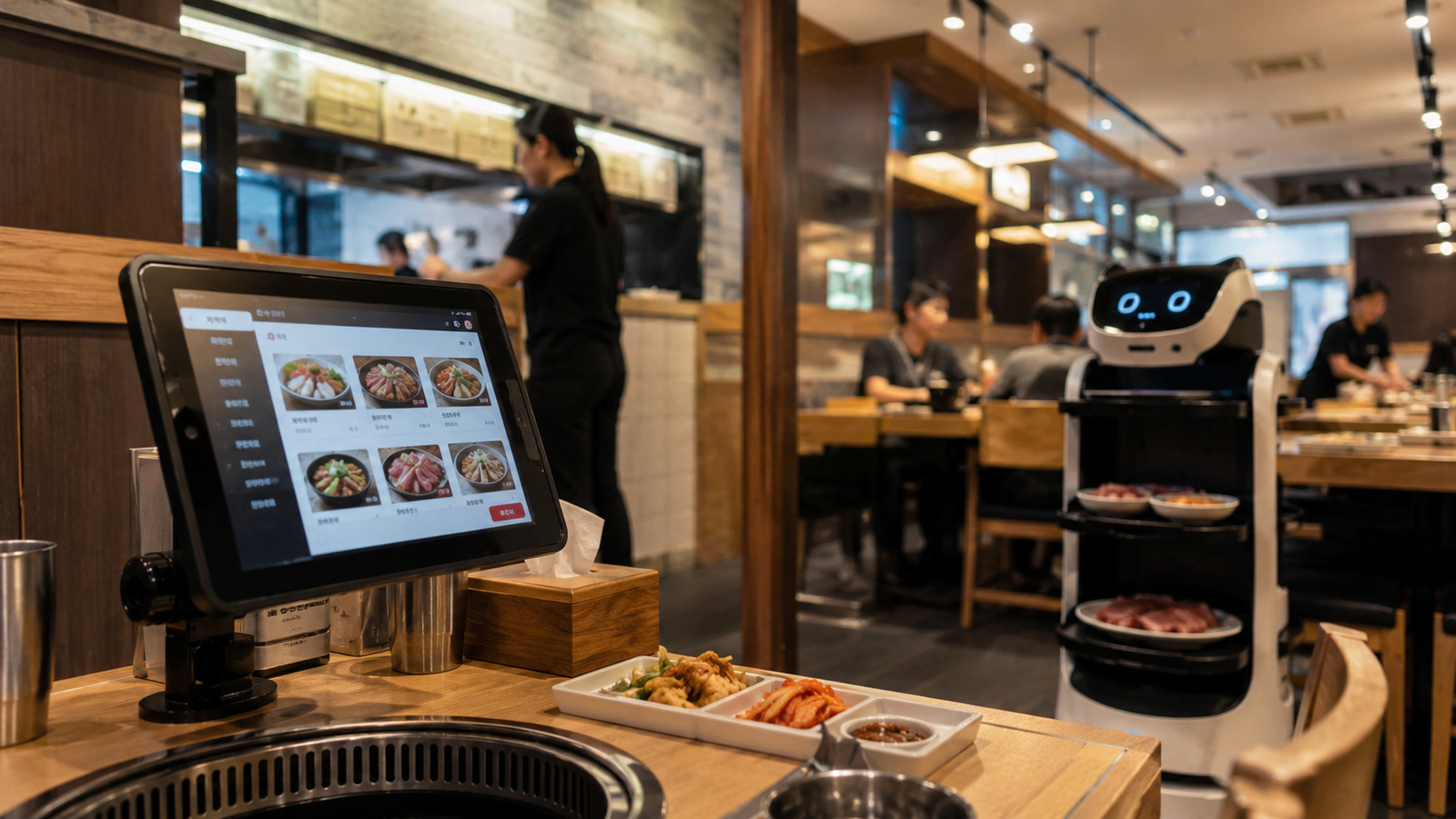
Walk into a fast-food restaurant in Korea and you may see three employees behind the counter.
None of them are taking orders.
Instead, a touchscreen is waiting for you.
At a regular restaurant, the setup may look different, but the idea is increasingly similar. You sit down and find a tablet attached to the table. You browse the menu, place your order, add another bottle of soju later, and sometimes even pay without calling a server.
And when the food arrives, it may be brought by a robot.
The employees are still there.
So why aren’t they taking your order?
To understand why Korea has so many kiosks, you have to look beyond the touchscreen itself.
Labor costs are part of the story, not the whole story
One common explanation is simple: labor became more expensive, so restaurants replaced workers with machines.
There is some truth behind the broader idea.
Korea’s Ministry of Agriculture, Food and Rural Affairs has itself described automated ordering as part of the restaurant industry’s efforts to reduce labor costs, respond to staffing pressures and improve operational efficiency.
In its release on the 2025 Foodservice Business Management Survey, the ministry noted that labor and ingredient costs were putting pressure on restaurant profitability, while the adoption rate of kiosks, table-order systems and other unmanned ordering systems had nearly tripled.
That does not mean rising wages alone explain Korea’s kiosk boom, though.
Labor costs are part of the story. What is happening inside Korean restaurants is broader than simply replacing a cashier with a screen.
The way restaurant work is divided between employees, customers and machines is changing.
This is no longer just about kiosks
According to the Ministry of Agriculture, Food and Rural Affairs and the Korea Rural Economic Institute’s 2025 Foodservice Business Management Survey, 13.0% of surveyed foodservice businesses were using unmanned ordering systems in 2025.
That was up from 4.5% in 2021.
The survey covered 3,138 foodservice businesses across Korea and was conducted through in-person interviews between August and October 2025.
The more interesting detail, though, is what those ordering systems actually looked like.
Among the 498 businesses in the survey that used unmanned ordering systems:
- 57.1% used kiosks
- 23.6% used tablet ordering
- 19.4% used mobile-phone ordering
Those figures come from Table 40 of the government’s full statistical report.
Official 2025 Foodservice Business Management Survey — full statistical report
So describing Korea’s shift as simply “restaurants installing kiosks” misses a large part of what is happening.
Nearly one-quarter of businesses using unmanned ordering systems were already using tablet ordering.
The kiosk has moved to the table
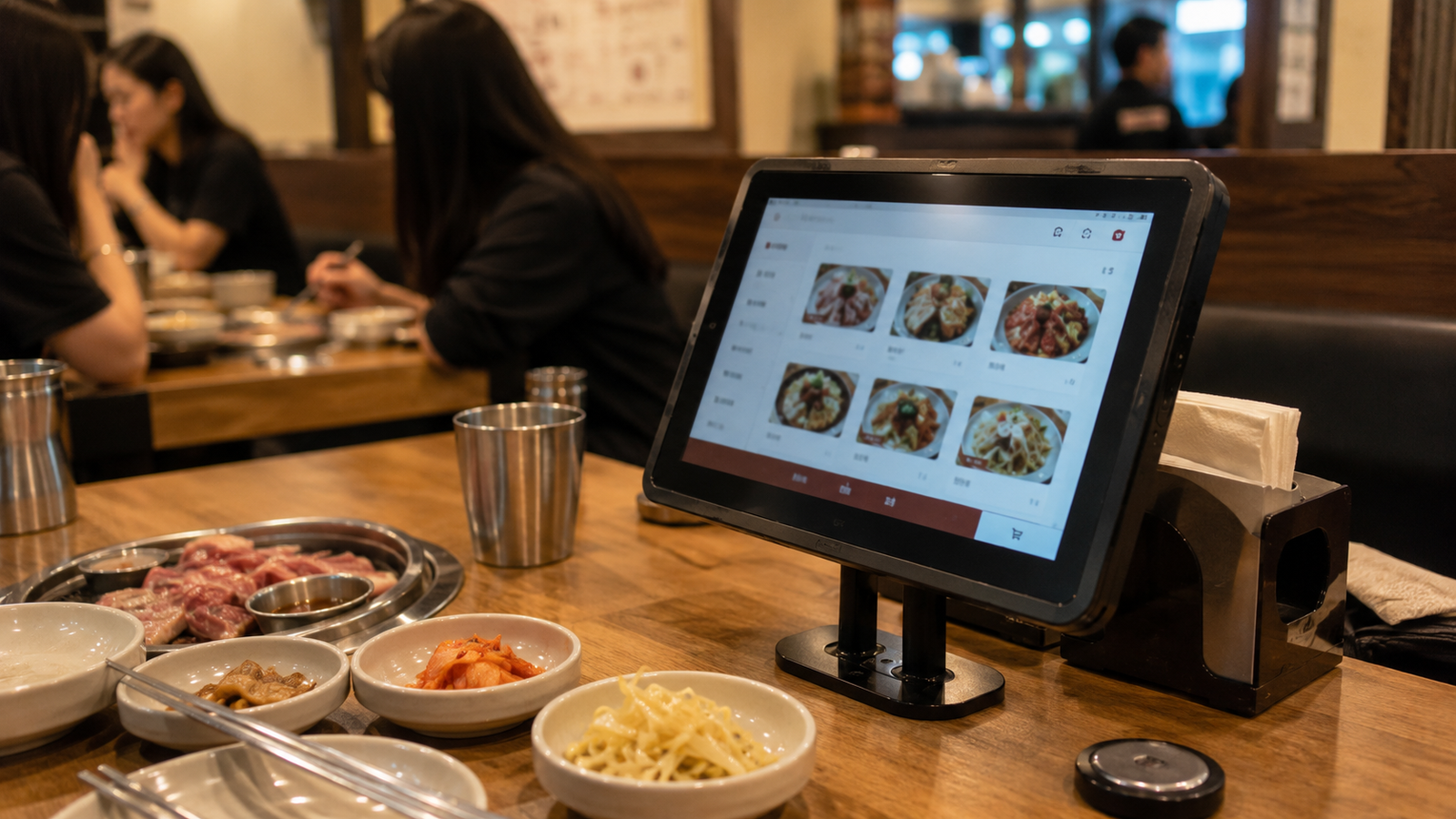
In many Korean restaurants, you no longer walk up to a machine.
The machine comes with your table.
Table-order tablets have become a familiar sight in restaurants where customers remain seated and place multiple orders during a meal.
Instead of calling a server, you tap the screen.
Want another serving of meat?
Tap the screen.
Another bottle of soju?
Tap the screen.
More rice or another side dish?
Tap the screen again.
The government survey shows an especially interesting pattern when businesses using unmanned ordering systems are grouped by average spending per customer.
Among those businesses, the share using tablet ordering was:
- 7.5% at businesses with an average customer spend below 5,000 KRW
- 29.7% at 10,000 to 20,000 KRW
- 65.8% at 20,000 to 30,000 KRW
- 74.1% at 30,000 KRW or more
The highest-spending groups had relatively small sample sizes, so these figures should not be read as saying that three-quarters of all Korean restaurants above 30,000 KRW use tablets. They show the mix of ordering systems among businesses in the survey that had already adopted unmanned ordering.
See Table 40 in the official statistical report
The data does not simply divide Korea into “cheap fast-food restaurants with kiosks” and “expensive restaurants with tablets.”
But the report does show that tablet ordering becomes much more prominent as average customer spending rises among businesses already using automated ordering.
There is another interesting clue in the same table. Among surveyed businesses using unmanned ordering, tablet ordering accounted for 79.9% among Korean meat restaurants and 79.3% among draft-beer pubs, although those subgroup sample sizes were relatively small.
That pattern makes intuitive sense.
At a Korean barbecue restaurant, for example, customers may place several additional orders during a meal.
A customer does not need to repeatedly call a server over.
The ordering system is already sitting on the table.
For foreign visitors, this is one of the ways Korea’s restaurant automation can feel different from the simple self-service kiosks found at fast-food restaurants.
The screen is no longer just near the entrance.
It has become part of the table.
Then the robots arrived
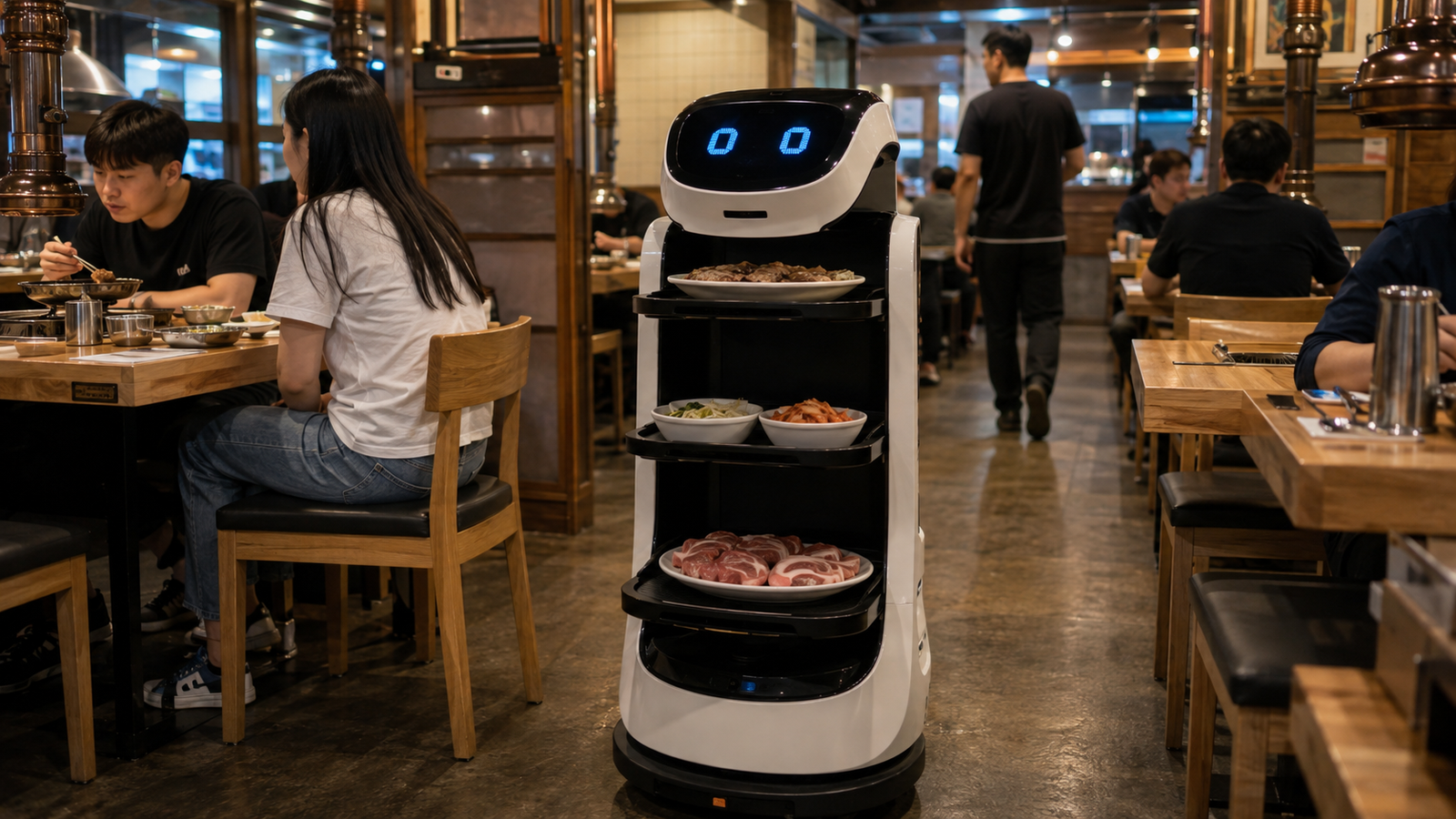
Once ordering becomes automated, another repetitive part of restaurant work can also be automated: moving food between the kitchen and the table.
That is where serving robots come in.
A kiosk or tablet connects the customer to the ordering system.
A serving robot handles part of the movement between the kitchen and the dining area.
They are different technologies, but they fit into the same broader change.
Korea’s 2025 foodservice trend report found that reported experience using serving robots rose slightly from 13.7% in 2024 to 14.7% in 2025.
Among respondents who were satisfied with serving robots, 29.2% cited the convenience of using them to clear finished dishes, 28.9% cited the experience itself, 18.5% liked not having to interact with staff, and 14.2% said they were easy to use.
The report also noted that “new experience” had been a much stronger reason for satisfaction a year earlier, suggesting that serving robots were becoming less of a novelty and more of an ordinary service method.
They are still far from replacing restaurant workers.
Still, they show that automation in Korean restaurants is moving beyond the ordering screen.
The work does not disappear. It moves.
This is the more interesting way to understand Korea’s kiosk boom.
The kiosk doesn’t eliminate the work of ordering.
The tablet doesn’t eliminate the work of taking an order.
The serving robot doesn’t eliminate restaurant work.
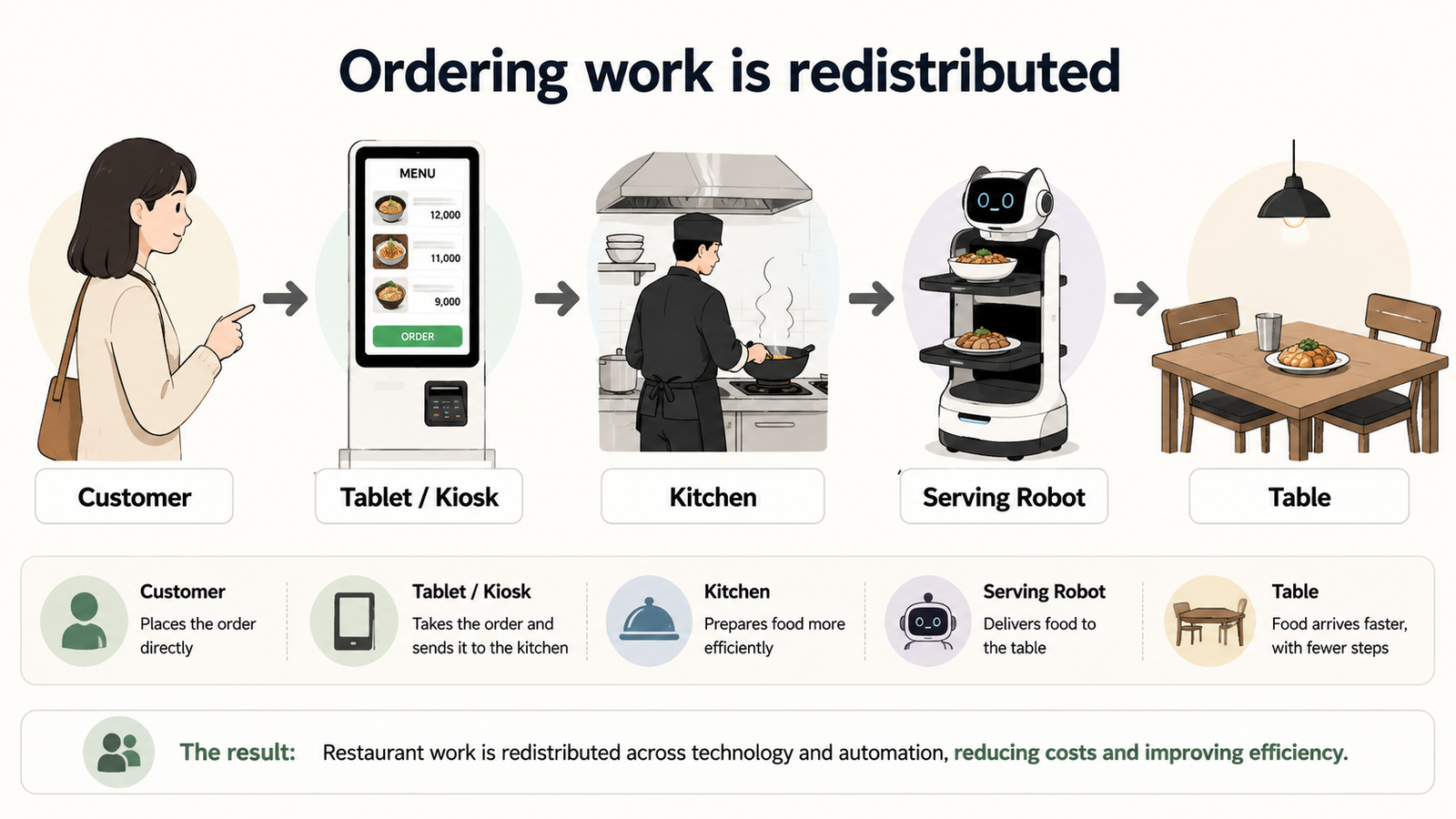
They redistribute who — or what — does each part of the work.
Think about what happens during a traditional restaurant order.
Someone looks through the menu, communicates the choices and selects any options.
Someone enters the order, handles anything added later and confirms payment.
With a kiosk or table-order tablet, more of those tasks move toward the customer and the ordering system.
The employee does not necessarily disappear.
Instead, less staff time needs to be spent repeatedly taking and entering orders, leaving more time for food preparation, clearing tables, customer support and other work inside the restaurant.
That is why “kiosk equals job replacement” is too simple a way to describe what is happening.
A repetitive part of restaurant work is being reassigned.
Some customers actually prefer it this way
Restaurant owners are only one side of the story.
Customers also have to accept self-service systems for them to spread this widely.
A 2023 Lotte Members survey of 1,333 people aged 10 and older across Korea found that the most commonly cited reason for preferring kiosks was not having to worry about an employee’s reaction, at 33.6%.
Another 24.2% cited faster menu selection and payment, while 19.5% cited shorter waiting times.
Kiosk preference was particularly high among younger respondents: 69.7% among teenagers, 73.5% among people in their 20s and 60.3% among those in their 30s. The survey’s reported margin of error was ±2.7 percentage points at a 95% confidence level.
Reported results of the 2023 Lotte Members kiosk survey
This was a corporate consumer survey rather than government statistics, so it should not be read as representing every Korean customer.
Even so, it helps explain one reason automated ordering can feel comfortable to some people.
You can spend five minutes deciding between samgyeopsal and moksal without a server standing next to the table waiting for an answer.
For some customers, less interaction is not a downside.
It is part of the convenience.
Automation is not equally convenient for everyone
What feels frictionless to a 25-year-old Korean can feel surprisingly difficult to a visitor or an elderly customer.
Foreign visitors may encounter screens that are only partly translated into English, unfamiliar payment steps, systems designed around Korean phone numbers or membership accounts, or complicated option menus that are difficult to understand without speaking Korean.
Sometimes there is an English button.
Sometimes the easiest solution is simply to ask a staff member for help.
Older customers face a different version of the problem.
Korean academic research has repeatedly examined difficulties older adults can experience with kiosks.
A 2021 study focusing on accessibility for older users at fast-food kiosks identified issues including complex interfaces and interaction processes. A separate 2019 study of people aged 65 and older examined the relationship between cognitive functions such as orientation, attention and recall and the ability to complete kiosk-like tasks.
- 2021 KCI study — Improving kiosk accessibility for older users
- 2019 KCI study — Cognitive ability and kiosk usage among adults aged 65 and older
A 2024 design study also described the digital divide faced by older people as particularly visible in kiosk use and examined how screen design could improve usability.
2024 KCI study — Improving kiosk usability for older users
So the same system can feel efficient to one customer and exclusionary to another.
Automation removes some friction.
It can also create new kinds of friction.
Korea’s kiosks are part of something bigger
The same pattern extends beyond restaurants.
Unmanned convenience stores, cafés, ramen shops and other self-service businesses have also expanded across Korea.
There is no single official government count covering every type of unmanned store, so estimates vary. Reuters reported that South Korea had around 9,000 unmanned establishments at the end of 2024, roughly four times the estimated number in 2020. Its reporting linked the broader move toward self-service and robotics to labor costs and staffing shortages, among other factors.
Reuters — South Korean shops turn to robots and self-service
The exact number matters less than the direction.
Counter kiosks.
Table-order tablets.
Serving robots.
Unmanned stores.
They are different parts of the same broader shift.
Korea has so many kiosks not simply because Koreans like touchscreens.
It is because everyday service work is being reorganized — divided differently between employees, customers and machines.