Where to Stay in Busan: Choose Your Base Before You Book
Busan looks easy to plan until you start looking at hotels.
There is a beach hotel with a sea view. Another place is close to the train station. A third seems to be in the middle of everything. On the booking map, none of them looks especially far away.
But a hotel beside Haeundae Beach and one near Jagalchi Market set up two very different trips. Busan’s sights are spread across the city, and the place you return to every evening matters as much as the attractions on your list.
For most first-time visitors, the decision comes down to four bases: Seomyeon, Nampo, Haeundae and Gwangalli. Here is how to pick one based on the trip you actually want.
The short answer
| Stay in | If your trip is mainly about | What you give up |
|---|---|---|
| Seomyeon12 | A flexible base for sightseeing in different parts of Busan | You will travel to the beach; there is no sea outside your hotel |
| Nampo1 | Markets, old downtown streets and the port side of Busan | East Busan’s beaches become longer outings |
| Haeundae2 | A beach-focused stay with plenty to do nearby | Repeated trips to the old downtown take time |
| Gwangalli2 | Evenings by the water and the view of Gwangan Bridge | Beachfront hotels may require a walk or ride from the metro |
If you cannot decide: Start with Seomyeon for a sightseeing-heavy trip, or Haeundae if waking up near the beach is the point of coming to Busan. Those are starting rules, not universal rankings.
First, put your saved places on a map
Before booking, divide your plans into two loose groups.
On the west and old-downtown side, you may have Busan Station, Nampo, Jagalchi Market, Gukje Market and Gamcheon Culture Village. On the eastern coast, you may have Haeundae, Gwangalli, Centum City and places farther east.
This is a planning shortcut, not a claim that every stop within a group sits next door to the others. Busan is large enough that crossing between groups every day changes how a short visit feels. You can absolutely see both sides. The useful question is which side you want to start and end your days on.
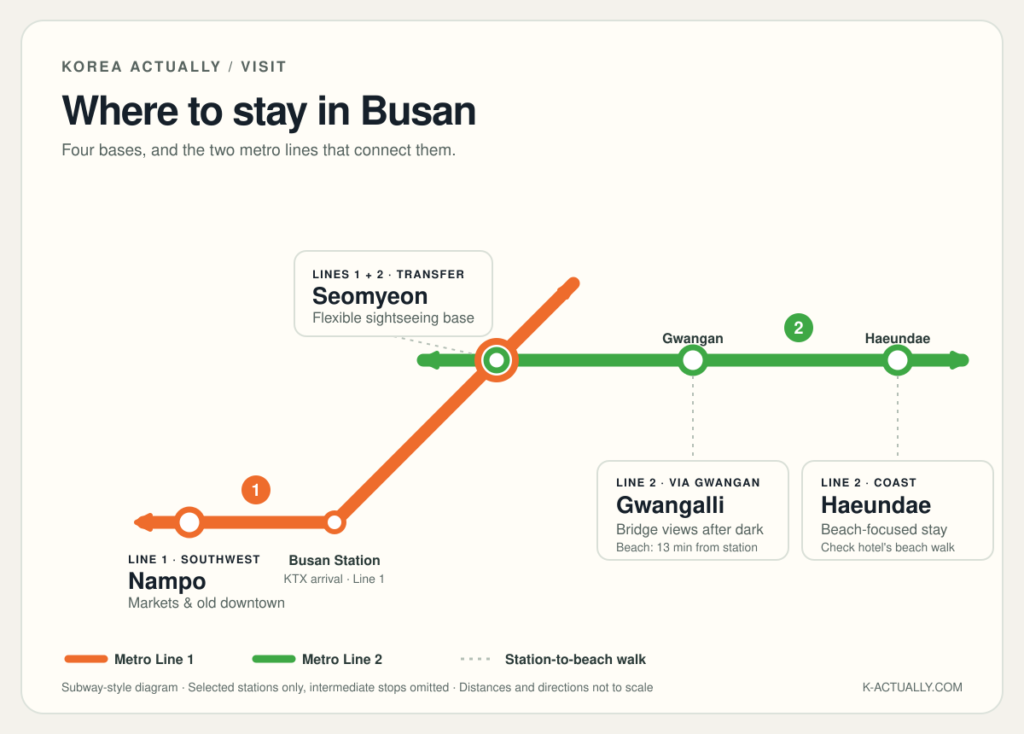
Busan Metro Line 1 runs through Nampo, Busan Station and Seomyeon, in that order. Line 2 runs through Seomyeon, Gwangan and Haeundae, in that order. Seomyeon is the transfer point between the two lines. You can check the Visit Busan’s map and guidebook downloads while comparing hotel addresses.
Seomyeon: the flexible base
Best for: A first visit with a mixed itinerary and no strong preference for a sea-view hotel.
Seomyeon’s appeal is practical. It connects Lines 1 and 2, so you can head toward Nampo on one day and toward Gwangalli or Haeundae on another without choosing one end of the city as your permanent base. There are also plenty of shops, restaurants and busy streets to come back to after a day out.

The trade-off is equally clear. Seomyeon does not give you that immediate I’m in a coastal city feeling when you leave the hotel. A beach sunset is an outing you plan, followed by a journey back.
It is a good default for two or three nights if your saved places are scattered across Busan. Check the hotel’s walking route to Seomyeon Station, though: a listing described as “Seomyeon” may still be less convenient than one that is actually close to the interchange.
Choose Seomyeon if you want the freedom to change your plans each morning.
If one of those evenings happens to include baseball, Busan is also home to the Lotte Giants at Sajik Baseball Stadium. Our Korean baseball guide for visitors explains how Sajik fits into the wider KBO experience.
Nampo: markets and the older city
Best for: Travelers more excited by food alleys, markets and port-city streets than by a resort-style beach stay.
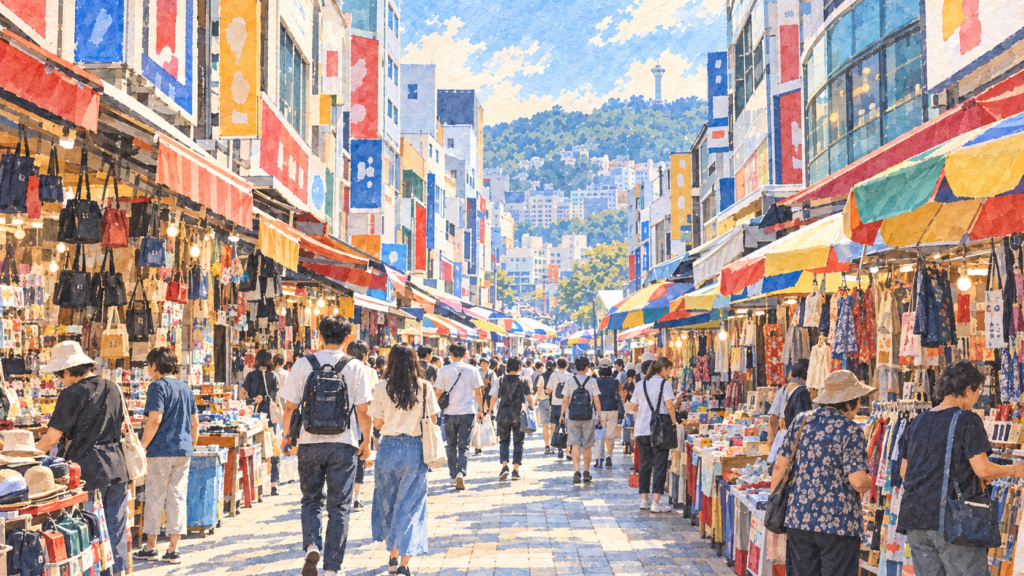
Nampo gives you a very different introduction to Busan. The broader downtown area brings together Gwangbok-ro, BIFF Square, Gukje Market, Bupyeong Kkangtong Market and Jagalchi. Visit Busan describes this as an area worth exploring over a full day or longer, rather than a single quick stop.
Nampo Station is on Line 1, the same line as Busan Station. That makes it especially appealing if you are arriving by train and plan to spend a good part of your trip in the older downtown area. You can still visit Haeundae, but if you plan to head east most days, choose an eastern base instead.
Watch the exact address. Booking sites may use “Nampo” for properties around Nampo Station, Jagalchi, Gwangbok or nearby streets. Those are related areas, but the walk back to your room can differ. Check the nearest station and the route you will take with luggage.
Choose Nampo if markets and older streets are your main reason to explore Busan.
Haeundae: make the beach your everyday backdrop
Best for: A slower coastal trip, especially if you want to walk to the water before breakfast or after dinner.
Haeundae is more than a beach photo stop. Around the shore, you can build easy days around the beach, Dongbaek coastal paths, local food streets and the Mipo side of the coast. Visit Busan even suggests a short Haeundae-focused arrival day and a second day spent in the same area.
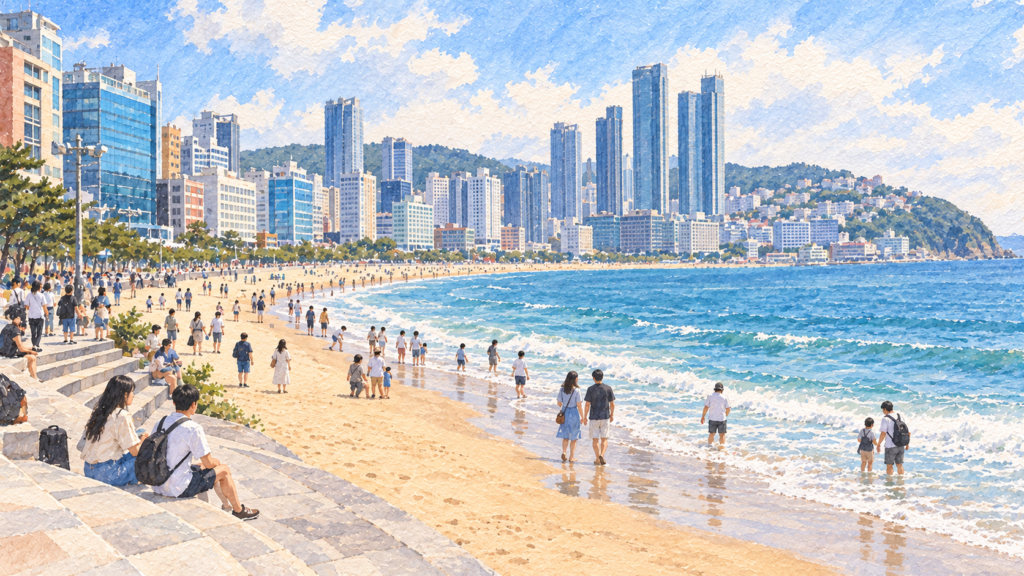
That is its advantage: you do not have to leave the district to feel that the trip has begun. The cost is time when you want to visit Nampo, Jagalchi and the older port-side streets. Haeundae is on Line 2; reaching the Line 1 corridor by metro involves a transfer at Seomyeon.
Do not assume “Haeundae” in a hotel title means “beside Haeundae Beach.” Check the walking route from the property to both Haeundae Station and the specific part of the shoreline you want. A hotel can be convenient for the metro without being a beach hotel, or the other way around.
Choose Haeundae if the coast is where you want to spend the unplanned hours of your trip.
Gwangalli: stay for the evenings
Best for: Travelers who want to finish their days with a walk, a meal and a view of Gwangan Bridge.
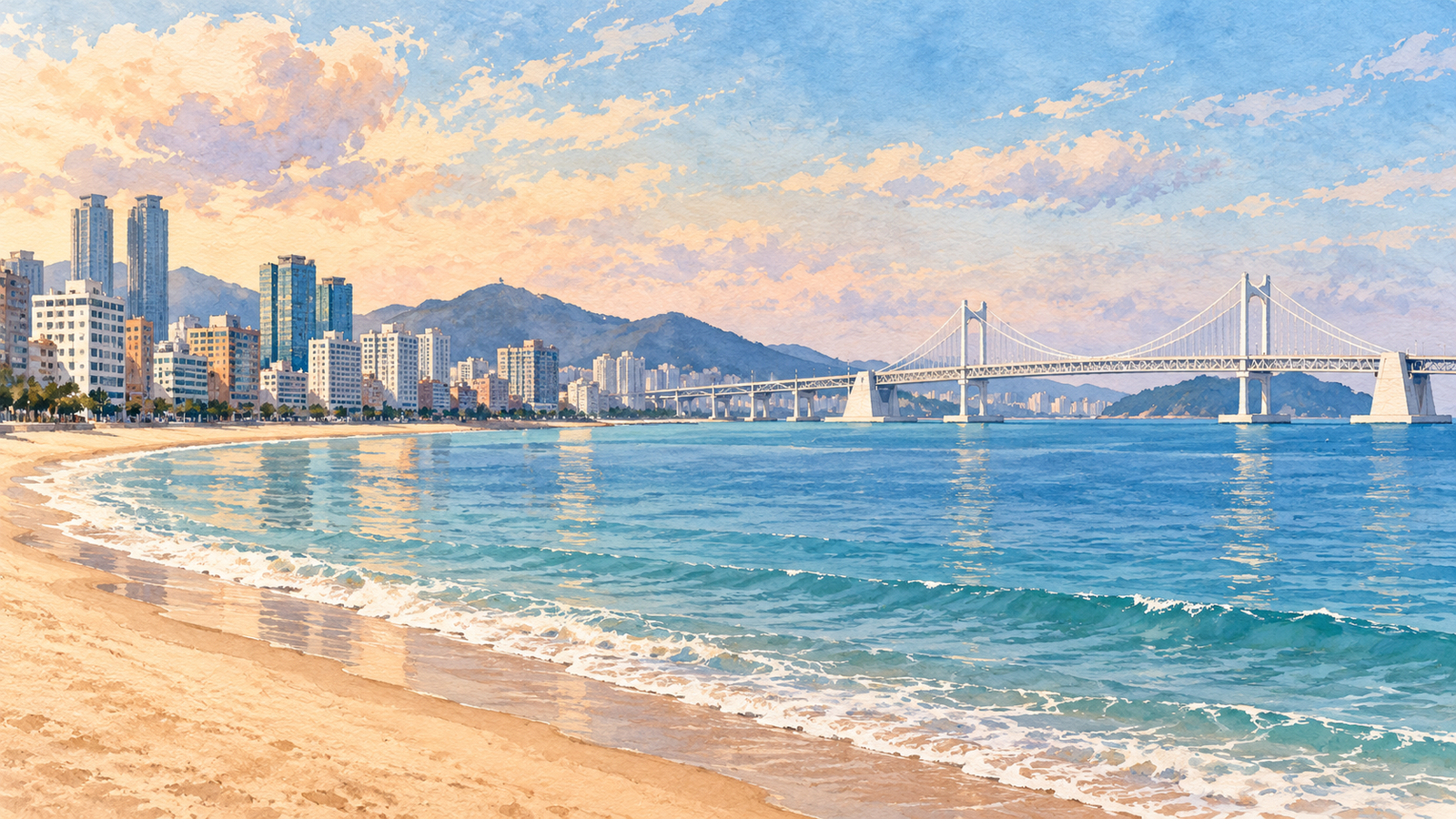
Gwangalli’s strongest argument appears after dark. The bridge faces the beach, and the seafront gives you an easy place to linger rather than a sight to tick off. Its feel is different from Haeundae: choose it because you want this particular waterfront, not because the two beach districts are interchangeable.
There is one detail to check carefully before booking. The sand is not directly outside the metro station. Visit Busan gives a 13-minute walk from Gwangan Station Exit 5 to Gwangalli Beach. Your actual walk depends on the hotel’s position along the waterfront. A sea-view room can be wonderful, but you should inspect its route to the station if you will cross the city frequently.
Gwangalli sits on Line 2, between the Seomyeon side and Haeundae. It can work well when you want eastern outings without sleeping in Haeundae itself. For a packed old-downtown itinerary, the repeated journeys still add up.
Choose Gwangalli if the view from the neighborhood at night is part of the holiday, not just an afternoon stop.
What about staying beside Busan Station?
It can make sense for a short stopover, a late train arrival or an early departure. The station is on Line 1, so you can reach Nampo or Seomyeon without changing lines. But staying next to the railway station is a transport choice. If you have several nights and want to spend your evenings by the sea or among market streets, pick the neighborhood where you would rather return.
Arriving at Gimhae Airport
If you are flying into Gimhae rather than arriving by KTX, compare the last part of the trip to your actual hotel. The airport’s official transit guide shows the airport light rail connecting with Busan Metro Line 2 at Sasang. The airport also publishes bus options toward Seomyeon and Haeundae; routes, schedules and fares can change, so check them again before travel.
Do not pick a hotel solely because the airport transfer is a few minutes easier. You make that journey twice, but you may commute from the hotel to your preferred sights every day.
Three checks before you pay
- Pin the exact address, not just the district name. A beach district can stretch farther than the booking-site label suggests.
- Test two real journeys. Check the route from your hotel to your most important daytime stop and to the place you want to spend an evening. Use a current Korean map app when you finalize the booking.
- Look at the last 10-15 minutes on foot. Luggage, slopes, crossings and a long walk from the station can matter more than one fewer subway stop.
Busan does not have one perfect neighborhood for everybody. The right base is the one that makes your own trip easier at the beginning and end of each day.
If you are planning Seoul as well, see our guide to choosing a place to stay in Seoul. For the first leg of your trip, our Incheon Airport to Seoul guide can help you compare arrival options.