How to Get Around Seoul: Subway, Bus, Taxi & T-money (2026)
If you’re wondering how to get around Seoul, the good news is that the city’s transportation system is genuinely good. That’s also part of the problem for a first-time visitor: subway, bus, T-money, Climate Card, Naver Map, KakaoMap, night buses, transfer rules. It’s a lot to take in on day one, and most guides try to explain all of it at once.
You don’t need all of it on day one. You need a starting setup, and a sense of when to reach for something else.
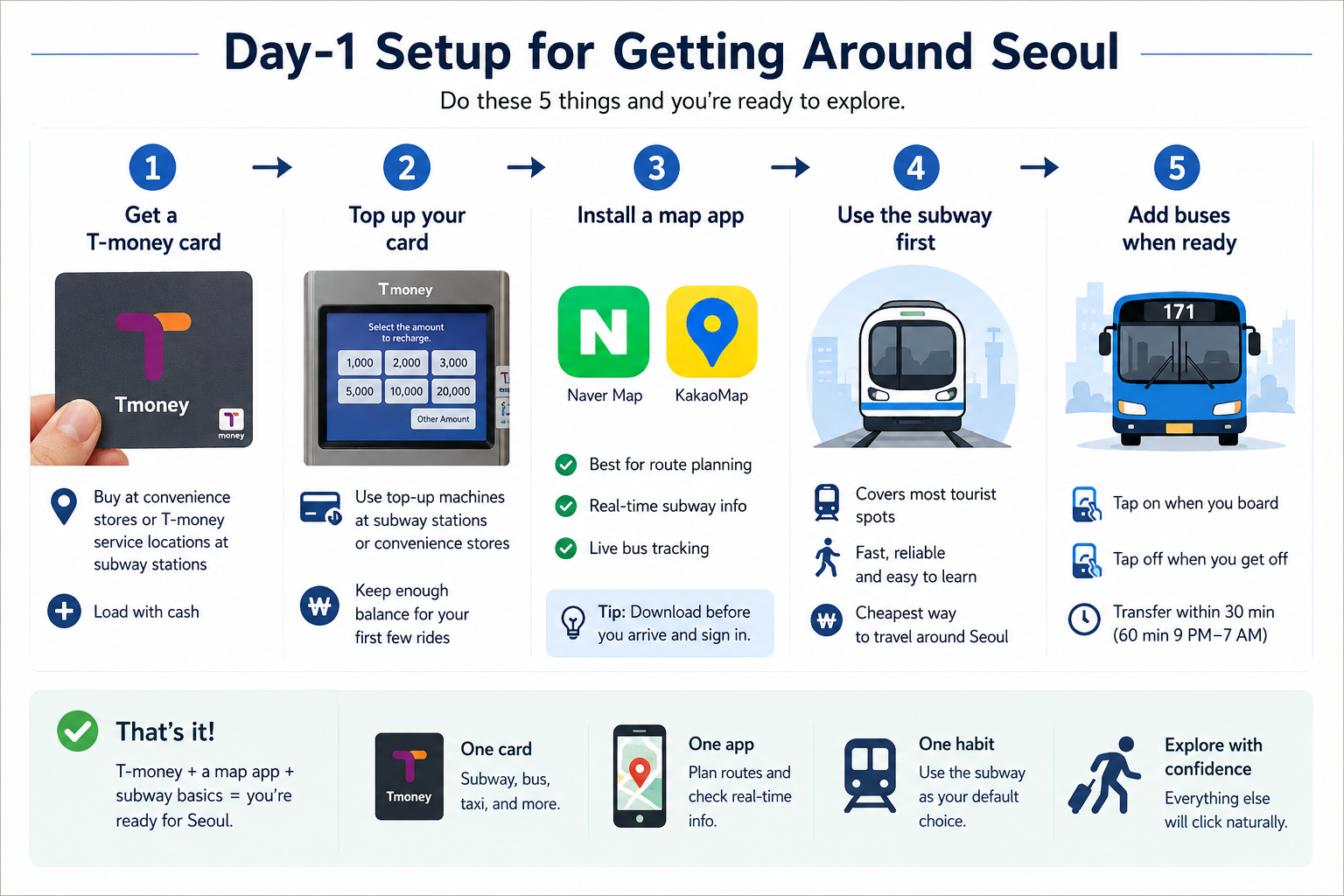
The short version: get a T-money card, install Naver Map, and start with the subway. Add buses once you know how tap-off works. Use a taxi when luggage, weather, a late hour, or a group makes it worth the extra cost.
Quick Answer: How to Get Around Seoul on Your First Day
| Need | Best option |
|---|---|
| Most sightseeing | Subway |
| Subway + bus in one system | T-money card |
| Route planning, live bus tracking | Naver Map or KakaoMap |
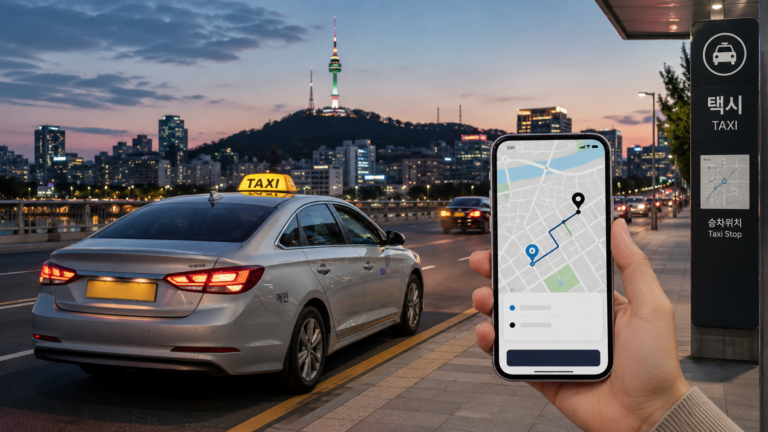
| Heavy luggage, door-to-door | Taxi |
| After the subway stops | Taxi or N-series night bus |
| One-off subway ride, no card | Single-journey ticket |
If this is your first day in Seoul, don’t try to learn the whole system before you leave the airport. Get a T-money card, install Naver Map, and start with the subway. Everything else can wait until you actually need it.
1. Subway — Your Default Choice in Seoul
For most tourist routes in Seoul, start by asking whether the subway can do it. It usually can.
- Adult base fare with T-money: ₩1,550
- Adult single-journey ticket: ₩1,650 (₩100 more than the T-money fare)
Official source: Seoul Metropolitan Government — Subway Fares
A few things worth knowing before your first ride:
- Lines are identified by number and color. Most maps and station signs use both, so you don’t need to memorize line names.
- Getting to the right station is only half the job. In Seoul, choosing the right exit can save you a genuinely long walk, especially at larger stations with a dozen or more exits.
- Transfer stations can involve a longer walk than the map suggests. Some transfers are a short hallway. Others take several minutes.
- “Fastest” isn’t always “easiest.” With a large suitcase, a route with two transfers can be more trouble than a slightly slower one with none.
- Weekday morning and evening rush hours can be extremely crowded on the busiest lines.
Single-Journey Tickets: The ₩500 Deposit Most Guides Skip
If you buy a single-journey ticket instead of using T-money, you’re not just paying ₩100 more per ride. You’re also paying a ₩500 deposit on top of the fare. You can get the ₩500 deposit back by inserting the used ticket into a deposit refund machine at your destination station.
KOREA REALITY CHECK
If you forget to use the deposit refund machine, you won’t get the ₩500 deposit back. It’s a small amount, but for a group buying single-journey tickets over several days, it adds up. If you’re going to be in Seoul more than a day or two, a T-money card avoids this altogether.
For the full setup, top-up and refund process, see our T-money Card in Korea guide.
If you want the full subway-specific guide, including current fares, transfers, exit numbers and the 2026 foreign credit card update, see our Seoul Subway Guide for Tourists.
2. Bus — Useful, but Not the Best Place to Start
Seoul’s bus network is extensive, and the city’s own English-language guidance acknowledges that first-time visitors often find it harder to navigate than the subway. Route numbers, colors, direction, and stop names all take some getting used to, and unlike the subway, there’s no single map that makes the whole system visually obvious at a glance.
You don’t need to master Seoul’s buses on day one. They’re worth using when:
- The walk from the nearest subway station to your destination is long
- You’re heading somewhere uphill or off the subway grid
- A specific bus goes directly where you’re going without a transfer
The One Rule That Matters Most
Tag your T-money card when you board, and tag it again when you get off. That second tap isn’t optional if you want the transfer discount to apply. Skip it, and your next ride gets charged as a fresh trip rather than a connected one.
To qualify for the integrated transfer discount on a bus-to-subway or subway-to-bus connection, tag on again within 30 minutes of tagging off (60 minutes between 9 PM and 7 AM). The system allows up to four transfers, for five total boardings, on one continuous trip. Your rides are calculated under Seoul’s integrated transfer fare system rather than being treated as completely separate trips, though a longer combined distance can still add a small distance-based fare on top.
Official source: Seoul Metropolitan Government — Public Transportation Guide
3. T-money — The Simplest Default
T-money works across the subway, city buses, most taxis, and convenience stores, and it’s what makes the transfer discount system work in the first place.
You can buy one at many convenience stores and T-money service locations at subway stations, then load it with cash and start riding.
For where to buy it, how to top it up, refund rules, and how it compares to alternatives like the Climate Card, see our complete T-money Card in Korea guide.
One thing tourists do not always see is that prepaid T-money is only one layer of Korea’s transit-payment system. Locally issued credit and debit cards can also include transit functions — here’s how postpaid transit cards in Korea differ from prepaid T-money.
4. Can You Use a Foreign Credit Card?
This is one of the more genuinely confusing 2026 updates, so it’s worth explaining carefully.
From March 17, 2026, Seoul installed 440 new transit-card vending machines across 273 subway stations on Lines 1–8. At these machines, an internationally issued Visa, Mastercard, or similar card can be used to buy a single-journey ticket or purchase and top up a short-term Climate Card. An average service fee of roughly 3.7% applies to foreign card transactions.
Official source: Seoul Metropolitan Government — International Card Payments at Subway Ticket Machines
That’s a real and useful change. It’s also easy to misread as something bigger than it is.
KOREA REALITY CHECK
As of August 2026, being able to use an international card at a subway ticket machine does not mean you can tap that card directly at the subway gate. Seoul is introducing direct EMV open-loop transit payments in stages, with terminal replacement on Seoul Metro Lines 1–8 scheduled for 2027 as part of a rollout planned through 2030. For now, the international-card update applies to the vending machines, not general direct card tapping at Seoul subway gates.
Official source: Seoul Metropolitan Government — Open-Loop Transit Payment Roadmap
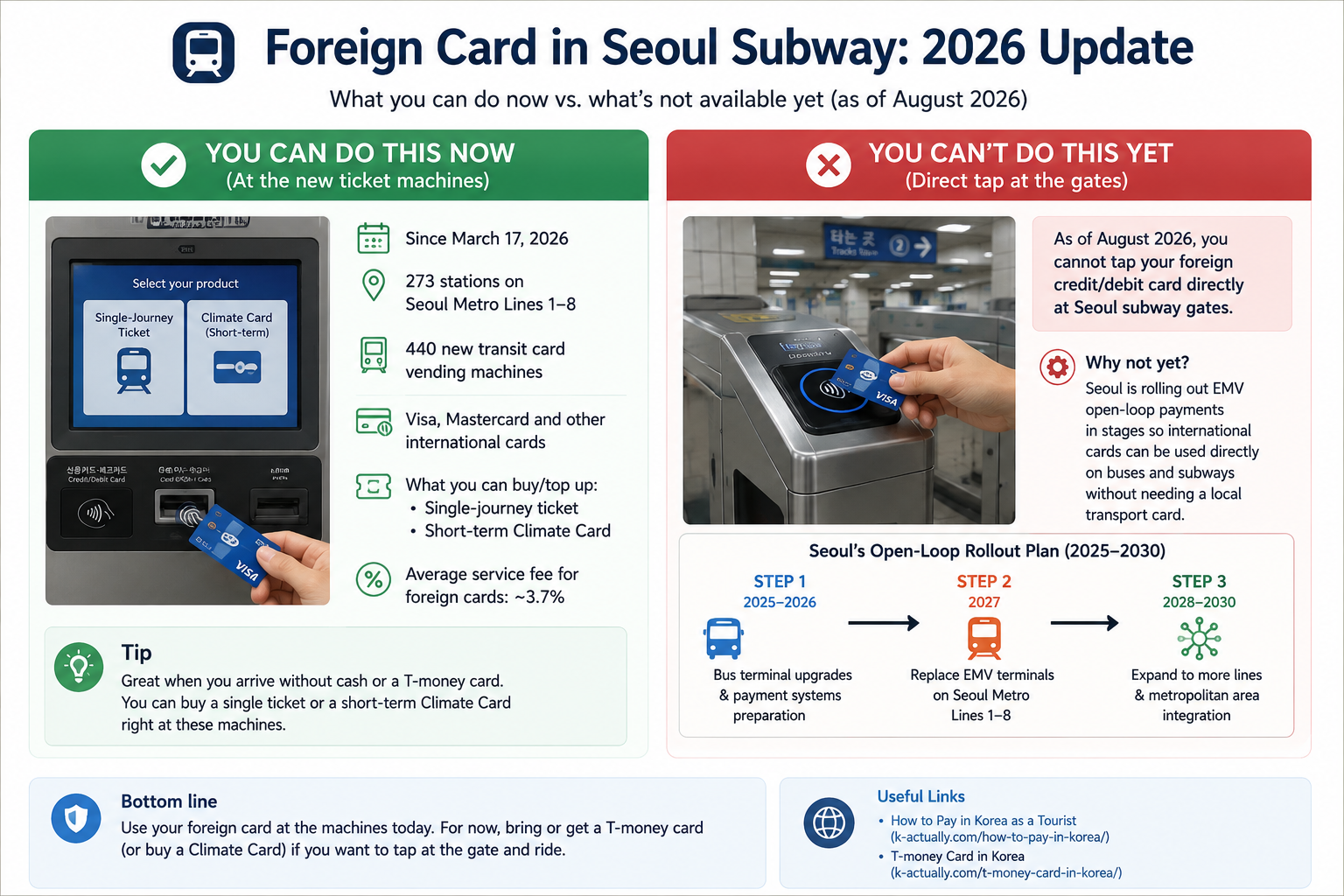
In practice, this means most visitors still find it simpler to buy a T-money card or a tourist Climate Card early in the trip, rather than relying on card machines at every station.
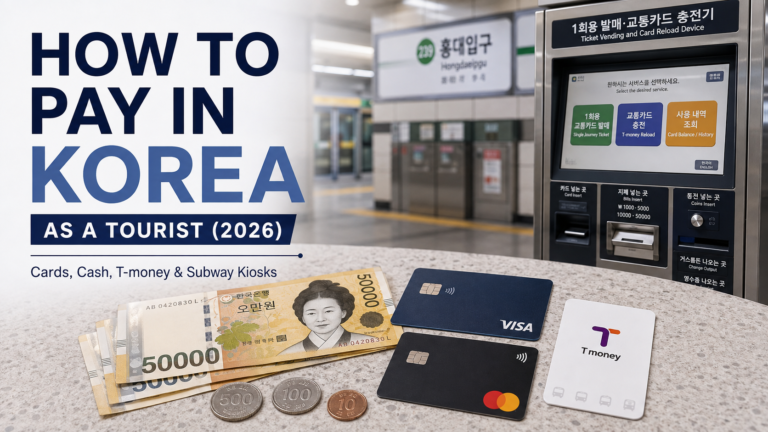
For a full breakdown of cash, card, T-money and kiosk payment options in Korea, see our How to Pay in Korea as a Tourist guide.
5. Which Navigation App Should You Use?
Naver Map is the simplest starting point for most visitors, with KakaoMap as a useful alternative. Both are officially recommended by Seoul’s city government for public-transport route planning and live bus information.
Official source: Seoul Metropolitan Government — Seoul Public Transportation
Google Maps works differently in Korea, especially for detailed local navigation and place data. We explain the background in a separate guide: Why Korea Still Relies on Naver and Kakao.
There’s also an official Seoul Subway app, which offers route recommendations, in-station directions to specific exits and restrooms, and real-time car-congestion information. It’s a solid option if you want more subway-specific detail, but for most visitors, one map app for the whole trip is simpler than switching between a general map and a subway-only app.
6. How Transfers Actually Work
Transfers cause more confusion than almost anything else in Seoul’s transit system, mostly because the rule is slightly different depending on what you’re transferring between.
Bus to Subway, or Subway to Bus
Your tag record matters here. Tag off the bus, then tag on at the subway gate (or vice versa) within the transfer window, and the connected trip qualifies for the integrated transfer discount.
Subway Line to Subway Line
Most subway-to-subway transfers don’t involve exiting the paid zone at all. You follow the transfer signage inside the station to the connecting platform, without tapping out and back in.
ACTUALLY
Not every transfer works the same way, so “just tap in and out at every transfer” isn’t quite right. The habit that actually matters is tagging correctly whenever you enter or leave the paid transit system, and always tagging off when you get off a bus.
7. When a Taxi Is Actually Worth It
A taxi isn’t the default option in Seoul, but there are specific situations where it’s worth the higher cost.
Consider a taxi when:
- You’re traveling as 3–4 people without too much luggage, making the per-person cost more reasonable
- You have heavy luggage and want to avoid transfers
- It’s raining or otherwise unpleasant to walk
- Your destination is far from a station and awkward to reach by bus
- It’s late at night and public transit options are limited
- The distance is short enough that a taxi is quick and inexpensive anyway
Skip the taxi when:
- You’re crossing Seoul during rush hour and road traffic will cost you more time than a transfer would
- You’re traveling alone and a direct subway line already covers your route
A regular mid-size taxi charges a daytime base fare of ₩4,800 for the first 1.6km, with a late-night surcharge of 20% from 10–11 PM, 40% from 11 PM–2 AM, and 20% from 2–4 AM.
Official source: Seoul Metropolitan Government — Taxi Fares
For taxi types, apps, payment methods and a full fare breakdown, see our complete guide to taking a taxi in Korea.
8. What Happens After the Subway Stops?
There’s no single “last train time” for all of Seoul. It depends on the line, the station, the direction you’re traveling, and sometimes the day of the week. A route that runs until well past midnight on one line can end noticeably earlier on another.
CHECK YOUR SPECIFIC ROUTE
Don’t assume “midnight” is a safe cutoff everywhere. Check the last train for your specific station, direction and destination in Naver Map or KakaoMap before heading out for the evening.
Once regular subway service ends, your main options are a taxi or one of Seoul’s N-series night buses. Night bus hours and routes vary, so rather than relying on one fixed schedule, check the specific route in Naver Map, KakaoMap, or Seoul TOPIS before counting on it.
Common First-Timer Mistakes
Relying Only on Google Maps
Local navigation, business info and live transit data are more complete in Naver Map and KakaoMap.
Checking the Station but Not the Exit Number
The right station with the wrong exit can mean a much longer walk than expected.
Forgetting to Tag Off the Bus
No tap-off means no transfer discount, and your next ride gets charged as a new trip.
Assuming a Foreign Card Works Directly at the Subway Gate
As of August 2026, foreign cards work at the new ticket machines, not at the gate itself.
Taking a Taxi Across Seoul During Rush Hour
Road traffic can make this both slower and more expensive than the subway.
Choosing a Multi-Transfer Route With Heavy Luggage
A route with fewer transfers, even if the map shows it as slightly slower, is often the easier real-world choice.
Assuming the Subway Runs All Night
It doesn’t, and the cutoff time is different for every line and station.
Which Transport Should You Use?
| Situation | Best choice | Why |
|---|---|---|
| Myeongdong → Hongdae | Subway | Fast and predictable |
| Hotel to a nearby neighborhood | Bus | Can cut out a long walk |
| 3–4 people, light luggage | Taxi | Often worth it when the fare is split |
| Rush-hour cross-city trip | Subway | Avoids road traffic |
| After the last train | Taxi or N-series night bus | Your two main late-night options |
| First day in Seoul | Subway + T-money | Simplest possible setup |
What to Read Next
- T-money Card in Korea: Complete Guide for Tourists — buying, topping up, refunds, and how it compares to the Climate Card.
- How to Take a Taxi in Korea — Kakao T, k.ride, street taxis, fares and late-night surcharges.
- Why Korea Still Relies on Naver and Kakao — why Google Maps works differently here, even after 2026’s data approval.
- How to Pay in Korea as a Tourist — cards, cash, T-money and the new subway kiosks explained together.
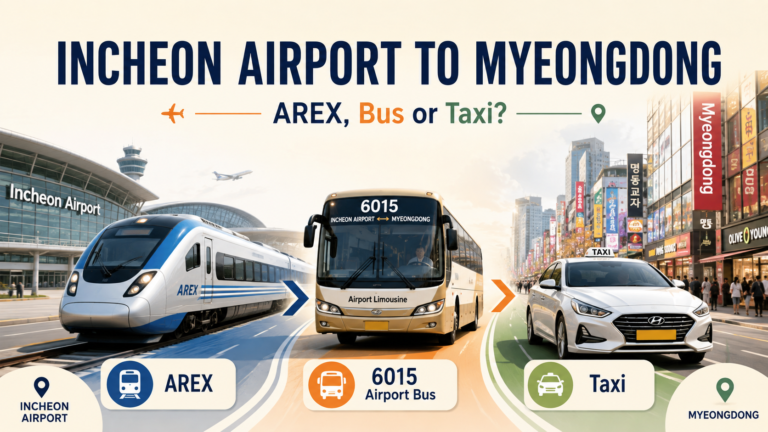
- Incheon Airport to Seoul: AREX, Bus or Taxi? — getting from the airport to wherever you’re staying.