Korea Rediscovered Distilled Soju. Now It’s Becoming Something Else.
Outside Korea, soju usually means one thing.
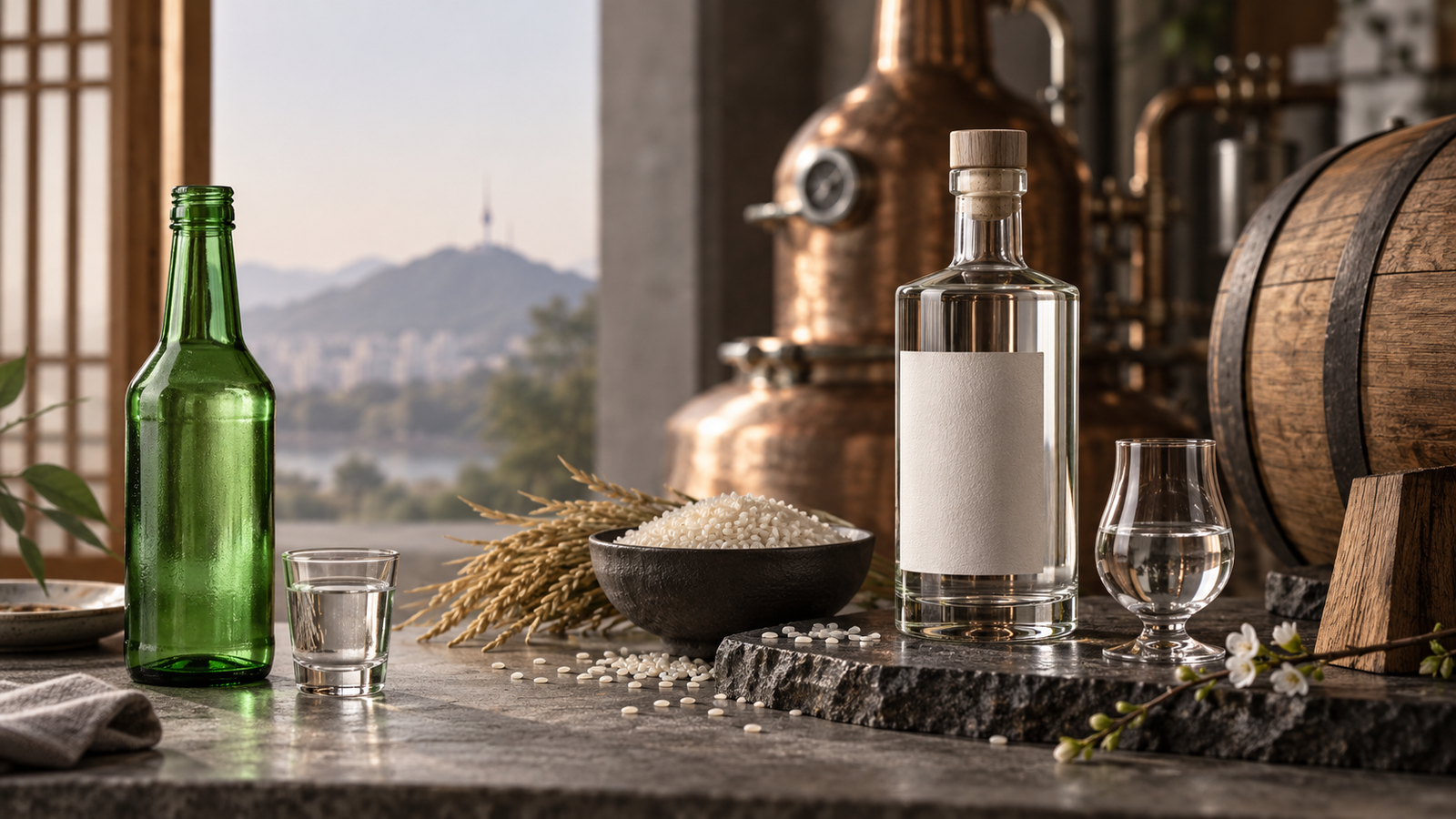
A green bottle. Clear liquor served cold. Cheap, easy to drink, and closely associated with Korean barbecue and late-night drinking.
But walk through a liquor shop in Korea today and that image no longer explains everything on the shelf.
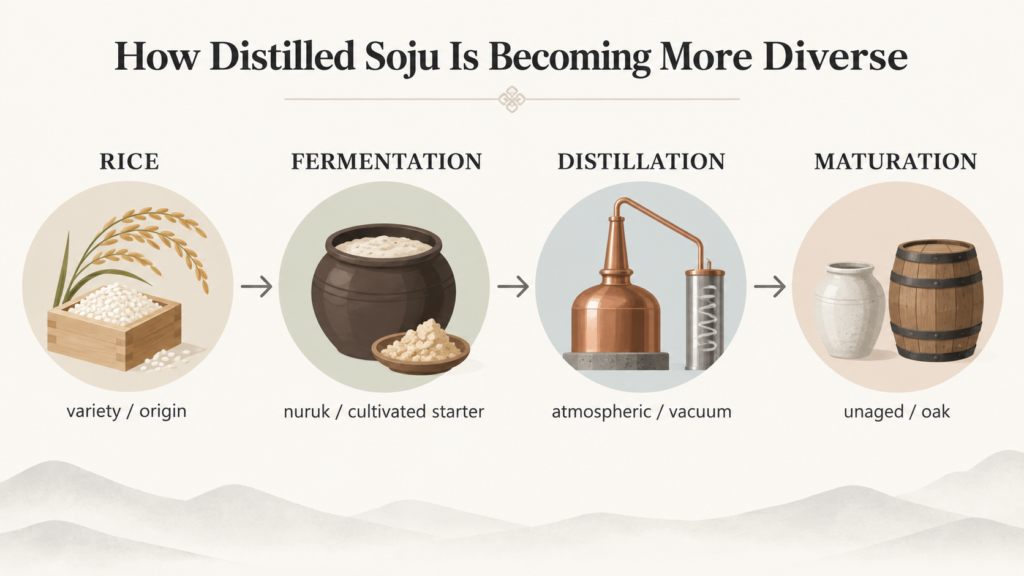
Some bottles now name the rice variety on the label. Others talk about nuruk, cultivated fermentation starters, or how the mash is controlled. Distillation methods are becoming part of the sales pitch too, and a handful of producers are putting their spirits into oak for years.
This raises a more interesting question than whether premium soju is becoming popular.
Is distilled soju simply getting more expensive, or is the category itself becoming something different?
The Boom Was Real. But It Didn’t Keep Booming.
The easy story is that distilled soju is still exploding in popularity in Korea.
The numbers say something more complicated.
According to the 2025 Liquor Industry Survey published by the Korea Agro-Fisheries & Food Trade Corporation (aT), based on Korean tax statistics, total shipments of distilled soju rose sharply between 2020 and 2022.
| Year | Distilled soju shipments |
|---|---|
| 2020 | 1,929 kL |
| 2021 | 2,480 kL |
| 2022 | 4,905 kL |
| 2023 | 4,877 kL |
| 2024 | 4,739 kL |
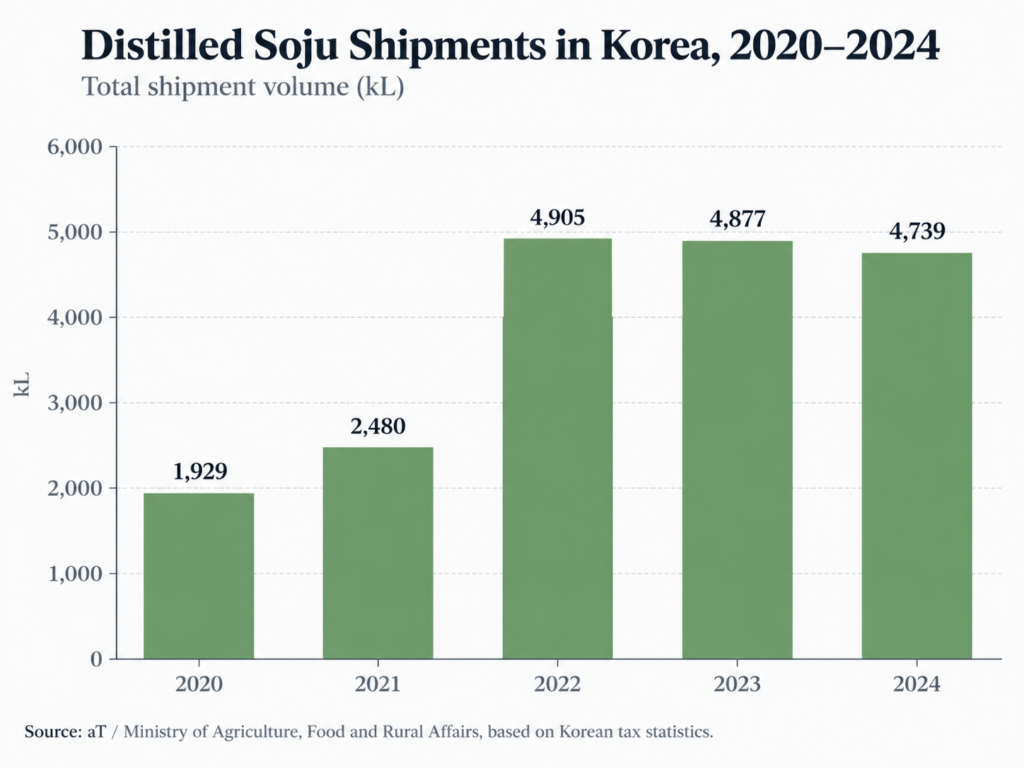
The market almost doubled in 2022.
But it did not keep climbing. Shipments edged down in both 2023 and 2024.
That does not mean the boom disappeared, either. In 2024, shipment volume was still about 2.46 times higher than it had been in 2020.
Distilled soju didn’t keep booming after 2022. But it didn’t go back to where it started either.
First, Distilled Soju Is Not the Same Thing as Traditional Liquor
Before going further, there is an important terminology problem.
Three categories that are often blurred together in English are not the same thing.
Diluted soju is the familiar mass-market style. Neutral spirit is diluted with water and adjusted into the final product. This is still the overwhelming majority of soju sold in Korea.
Distilled soju is made by fermenting raw materials and then actually distilling the resulting alcohol.
Traditional liquor, meanwhile, is a legal category in Korea. Under Korea’s Traditional Liquor Industry Promotion Act, it depends on specific qualifications, including certain intangible-heritage producers, Korean Food Masters, and licensed regional specialty liquor producers.
So not every distilled soju is legally classified as traditional liquor in Korea.
Brands such as Hwayo or Ilpoom Jinro may produce distilled soju without necessarily falling into the legal category of traditional liquor.
We break down that legal framework — and why it has nothing to do with how old a recipe is — in our guide to what traditional Korean liquor actually means.
Makgeolli sits on a different branch of this family tree. It’s a fermented drink rather than a distilled one, and its own everyday name doesn’t map perfectly onto its legal classification either.
This distinction matters when reading Korean market data as well. Statistics for the entire distilled-soju market and statistics covering only traditional-liquor producers are measuring different things.
Korean tax law once listed distilled soju and diluted soju separately. A 2013 revision merged the names into the broader legal category of soju because the tax rates and other treatment were largely the same. Producers, regulators and industry statistics still distinguish between the two styles when necessary.
Soju Used to Mean Something Else
Before the green bottle became the default image of Korean soju, the word referred to a very different kind of drink.
Historically, soju was a distilled spirit.
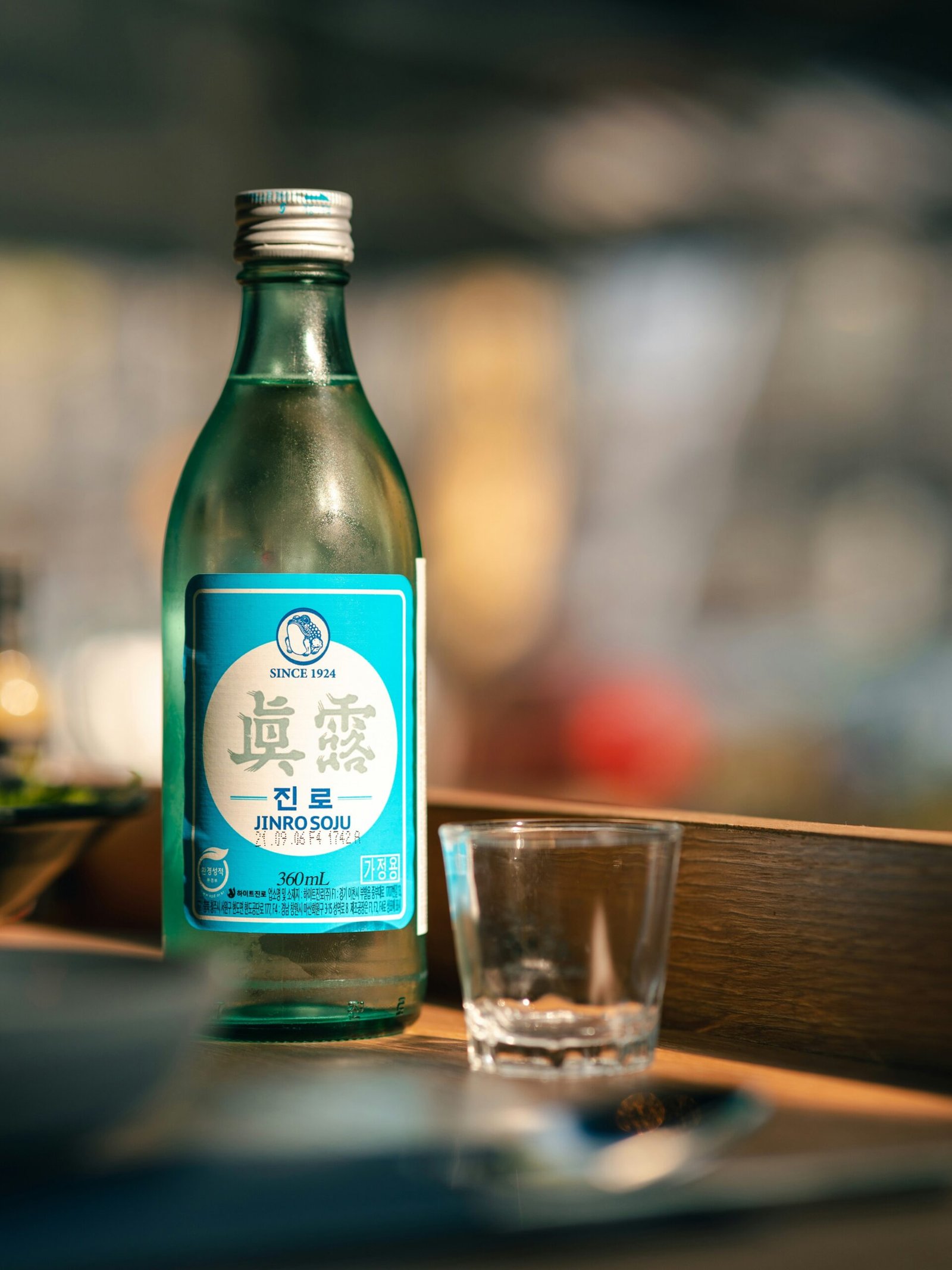
That changed dramatically in the early 1960s.
Korea was dealing with chronic grain shortages, and the government tightened grain-saving policies and restrictions on the use of rice in alcohol production. By April 1962, Korea’s Liquor Tax Act Enforcement Decree was already operating within a regulatory system that restricted white-rice use, and later versions explicitly defined distilled soju as being made from starch- or sugar-containing materials excluding white rice. The 1965 version of the decree makes that wording explicit.
In the early 1960s, grain-saving policies and liquor regulations effectively pushed traditional rice-based distilled soju out of legal commercial production.
It is tempting to reduce this history to a single sentence such as “rice soju was banned in 1965.” The original regulations are more complicated than that. Different grain controls and liquor rules were introduced and revised across the period, so pinning the entire shift on one year oversimplifies what happened.
The result was clear.
Traditional rice-based distillation lost its commercial footing, while inexpensive diluted soju became the mass-market standard.
For most Koreans today, the word soju came to mean something very different from the spirit it once described.
Then a Different Kind of Soju Market Started to Appear
The modern distilled-soju story did not begin with Won Soju.
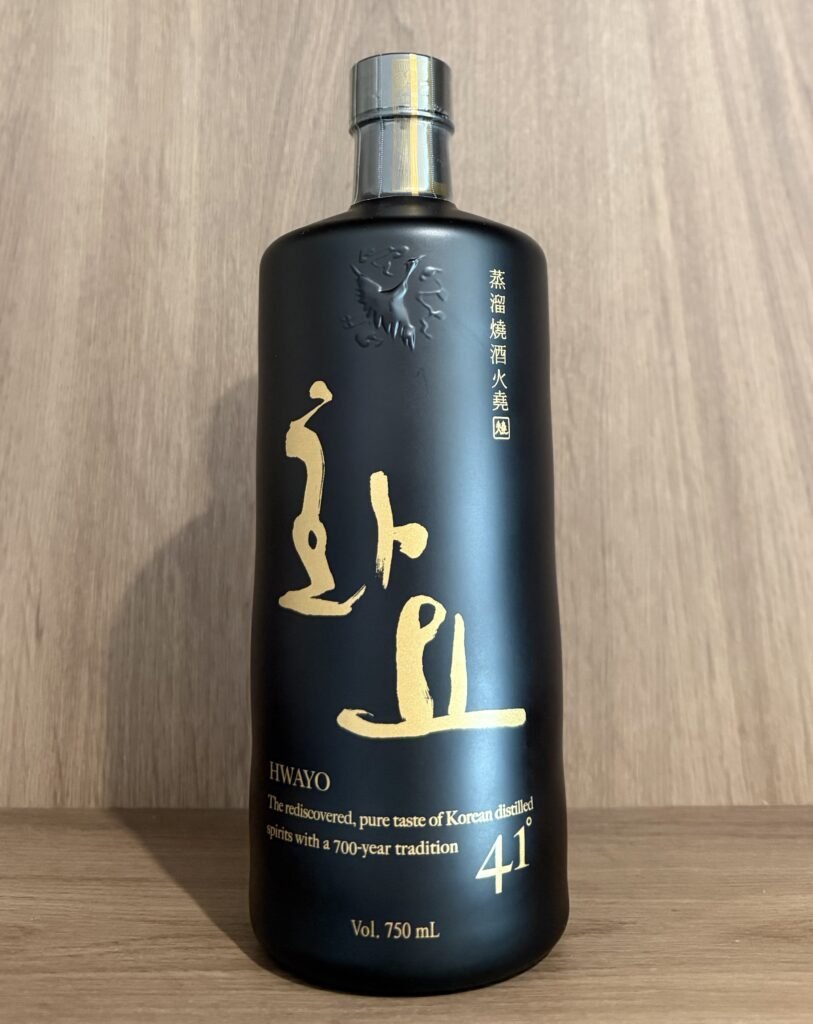
Hwayo was founded in 2003 and began releasing premium distilled soju in 2005. It used Korean rice, adopted vacuum distillation, and later expanded into oak-aged products. Hwayo’s own manufacturing guide still highlights 100% Korean rice, vacuum distillation, pure cultured microorganisms and long maturation as core parts of its process.
In other words, Hwayo was already trying to modernize distilled soju nearly two decades before the 2022 boom.
Then came Won Soju.
Won Spirits launched its first Won Soju product in February 2022. On July 12 that year, its second product, Won Soju Spirit, launched through GS25 convenience stores.
By September 12, exactly two months later, Won Soju Spirit had passed one million bottles sold and KRW 10 billion in sales at GS25. During July and August, GS25’s distilled-soju sales rose 1,281% year over year, according to GS25 figures reported by Newsis.
That does not mean Won Soju created the category.
Won Soju did not create the category, but it became one of the most visible symbols of its sudden expansion.
The more important question is what producers began doing after consumers started paying attention.
Rice Is Becoming Part of the Identity
For years, the premium message around Korean distilled soju was relatively simple:
Made with 100% Korean rice.
Now the question is starting to change.
Which rice?
HiteJinro says it jointly evaluated the brewing characteristics of a new rice variety developed by Korea’s National Institute of Crop Science and selected it for use in distilled soju.
The variety, Juhyangmi, was filed for trademark use under the name Ilpoom Jinro Rice, and HiteJinro worked with farms in Hongcheon, Gangwon Province, on trial cultivation. The company said the variety was selected for its fermentation and aroma characteristics. The project was reported in detail by The Korea Economic Daily, while the National Institute of Crop Science later confirmed its ongoing collaboration with HiteJinro on Juhyangmi and premium distilled spirits.
That may sound like a small distinction, but it marks a meaningful shift.
Once producers start talking about rice varieties rather than simply “rice,” the ingredient itself becomes part of the spirit’s identity.
That kind of specificity is normal in wine, sake or whisky. It is much newer in the way Korean soju is marketed. The raw material is no longer just something that produces alcohol. It becomes part of the story producers want consumers to taste.
There is also a broader agricultural reason for this interest. Korea’s Rural Development Administration has estimated that if traditional distilled soju grew to account for 10% of the domestic soju market, it could create annual demand for roughly 36,000 tons of Korean rice. That figure is a theoretical potential, not an actual result, but it helps explain why agricultural institutions are interested in the category. The estimate was reported when the agency introduced new rice-fermentation and yeast technology for distilled soju in 2020 (Electronic Times).
Fermentation Is No Longer Just a Hidden Process
The differences do not stop with rice.
Traditional nuruk, cultivated rice fermentation starters, commercial yeasts and controlled fermentation systems can all lead producers toward different styles.
Hwayo, for example, does not simply follow a traditional wheat-nuruk model. Its official manufacturing process emphasizes pure cultured microorganisms, while interviews with the company have described the move from traditional nuruk toward ipguk, or cultivated starters, as a way to reduce unwanted aromas and improve consistency (ChosunBiz).
The reasoning is practical as much as philosophical.
Fermentation is difficult to keep perfectly consistent from batch to batch. If microbial activity varies too much, the flavor can change with it. A more controlled system gives producers more consistency and makes it easier to design a cleaner house style.
That means fermentation is no longer just something that happens before distillation.
Producers are beginning to treat fermentation as a style decision, not just a step before distillation.
That does not make one approach automatically better than the other.
One producer may want to preserve more of the earthy, grainy or fermented character associated with traditional methods. Another may want greater consistency and a cleaner profile.
Both are making deliberate choices.
Distillation Changes the Style
The same is true of distillation.
At a basic level, one important distinction is between atmospheric-pressure distillation and vacuum distillation.
Atmospheric distillation generally operates at higher temperatures. It can preserve heavier aromas from the mash and fermentation, including more pronounced grain or nuruk character.
Vacuum distillation lowers the boiling point by reducing pressure. That allows distillation at lower temperatures and can produce a cleaner, lighter spirit with fewer heavy cooked or burnt notes.
Hwayo specifically describes vacuum distillation as a way to distill at lower temperatures and produce a cleaner, clearer taste.
Neither method is automatically better.
The choice reflects what the producer wants the spirit to become.
The still and the pressure used in distillation help shape what ends up in the glass.
That is a very different way of thinking about soju from the mass-market model, where brand differences have historically been much narrower.
Then Some Distilled Soju Goes Into Oak
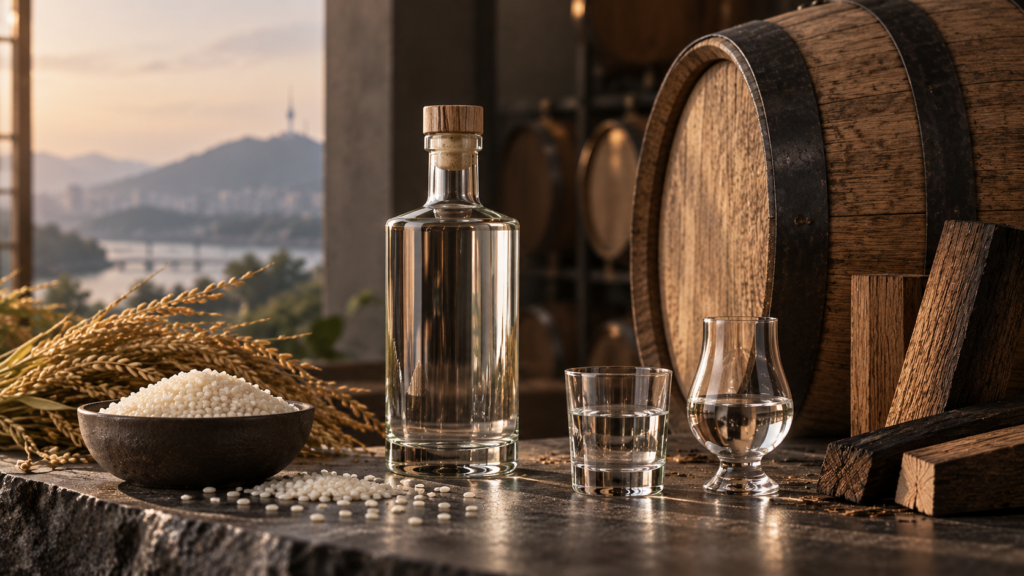
This is where the boundaries become especially interesting.
Hwayo X.Premium starts as a distilled spirit made from Korean rice and is matured in oak for an extended period.
In 2020, Hwayo announced that X.Premium would be exported to France and sold in Europe as a Korean rice whisky. The company’s European export announcement described it as a whisky made entirely in Korea from Korean ingredients and spirit.
Then, in 2023, Hwayo X.Premium was named World’s Best Grain at the World Whiskies Awards. It was also named Best Korean Grain and a category winner.
Korea’s whisky industry is asking a similar question about identity. Ki One is exploring that through Korean grain, oak and maturation.
So how can a spirit rooted in Korean soju production also compete internationally as whisky?
Because legal and commercial spirit categories are not universal.
Different markets define and label spirits using different rules around raw materials, production methods, maturation and labeling.
The liquid did not suddenly change when it crossed a border.
The category around it did.
This does not mean Korean soju is “turning into whisky.” That would be too simple.
What it shows is that some Korean distilled spirits are now being made in ways that stretch far beyond the image most people still associate with the word soju.
There Isn’t One Distilled Soju Revival
It is also misleading to describe all of this as one unified revival of traditional soju.
One useful way to understand today’s market is to see three different lineages developing alongside each other.
The first is the heritage lineage.
This includes traditions such as Andong soju, where preserving regional identity, inherited production methods and recognized master lineages is central to the product’s meaning.
The second is the premium industrial lineage.
Hwayo and Ilpoom Jinro fit more comfortably here. These brands are less about recreating a protected historical method and more about applying modern quality control, consistency and product development to build a premium distilled-spirit market.
The third is a newer craft-distillery lineage.
Smaller producers have begun experimenting with regional grains, different fermentation systems, imported stills, alternative raw materials and new approaches to maturation.
These are not three versions of the same revival.
They are three different answers to what Korean distilled spirits should become.
That distinction matters.
Calling all of them “traditional soju” may sound convenient, especially outside Korea, but it hides the fact that they are pursuing very different goals.
One is trying to preserve something. Another is trying to refine it for a modern market. A third is trying to invent something new.
So Is This Still Soju?
Twenty years ago, the premium question was whether Koreans would pay more for distilled soju.
Today, the more interesting question is how different those spirits can become while still sharing the same name.
Rice varieties are becoming part of product identity. Fermentation systems are being chosen deliberately. Distillation methods are shaping house style. Oak aging is pushing some products across international category boundaries. And producers with very different ideas about tradition, consistency and experimentation are all working under the broad umbrella of soju.
At this point, the more interesting question is not whether distilled soju is back.
It is how many different kinds of it Korea is willing to make.
What Happens After the Boom
There is still a reality check.
Distilled soju remains a small part of Korea’s overall alcohol market.
The sharp growth of 2022 did not continue indefinitely. Growth slowed, and shipment volume declined slightly in 2023 and 2024.
Premium alcohol is also sensitive to economic conditions, and there is no guarantee that every new craft producer or premium label will survive.
But the market has not simply gone back to where it was. It is still much larger than it was before 2022.
More importantly, the differences between products are becoming more real. Rice variety, fermentation, distillation and maturation are no longer just technical details hidden behind the label. They are increasingly becoming part of how producers define the spirit itself.
That may matter more than whether distilled soju keeps growing at double-digit rates.
The next chapter of Korean soju may not be about making more of it.
It may be about deciding how many different kinds of soju Korea wants to make.