Can Makgeolli Go Global? The Problem Is What Makes It Special
Makgeolli exports have already had their international moment.
In 2011, South Korea exported more than $52 million worth of the cloudy rice drink, and Japan accounted for over 90% of it. It looked like the start of something much bigger. By 2025, makgeolli exports had fallen to $14.27 million, less than a third of the peak. That is an odd result for a country whose food, music, and popular culture have become familiar around the world.
Awareness is not the main obstacle. Some of the qualities that make makgeolli distinctive also make it hard to produce, transport, and introduce to unfamiliar drinkers. Korean breweries are now responding in three different ways. Some adapt their products for overseas markets. Others export the existing product under carefully controlled conditions. In New York, one brewery makes the drink locally.
None of these has proved to be the answer. Together, though, they suggest that makgeolli’s next international chapter may look very different from its first.
The first boom
The First Makgeolli Boom Was Mostly a Japanese Story
In the late 2000s and early 2010s, makgeolli became fashionable in Japan. The Korean Wave introduced the drink to a wider audience, particularly younger consumers, and makgeolli was promoted as a relatively low-alcohol drink associated with fermentation and wellness. According to trade figures reported by Yonhap News Agency, exports reached about $52.74 million in 2011, with Japan accounting for 91.8% of the total.
It was a real success with an obvious weakness: almost all the demand came from one country. When the Japanese market cooled, the effect was quick. Total exports fell to about $36.89 million in 2012 and $18.86 million in 2013. Yonhap’s 2014 report on declining exports and its analysis of Japan’s shrinking share point to several causes rather than one: changing drinking preferences, a weaker yen, cooler Korea-Japan relations, and the fading of the early Korean Wave enthusiasm. The industry had found a large audience abroad without building an equally broad market.
The years since have brought new markets, new producers, and more varied products, yet the headline figures remain modest. Data from the Korea Agro-Fisheries & Food Trade Corporation (aT), cited by Herald Business, put exports at $15.68 million in 2022 and $14.27 million in 2025, a 3.1% decline from 2024. Japan was still the largest destination in 2025.
A second export boom has not arrived, but the totals do not show what is changing. For that, it helps to look at what breweries are actually doing.
The product
The Drink That Makes Exporting Complicated
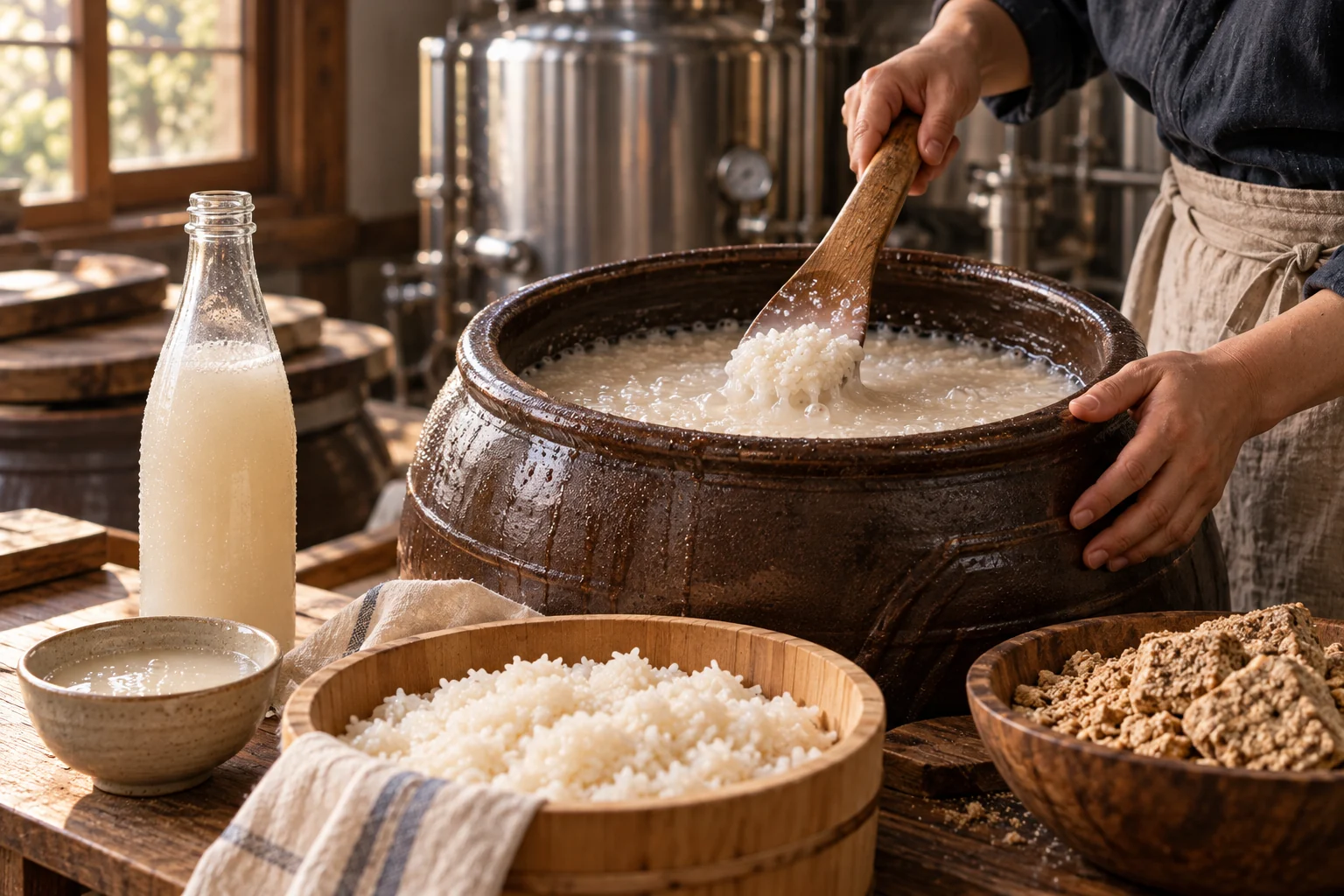
Makgeolli is made by fermenting rice with water and nuruk, a traditional Korean fermentation starter containing enzymes and microorganisms. There is no single flavor. Some bottles are sweet and lightly sparkling. Others are dry, tart, rich, or considerably stronger than the inexpensive bottles common in Korean supermarkets. If the drink is new to you, our guide to what makgeolli actually is explains how it is made and why the styles differ.
One distinction matters most once makgeolli leaves Korea: whether it has been pasteurized. Unpasteurized makgeolli can contain living microorganisms, and fermentation-related changes may continue after bottling. How stable it is depends on the product and the production process, but temperature control can be critical.
Kimchi works in a similar way. It keeps fermenting after it is made, which is part of why Korea built a refrigerator to manage it. Our piece on how Koreans use kimchi at every stage of ripeness explains that clock.
For a brewery exporting this kind of makgeolli, the journey does not end when the container leaves the port. There is refrigerated transport, time in transit, storage at the importer, delivery to shops and restaurants, and the conditions in which the customer keeps the bottle. Each stage adds cost and risk. Pasteurization and other stabilization methods make distribution easier, but they may also change the finished drink’s character.
That leaves breweries with a commercial decision: how much to adapt makgeolli for overseas sale, and how much of the original product to preserve. The answers are not the same.
Approach one
One Approach: Make Makgeolli for Overseas Consumers
Jipyeong Brewery is one of the producers developing makgeolli with international markets in mind. In April 2026, it introduced matcha and lychee makgeolli overseas, targeting the United States, Japan, and Southeast Asia. Both contain 5.6% alcohol. The flavors were designed to appeal to people used to matcha lattes and fruit-flavored drinks, while keeping some of makgeolli’s original texture. The products reached Korean shelves in July, a reversal of the usual export story: drinks developed for overseas markets found their way back home. (Asia Business Daily, July 2026)

Jipyeong has also been expanding its distribution. In December 2025, the company said its export destinations had grown from seven countries to 15, and that overseas sales had risen by about 540% compared with the previous year. (Asia Business Daily, December 2025) These are company-reported results, the report did not disclose the starting sales figure, and they do not describe growth across the Korean makgeolli industry as a whole.
Even so, Jipyeong shows one way forward. A brewery does not have to assume that a drink developed for Korean consumers will suit another market. It can develop different flavors, adjust its lineup, and respond to local drinking habits. For some producers, making makgeolli travel means making a different makgeolli for the journey.
Approach two
Another Approach: Don’t Change the Makgeolli
Bewater Brew takes the opposite view. The small craft brewery, based in Sangju, North Gyeongsang Province, makes its INNER PEACE range from locally grown organic rice and nuruk, without artificial additives. It also exports to Singapore. We have written before about Bewater Brew and the ideas behind its craft makgeolli.
For this story, K-Actually asked the brewery what it had changed for the overseas market. The answer was short: nothing. According to Bewater Brew, the makgeolli exported to Singapore is the same as the one sold in Korea. It is not reformulated for export. It travels in refrigerated containers kept at about 2°C.
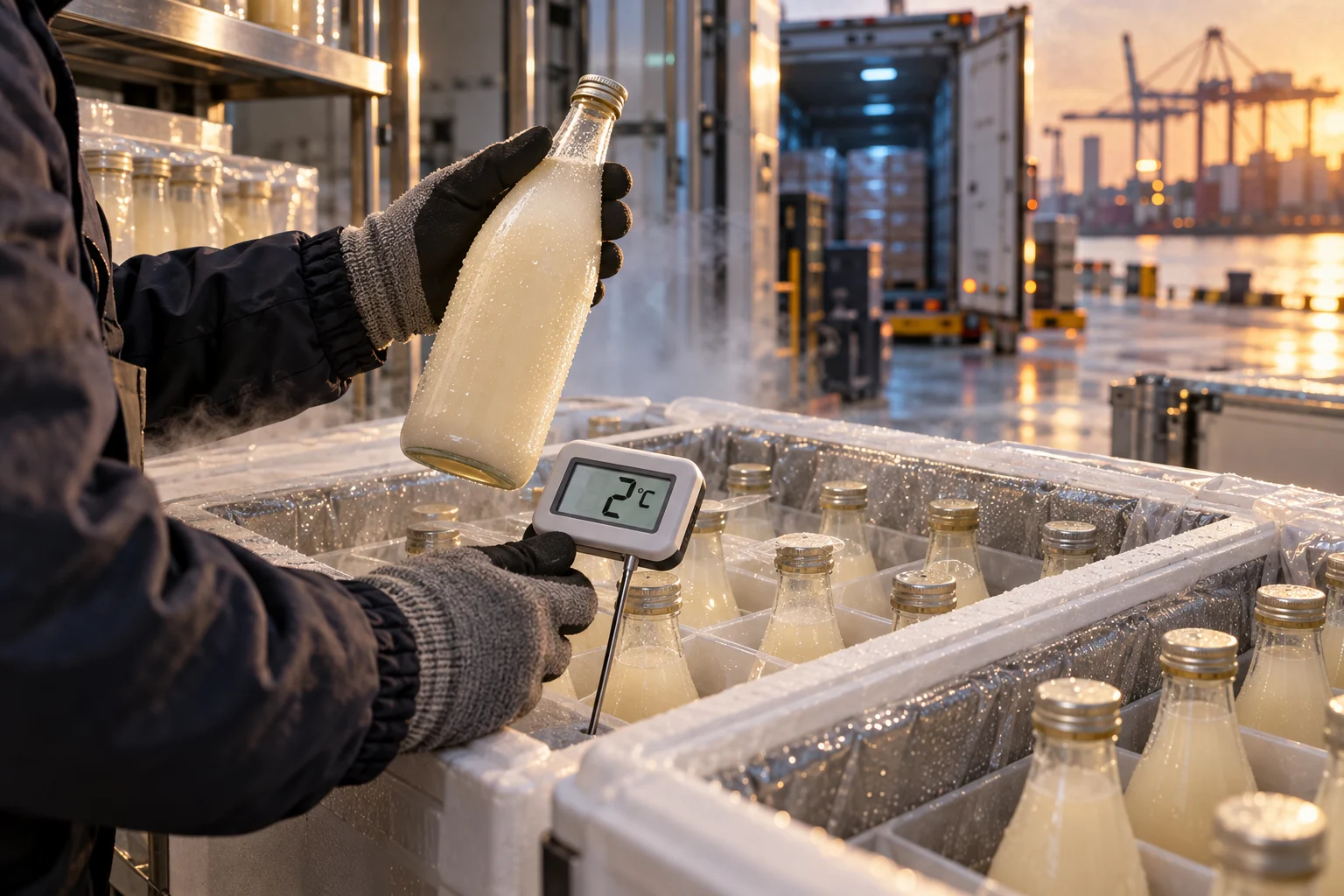
That adds a logistical requirement instead of removing one. The brewery has chosen to preserve the product and manage the conditions needed to move it. This will not suit every producer, price point, or destination, since refrigerated distribution costs more and depends on reliable partners beyond the brewery. But it shows that going abroad does not always mean changing the drink. Sometimes the supply chain has to adapt to the makgeolli.
Source: Direct written correspondence between Bewater Brew and K-Actually, October 2026.
The market
Getting the Makgeolli Overseas Is Only Half the Job
Bewater Brew’s makgeolli sells for considerably more in Singapore than it does in Korea, and there are ordinary reasons for that. Singapore imposes duties on alcoholic beverages, and imports also carry a 9% Goods and Services Tax (GST). Transportation, handling, and distribution add more, and refrigerated shipping and storage add further to that. This applies to imported alcohol in general, not only to makgeolli. Bewater Brew’s own cost breakdown is not public.
Singapore is also a relatively affluent market. According to the Singapore Department of Statistics, median monthly household market income among resident households was SGD 12,446 in 2025. That does not mean everyone can afford premium imported alcohol. Household income is not disposable income, and national statistics cannot tell us who buys craft makgeolli. But a high-income consumer segment, an established market for imported alcohol, and a scene of specialist restaurants leave room for premium products.
Bewater Brew’s experience shows how that plays out. At a tasting and sales event in Singapore, the brewery found that some customers were willing to pay a premium for Korean craft alcohol. The less expected problem was acidity. According to the brewer, certain customers were less comfortable with the sourness in its makgeolli, and even citrus-like acidity could draw complaints, while sweetness was accepted more readily.
This was not a formal consumer study, and one brewery’s experience cannot speak for everyone who drinks in Singapore. Still, it points to a challenge that transport and pricing cannot solve. Someone can appreciate the story of Korean craft alcohol, accept its premium positioning, and still find the flavor hard to enjoy. A bottle can arrive in perfect condition and still not be understood by the person drinking it.
Selling the Drink Means Explaining It
Bewater Brew found itself explaining things an experienced Korean drinker might already take for granted: what nuruk is, why the drink has acidity, how unpasteurized and pasteurized makgeolli differ, and what it means for a brewery to avoid additives. It also suggested pairings with local Singaporean food, instead of relying only on familiar Korean dishes.

According to the brewery, its products are distributed in Singapore through an exclusive arrangement with The Sool Company, a specialist in Korean traditional alcohol, and restaurants including NAE:UM and ODEM are among its customers. ODEM, a Korean craft makgeolli bar and restaurant, independently lists Bewater Brew among its featured breweries; its concept centers on small-batch Korean drinks served with food chosen to complement them. (See Sool Cellar’s Bewater Brew listing and ODEM’s profile.)
Places like these suit an unfamiliar drink. A specialist restaurant can explain what makes a bottle unusual, suggest what to eat with it, and help someone understand the flavors before they decide whether to buy it again. The brewery also saw interest from younger, relatively affluent customers who had visited Korea or already cared about Korean culture. For them, makgeolli was not entirely new. Some had tried it while traveling and wanted to find it again closer to home.
That points to a distinction the export figures cannot capture.
Getting someone to try makgeolli is one thing. Giving them a reason to come back to it is another.
Source: Direct written correspondence between Bewater Brew and K-Actually, October 2026.
Approach three
What If Makgeolli Doesn’t Have to Come from Korea?
There is another route for makgeolli, and it does not start with a shipping container. It starts in Brooklyn.
Hana Makgeolli, founded by Korean American brewer Alice Jun, began commercial production in New York in 2020. Jun learned about brewing from her father and developed a style of Korean rice wine shaped by both her family background and her life in the United States. Her Takju 16 Dry is a good example. According to Jun, it is fermented for 28 days and made with organic rice from a family farm in California, nuruk from Korea’s Jeolla Province, and New York water. It is a Korean-style rice wine made in America from Korean brewing knowledge and local ingredients.

In April 2025, Hana was introducing its Brooklyn-brewed Takju 16 Dry to consumers in Korea. The drink had made a round trip: a Korean brewing tradition carried to the United States, turned into a commercial product there, and brought back to Korean drinkers. (The Korea Times, April 2025)
Hana raises a different kind of question. If makgeolli is brewed in New York with American rice, is it still makgeolli in the same sense as a bottle made in Korea? How much of its identity rests on ingredients, methods, geography, or the people making it? Many foods and drinks with strong regional origins end up developing traditions in other countries, so the question is not unique to Korean alcohol.
Hana does not prove that local production works commercially in every overseas market. It is one brewery with its own customers, style, and cultural context. But it challenges the idea that makgeolli’s international future depends entirely on bottles exported from South Korea. The knowledge and culture behind the drink can travel, too.
The verdict
So, Can Makgeolli Go Global?
Makgeolli has more than one possible route abroad. Jipyeong is developing products for new drinking preferences and overseas markets. Bewater Brew keeps its Korean products as they are and moves them through a refrigerated supply chain to customers willing to try premium craft alcohol. Hana Makgeolli applies Korean brewing traditions in the United States and makes its own interpretations there.
These are not competing definitions of success. They serve different purposes and may reach very different drinkers. The first export boom showed how quickly international interest can grow, and its decline showed the risk of depending so heavily on one country and one wave of enthusiasm. Today’s export totals are much smaller, but the approaches being tested are more varied. Whether any of them produces lasting growth is still uncertain.
What makgeolli needs is people who understand what they are drinking, enjoy the flavor, and have occasions when they want to choose it again. A Korean restaurant may give them the first introduction, and a specialist bar may explain the flavors. A local brewery may make the drink familiar to people who would never otherwise encounter it.
The real measure of success may not be whether someone tries makgeolli because it is Korean. It may be whether they order another glass because they like it.
◆
Read next
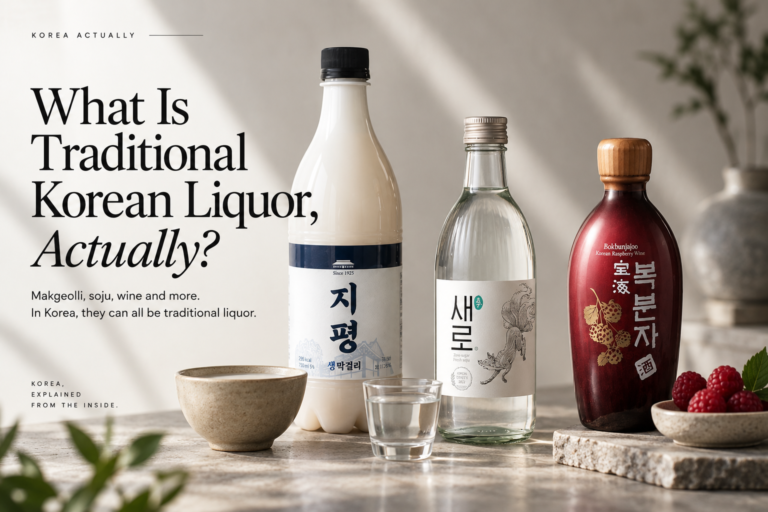
What Is Traditional Korean Liquor, Actually? How Korea defines and classifies its traditional drinks.
Bewater Brew and Korean Craft Makgeolli The ideas behind the Sangju brewery.
References
Sources and Further Reading
Export history and industry data
- Yonhap News Agency: Makgeolli Export Decline, 2014
- Yonhap News Agency: Japan’s Falling Share of Makgeolli Exports
- Herald Business: Makgeolli Export Performance, March 2026
Korean brewery export strategies
- Asia Business Daily: Jipyeong’s International Sales and Distribution
- Asia Business Daily: Jipyeong Matcha and Lychee Makgeolli
- Sool Cellar: Bewater Brew
- ODEM: Bewater Brew
Singapore market context
- Singapore Customs: Dutiable Goods and Alcohol
- Inland Revenue Authority of Singapore: GST on Imports
- Singapore Department of Statistics: Household Income Trends, 2025
Makgeolli brewed outside Korea
Original reporting: K-Actually’s written correspondence with Bewater Brew, October 2026.
Information reviewed: October 2026.