What Ramyeon Means to Koreans: From Food Shortages to the Han River
What ramyeon means to Koreans begins in 1963, when it arrived as a practical wheat-based food at a time when rice and other staples were in short supply. Today people cook it beside the Han River because they want to. Ramyeon did not disappear when Korea became wealthier. The reason Koreans eat it has simply changed.
NowThe Bowl at the River
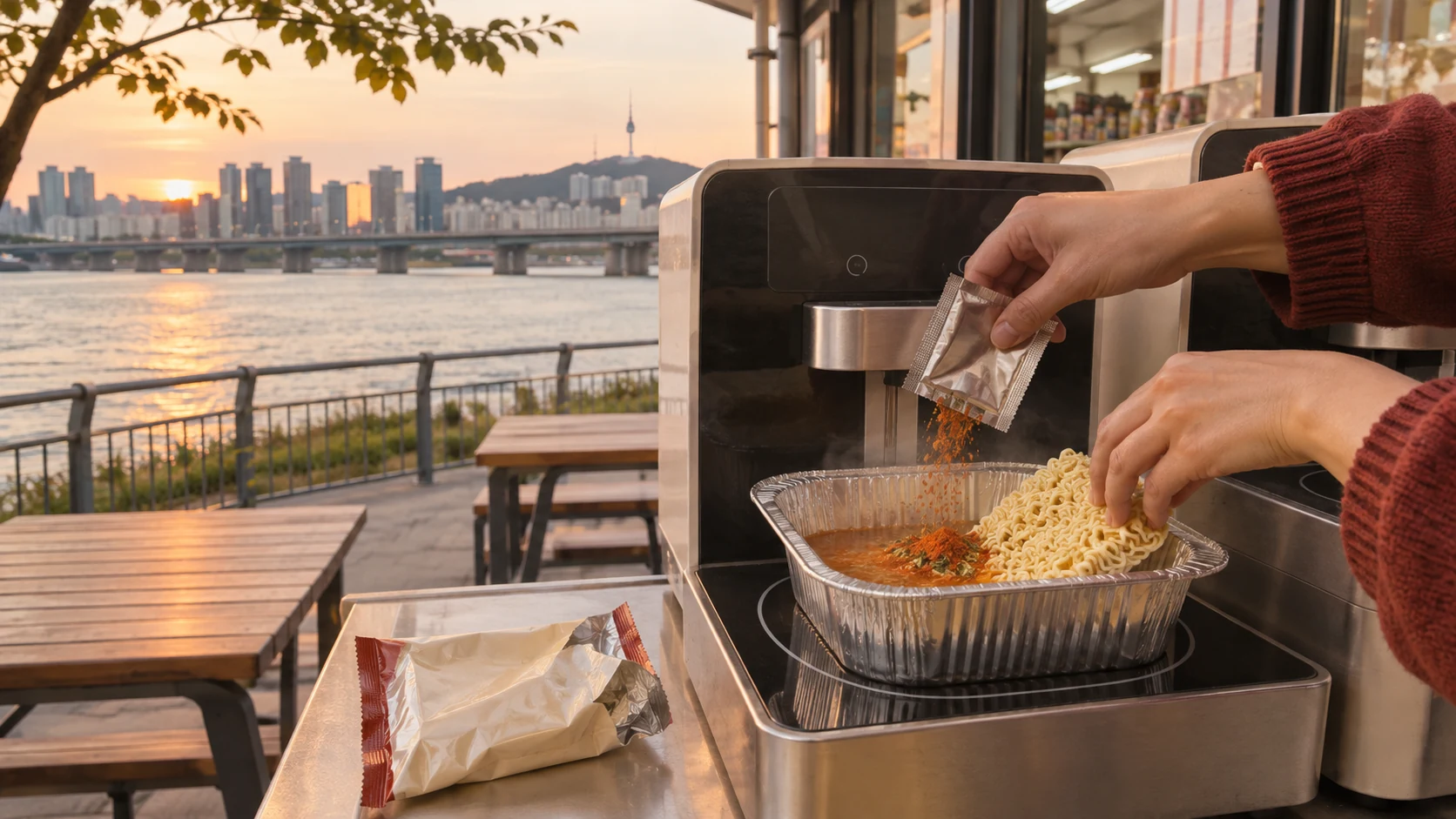
At a convenience store in a Han River park, one of the most common things to buy is a packet of ramyeon. You choose a packet, pay at the counter, and place the noodles and seasoning in a disposable container. A cooking machine adds the water and heats it. When it is ready, you take it outside.
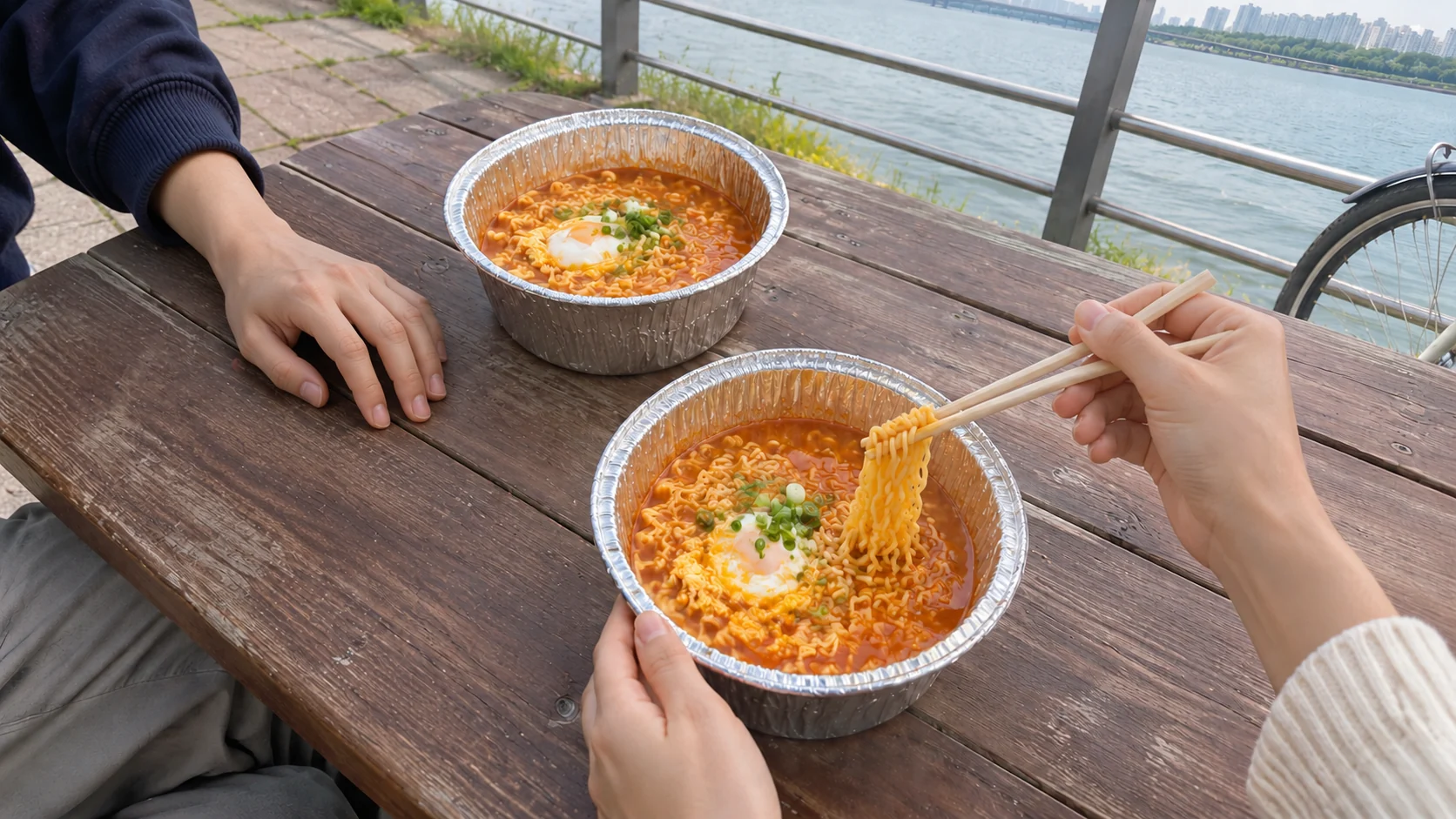
Koreans call this Hangang ramyeon, the Han River ramyeon. For a visitor it looks like a fun piece of Seoul. Seen against its history, the scene carries a quieter contrast: the same food once eaten out of necessity is now chosen as part of an outing.
Today, people cook ramyeon beside the Han River because they want to. In 1963, Korea needed it for a very different reason.
1963The First Bowl
The first ramyeon sold in Korea was Samyang Ramyeon, released in September 1963. Its founder, Chun Joong-yoon, had encountered instant noodles in Japan and saw them as a possible answer to Korea’s food shortages. Samyang imported production equipment and know-how from Japan’s Myojo Foods. One pack cost 10 won.
It did not become a national food overnight. Sales were weak at first, according to the National Archives of Korea, in a country whose meals were built around rice and soup. A fried wheat block with a seasoning packet was an unfamiliar thing to put on the table.
Ramyeon is not a traditional Korean dish. It became a Korean one through use.
1960s – 1970sThe Years of Shortage
No single factor turned ramyeon into an everyday food. The government encouraged, and sometimes required, people to eat more wheat and barley and less rice. In 1964, restaurants were told to mix barley or noodles into what they sold. From 1969, rice-based dishes could not be sold in restaurants between 11 a.m. and 5 p.m. on Wednesdays and Saturdays, a rule known as the day of flour-based meals. It ended in the late 1970s, after rice self-sufficiency was reached.
The National Archives attributes ramyeon’s rise to several factors: the campaign for mixed grains and flour, free tasting events, adjustments to suit Korean tastes, and the plain fact that it was cheap and quick. Any one of them alone is too simple an explanation.
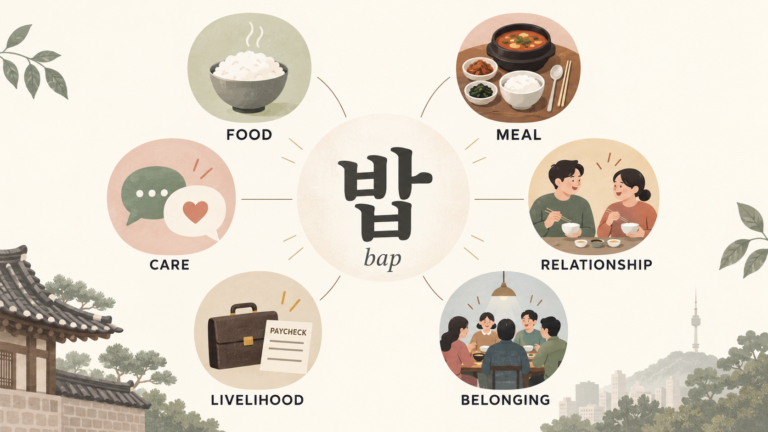
To understand why replacing rice mattered so much, it helps to understand what bap means in Korean life.
It is tempting to call ramyeon a symbol of poverty. A more accurate description is that it was a useful convenience food at a moment when Korea needed one.

TodayThe Everyday Bowl
Once the shortage eased, ramyeon stayed. That is the part that is easy to miss.
Korea led the world in instant noodle consumption per person through 2020, according to the World Instant Noodles Association. Vietnam has ranked first since 2021, while Korea consumed about 79 servings per person in 2024. In total volume, Korea ranked ninth in 2025, at 4.06 billion servings.
Those numbers say how much Korea eats. They do not say why. Part of the answer is how many situations a single packet can fit into: a meal at a convenience store, a pot at home with an egg or kimchi added, or a quick lunch when there is no time for anything else. There is no single ramyeon memory that every Korean shares. That is part of the point. The food stayed in daily life because it fit into so many different parts of it.
1989The Scar
Ramyeon’s history was not a straight line up. On November 3, 1989, prosecutors announced that several food companies had used beef tallow they described as industrial grade in ramyeon and other products. Executives of Samyang and other companies were arrested. The legal case continued for years, until the Supreme Court upheld the defendants’ acquittals in August 1997, eight years after it began.
The episode does not explain what ramyeon means to Koreans. It does show how far ramyeon had already entered daily life by 1989: a question about an everyday food became national news. In November 2025, thirty-six years to the day after the scandal broke, Samyang released a premium noodle called Samyang 1963, fried in beef tallow again.
The Han RiverThe River
The river itself has changed. A 2019 Money Today feature noted that in 1990s television dramas, the Han River often appeared as a place for heartbreak, lost jobs and drinking alone. By the 2000s it had also become a place for families and friends to spend an afternoon.
Neither version replaced the other. The river kept its older meanings and gained a new one.
Ramyeon did something similar. Hangang ramyeon is the name for packet ramyeon cooked in a convenience store machine, a name that grew from its popularity at convenience stores in Han River parks. By 2019, Money Today reported that it was the top-selling item at the major Han River convenience stores.
Here, ramyeon is not merely the fastest way to fill an empty stomach. Choosing and cooking it is part of the outing.
The packet is familiar. What changed is the occasion.
2023 – 2026The Loop
The habit kept growing. CU opened its first ramyeon-focused store, called Ramyun Library, in Hongdae in December 2023. In November 2024, the Korean Cultural Center in New York recreated a Han River convenience store as a pop-up, with cooking machines and Shin Ramyun.
Then, on September 9, 2026, Ottogi released a packaged noodle product called Hangang Ramyeon at convenience stores nationwide, with noodles adapted for cooking machines, an egg block, and Cheongyang chili. The name is printed in Korean, English, Chinese and Japanese.
First, a packet of ramyeon became an experience at the Han River. Then the experience returned to the shelf as a packet called Hangang Ramyeon.

The TakeawayWhat the Packet Holds
The history of Korean ramyeon is not a story about one food replacing another. It is a story about the same food being asked to do different things. First, to fill an empty stomach. Later, to fit into a busy life. And now, sometimes, simply to make an ordinary evening by the river feel complete.
National Archives of Korea: first ramyeon, ramyeon and sales, flour-based meal days. Seoul Metropolitan Government, end of the flour-meal day, 1977.
Samyang Foods, company history. Newsis, Samyang history. Law Times, 1989 beef tallow case and 1997 acquittal. Hankyung, Samyang 1963 launch.
World Instant Noodles Association data via Hankyung, per-person consumption (2024), and Korea Herald, total servings (2025).
Money Today, Han River convenience stores (2019). Korea Times, Ramyun Library. Jack Morton, Han River pop-up in New York. Ottogi, Hangang Ramyeon launch release.