How to Buy Medicine in Korea as a Tourist
You’re back at your hotel in Seoul after a long day of sightseeing. It’s 10 PM, your head hurts, and you’ve run out of painkillers. The pharmacy down the street has closed, but there’s a 24-hour convenience store around the corner.
Can you buy medicine in Korea at a store like that?
The short answer
Yes, but only certain kinds.
Some Korean convenience stores sell a short list of basic medicines. Anything beyond that list comes from a pharmacy, called a yakguk (약국). Prescription medicine requires a doctor’s visit first.
This guide explains how to buy medicine in Korea: how to find an open pharmacy, what the convenience-store list includes, and what to do if you don’t speak Korean.
Start here
First, Where Should You Go?
If it’s an emergency
If someone has severe difficulty breathing, significant chest pain, signs of a stroke, loss of consciousness, or a severe allergic reaction, call 119 immediately. Don’t spend time searching for medicine.
The Korea Tourism Organization’s 1330 Travel Helpline offers interpretation help and can connect you with other services, including emergency services.
Finding one
1. How to Find a Pharmacy in Korea
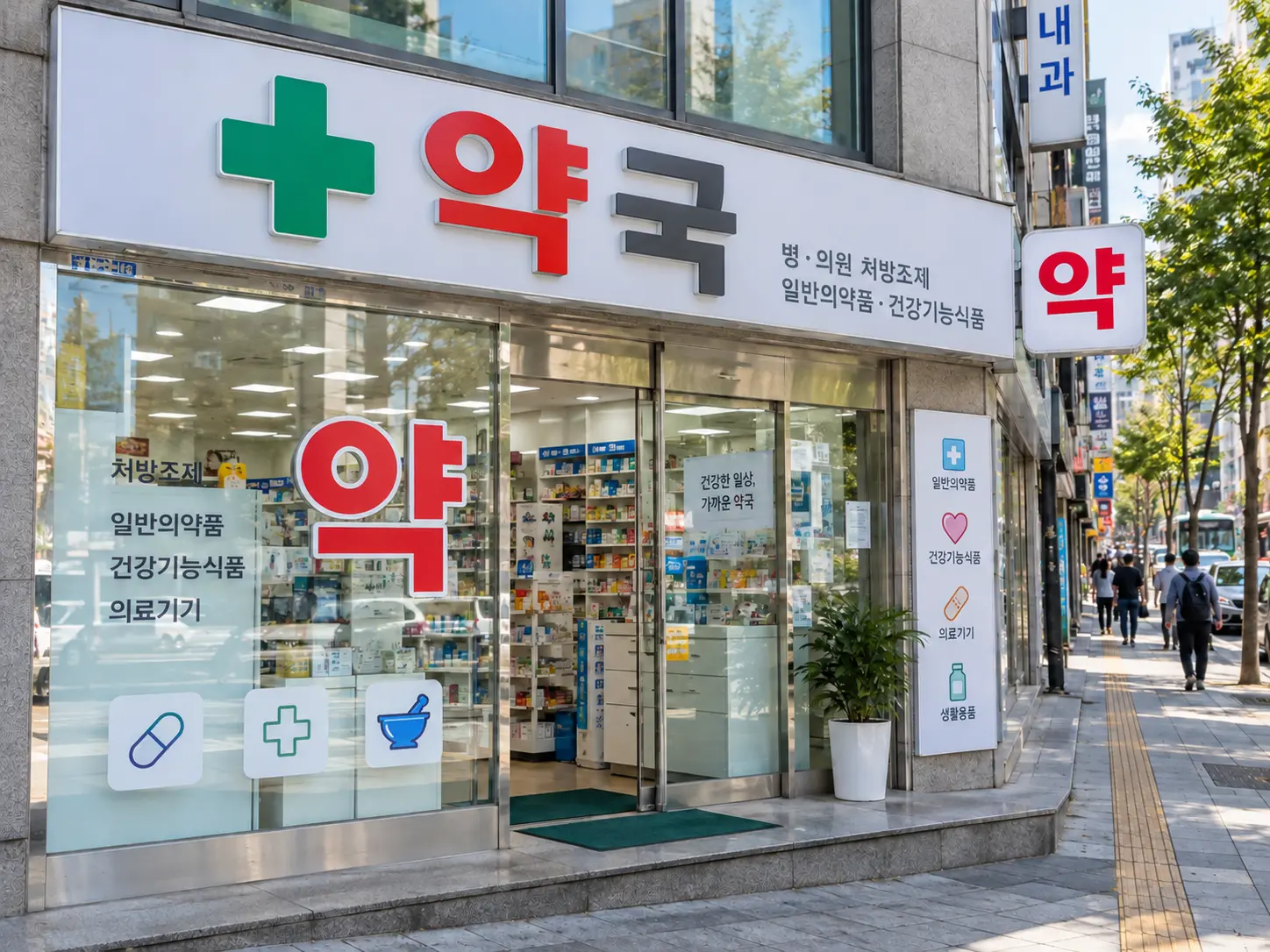
Look for the word 약국 (yakguk) on signs. If you need one nearby, open Naver Map or KakaoMap and search in Korean rather than English.
You can copy these straight into your map app.

Two more ways to find an open pharmacy
Pharm114 is run by the Korean Pharmaceutical Association. It lets you search pharmacies by area, including those open on holidays and late at night. The site is mostly in Korean, so use your browser’s translation feature and keep the Korean name of your neighborhood handy.
E-Gen is the government’s emergency medical information site. It lists pharmacies, clinics, hospitals and emergency rooms. Search works best with Korean place names.
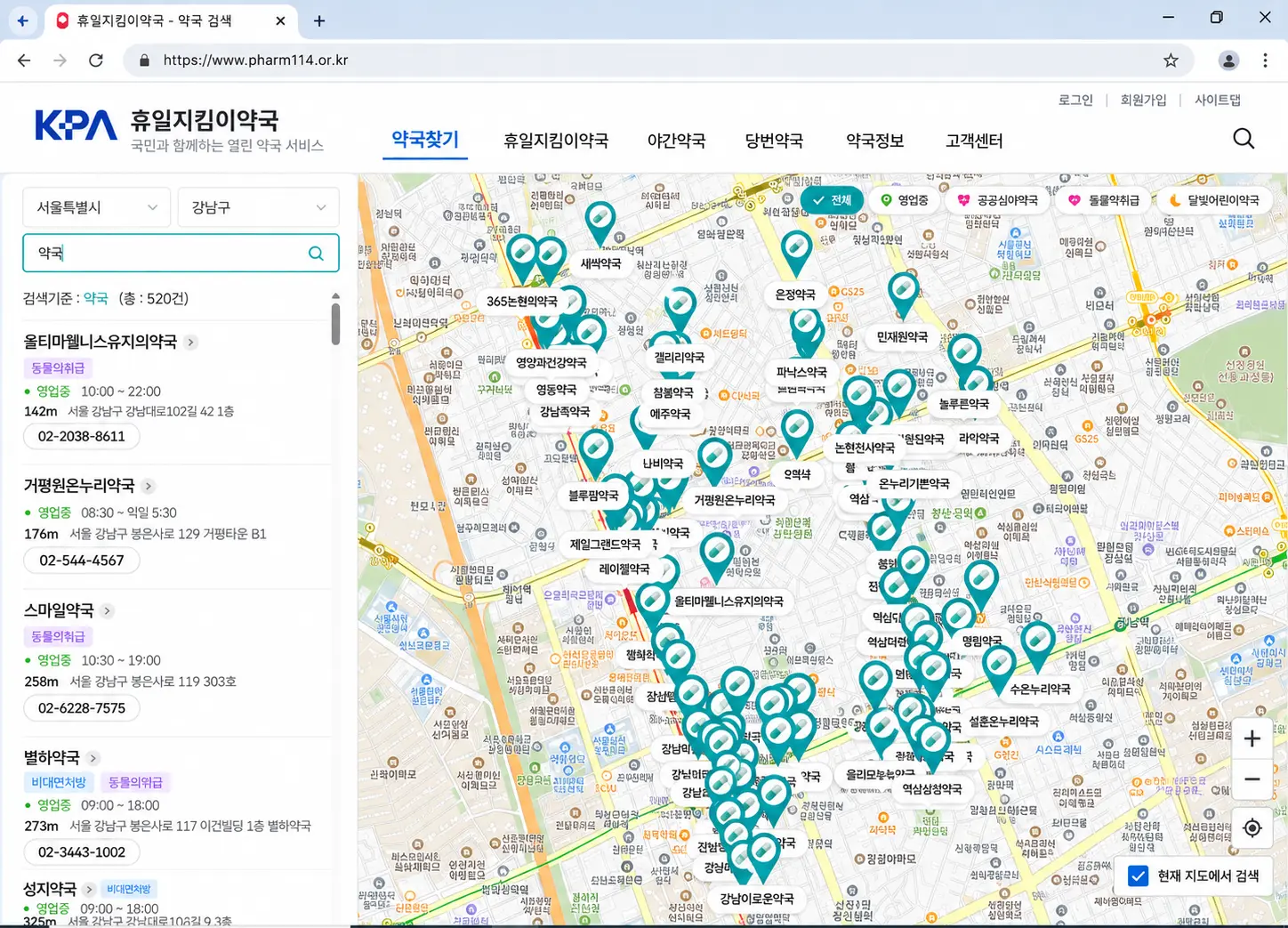
Whichever you use, confirm the opening hours and call the pharmacy if you can. Maps go out of date, especially on Sundays, public holidays and late at night.
The convenience store
2. Can You Buy Medicine at a Korean Convenience Store?
Yes, within limits. Convenience stores can sell only a short list of designated non-prescription medicines, known as 안전상비의약품. They exist to give people basic self-care options when a pharmacy isn’t within reach.
Not every CU, GS25 or 7-Eleven sells them. The store has to operate 24 hours a day, all year, and be registered with the local government as a designated-medicine seller.

What medicines are available?
As of October 2026, the designated list has 13 products. Two of them, Tylenol 160 mg and Children’s Tylenol 80 mg tablets, have been discontinued, so 11 remain on the market.
A registered store doesn’t necessarily stock every item on the list.
What you can’t buy at a convenience store
Adult ibuprofen tablets, aspirin, antihistamines and anti-diarrheal medicines are not on the designated list. If you need one of these, go to a pharmacy.
Tylenol 500 mg is the only adult oral pain and fever reliever on the list. Children’s Brufen syrup contains ibuprofen, but adult ibuprofen tablets aren’t sold at convenience stores.
A convenience-store employee isn’t a pharmacist. If you’re unsure which medicine fits your symptoms, ask at a pharmacy.
Two purchasing rules
- You can buy only one package of the same medicine per transaction.
- Stores can’t sell these medicines directly to children under 12 or elementary school students, so an adult has to make the purchase. Even then, check the age, weight and dosing instructions on the label.
The list may change
The Ministry of Health and Welfare has said it aims to expand the list by the end of 2026, to as many as 20 products. Pharmacist organizations oppose the expansion, and the ministry has said it will first review sales practices and compliance with the current rules.
As of October 2026, nothing has taken effect. Check the official list before relying on this one.
The pharmacy
3. What Can You Buy at a Pharmacy Without a Prescription?
A Korean pharmacy carries a much wider range than a convenience store. Depending on the product, you may find over-the-counter treatments for:
- Headaches and fever
- Cold symptoms
- Indigestion and stomach discomfort
- Motion sickness
- Allergies
- Minor skin problems
A medicine that treats one of these conditions may still require a prescription. The rules depend on the medicine’s ingredients, strength and Korean regulatory classification.
Bring the ingredient name, not just the brand
If you can’t find your usual brand, show the pharmacist the active ingredient and strength instead. The ingredient called acetaminophen in the United States is paracetamol in the UK and many other countries. Same ingredient, different name.
A matching ingredient still isn’t a reason to swap products on your own. Confirm the formulation, dose and suitability with the pharmacist.
If you take other medication, show the pharmacist what you’re taking before buying anything new. Combination cold medicines are the usual trouble spot, because they can contain an ingredient already present in another medicine you use.
After hours
4. What If You Need Medicine Late at Night?
Not all Korean pharmacies close in the early evening. Some belong to the public late-night pharmacy system, known as 공공심야약국, and offer medicine sales and pharmacist consultations outside normal hours.

Depending on the area, a participating pharmacy may stay open until midnight or around 1 AM. Hours vary by location and day, so don’t count on any of them being open 24 hours.
After regular pharmacy hours, start by checking Pharm114 or E-Gen for an open pharmacy, then verify its hours before you travel there. If none is open, a registered convenience store may carry one of the designated medicines listed above. If you need medical attention rather than an over-the-counter product, look for a clinic or hospital that is operating.
A closed pharmacy alone isn’t a reason to go to an emergency department. Base that decision on how serious your condition is. For a medical emergency, call 119.
Traveling with children?
Korea has an after-hours pediatric care program called 달빛어린이병원 (Moonlight Children’s Hospital). Designated facilities treat children with non-emergency conditions during certain evening, weekend and holiday hours. Availability varies by region, and E-Gen can help you find participating locations.
If your child has severe or potentially life-threatening symptoms, seek emergency care instead of waiting for an after-hours clinic.
Asking for help
5. How to Ask a Korean Pharmacist for Help
You don’t need fluent Korean at a pharmacy, but not every pharmacist speaks English. A translation app helps, and so do a few saved phrases you can show on your phone.
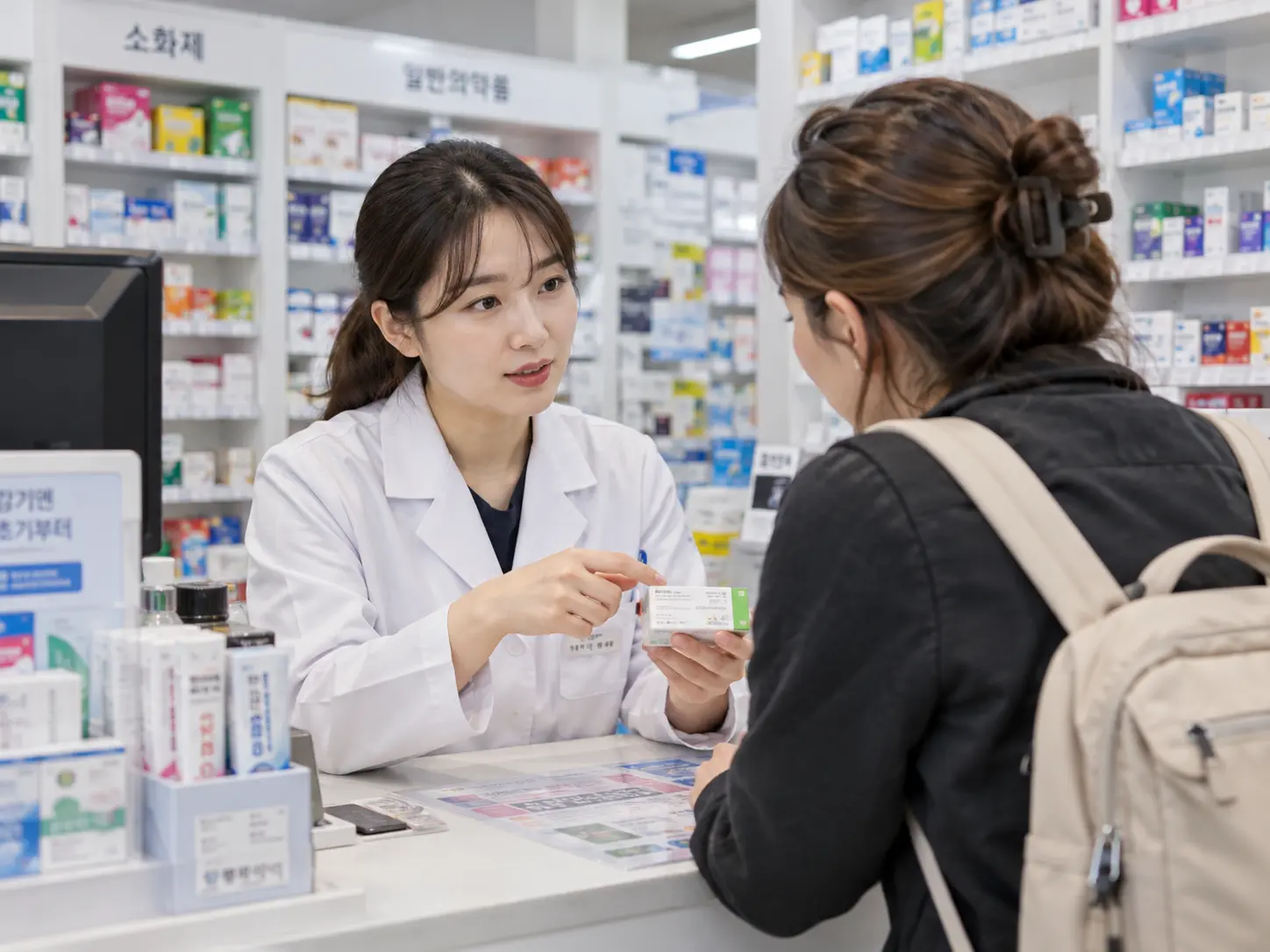
A photo of the medicine you normally take, with its ingredient list visible, also helps. Tell the pharmacist how long you’ve had symptoms, what you’ve already taken, and any allergies. Before you leave, make sure you understand the instructions.
Phone help in your language
The Korea Tourism Organization runs the 1330 Korea Travel Helpline for travel information and interpretation in eight languages, including English. Call 1330 within Korea, or use the free online voice call on Wi-Fi or a chat app (KakaoTalk, WhatsApp, Line, Facebook or 1330 Messenger). It can connect you with other services, but it doesn’t diagnose illness and can’t replace a pharmacist or doctor. Check the official page for current hours.
The Korea Disease Control and Prevention Agency runs 1339, a 24-hour call center for disease information and infectious disease questions. Foreign visitors staying in Korea can be connected through a three-way call with 1330 or 1345, the Ministry of Justice’s immigration contact center. It isn’t a substitute for a pharmacist or emergency care. If you’re in immediate danger, call 119 first.
Prescriptions
6. What If You Need Prescription Medicine?
Some medicines can’t be sold without a prescription in Korea. The usual route is:
| 1 | Visit a clinic or hospital. |
| 2 | Explain your symptoms and medical history. |
| 3 | Receive a prescription if the doctor thinks it’s appropriate. |
| 4 | Take the prescription to a pharmacy to have it dispensed. |
Short-term tourists aren’t automatically covered by Korea’s National Health Insurance. Without applicable Korean coverage, expect to pay the provider directly. Your travel insurance may reimburse some expenses, so keep receipts, prescriptions and any other documents your insurer asks for.
Can you use a prescription from home?
Don’t assume a pharmacy in Korea can fill a prescription issued abroad. If you need a prescription-only medicine during your visit, ask a Korean medical provider what they require.
If you take regular medication, plan before you leave. Medicines containing narcotic or psychotropic ingredients need advance approval from Korea’s Ministry of Food and Drug Safety. For other medicines, customs may ask for proof such as a prescription, a doctor’s note or a pharmacy label, so keep them in the original packaging. Check the rules from the Korea Customs Service and the Ministry of Food and Drug Safety before you travel.
Before you take it
7. Before Taking Medicine Bought in Korea
Read the label before you take anything, even if the brand looks familiar. The formulation, strength and instructions can differ from the version sold in your home country. Check:
Accidental duplication is the easiest mistake to make. Some cold medicines contain acetaminophen, and so might the painkiller you’re taking separately. Taking both can mean an excessive dose.
If you can’t understand the instructions, ask a pharmacist before you use the medicine.
The takeaway
Before You Go
Save 약국 on your phone, along with Pharm114, E-Gen and the 1330 number. For routine needs, start at a pharmacy. If it’s late, look for a public late-night pharmacy or a registered convenience store. For a prescription, see a doctor. For a serious emergency, call 119.
◆
Read next
Korea eSIM and SIM card guide. Translation apps and map searches need data, so sort your connection before you land.
Sources
Useful Official Resources
- Pharm114: Holiday and Late-Night Pharmacy Search
- E-Gen: Emergency Medical Information
- 1330 Korea Travel Helpline
- 1339 KDCA Call Center
- Pharmaceutical Affairs Act
- Pharmaceutical Affairs Act Enforcement Rules, Article 28
- Korea Customs Service: Medicines Containing Controlled Substances
- Ministry of Food and Drug Safety: Bringing Controlled Medicines into Korea
Information reviewed: October 2026. Medicine availability, pharmacy opening hours and government regulations can change. This guide provides general information and is not a substitute for professional medical advice.