Why Does Autumn in Korea Feel So Short?
The short answer
Korea’s autumn has become a little shorter, but the bigger change is timing. It now starts later than it used to, while summer has expanded much more dramatically.
A line that shows up in many introductions to Korea is that the country has four distinct seasons. September can still feel more like late summer than fall. The calendar says autumn, the air disagrees, and then sometime in October a cold morning arrives and the coat comes out.
So when does autumn in Korea actually start, and has it really gotten shorter? The answer depends on who is defining the season.
The calendarKorea says September is autumn. The weather is not so sure.
The everyday convention puts autumn in September, October and November. It is the calendar most people use for school terms, festivals and holidays, and it has little to do with temperature.
The numbers show the gap. In the 1991–2020 KMA climate normal, Seoul’s September average temperature is 21.6°C. October drops to 15.0°C. Busan and Jeju stay warmer for longer, at 22.6°C and 23.3°C in September.
A month averaging above 20°C is hard to call cool. That is the first clue that autumn on a calendar and autumn in meteorology do not begin on the same day.
The definitionHow the KMA decides when autumn starts
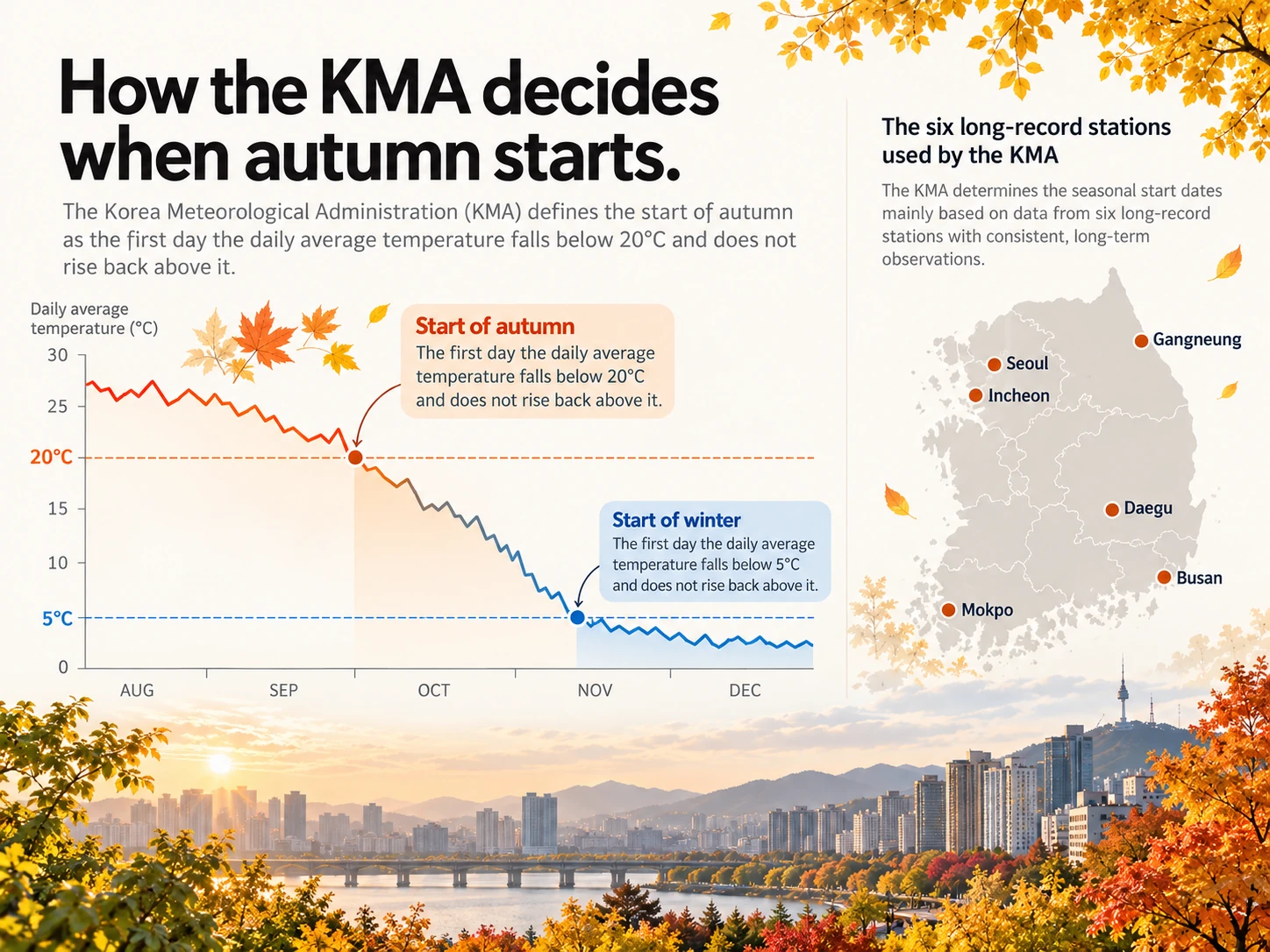
The Korea Meteorological Administration, or KMA, does not use the calendar. It defines autumn as starting on the first day the daily average temperature falls below 20°C and does not rise back above it. Winter starts the same way, with a threshold of 5°C. You can see that definition in the KMA’s climate explainer here.
For long-term comparisons, the KMA uses six stations with unusually long records: Seoul, Incheon, Daegu, Busan, Gangneung and Mokpo. A season date from this method is an average across those six places. It is not the date autumn arrives in your city.
The dataWhat a century of data shows
The KMA’s figures can be read against three different baselines, and they tell different stories if mixed together.
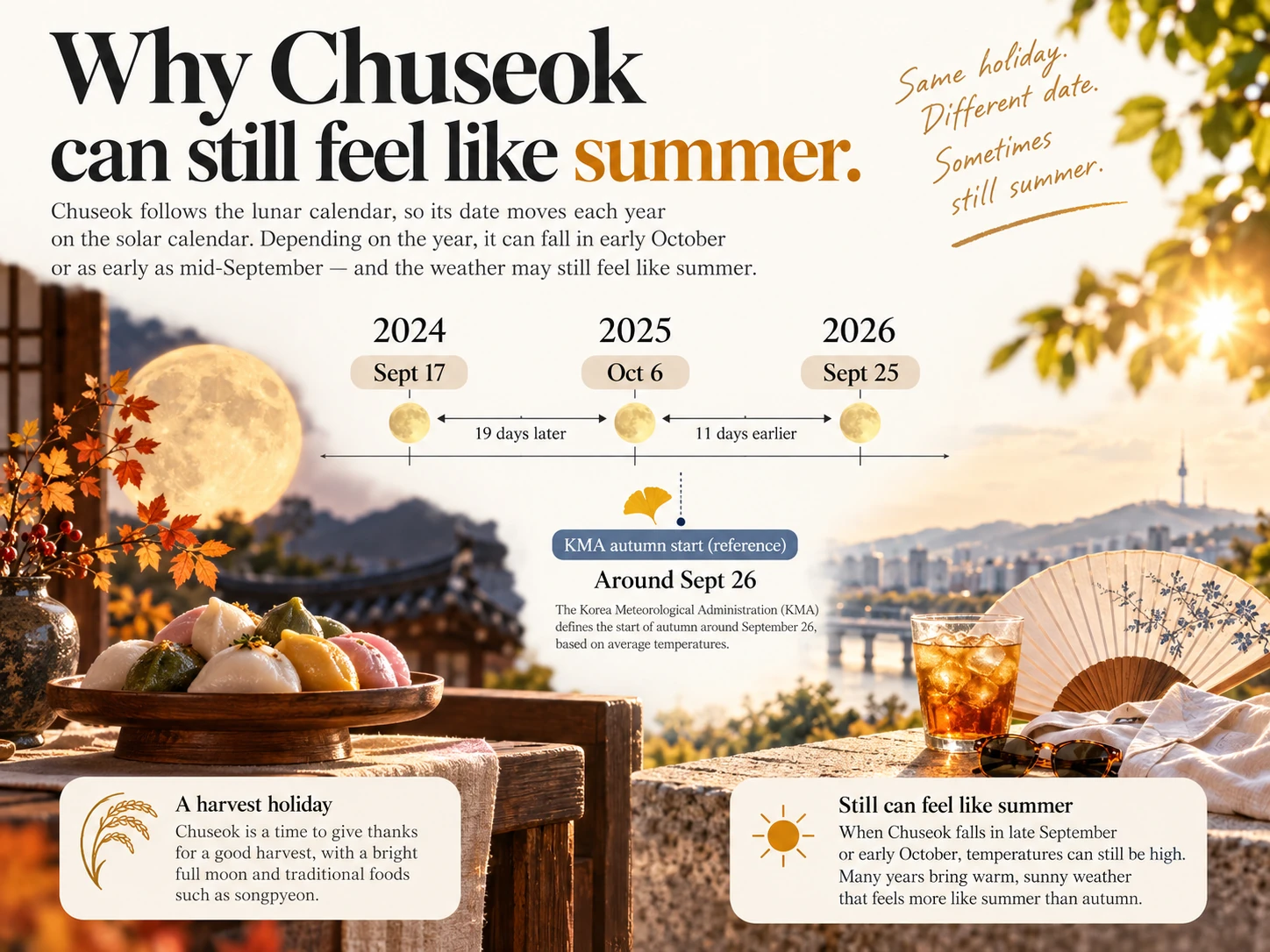
| Period | Summer length | Autumn starts | Autumn length |
|---|---|---|---|
| 1912–1940 | 98 days | Sept 17 | 73 days |
| 1981–2010 | 114 days | Sept 24 | 70 days |
| 1991–2020 | 118 days | Sept 26 | 69 days |
| 2011–202010-year average | 127 days | Sept 29 | 64 days |
The long-run comparison comes from the KMA’s 109-year climate change analysis. Compare the earliest and most recent 30-year periods and summer grew by about 20 days, from 98 to 118. Autumn lost about four days, from 73 to 69. Its starting point moved from September 17 to September 26, and the start of winter moved from November 29 to December 4. Both edges of autumn shifted later. The start moved more, which is why the season got shorter.
Compare the previous and current 30-year climate normals, 1981–2010 and 1991–2020, and the two are much closer to each other. Autumn went from 70 to 69 days, and summer from 114 to 118.
The 2011–2020 row looks shorter still, at 64 days. The KMA publishes that figure as a 10-year average, so it should not be read as equal to a 30-year climate normal.
Put together, summer changed far more than autumn did. Autumn became somewhat shorter, but it also moved later on the calendar.
The clichéDoes Korea still have four distinct seasons?
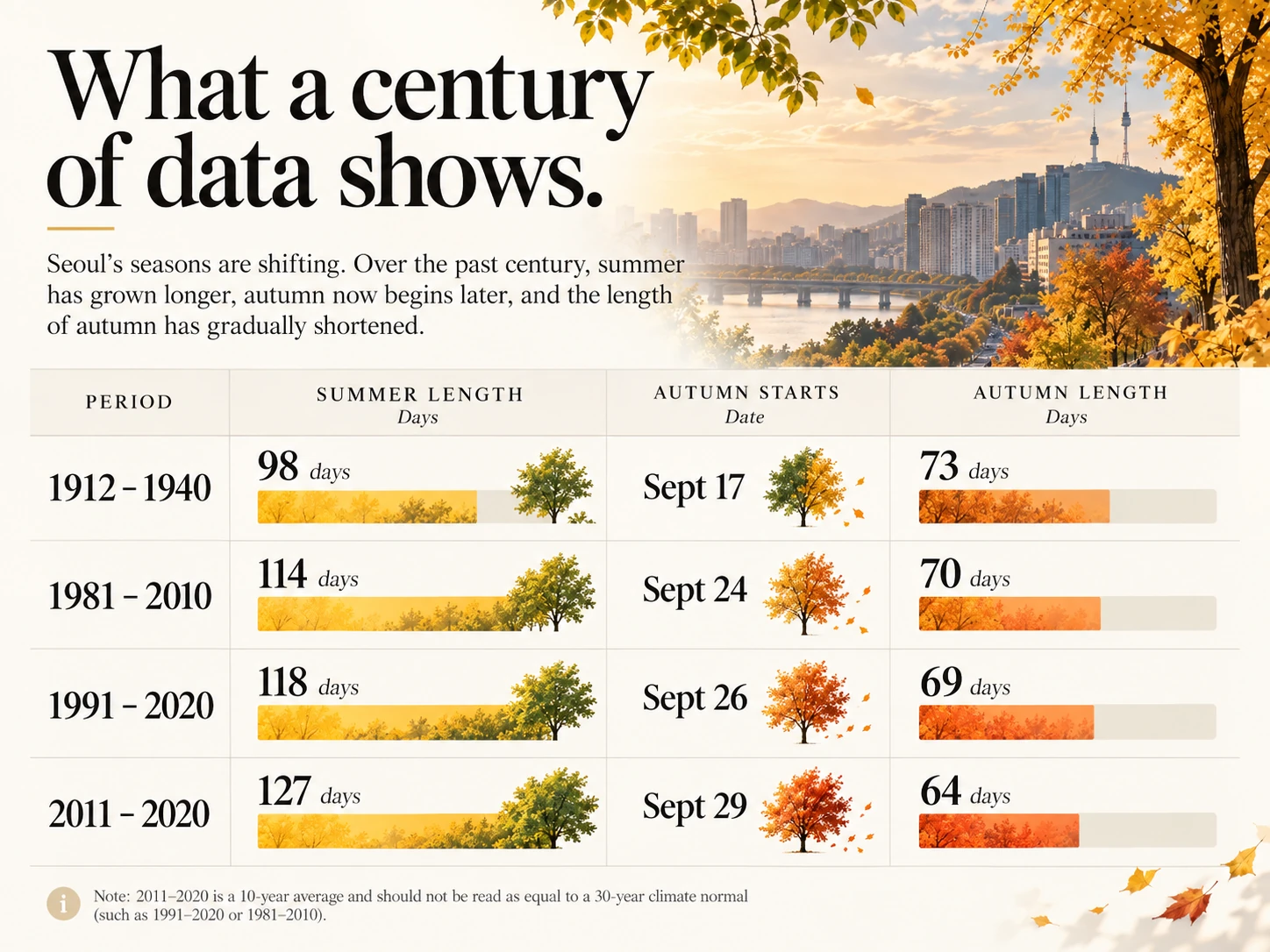
Yes, at least in this KMA framework. All four seasons still show up in the data.
What has shifted is the balance. Summer takes up more of the year, and autumn begins later than it used to. This article stays focused on autumn, so it is not making a separate claim about how spring or winter have changed overall.
The holidayWhy Chuseok can still feel like summer
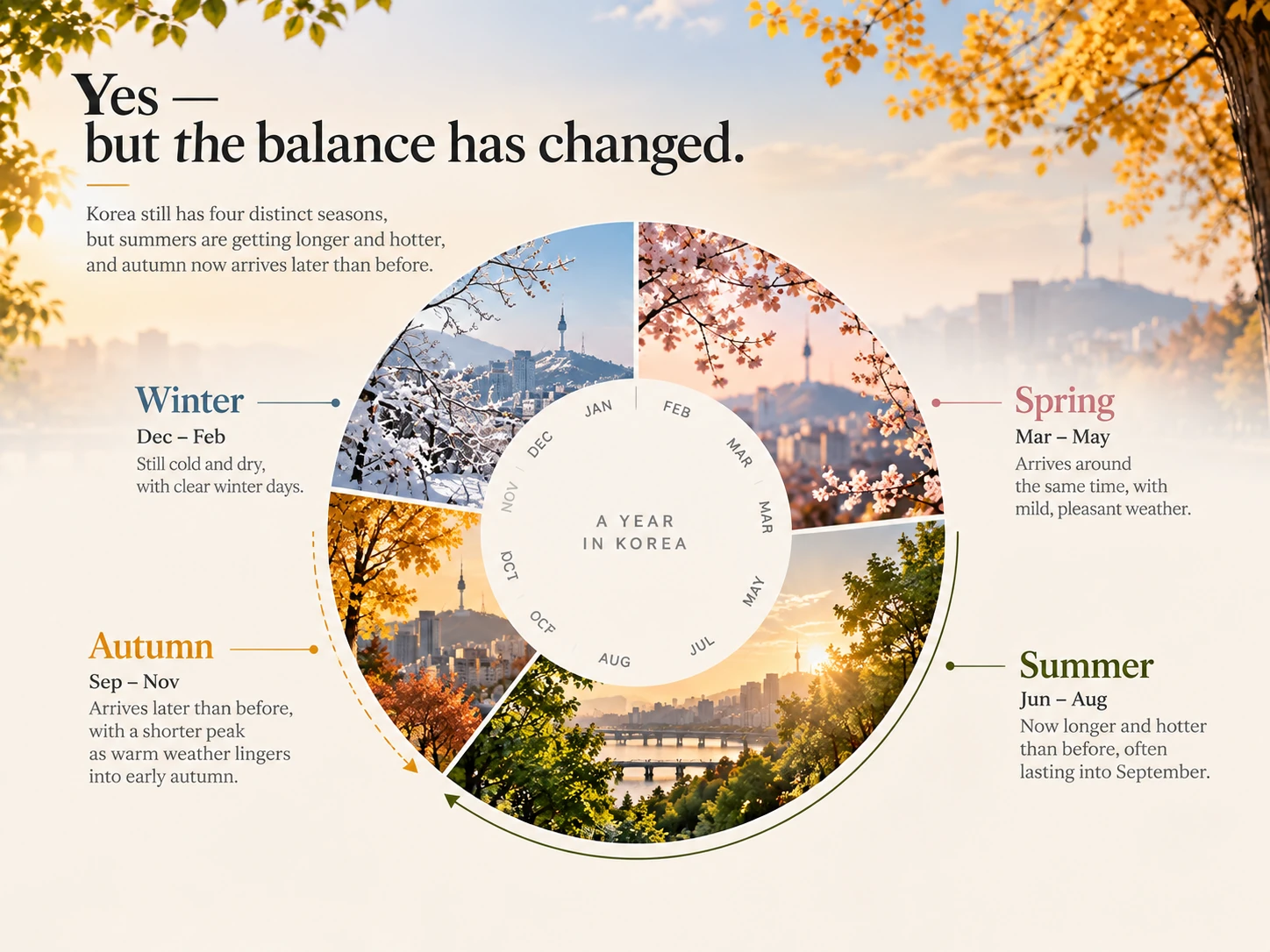
Chuseok, the autumn harvest holiday, follows the lunar calendar. That means its date on the standard calendar moves around from year to year.
According to the Korea Astronomy and Space Science Institute, Chuseok fell on September 17 in 2024, October 6 in 2025, and September 25 in 2026. Between 2024 and 2025 alone, that is a 19-day swing.
Now compare it with the KMA’s autumn start of about September 26 in the 1991–2020 data. In 2026, the holiday landed a day before that long-term average date. This is a coincidence of one year, and it does not mean the weather on Chuseok was summery. Autumn’s start date is a six-station climate average, and any given year can be warmer or cooler.
Two recent years show how far the weather can drift from the pattern. On Chuseok day in 2024, Seoul’s daily average temperature was 28.6°C and its daily low was 25.8°C. That September was the hottest in the national records, which begin in 1973. In 2025, Chuseok came on October 6, and Wando still recorded 30.5°C that day. The KMA also reported that October 2025 was the warmest on record nationally.
Neither year is a typical Chuseok. They make a smaller point instead: a lunar-calendar holiday can move by weeks, and the weather underneath it has been moving too.
The expressionCheongomabi and the high autumn sky
Cheongomabi (天高馬肥) is a familiar Korean expression for autumn. The National Institute of Korean Language’s Basic Korean Dictionary defines it as autumn with a high, clear sky and ripening crops. In modern Korean, it is a warm phrase.
Older related expressions appear in a very different setting. The Han Shu contains a passage about the frontier in which horses fattening in autumn means trouble is coming. Korean royal records from the Joseon period also contain the closely related phrase 秋高馬肥. In the 1467 Sejo Sillok entry, it appears in a discussion of when to attack Jurchen forces. A 1491 Seongjong Sillok entry uses it while discussing the threat of enemy movement.
Where the evidence stops
I could not verify a clean textual chain from those older phrases to the modern idiom. The wording differs, and the sources do not connect them step by step. What can be said more safely is that the idiom belongs to a family of related expressions, some of which had a military meaning.
The sky itself has an official place in Korean culture. The Ministry of the Interior and Safety notes that the third verse of the national anthem opens with an autumn sky.
The KMA also explains that autumn air is generally drier and carries less dust, which makes blue light appear clearer. You can see that explanation on the KMA’s children’s weather page. Why the sky seems high, as the idiom says, is better treated as cultural language than as physics.
On the groundWhat you will actually meet in Seoul, Busan and Jeju
For a trip, climate normals are more useful than a season label. These are the 1991–2020 monthly average temperatures from the KMA climate normals page.
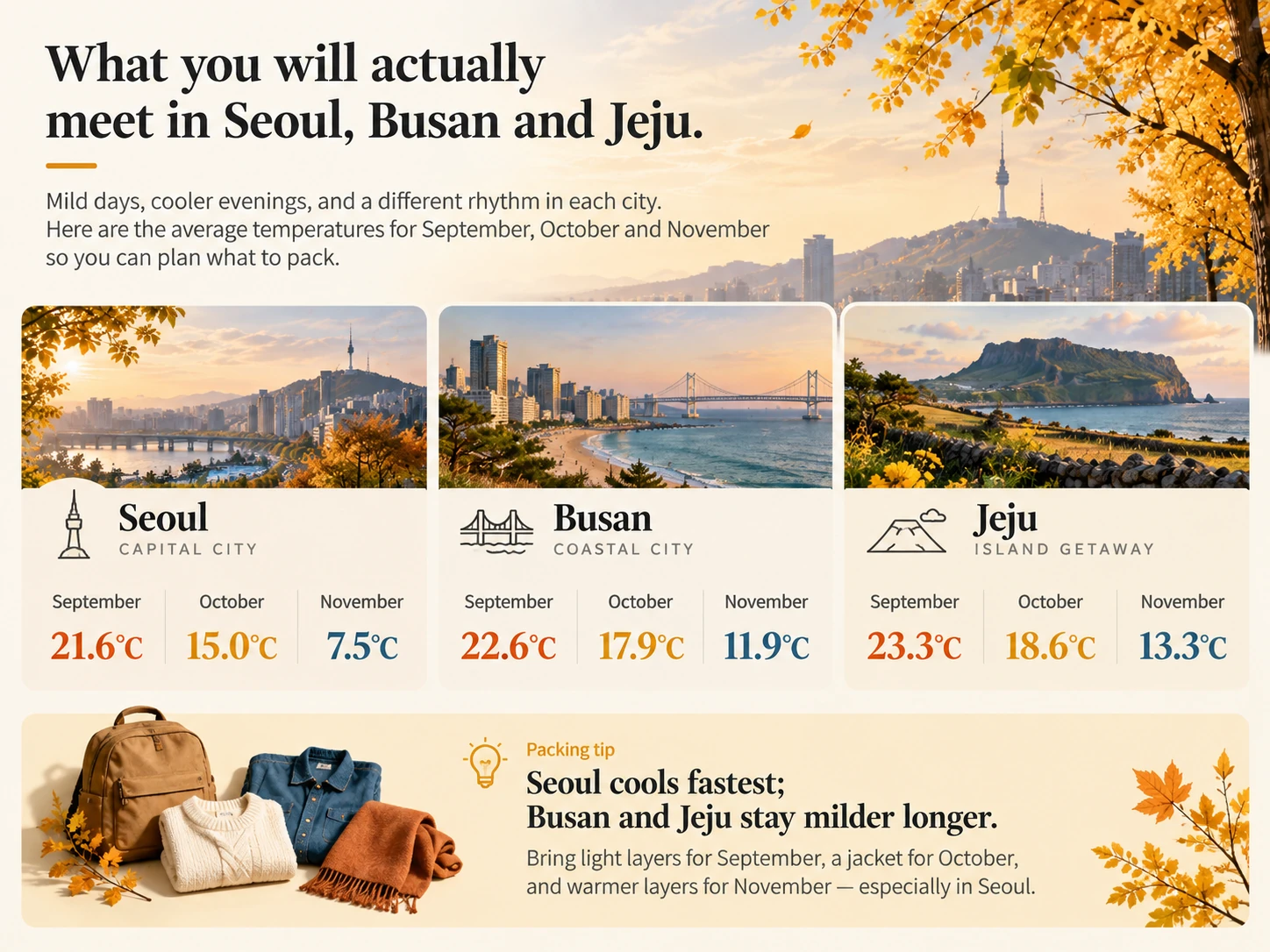
| City | September | October | November |
|---|---|---|---|
| Seoul | 21.6°C | 15.0°C | 7.5°C |
| Busan | 22.6°C | 17.9°C | 11.9°C |
| Jeju | 23.3°C | 18.6°C | 13.3°C |
Seoul cools quickly. Its normal daily high and low are 26.2°C and 17.7°C in September, 20.2°C and 10.6°C in October, and 11.9°C and 3.5°C in November. Busan and Jeju fall more gradually.
The packing notes below are K-Actually’s reading of those temperatures, not KMA guidance:
- Seoul in September: still warm. Light clothes, with a thin layer for evenings late in the month.
- Seoul in October: a real change within the month. Bring layers, since early October and late October feel different.
- Seoul in November: cold mornings. A proper coat is reasonable.
- Busan and Jeju: the same pattern, a few degrees warmer and slower to turn.
The takeawayAutumn didn’t disappear
Autumn didn’t disappear. It starts later, ends later, and is a little shorter than it used to be.
If autumn in Korea seems to arrive late, the data point to a clear shift: summer has expanded much more than autumn has contracted. The calendar still calls September 1 autumn. By the KMA’s temperature threshold, the 1991–2020 average puts its start around September 26.