Why Is Baseball So Popular in Korea? It Isn’t Just About Baseball
Why is baseball so popular in Korea right now? For one thing, getting a ticket to a big KBO game takes more effort than it used to.
Good seats for weekend games and marquee matchups can disappear almost as soon as booking opens, and sellouts have stopped feeling unusual.
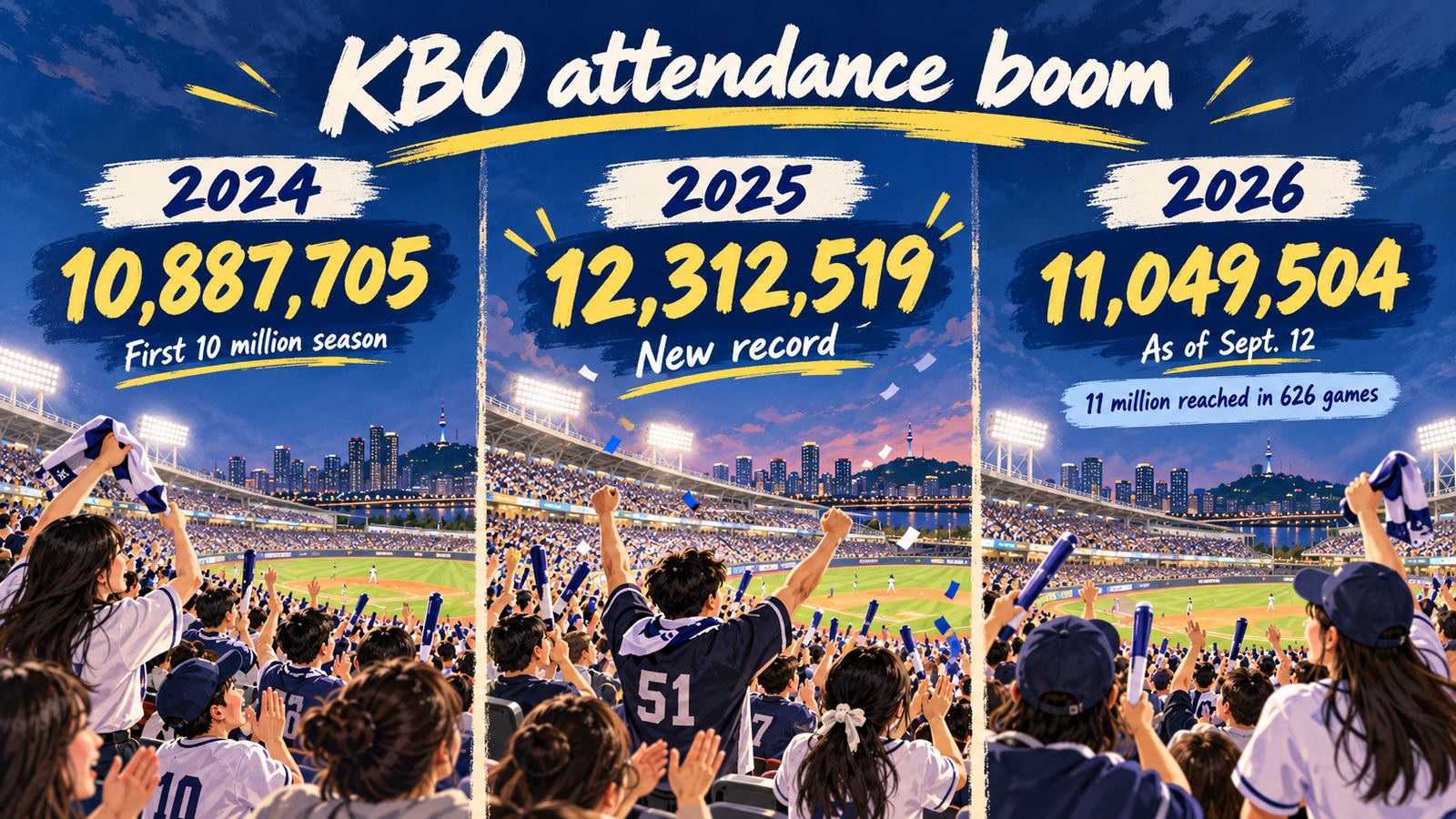
In 2024, the KBO League drew 10,887,705 fans during the regular season, the first time Korean professional baseball had passed ten million. A year later, it broke the record again with 12,312,519 spectators. Of the 720 games played in 2025, 331 sold out.
KBO: 2024 Final Attendance Report
The crowds have come even faster in 2026.
By September 12, the league had already recorded 11,049,504 spectators. It reached eleven million after 626 games, seventeen games sooner than in 2025, with an overall seat occupancy rate of 85.2 percent. Nearly half of those 626 games, 298 of them, had sold out.
KBO has also pointed to South Korea’s run to the quarterfinals of the 2026 World Baseball Classic, its first trip to the final eight in seventeen years, as one factor that helped carry baseball interest into the domestic season.
KBO: 2026 League Reaches 11 Million Spectators
KBO: WBC Momentum and 2026 Attendance
Read only through the attendance numbers, this could be a simple story: Koreans like baseball more, so more Koreans are going to baseball games.
But the scale of the recent surge is harder to explain through what happens on the field alone.
The honest answer to why baseball is so popular in Korea starts with a different question.
What they’re buying
People don’t go to the ballpark only for the baseball
A KBO survey conducted in 2025 asked 2,130 spectators why they were going to games and what kept bringing them back.
Among people who had already attended KBO games before the pandemic and said they were now going more often, the most common reason was not their team’s performance.
It was the cheering culture.
Some 47.7 percent pointed to the fun of cheering at the ballpark, compared with 38.3 percent who cited how their team was playing.
The newer spectators are even more revealing.
Among people who began attending games after the pandemic, 67.7 percent said something other than the baseball itself had first brought them to a stadium. For 33.8 percent, it was the prospect of experiencing the cheering culture. Another 19.9 percent wanted to try the ballpark food scene, including chimaek, the very Korean pairing of fried chicken and beer.
When asked what they remembered most from that first visit, 35.8 percent chose the cheering culture. The game itself came next, at 24.9 percent.
KBO: 2025 Spectator and Attendance Analysis
Those numbers say something important about what Korean baseball is selling today.
Baseball still sits at the center of everything. Without the game, there are no cheer songs, jerseys or chicken-and-beer nights.
But a spectator walking through the gate is buying more than nine innings. The ticket opens the door to several hours of sport, food, singing, socializing and belonging to a crowd.
The game is still at the center. But it is no longer the entire product.
And that experience did not appear overnight.
Roots
Sometimes your baseball team feels like part of the family
Baseball fandom often begins long before anyone consciously chooses a team.
There are simply so many games.
A child goes to the stadium with a parent, or sits beside them while the same team appears on television night after night. Eventually, the club can stop feeling like a preference and start feeling like part of the household.
Almost like a family religion.
It is not literal DNA. Children can and do support different teams from their parents. But baseball fandom has a habit of traveling through families until, from the inside, it can feel almost hereditary.
Korea is not unusual in that respect. A family of Yankees fans in New York or Red Sox fans in Boston will understand the feeling immediately.
What is more distinctive about the Korean version is how strongly that inherited loyalty has historically overlapped with place.
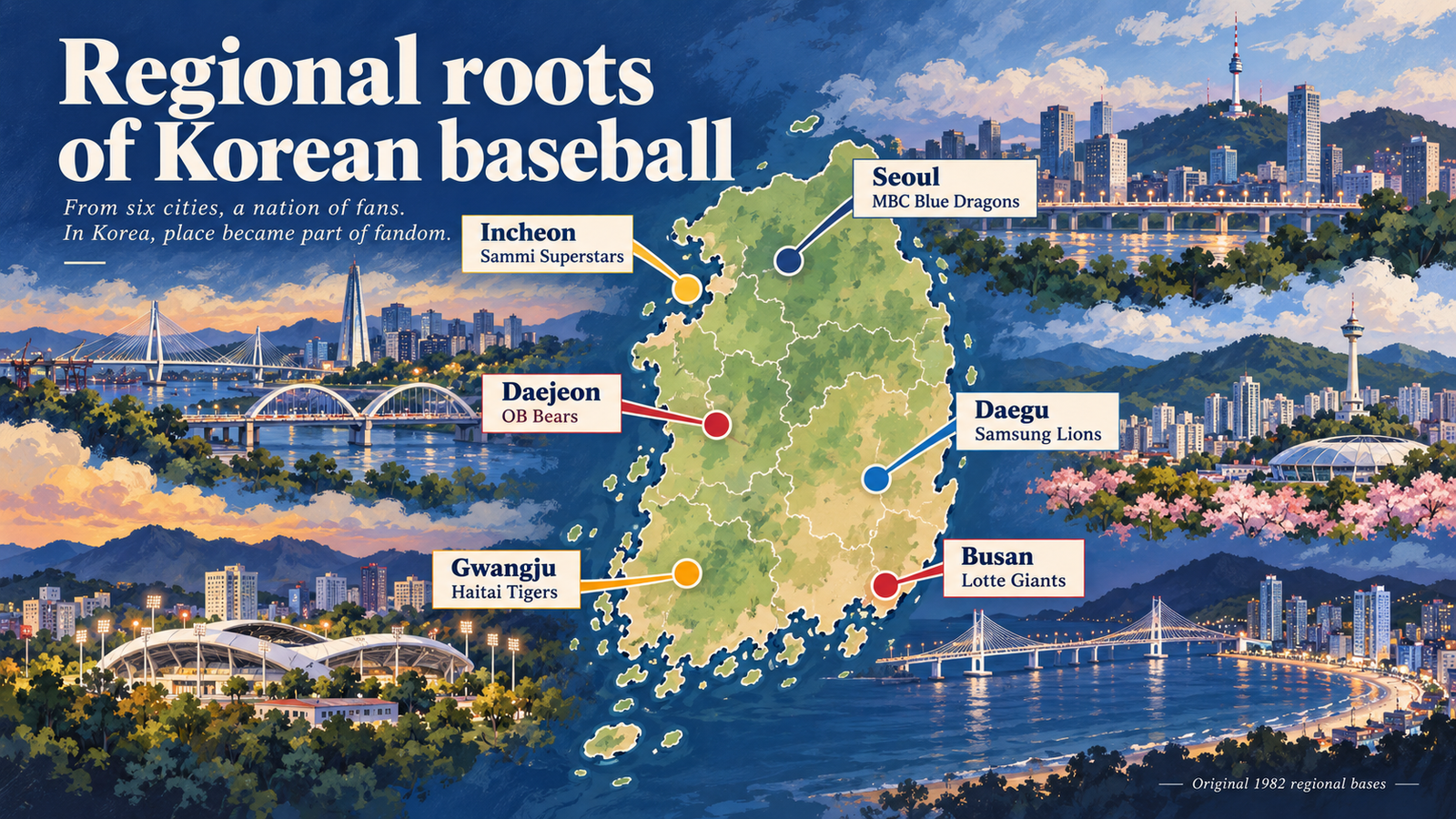
When Korean professional baseball began in 1982, its six original clubs were organized around regional bases: the MBC Blue Dragons in Seoul, Lotte Giants in Busan, Samsung Lions in Daegu, OB Bears in Daejeon, Haitai Tigers in Gwangju and Sammi Superstars in Incheon.
Regional affiliation was part of the league’s structure from the beginning.
Yonhap: 40 Years of Korean Professional Baseball
More than four decades later, much of that imprint remains visible.
Busan is still closely associated with the Lotte Giants. Daegu has Samsung. Gwangju and the wider Honam region have the Tigers, today the KIA Tigers. Daejeon and Chungcheong are closely identified with the Hanwha Eagles.
The map is no longer perfectly one-to-one. Seoul has several clubs. People move around the country, marry into different baseball families or simply decide they prefer another team.
Still, place remains an important route into fandom.
Research offers some support for that relationship without turning it into a universal rule.
A 2013 study of university students in Busan found that aspects of regional identity were positively associated with their intention to attend Lotte Giants games. A separate 2019 study analyzed 1,034 residents across the home regions of all ten KBO clubs and found relationships between sports involvement, regional identity and professional baseball fandom.
KCI: Regional Identity and Baseball Attendance in Busan
KCI: Sports Involvement, Regional Identity and Professional Baseball
Research can show that regional identity matters, but it cannot fully capture how personal that attachment can become.
Once a team is tied to both a place and years of family memory, a few losing seasons do not necessarily erase the relationship.
That durability has mattered, because Korean professional baseball has not always been on an uninterrupted rise.
Regular-season attendance reached 5,406,374 in 1995. By 2004, it had fallen to 2,331,978.
Popularity could fade, and it did.
KBO: Historical Attendance Records
Today’s boom is therefore not simply the continuation of a sport that was destined to grow forever.
Something about the experience around the game also became more valuable.
The stadium
A Korean ballpark is a show the crowd helps create
For a first-time visitor from overseas, one of the most surprising things about a KBO game may happen in the stands rather than on the field.
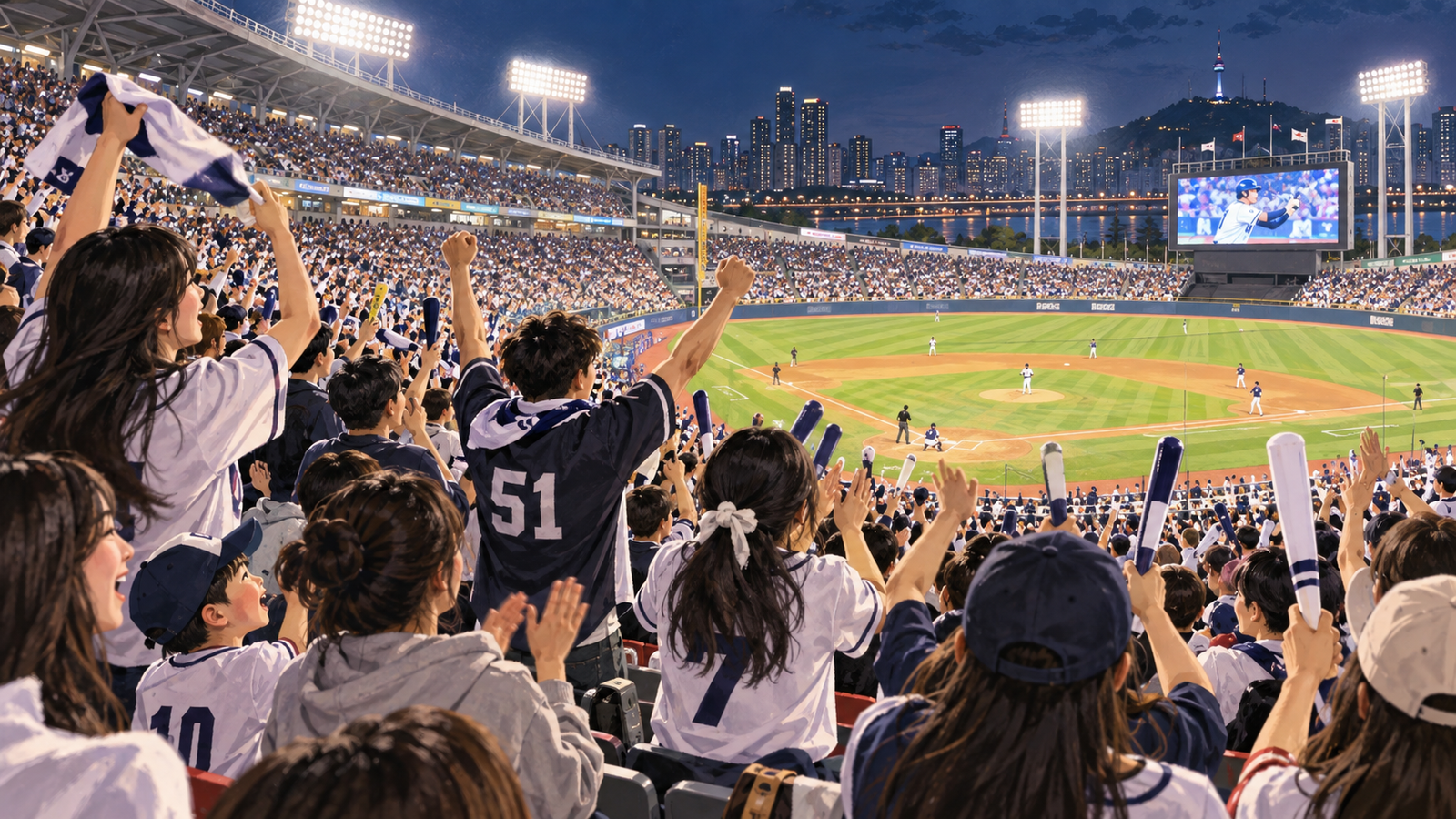
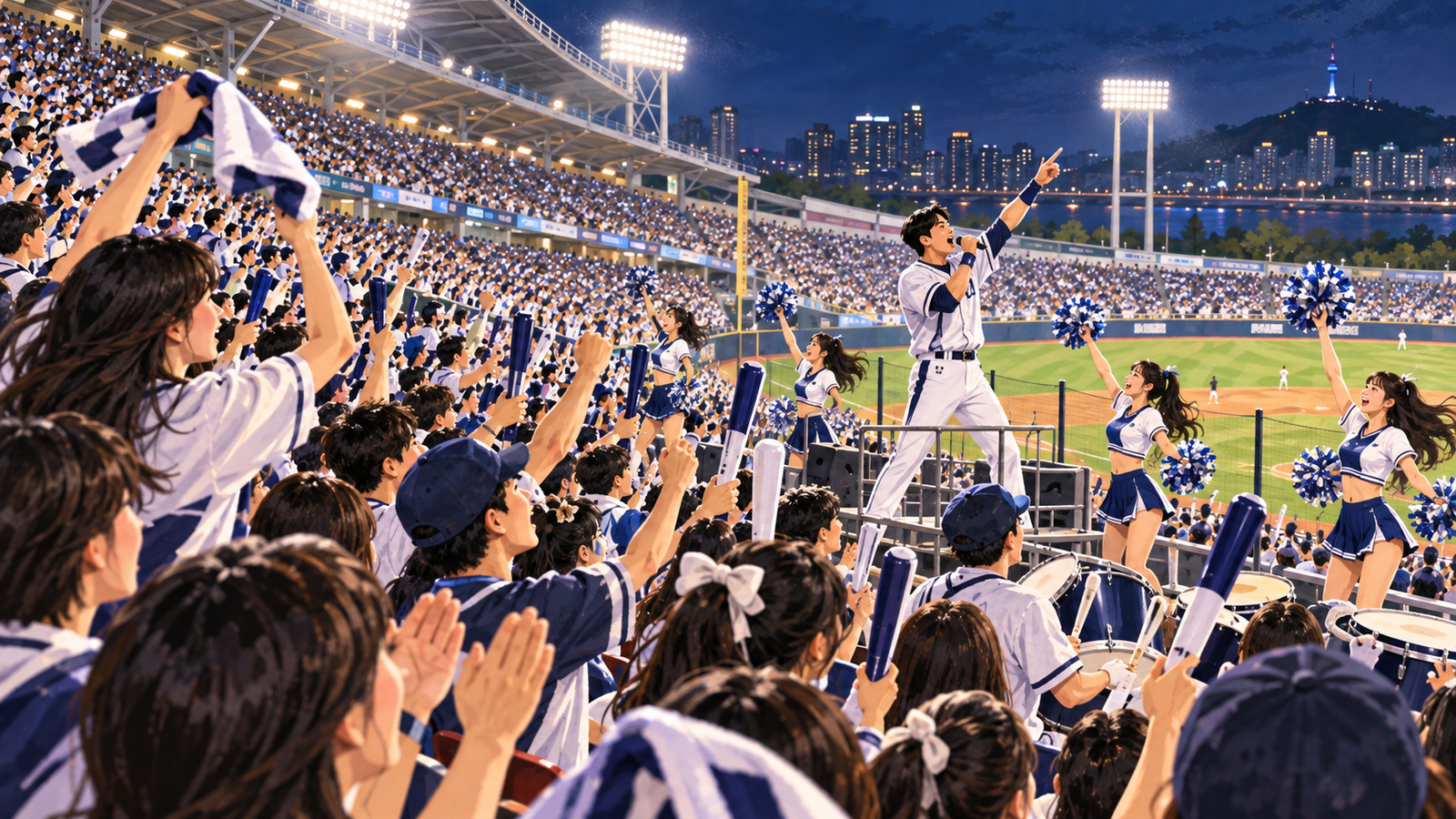
When the home team bats, a cheer captain directs the crowd from a stage near the stands. Cheerleaders perform alongside them, and individual hitters have their own cheer songs and chants.
Many borrow melodies from familiar pop songs and replace the original lyrics with a player’s name or a call for a hit. Thousands of people can switch songs every time the batter changes.
And this does not wait for a home run.
The singing continues when the score is 0-0. It continues when the home team is behind. At many games, the crowd is not simply an audience reacting to the result. It helps produce the atmosphere for much of the evening.
That makes the experience unusually accessible to someone who does not yet know much about baseball.
You can follow what the section around you is doing, eat, have a beer, talk to friends and gradually pick up the rhythm of the game. Three hours can pass before you notice.
Visiting Korea and thinking about seeing a game yourself? Our Korean baseball guide for visitors explains all 10 KBO teams, their ballparks and which one fits most naturally into a Korea itinerary.
Price has also kept the barrier to entry relatively low.
As of September 4, 2025, KBO’s average admission revenue per attendee (total gate revenue divided by attendance) was 16,715 won.
That is not the same thing as saying every KBO ticket costs 16,715 won. Prices vary widely by stadium and seat type.
But in the same KBO survey, 20.5 percent of respondents who said they were attending more often specifically pointed to baseball being reasonably priced compared with other leisure options.
KBO: 2025 Spectator and Attendance Analysis
That helps explain the basic value proposition.
For something around the cost of a casual meal, many fans can spend several hours watching a live sporting event while eating, singing and spending time with friends.
Seen from that angle, baseball is not competing only with other sports. It is competing for an evening that might otherwise go to a film, a concert, a restaurant or a night out with friends.
Somewhere along the way, a KBO game became both a sporting event and a repeatable night out.
Baseball itself is especially well suited to that role.
A KBO club plays 144 regular-season games. Unlike a soccer club that might play once or twice in a week, a baseball team creates a new result, storyline and reason to check back almost every day.
Lose tonight and, very quickly, there is another game tomorrow.
That rhythm gives fandom room to become part of everyday life.
The new wave
Young women are changing the audience, but they didn’t create the boom alone
One of the most visible changes in recent KBO crowds has been the growth of younger female fandom.
The signal appears across several different measures.
In an on-site KBO survey of 4,000 ballpark spectators during the 2024 season, 77.9 percent of women in their twenties said their interest in the league had increased from the year before. The figure for all respondents in that on-site survey was 64.3 percent.
Among women in their twenties, the share using social media to get KBO-related information rose from 68.0 percent in the 2023 survey to 76.6 percent in 2024.
Ticketing data points in the same direction, although it needs an important qualification.
Through August 2025, women accounted for 57.5 percent of online KBO ticket buyers in Ticketlink data. Among buyers in their twenties, women made up 63.6 percent.
But those figures are not the gender breakdown of the entire KBO audience.
Ticketlink handled online bookings for six clubs in that dataset (KIA, Samsung, LG, KT, SSG and Hanwha), so the numbers should be read within that scope.
KBO: 2025 Ticketlink Booking Analysis
It would also be too simple to turn those figures into a headline saying young women “saved” Korean baseball.
The regional roots were already there. So were the ballpark cheering culture and generations of families watching together.
What has changed is how easily a new generation can encounter all of that before becoming traditional baseball fans.
Social media has made that process much faster.
A major change came with the KBO’s digital broadcasting agreement for 2024-2026.
Under the deal, fans were allowed to freely use game footage in social-media clips shorter than 40 seconds. KBO noted that the previous five years had placed much tighter restrictions on fans using official game footage on social platforms.
KBO: 2024-2026 Digital Broadcasting Agreement
That matters because the route into baseball no longer has to begin with a full television broadcast.
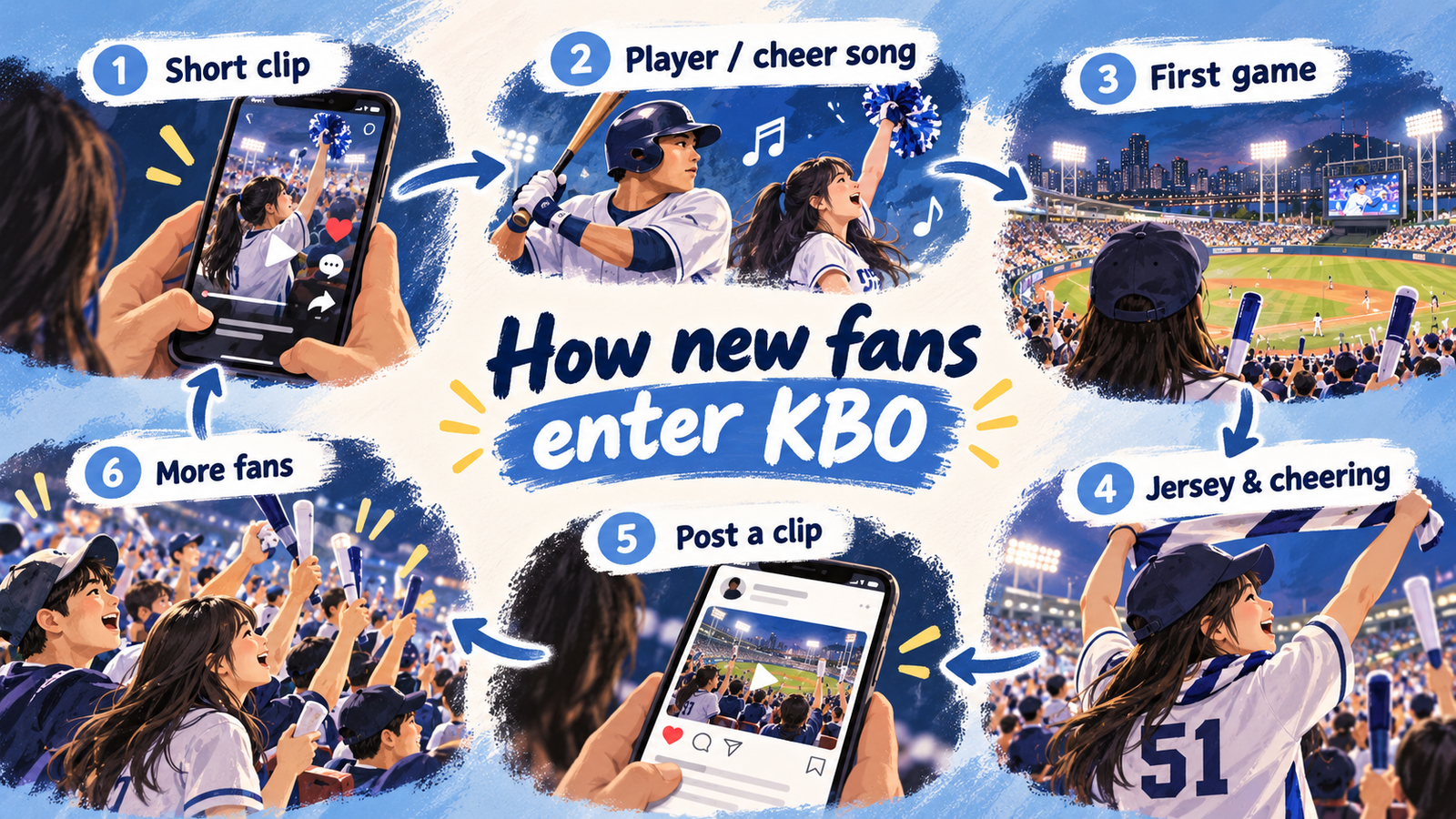
Someone can first encounter a player through a short clip. A cheer song keeps appearing in their feed. A funny moment becomes a meme. They learn a player’s name before they understand the standings, go to a game with a friend and gradually find themselves following the team.
By 2025, KBO said more than half of first-time spectators in its survey had encountered baseball-related content through YouTube.
KBO: 2025 Spectator and Digital Content Analysis
The stadium and the feed now reinforce each other.
That helps explain why today’s KBO can be understood partly as a fandom business as well as a sports league.
The commercial value has followed.
KBO’s domestic digital and mobile broadcasting rights for 2024-2026 went to CJ ENM in a three-year deal worth 135 billion won, or 45 billion won per year. KBO said the annual value was more than double that of the previous contract.
KBO: CJ ENM Digital Rights Agreement
That number is more useful as evidence of the boom than as an explanation for it.
The audience grew. The game became easier to encounter away from the stadium. More people began consuming baseball as something that extended beyond nine innings.
The value of access to that audience rose with it.
The catch
Success is creating a new problem
There is an awkward side to all of this growth.
The more desirable the KBO ballpark experience becomes, the harder it can be for ordinary fans to get inside.
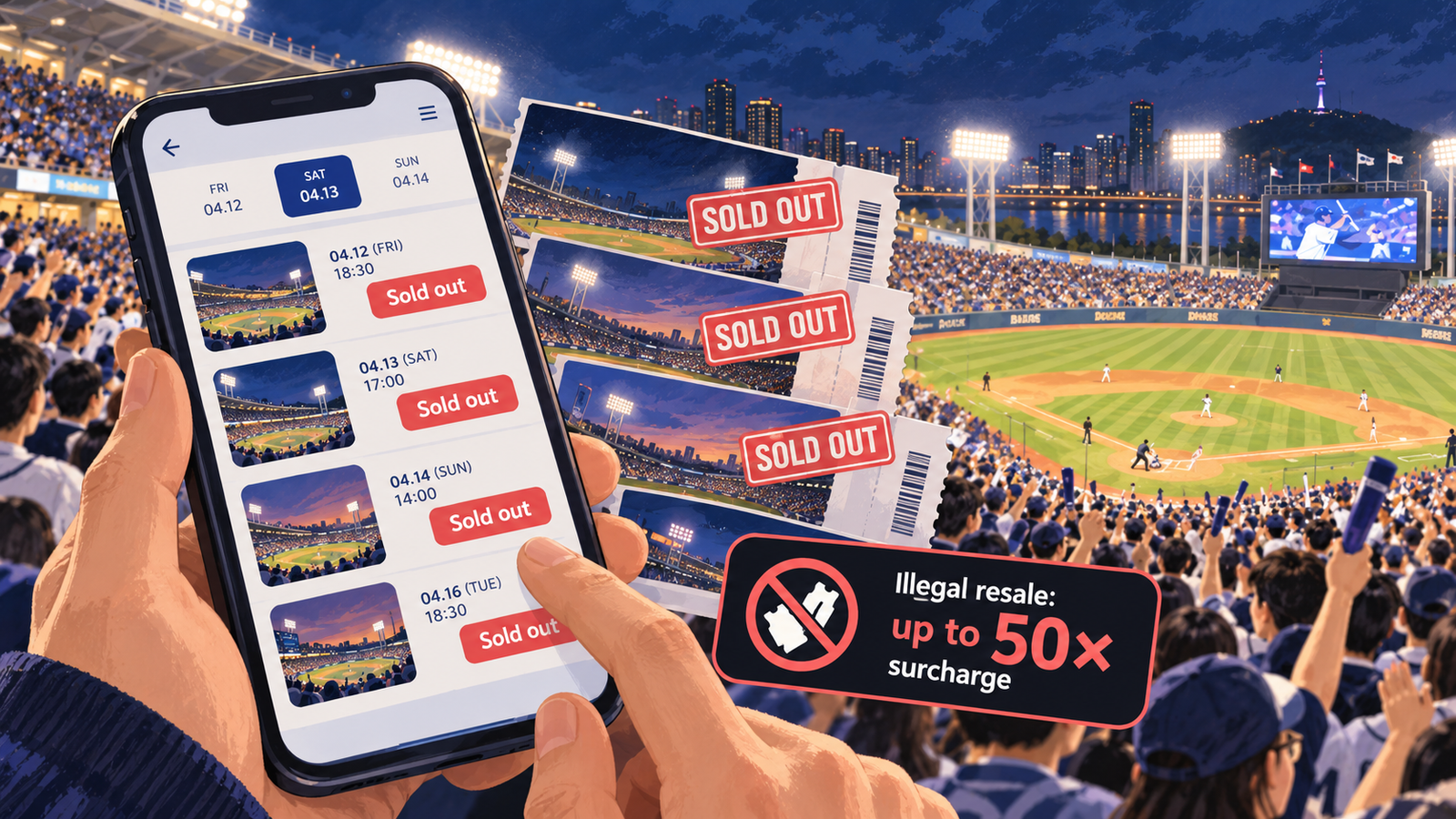
Popular games sell out quickly. Competition during online booking has intensified, and the resale market has become difficult to ignore.
Korea strengthened its legal response in 2026.
For sports tickets, revisions to the National Sports Promotion Act and related enforcement rules took effect on August 28. The rules broadened restrictions on improper ticket purchasing and resale regardless of whether an automated macro program was used.
They also introduced penalties that can include an administrative surcharge of up to 50 times the sale amount, confiscation or recovery of illegal proceeds, and rewards for people who report violations.
Ministry of Culture, Sports and Tourism: 2026 Anti-Scalping Rules
The law applies to sports more broadly, not just professional baseball.
But its arrival lands directly in the middle of the KBO’s own ticket-scarcity problem.
And that creates a genuine tension.
Part of baseball’s recent appeal has been its accessibility.
You did not have to be a serious fan. You could go with friends, pay a relatively manageable entry price and still have plenty to enjoy even if you could not explain every rule.
But if demand makes normal tickets increasingly difficult to buy at face value, one of the qualities that helped create the boom starts to weaken.
The next challenge for Korean baseball may not simply be finding more spectators.
It may be keeping a mass-market night out genuinely open to the mass market.
The takeaway
It isn’t simply that Koreans fell for baseball
There is no single explanation for the KBO’s current boom.
Its regional roots gave generations of fans a powerful way to attach themselves to a club. Repeated games, often watched with family, helped turn that attachment into memory.
The cheering culture made spectators part of the event rather than people simply sitting through it. Relatively accessible prices and the ballpark food culture gave casual visitors reasons to come even before they cared deeply about baseball.
Then social media made the whole experience easier to discover.
The result is a crowd that can include someone who first came for a player, a cheer song, chimaek with friends or simply because the ballpark sounded like a fun place to spend an evening.
And some of those people keep watching.
Someone who arrived for the singing can eventually find themselves arguing over the strike zone, checking a favorite player’s statistics and following the standings without being quite sure when the transition happened.
The remarkable thing about Korea’s baseball boom isn’t that everyone suddenly became a serious baseball fan. It’s that Korean baseball gave people a reason to come before they were fans at all.
◆