Koreans Never Thought of Gim as a Superfood — Then the World Discovered It
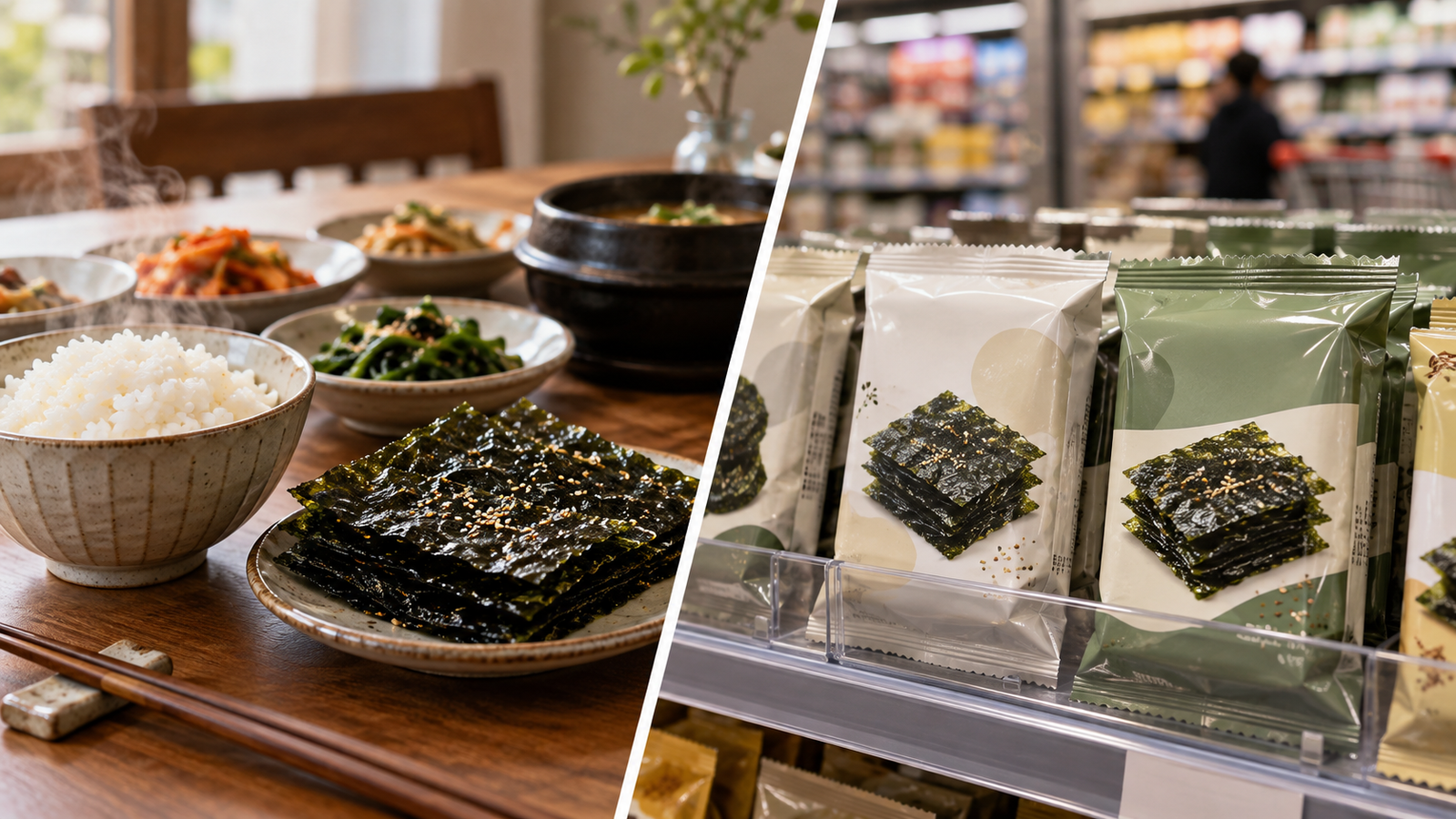
Walk into a supermarket outside Korea and you might find Korean seaweed sitting in the snack aisle: small crispy sheets in a plastic tray, sometimes flavored, usually sold as something light and healthy.
For a lot of people, that is where gim begins.
In Korea, it begins somewhere else.
For most Koreans, gim was never a health food they discovered. It was simply there, next to the rice.
A pack shows up at breakfast. A few sheets turn plain rice into something a child will actually finish. Gim wraps a roll of gimbap, gets crushed over another dish, or waits in a lunchbox as one more ordinary part of the meal.
That gap is the whole story.
Gim did not go global by teaching the rest of the world to eat a Korean meal.
The same sheet crossed a border and changed jobs.
What it isWhat gim actually is
“Seaweed” is a fair translation and a very loose one.
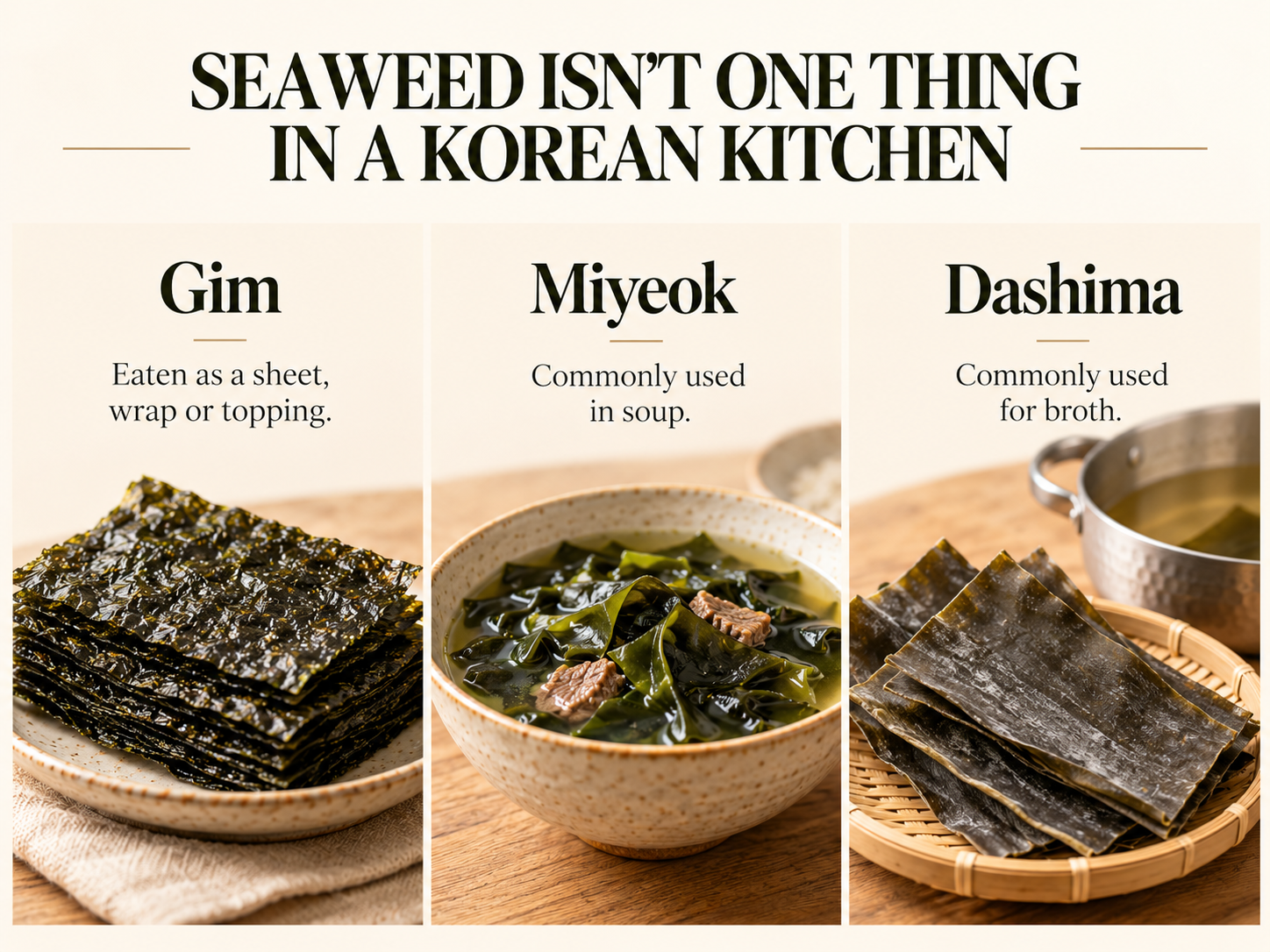
Miyeok, the seaweed in Korean birthday soup, is seaweed. Dashima, the thick kelp used for broth, is seaweed. Gim is seaweed too.
None of them are interchangeable in a kitchen.
In food terms, gim usually refers to thin edible laver, commonly dried into sheets. It is also not one single species. Several kinds of laver have been cultivated in Korea, and their scientific names have been reorganized over time.
Korean fisheries materials, for example, have used names such as Pyropia yezoensis for 방사무늬김(bangsamunuigim), while current taxonomic databases recognize several former Pyropia species under the newer genus Neopyropia. The current Codex draft does not reduce laver to one species either: its scope covers products from the genera Pyropia and/or Porphyra.
For anyone actually eating it, the point is much simpler.
Gim is not just another English-language “seaweed.” It is the thin sheet that has been part of the Korean table for generations.
Sources: National Institute of Fisheries Science — Standard Manual for Gim Aquaculture · AlgaeBase — Neopyropia genus · Codex — Draft Standard for Laver Products at Step 5
At the tableBefore it was a snack, it belonged with rice
This is the part most easily lost once gim leaves Korea.
In Korea, gim usually makes sense in relation to something else. Most often, that something is rice.
Rice sits so close to the center of the Korean meal that even the word bap stretches far beyond the grain itself. K-Actually looked at that relationship in Why Koreans Say 밥 So Often — Even When They Aren’t Talking About Rice.
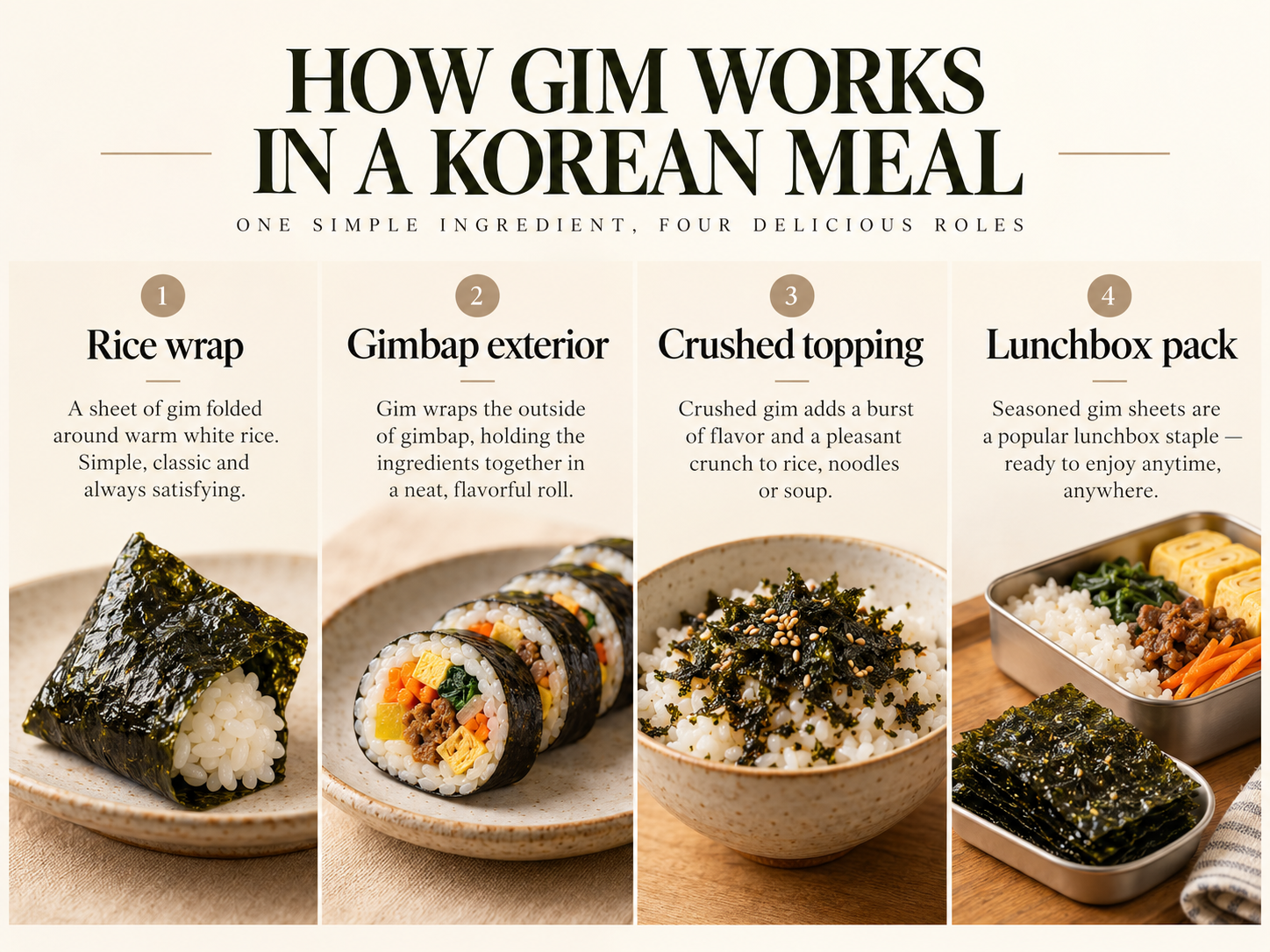
Take a sheet of seasoned gim, place some warm rice on it, fold and eat. No recipe. For many households, this is such an ordinary way to eat that it barely registers as a dish.
The same sheet does other work. It forms the outside of gimbap. Cut into strips or crushed into flakes, it goes over rice, noodles, soups and other dishes. Small packs of seasoned gim are an easy addition to a lunchbox or a simple meal at home.
In 2014, Korea.net described seasoned gim as a staple side dish on the Korean table, one that could appear as routinely as kimchi.
Koreans did eat gim on its own, of course. But its starting point was not the packaged “seaweed snack” that shows up abroad. Its job was to help finish the meal.
And notice what that job depends on: something else on the table.
Source: Korea.net — “Yangban Gim: from side dish to snack” (2014)
The switchThen it crossed the border without the rice
A useful clue sits in how Korean food companies actually sold gim abroad.
In 2014, Korea.net profiled Dongwon F&B adapting seasoned gim for different markets.
For China and parts of Southeast Asia, where the company said consumers were less accustomed to eating laver together with rice, Dongwon developed a product called Kimmy and marketed it as a snack rather than a side dish. The company reduced the saltiness and emphasized crispness.
In the United States and Canada, Dongwon had already launched another brand, Sea Veggies, in 2011. It came in original, pepper and chili flavors and was marketed as a crunchy, low-calorie seaweed snack.
One company cannot explain an entire food going global. But this case captures a change that was already underway.
A shopper no longer needed to know what gim was supposed to go with. No bowl of Korean rice. No knowledge of how a Korean meal is structured. Open the pack and eat.
In this particular example, the change in use is visible before the broader “superfood” story: a Korean side dish was deliberately rebuilt as a standalone snack for consumers who did not share its usual relationship with rice. The health message then fitted neatly around that new use.
That is a different story from simply saying the world discovered a superfood.
The food had already changed categories.
Source: Korea.net — “Yangban Gim: from side dish to snack” (2014)
The correctionAbout that “70% of the world’s gim”
Here the story gets slippery. And correcting it is worth doing carefully.
Korean government material has said that Korean gim holds around 70 percent of the global market. Read quickly, that can sound as if Korea grows 70 percent of all the laver in the world.
It does not.
FAO aquaculture figures reproduced in a 2025 Codex document show that China farmed about 74 percent of the world’s Pyropia in 2023. Korea accounted for about 19 percent. Japan accounted for about 7 percent.
Trade looks very different. The same Codex document records about $1.08 billion in 2023 laver-product exports across five major Asian trading areas with dedicated HS-code data: Korea, China, Japan, Chinese Taipei and Hong Kong. Korea accounted for about $793 million of that value. Roughly 73 percent.
China grows far more laver. Korea leads that international export dataset by value.
Those are two different claims. And the difference is the point.
Korea’s strength in gim is not simply a story about growing the most seaweed. It is also about turning laver into products that travel, sell and make sense in markets far beyond the Korean meal.
That distinction, between raw production and the system that turns a product into a global business, matters elsewhere in Korea too, although the industries work very differently. We saw another version of it in How Korea Became a Beauty Superpower — and What Comes Next.
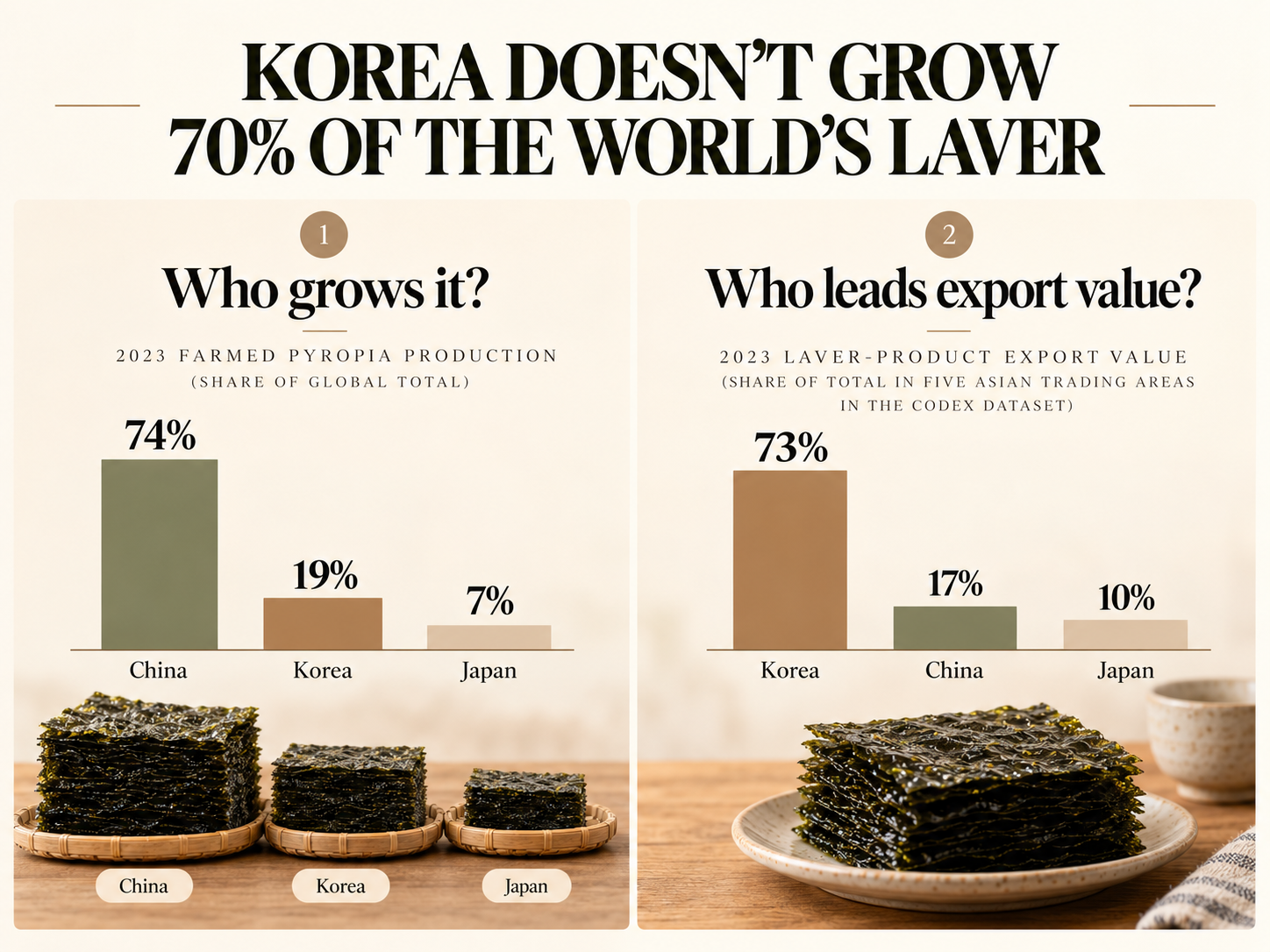
Sources: Ministry of Oceans and Fisheries — government 70% market-share reference · Codex REP25/ASIA — 2023 aquaculture and laver trade tables
The numbersThe export numbers, briefly
Once that distinction is clear, the growth is hard to miss.
Korean gim exports were worth about $105 million in 2010. By 2023, they were roughly $793 million. In 2024, the figure climbed to $997 million, close to a billion dollars but not over it. The actual first billion-dollar year came in 2025, when annual exports reached about $1.13 billion.
Those numbers are remarkable. But they are context, not the headline.
The more revealing change happened before the billion-dollar milestone: a food that once made the most sense beside a Korean bowl of rice had learned to make sense without one.
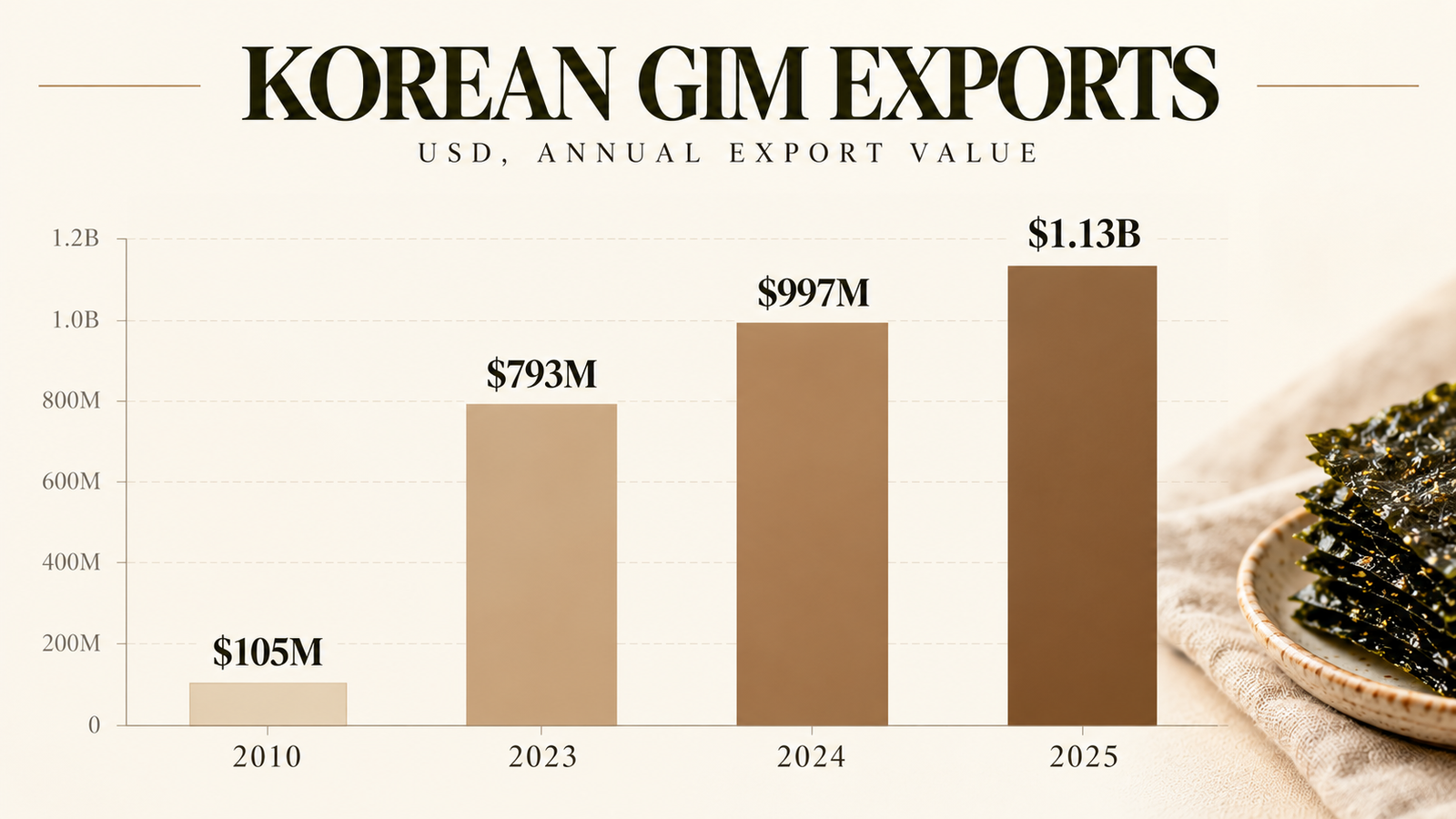
Sources: MOF — 2010 export figure · MOF — 2024 export results · MOF — 2025 export results
The standardNow the world has to define it
One stage of the story is still running.
In 2010, Korea proposed creating an international standard for laver products through Codex Alimentarius, the international food-standards programme run jointly by the FAO and WHO. An Asian regional standard for laver products was adopted in 2017.
Then the process moved beyond Asia. At the 48th Codex Alimentarius Commission meeting in November 2025, new work was approved to convert the Asian regional standard into a worldwide Codex standard. The work covers dried, roasted and seasoned laver products.
There is a procedural detail worth noting. Codex normally develops standards through an eight-step process. In this case, because an existing regional standard is being converted into a worldwide one, the regional text is treated as the draft. According to Korea’s Ministry of Oceans and Fisheries, that allowed the conversion work to skip Steps 1 and 2 and begin at Step 3.
In May 2026, the Codex Committee on Fish and Fishery Products forwarded the draft for adoption at Step 5. The draft’s scope was also expanded to cover the genera Pyropia and/or Porphyra. Then, at the 49th Codex Alimentarius Commission meeting in July 2026, the laver draft passed that Step 5 intermediate review.
It is not a final worldwide Codex standard yet. As of September 2026, an electronic working group for the conversion remains active, chaired by Korea and co-chaired by China and Japan.
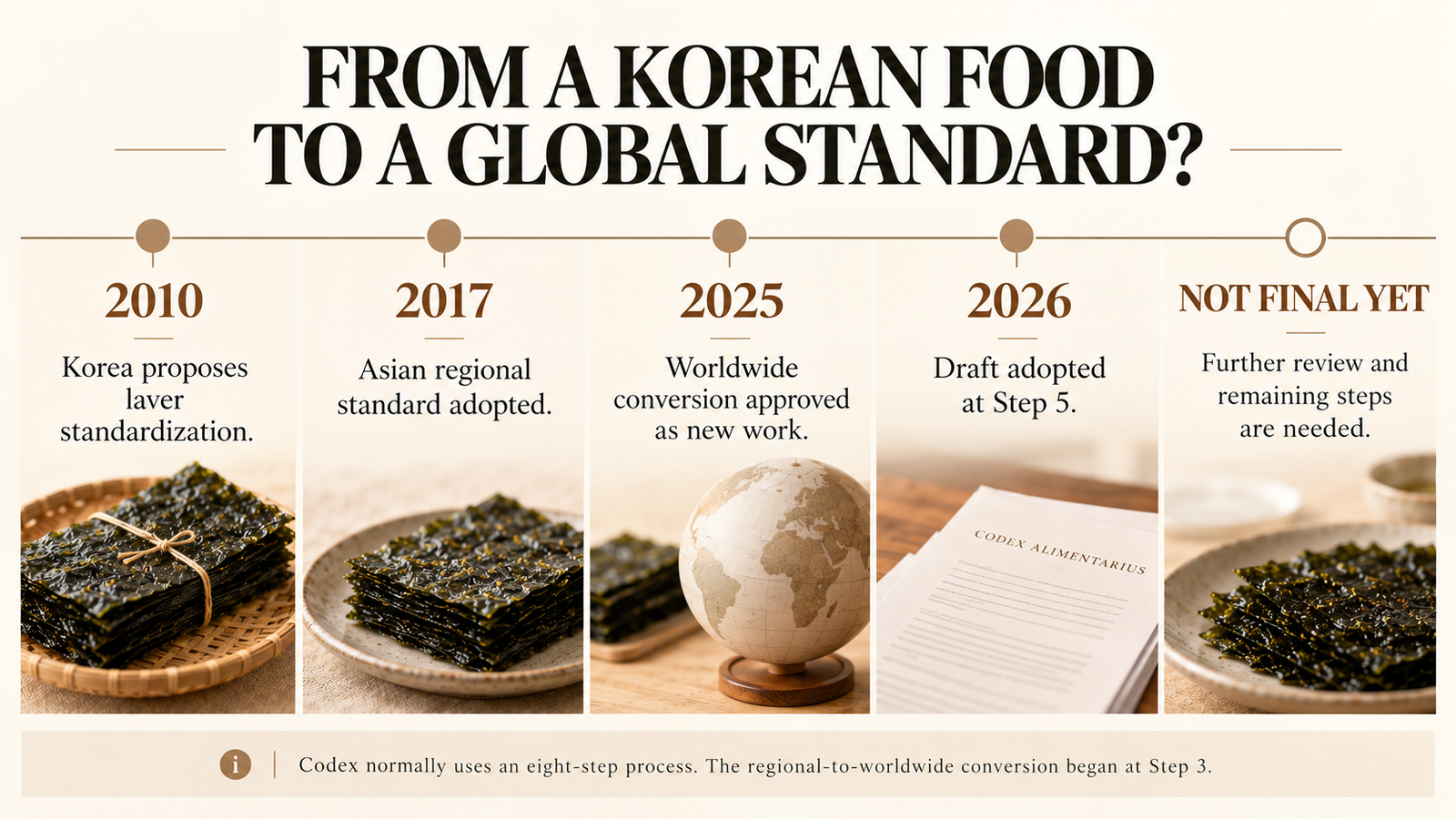
Sources: MOF — worldwide Codex conversion approved (2025) · Codex — CCFFP37 Step 5 decision · MOF — CAC49 Step 5 update (July 2026) · Codex — active laver-products electronic working group · Codex — the eight-step process
Sit with what that means.
A food so ordinary on the Korean table that it rarely needed explaining is now the subject of an international process to decide how laver products should be defined, labelled and traded worldwide. That may say more about gim’s transformation than the billion-dollar number does.
Gim did not go global because the rest of the world learned to eat it exactly the way Koreans do. It went global partly because it no longer needed the Korean meal around it.
At home, it can stay what it always was: something simple beside a bowl of rice. Everywhere else, the same sheet became something new. And now the world is working out how to define it.
◆