What Happens to Your Lease If Your Korean Landlord Sells the Apartment?
If your landlord sells your apartment in Korea, the lease does not automatically end.
You are renting an apartment in Korea when your landlord suddenly tells you:
“I’m selling the property.”
For a foreign tenant, that can immediately raise several questions.
Do you have to move out when the owner changes?
Does your existing lease still count?
Who has to return your deposit — the old landlord or the new one?
And what if the buyer says they plan to live in the apartment themselves?
The confusing part is that you may hear several completely different answers:
“The lease continues even if the apartment is sold.”
“If the new owner wants to live there, you have to leave.”
“Tenants get 2+2 years, so you can stay for four years no matter what.”
Each of these is true in some situations and wrong in others.
The problem is that they apply to different stages of the lease.
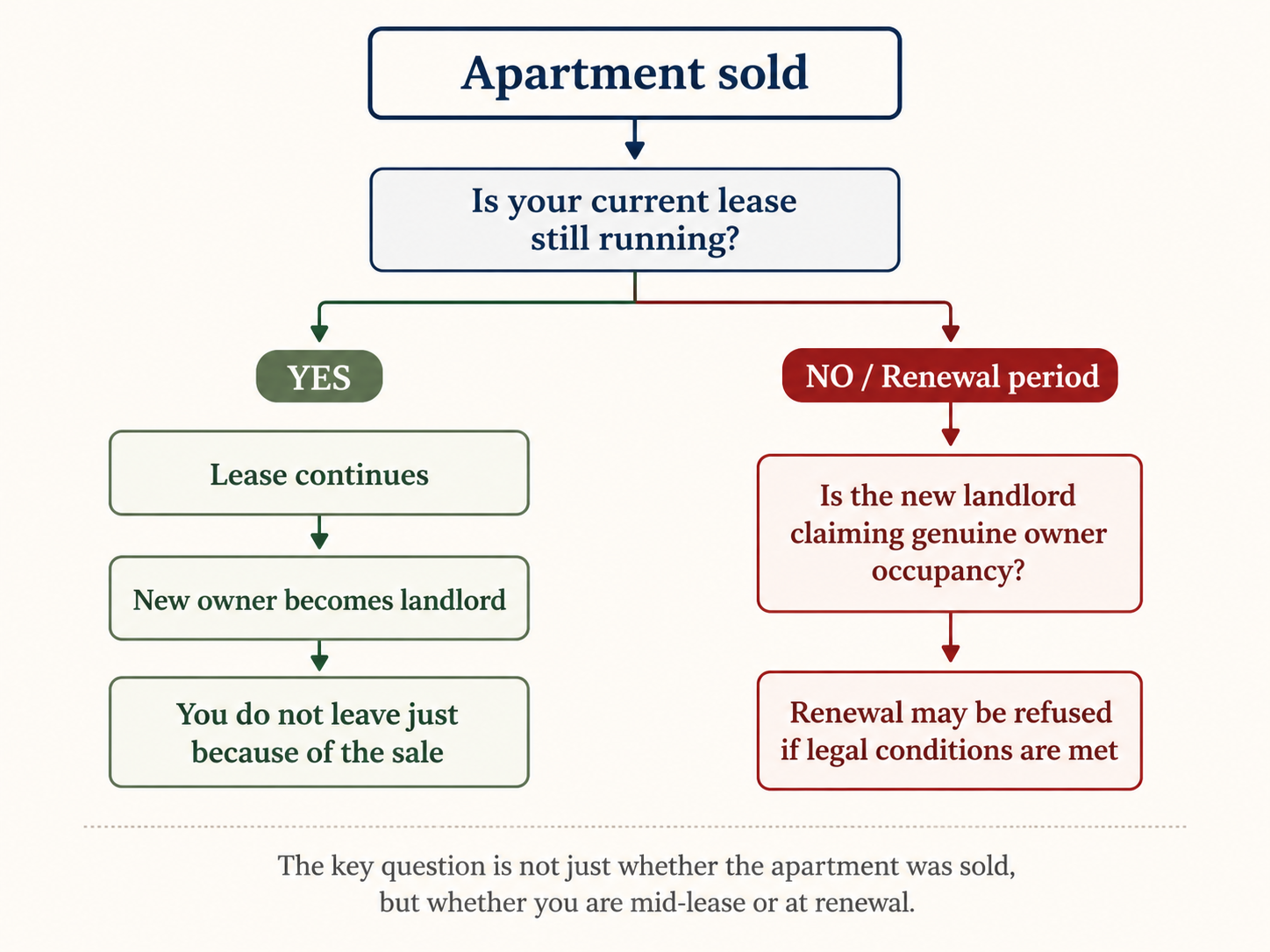
The most important question is usually not whether the apartment was sold.
It is whether you are still in the middle of your current lease or approaching the point where the lease may be renewed.
The Short Answer
If you have established legal opposability under Korea’s Housing Lease Protection Act, the sale of the apartment does not automatically terminate your lease.
The buyer steps into the legal position of the landlord.
That means if your current lease period is still running, the new owner cannot simply tell you to leave because they bought the property.
The situation can change as your lease approaches renewal.
A new owner who has legally become the landlord may, under certain conditions, refuse renewal if they genuinely intend to live in the apartment themselves.
So the basic decision path looks like this:
Did you establish legal opposability?
→ Are you still within the existing lease term?
→ Or are you approaching the renewal period?
→ If renewal is involved, is the new landlord claiming genuine owner occupancy?
That sequence matters far more than the simple fact that the property changed hands.
Does the Lease End When the Apartment Is Sold?
No.
Under Korea’s Housing Lease Protection Act, a tenant who satisfies the required conditions can assert the lease against third parties, including a new owner.
For most Korean tenants, this protection is established by taking possession of the home and completing resident registration. The legal effect begins from the following day.
The Supreme Court has also held that when ownership of a leased home changes, the buyer automatically succeeds to the legal position of the landlord if the tenant has opposability. The tenant’s separate consent is not required. See Supreme Court Decision 95Da35616, February 27, 1996.
So imagine this situation:
Your lease runs from January 2026 to January 2028.
The landlord sells the apartment in the middle of 2027.
The sale itself does not mean your lease suddenly ends in 2027. The buyer steps into the position of the landlord, while the existing lease continues for its remaining term.
This is why the common line “the lease ends when the home is sold” is misleading.
What About Foreign Tenants Who Do Not File Korean Resident Registration?
This is one of the differences that matters most for foreign residents.
Foreign tenants usually do not complete the same resident registration procedure used by Korean citizens. That does not mean they are excluded from tenant protection.
For registered foreign nationals, Article 88-2 of the Immigration Act provides that alien registration and notification of a change of place of stay substitute for resident registration and moving-in notification for these purposes. The legal system recognizes the foreign resident’s own registration and address-reporting procedure rather than demanding the exact administrative steps used by Korean citizens.
Foreign nationals of Korean heritage using domestic residence reporting are covered through the equivalent residence-reporting system.
Korean nationals residing abroad sit in a slightly different position. The statute did not originally spell out the same wording for them, but the Supreme Court has since recognized equivalent protection for domestic residence reporting and notification of a change of residence. See Supreme Court Decision 2015Da254507, April 11, 2019.
The point that matters:
Foreign tenants are not outside Korea’s tenant-protection system simply because their address-reporting procedure has a different name. What matters is whether the legally recognized reporting requirement has actually been completed.
Your Address Report and Your Fixed Date Are Not the Same Thing
This distinction is easy to miss.
Completing your address-related registration does not automatically give you every form of deposit protection available under Korean law. Legal opposability and preferential repayment rights are different protections.
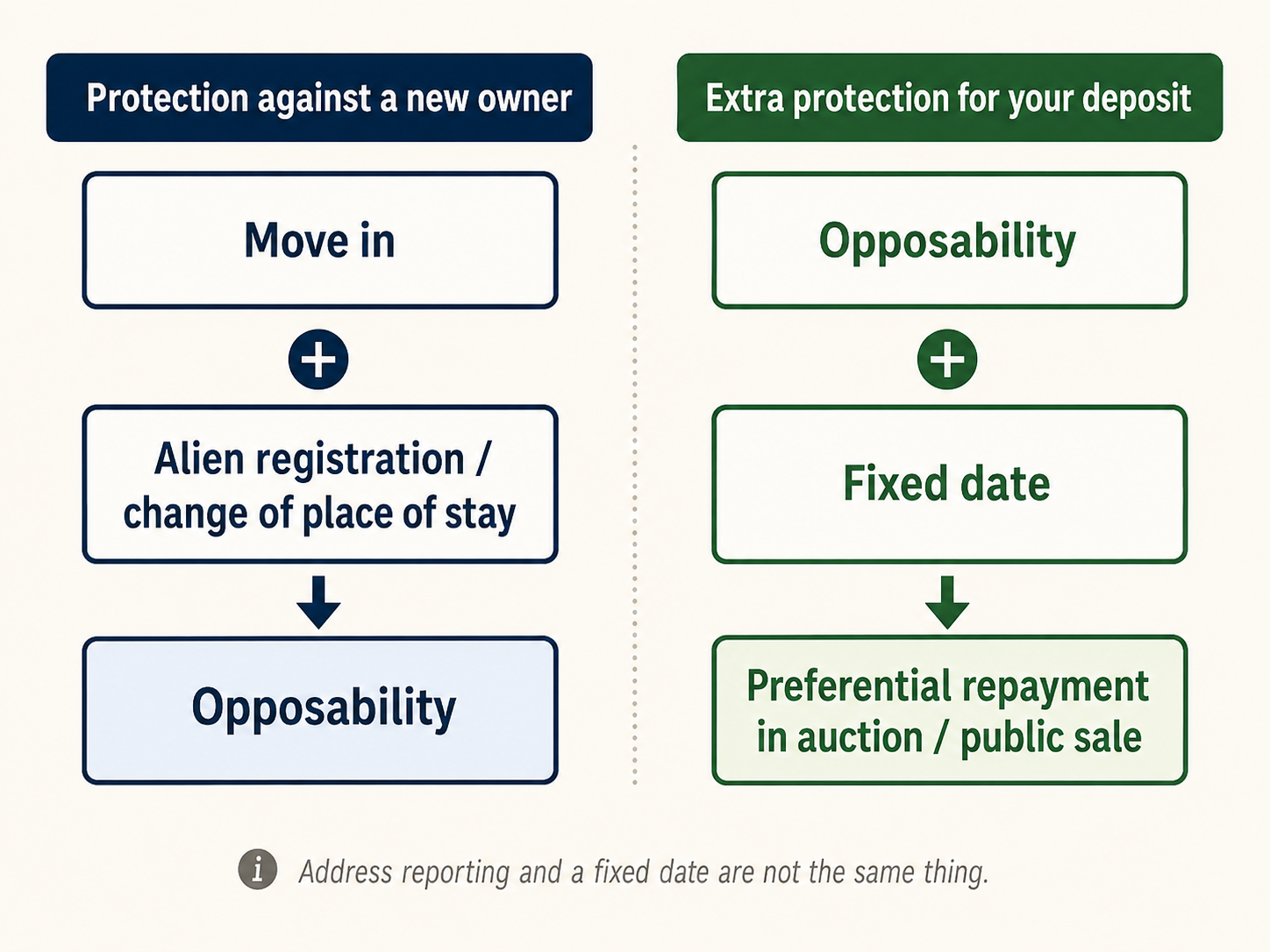
Legal opposability generally requires:
- possession of the home, and
- resident registration or the legally equivalent foreign-resident reporting procedure.
This lets the tenant assert the lease against third parties, including a later buyer of the property.
A fixed date, known in Korean as hwakjeong-ilja, does something else. If the property later enters auction or public sale, a tenant who has both the opposability requirements and a fixed date may receive preferential repayment ahead of certain junior creditors under Article 3-2 of the Housing Lease Protection Act.
Two ways to think about it:
Address registration or change-of-stay reporting establishes opposability.
A fixed date is an additional requirement for preferential repayment priority in an auction or public sale.
They are not the same procedure, and they do not create the same legal protection.
Who Has to Return the Deposit After the Apartment Is Sold?
For a tenant with opposability, the new landlord typically also takes over the obligation to return the rental deposit.
The Supreme Court has repeatedly treated the transfer of landlord status as including both rights and obligations under the lease, including the deposit repayment obligation. Supreme Court Decision 95Da35616 states that the deposit repayment obligation transfers together with the landlord’s status.
For example:
You paid a KRW 100 million deposit to Landlord A.
While your lease is still running, A sells the apartment to Buyer B.
If the landlord position is validly transferred to B, B becomes the person responsible for returning the deposit when the lease later ends. The previous landlord normally leaves the lease relationship once that transfer occurs.
There Is an Important Exception
Korean case law also protects tenants who do not want the landlord position to transfer to the buyer.
If the tenant learns of the sale and objects to the transfer within a “reasonable period,” the tenant may in some circumstances end the lease relationship with the original landlord and seek return of the deposit from that landlord instead.
A 2023 Seoul High Court decision applied this principle where the tenant objected within a reasonable period after learning about the transfer. See Seoul High Court Decision 2023Na2024464, November 24, 2023.
This is not a free choice between the old and new landlord whenever it suits you. The default rule is still that the new owner succeeds to the landlord position. The exception depends heavily on the tenant’s response after learning of the sale, including when and how the objection was made.
Because that can turn into a real legal dispute, a tenant considering this route should get individual legal advice rather than relying on a general online explanation.
Can the New Owner Make You Leave Because They Want to Live There?
Not immediately.
Two very different situations often get mixed together here.
Situation 1: Your Current Lease Is Still Running
Suppose you still have one year left on your lease. The apartment is sold, and the buyer tells you:
“I bought this place because I want to live here. Please move out next month.”
The sale, and the buyer’s desire to live in the property, do not erase the remaining term of the existing lease. If your current lease is still valid, it continues.
Situation 2: Your Lease Is Approaching Renewal
Owner occupancy becomes far more important once your existing lease is approaching its end and you are trying to exercise your statutory right to request renewal.
Under Article 6-3 of the Housing Lease Protection Act, a landlord may refuse renewal in certain situations. One of them is when:
“the landlord, including the landlord’s lineal ascendants or descendants, intends to actually reside in the housing.”
The window that matters for renewal notices runs from six months before the lease expires until two months before expiration.
The Supreme Court has held that even if the tenant requested renewal first, a buyer who becomes the landlord within the legally permitted refusal period may still refuse renewal on the basis of genuine owner occupancy. See Supreme Court Decision 2021Da266631, December 1, 2022.
That is why “I asked for renewal first, so the buyer can never refuse it” is also too simple. Timing matters. The buyer must have actually obtained the legal position of landlord at the relevant point — someone who has merely agreed to buy the apartment but hasn’t yet become the landlord cannot exercise rights that belong to the landlord.
INSIDE KOREA
The statute sounds simple: the landlord can refuse renewal if the landlord or certain close family members genuinely intend to live in the home.
In practice, saying “I plan to live there” is not necessarily enough. Korean courts examine whether the claimed intention to occupy the property is genuine, and the Supreme Court has made clear that the landlord bears the burden of proving that intention.
Courts may look at circumstances such as:
- where the landlord currently lives
- where family members work or attend school
- why the landlord says the move is necessary
- whether actual preparations to move have been made
- whether earlier statements or conduct conflict with the later owner-occupancy claim
So if a new landlord tells you renewal is being refused because they plan to move in, what they said is only part of the picture. The timing of the refusal, whether they had legally become the landlord, and whether the occupancy claim holds up all matter too.
Source: Supreme Court Decision 2022Da279795, December 7, 2023.
Does Korea’s “2+2” Rule Mean You Are Guaranteed Four Years?
Not necessarily.
Korea’s renewal system is often simplified into “two years plus another two years.” That shorthand is useful, but it is not an unconditional four-year guarantee.
A tenant may exercise the statutory renewal request right within the framework of the Housing Lease Protection Act. But the landlord can refuse renewal if one of the legally recognized grounds applies, and genuine owner occupancy is one of those grounds.
When a property is sold around the renewal period, several dates become important:
- when the property was sold
- when the buyer legally became the landlord
- when the tenant requested renewal
- when the new landlord refused renewal
- whether the refusal happened within the legally permitted period
- whether the owner-occupancy claim was genuine
Neither of these statements is fully accurate: “You automatically get four years” and “The new owner wants to live there, so you immediately have to leave.” The actual result depends on which stage of the lease you are in.
What If the Apartment Is Already for Sale When You Sign the Lease?
This worries a lot of foreign tenants.
You find an apartment you like, but the agent tells you: “The owner is also trying to sell it.”
That does not automatically mean you cannot rent the property. It does mean you should understand the ownership situation before signing.
At a minimum, check:
- who currently owns the property
- whether a sale is already in progress
- whether ownership is expected to transfer soon
- what your lease says
- whether you can complete the required address reporting after moving in
Check the property registration record before signing, and again if ownership later changes.
Once you move in, do not delay the address-reporting procedures that establish your legal position as a tenant. For a foreign resident, that may mean completing or updating alien registration and reporting the correct place of stay. You should also get a fixed date for the lease agreement.
Do not assume you can “take care of the paperwork later” because the apartment may be sold. The timing of your legal protections matters once a third party becomes the new owner.
What Should You Check If You Already Live There?
If your landlord tells you the apartment is being sold, you don’t need to panic or start packing immediately.
First check the basic facts. Confirm:
- when your current lease ends
- whether your foreign-resident address reporting is up to date
- whether you obtained a fixed date
- who is currently listed as the owner
- whether ownership has actually transferred
- whether the buyer has contacted you
- whether anyone has asked you to sign a new document
- whether the lease is still in its current term or approaching renewal
If ownership has already changed, confirm the new landlord’s identity and contact information.
If your lease is approaching expiration, pay particular attention to the renewal timeline. A dispute in the middle of an existing lease and a dispute about renewal are not the same legal problem.
The Real Question Is Not Simply Whether the Home Was Sold
The biggest misunderstanding about a landlord selling a rented apartment in Korea is treating the sale itself as the event that ends the lease.
For a tenant with legal opposability, that is not how the system works. The buyer steps into the landlord’s position. The existing lease continues. The deposit repayment obligation moves with the landlord position. Only after that do questions such as renewal and genuine owner occupancy become relevant.
For foreign tenants, one more thing matters: have you completed the legally recognized address-reporting procedure that gives your tenancy protection against third parties?
So if your landlord tells you, “I’m selling the apartment,” the first question probably shouldn’t be “Do I have to move?”
A better starting point is: “Have I established opposability, and where am I in the lease timeline?”
That distinction is why so much advice online sounds contradictory. People are often describing different stages of the same legal system.
Official Sources
- Housing Lease Protection Act — National Law Information Center
- Immigration Act, Article 88-2 — National Law Information Center
- Supreme Court Decision 95Da35616 — landlord status and deposit obligation after transfer
- Supreme Court Decision 2015Da254507 — foreign residents and tenant opposability
- Seoul High Court Decision 2023Na2024464 — tenant objection to landlord-status succession
- Supreme Court Decision 2021Da266631 — buyer’s owner-occupancy refusal of renewal
- Supreme Court Decision 2022Da279795 — burden of proving genuine owner occupancy
This article provides general information about Korean housing law and is not individual legal advice. The outcome of a dispute can depend on the lease terms, registration status, dates, and other facts of the case.