Korean Language School in Korea: Visa, Cost & What to Expect
Choosing the right Korean language school in Korea depends on your visa, study length, budget, and schedule. If you want to study Korean full-time and need a D-4-1 visa, a university-affiliated language institute is the standard route. In 2026, major Seoul programs cost roughly ₩1.8–1.86 million per 10-week term.
The major university programs we checked also require D-4 applicants to register for at least two terms upfront. A dorm bed isn’t guaranteed just because you enroll; it varies sharply by school. Part-time work isn’t available right away either. D-4-1 students can only apply for permission after six months from their date of entry or change to D-4 status. If you’re only staying briefly, or you need evening or weekend classes, a private academy may actually fit you better than a university program.
What Is a University Korean Language Program?
“Korean language school” can mean two very different things.
University language institute
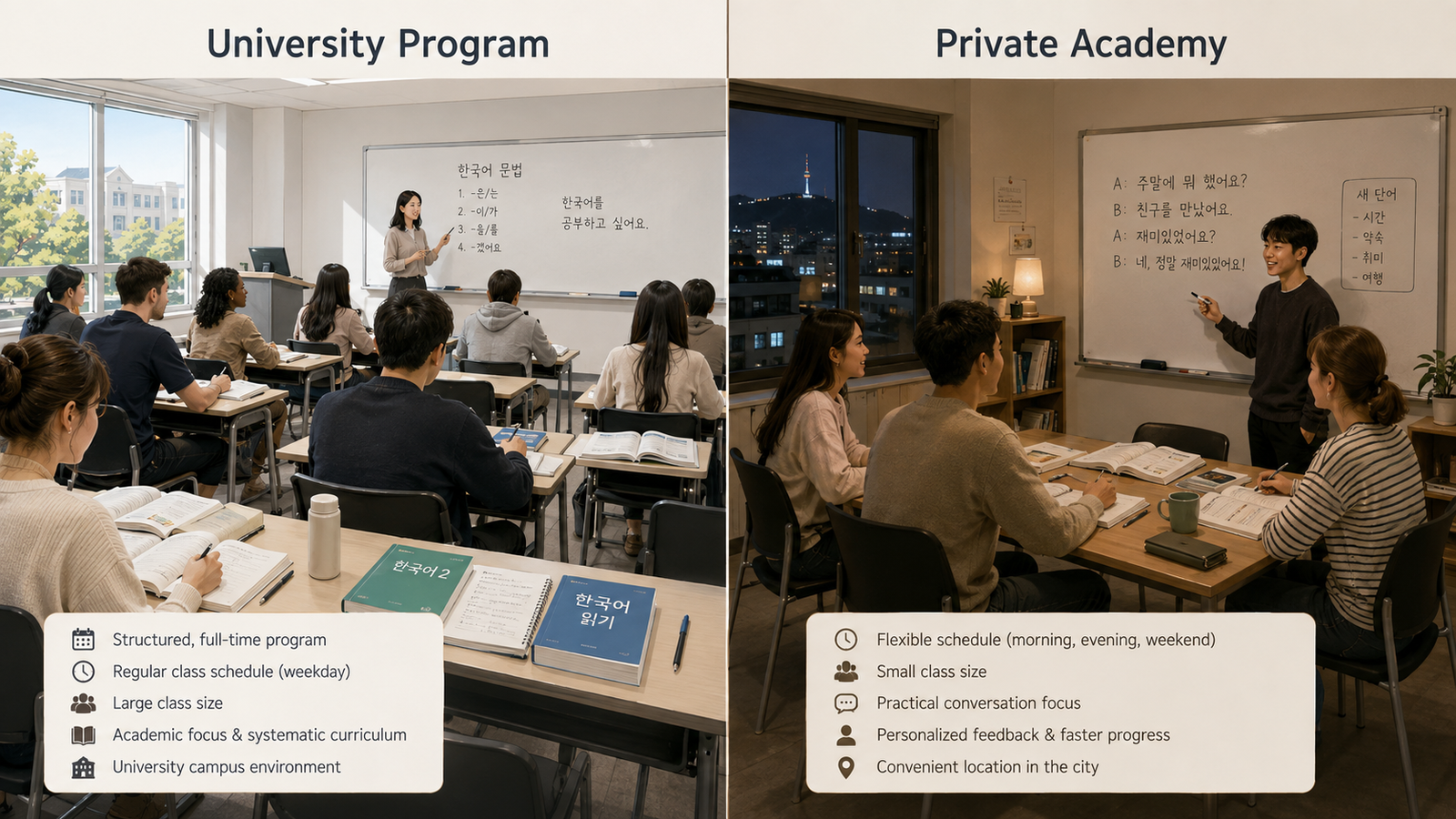
These are Korean-language programs run directly by a university: Yonsei’s KLI, Sogang’s KLEC, Korea University’s KLC, and similar centers at other schools. They typically run in 10-week terms, five days a week, full-time, from beginner to advanced levels. This is the track that connects to the D-4-1 visa.
Private Korean academy
These are independent language schools not affiliated with a university. They tend to offer more flexibility: evening classes, weekend classes, and short intensive courses. What they don’t offer is a D-4-1 pathway. Ordinary private Korean-language academies aren’t the institutions that issue the standard admission letter D-4-1 requires. There is a separate visa code, D-4-6, for foreign trainees at accredited private institutions, but that one is built for specialized technical training programs, not general Korean-language study. It isn’t a realistic option for someone starting from zero Korean.
A private Korean academy and a university language institute are not interchangeable if you need a D-4-1 visa.
Do You Need a D-4-1 Visa?
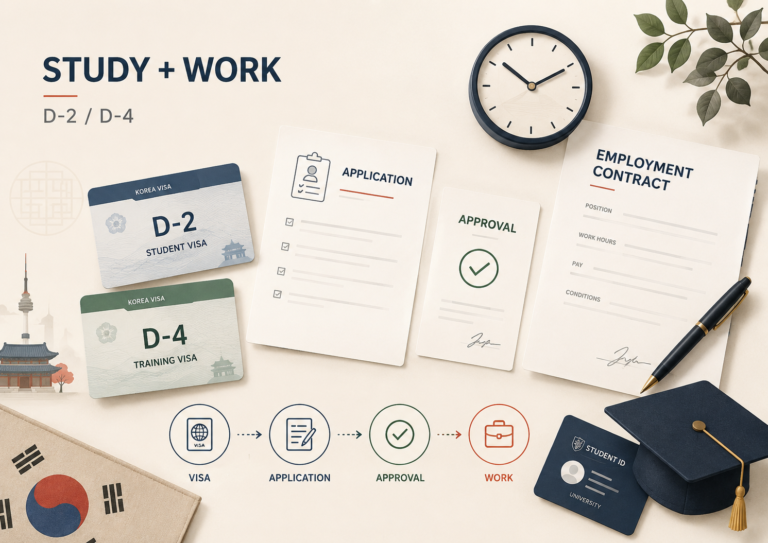
You generally need a D-4-1 visa if you’re planning long-term, full-time Korean study at a university-affiliated institute. In practice, this means your stay in Korea is centered on the language program itself, not a side activity alongside something else.
If you’re studying for 90 days or less, you generally don’t need a D-4-1. Depending on your nationality and circumstances, you may use a short-term visa such as C-3-1 or an eligible visa-free or K-ETA entry route. Always check the entry rules for your nationality before applying.
The major university programs we checked, Yonsei, Sogang, and Korea University, require D-4 applicants to register for at least two terms upfront, not one. (Yonsei KLI · Sogang KLEC · Korea University KLC)
Official rule: D-4-1 is the standard route for long-term Korean-language study at a university-affiliated institute.
In practice: If you already hold another status, including working holiday, changing to D-4 inside Korea may not be straightforward. The universities we checked describe the procedure differently.
What to do: Confirm with both the language institute and immigration before paying tuition on the assumption that you can change status in Korea.
How Much Does a Korean Language School in Korea Cost in 2026?
Study in Korea, the government’s own portal, gives a general range of about ₩1.2–1.8 million per 10-week university-affiliated program at 20 hours a week. Major Seoul programs in 2026 tend to sit near the top of that range.
| Program | Tuition | Application fee |
|---|---|---|
| Yonsei KLI | ₩1,860,000 | ₩120,000 |
| Sogang KLEC (KGP200) | ₩1,860,000 | ₩100,000 |
| Korea University KLC | ₩1,800,000 | ₩120,000 |
| Ewha ELC | ₩1,800,000* | ₩100,000* |
*From the 2026 winter term, Ewha’s tuition rises to ₩1,850,000 and its application fee to ₩120,000. Fees can change even within the same year, so check the linked official page before paying.
Tuition and the application fee aren’t the only costs. Depending on the school, you’ll also need to budget separately for textbooks, housing, health insurance for international students in Korea, and everyday living expenses.
What Does a Typical Term Look Like?
Across the schools we checked, the shape is broadly similar: a 10-week term, five days a week, roughly 20 hours of class per week. You’ll usually take a placement test before your first class to determine your starting level, then move up a level each term if you meet that school’s progression requirements. Morning and afternoon scheduling, exact class hours, and level structures vary by school. Check your specific program’s schedule instead of assuming it matches what you’ve read elsewhere.
Attendance Matters More Than You Might Expect
There is no single attendance rule that applies to every university language institute.
| School | Attendance requirement |
|---|---|
| Yonsei KLI | 80% or higher |
| Sogang KLEC | 70% or higher (140 hours) |
| Korea University KLC | 80% or higher (160 hours) |
| Ewha ELC | 80% (40 of 50 sessions) |
This isn’t just about whether you can retake a quiz. Falling below your school’s attendance threshold can affect level progression, your ability to re-enroll for the next term, and, for D-4 visa holders, your standing with immigration.
Official rule: Attendance thresholds exist at every school we checked.
In practice: The number itself ranges from 70% to 80%, and how it’s calculated, whether by percentage, hours, or absence count, also differs.
What to do: Check your own institute’s attendance rules instead of relying on a generic “80% rule” you found online.
Can You Live in a University Dorm?
Sometimes. Never assume language-school enrollment includes university housing.
- Yonsei: Very limited. Yonsei says dormitory capacity is only around 10% of its language-program enrollment, and rooms are first-come, first-served.
- Korea University: New students only, for one semester only.
- Sogang: Regular-course students cannot get a dorm at all.
- Ewha: Dormitory applications are available for the Intensive Program, subject to each term’s notice and capacity.
Can D-4 Students Work Part-Time?
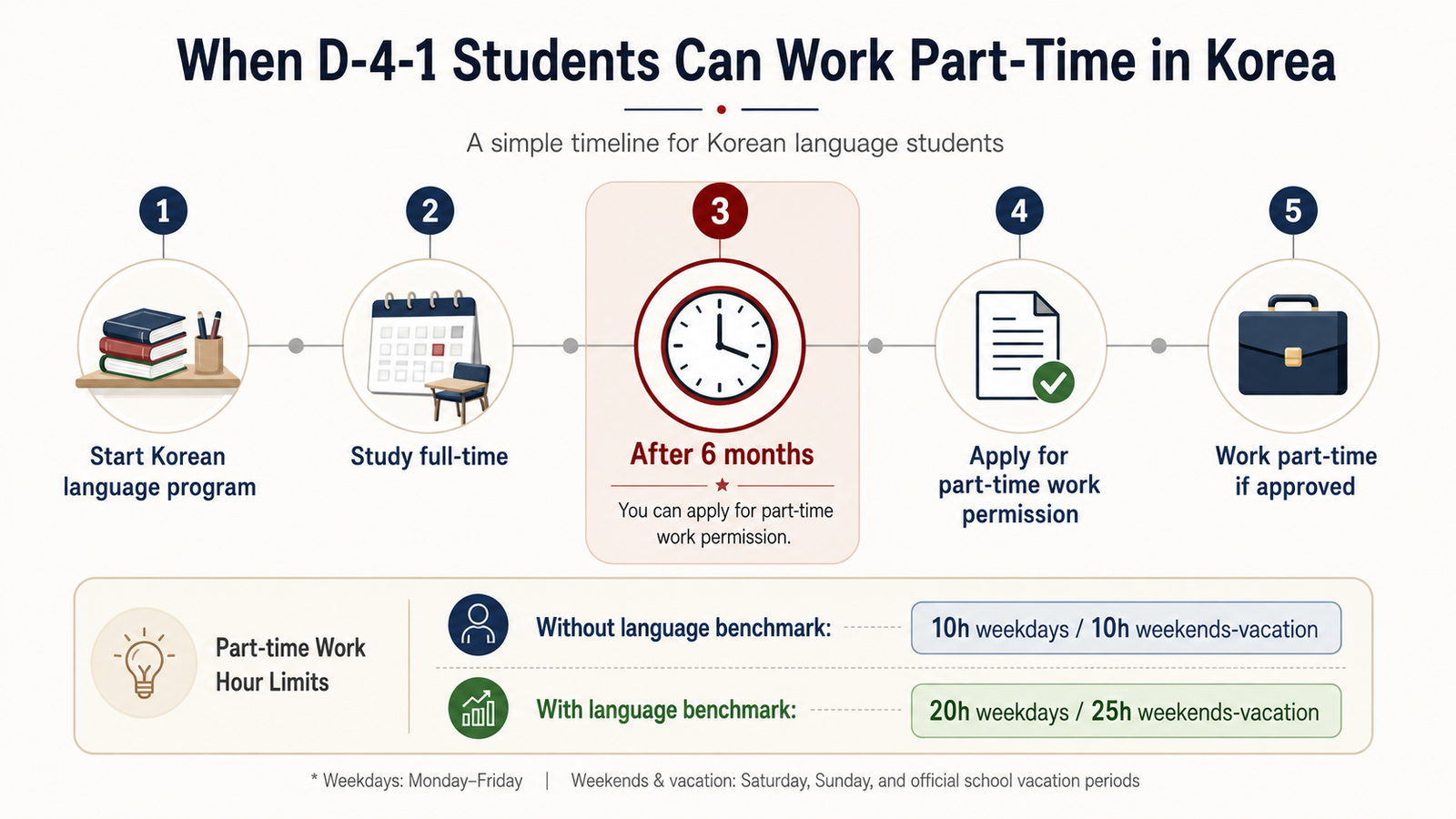
Not right away. D-4-1 students can apply for part-time work permission only after six months from their date of entry or change to D-4 status. Even then, it requires both your school’s confirmation and immigration’s approval. Working before that permission is granted is illegal.
Allowed hours depend on your Korean ability. Without meeting the language benchmark, the limit is 10 hours on weekdays and 10 hours on weekends or during vacation. Meeting the benchmark raises the limit to 20 hours on weekdays and 25 hours on weekends or during vacation. It’s not unlimited hours just because it’s a break.
For the full rules, see our guide to part-time work for international students in Korea.
University Language School vs Private Academy: Which Should You Choose?
| Choose a university program if… | Consider a private academy if… |
|---|---|
| You need a D-4-1 route | You already have another valid status |
| You want full-time structured study | You want evenings or weekends |
| You plan to study for several months | You only want short-term classes |
| You are preparing for university | Flexibility matters more than campus life |
| You want an academic environment | You don’t need university facilities |
A university language institute is not automatically “better.” It’s built for a different type of student.
Who Is This Actually Best For?
Good fit: Long-term Korean study, preparing for university admission, needing a D-4-1 visa, or preferring a focused, structured learning environment.
Probably overkill: A two-to-four-week trip, wanting evening classes only, already having a job or life set up in Korea, or needing to keep your schedule flexible.
If you are using language study as a test run for a longer stay, remember that student life can feel very different from working or settling here. Our look at what living in Korea as a foreigner actually feels like explains why those stages can produce very different experiences of the same country.
Before You Apply
- Confirm the exact program name. Sogang’s KGP200 and KAP200 are priced differently, for example.
- Confirm the program actually issues D-4-eligible admission, if you need it.
- Confirm the minimum number of terms required for D-4 applicants.
- Check the current tuition and application fee on your chosen school’s official program page.
- Confirm whether dormitory housing is actually available for your program.
- Check your specific institute’s attendance rule.
- Check that school’s current visa instructions.
- Recheck the official page immediately before paying. Fees can change mid-year.