Why Your Korean Banking App Won’t Let You Open Another Account Yet
You already have a Korean bank account. You open your banking app to set up another one, maybe at a different bank, for a separate purpose, or simply because another bank has features you prefer.
Then the application gets rejected with a vague message saying the account cannot be opened right now.
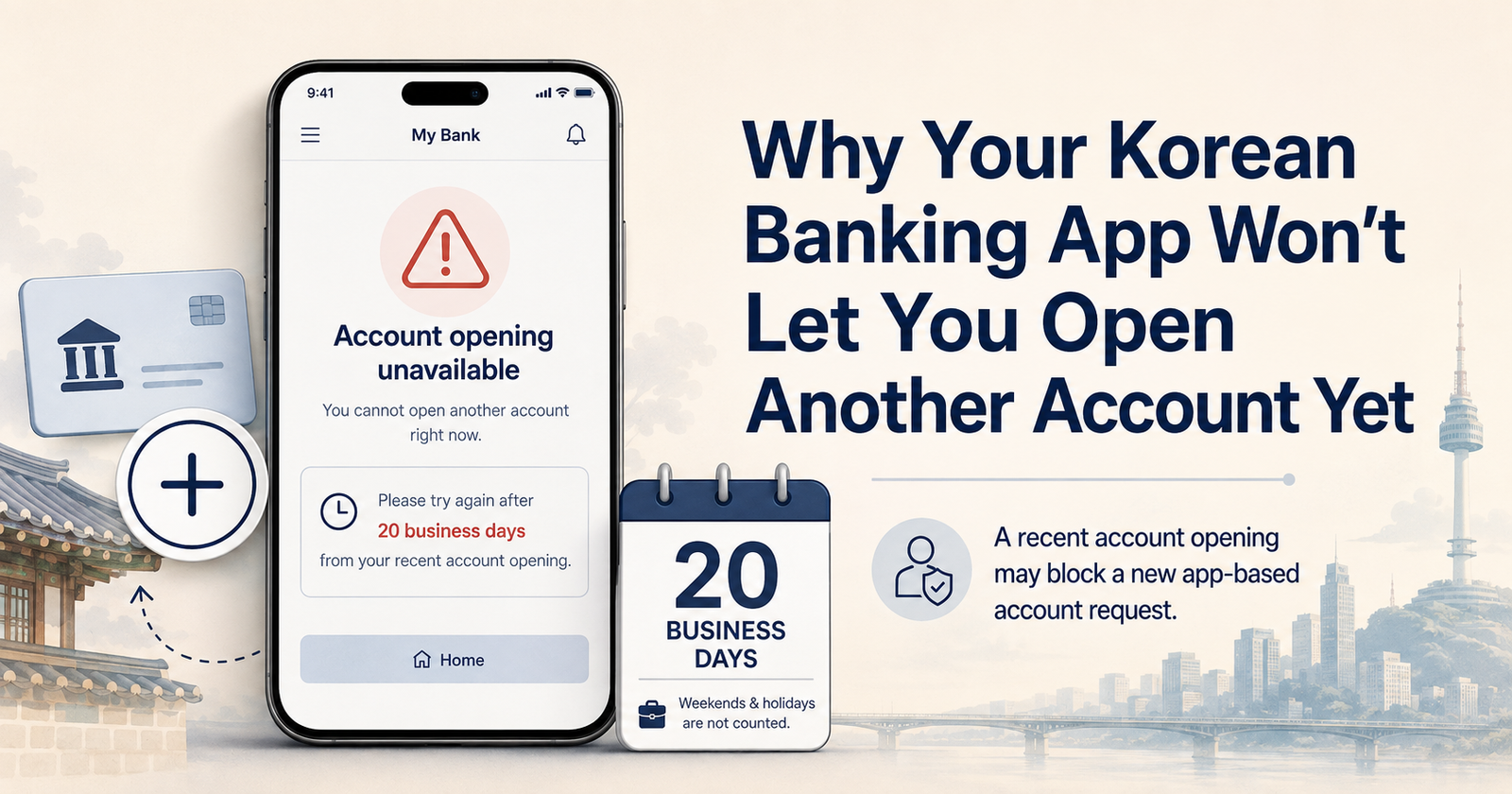
The Korea 20 business day bank account rule is one possible reason an app-based application can be blocked after you recently opened another account.
That does not necessarily mean there is something wrong with your documents or the app itself. One possible reason is a 20-business-day restriction tied to recent account openings that appears in the non-face-to-face account-opening rules of some Korean financial institutions.
And importantly, this is not the same thing as Korea’s better-known limited-transaction account (한도제한계좌).
Two Different Banking Restrictions, Often Confused
A lot of English-language guides to Korean banking explain the limited-transaction account: an account that is successfully opened but comes with transaction limits until the bank is satisfied with the financial purpose of the account.
The 20-business-day condition is different. It can affect whether certain new non-face-to-face account applications can proceed in the first place.
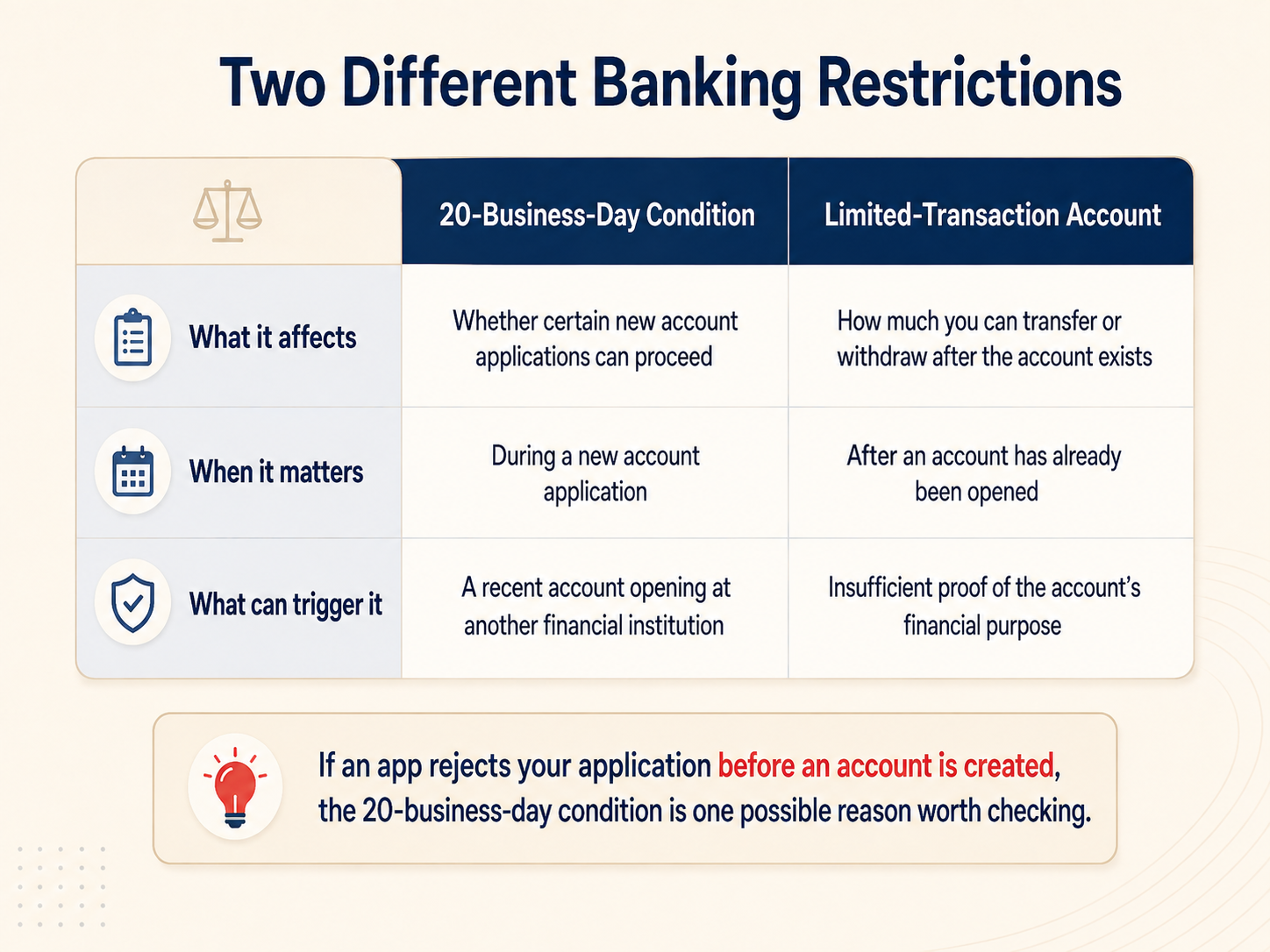
If an app rejects your application before an account is created, the 20-business-day condition is one possible reason worth checking.
If the account already exists but transfers or withdrawals are capped, you are dealing with a different issue.
What the 20-Business-Day Condition Actually Means
Some Korean financial institutions explicitly restrict certain non-face-to-face account applications when the applicant has recently opened another demand-deposit account.
The Korea 20 business day bank account rule is best understood as a recent-account-opening condition used in some non-face-to-face banking processes.
The important detail is that the window is measured in business days, not calendar days.
For example:
- Woori Bank: Its official non-face-to-face account-opening guidance for individual businesses says an application cannot proceed when the applicant has opened a demand-deposit account at any financial institution within the previous 20 business days.
- Suhyup Bank: Its official non-face-to-face account-opening guide lists having opened a demand-deposit account at Suhyup or another bank within the previous 20 business days as a restriction on using the service.
These examples do not prove that every Korean bank, every product, and every account-opening channel applies an identical rule.
What they do show is that a 20-business-day condition tied to recent account openings is real and is explicitly built into some Korean financial institutions’ non-face-to-face account-opening rules.
20 Business Days Is Longer Than It Sounds
Twenty business days does not mean 20 calendar days.
Weekends are not counted, and public holidays can extend the waiting period further.
In a typical month, 20 business days works out to roughly four calendar weeks, although the exact date depends on weekends and holidays.
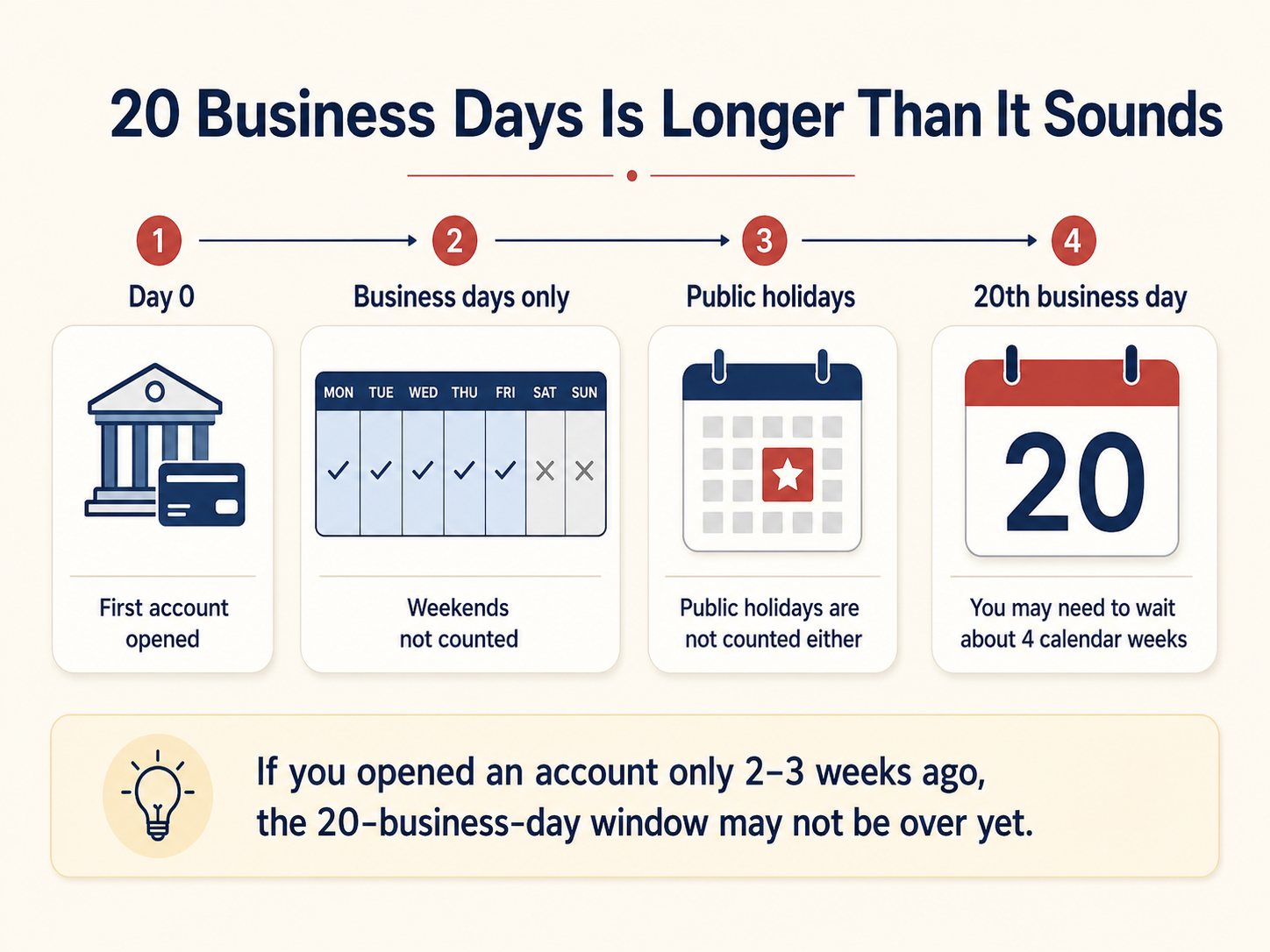
So if you opened an account only two or three weeks ago and another banking app refuses to let you open a new one, check the original account-opening date before assuming something is wrong with your identity documents or application.
Is This a Foreigner-Specific Rule?
No. The official bank guidance we reviewed does not describe the 20-business-day condition as a rule specifically for foreign residents.
For example, Suhyup’s non-face-to-face service page actually describes a service for Korean nationals and still applies the recent-account-opening restriction.
That matters because a foreign resident who runs into this rule may reasonably assume the problem is related to nationality, a Residence Card, or Korean identity verification.
It may not be.
The more useful question is simply:
Have I opened another relevant account recently?
Foreign residents may notice the issue soon after arriving in Korea because they are often setting up several financial and mobile services in a short period of time. But the 20-business-day condition itself is not presented in the official guidance we reviewed as a foreigners-only restriction.
If you’re setting up life in Korea at the same time, housing can involve its own unfamiliar rules. Our guide to renting an apartment in Korea as a foreigner explains how Korean deposits, brokerage fees, address reporting, and tenant protection work.
This Is Not a Limited-Transaction Account
This distinction is worth repeating because the two issues require completely different responses.
A limited-transaction account already exists. The problem is that the amount you can transfer or withdraw is restricted until the bank accepts sufficient evidence of the account’s financial purpose.
The 20-business-day condition discussed here comes earlier. It can prevent certain non-face-to-face applications from proceeding after another account was recently opened.
In simple terms:
20-business-day condition: Can I open this account right now?
Limited-transaction account: I opened the account — how freely can I use it?
They can both appear during the process of setting up banking in Korea, but they are not the same restriction.
What to Do If a Banking App Blocks Your Application
If an app refuses to let you open another account, work through these checks before assuming the issue is your foreign-resident status.
- Check when you last opened an account. Count business days, not calendar days.
- Check the specific bank’s rules. The scope and wording of the 20-business-day condition can differ by institution, product, and channel.
- Confirm which problem you actually have. An application that cannot proceed is different from an account that has already opened with transaction limits.
- Ask the bank about your specific case. If the app blocks you, ask whether the recent-account-opening condition applies to the product you are trying to open.
- Ask separately about an in-person application if necessary. We did not find sufficiently consistent official documentation to say that visiting a branch automatically bypasses the restriction, so do not assume it will. Ask the bank directly.
Why the App Doesn’t Always Explain This Clearly
From the user’s side, several very different banking problems can look almost identical.
You tap “open account,” complete part of the application, and eventually receive a message saying you cannot continue.
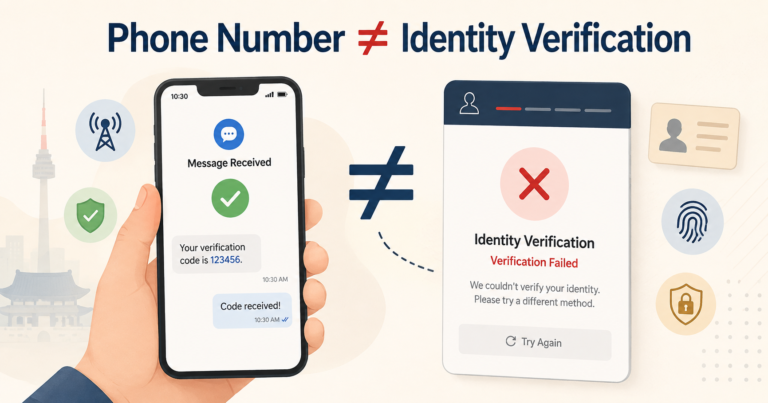
But the underlying reason could involve account-opening eligibility, identity verification, product-specific requirements, or a recent account-opening condition.
That is why it helps to separate these systems instead of treating every rejected application as one generic “foreigner banking problem.”
A Korean bank account can exist and still have transaction limits.
And having one Korean bank account does not necessarily mean an app will let you immediately open another one.
What We Verified
Official guidance from Woori Bank and Suhyup Bank confirms that a 20-business-day condition tied to recent demand-deposit account openings appears in certain non-face-to-face account-opening processes.
The official sources differ in their exact scope and target customer, so this article does not claim that every Korean bank or every account-opening channel applies an identical rule.
We also confirmed that this issue is conceptually different from a limited-transaction account: one concerns whether a new application can proceed, while the other concerns how an account can be used after it has already been opened.
What We Couldn’t Verify Clearly
We did not find sufficiently consistent official documentation explaining whether an in-person branch application is always treated differently from a non-face-to-face application.
We therefore do not describe visiting a branch as a guaranteed workaround.
If a banking app blocks your application before 20 business days have passed, ask the bank whether the condition applies to that specific product and whether another application method is available in your case.