How to Find an Apartment in Korea as a Foreigner
Finding an apartment in Korea as a foreigner isn’t difficult because listings are hard to find. Open Naver Real Estate, Zigbang, or Dabang, search a neighborhood and a price range, and you’ll have plenty of options to look through.
The hard part comes after.
Korean rental listings price things differently from what many foreign renters are used to, and the paperwork you complete to protect your deposit after signing isn’t exactly the same for a Korean tenant and a foreign one. Registered foreigners don’t use the standard resident move-in registration that Korean citizens use.
So what happens to a foreign tenant’s deposit protection?
That question matters more than which app you use. This guide walks through how to read a listing correctly, how to check whether a price is realistic, and what you actually need to do before and after signing to protect a deposit that, in Korea, can be the largest sum of money you’ll hand anyone.
1. First, Understand What the Listing Price Actually Means
Korean rental listings use terms that don’t map cleanly onto rental systems many foreign renters have seen before: jeonse, wolse, and ban-jeonse.
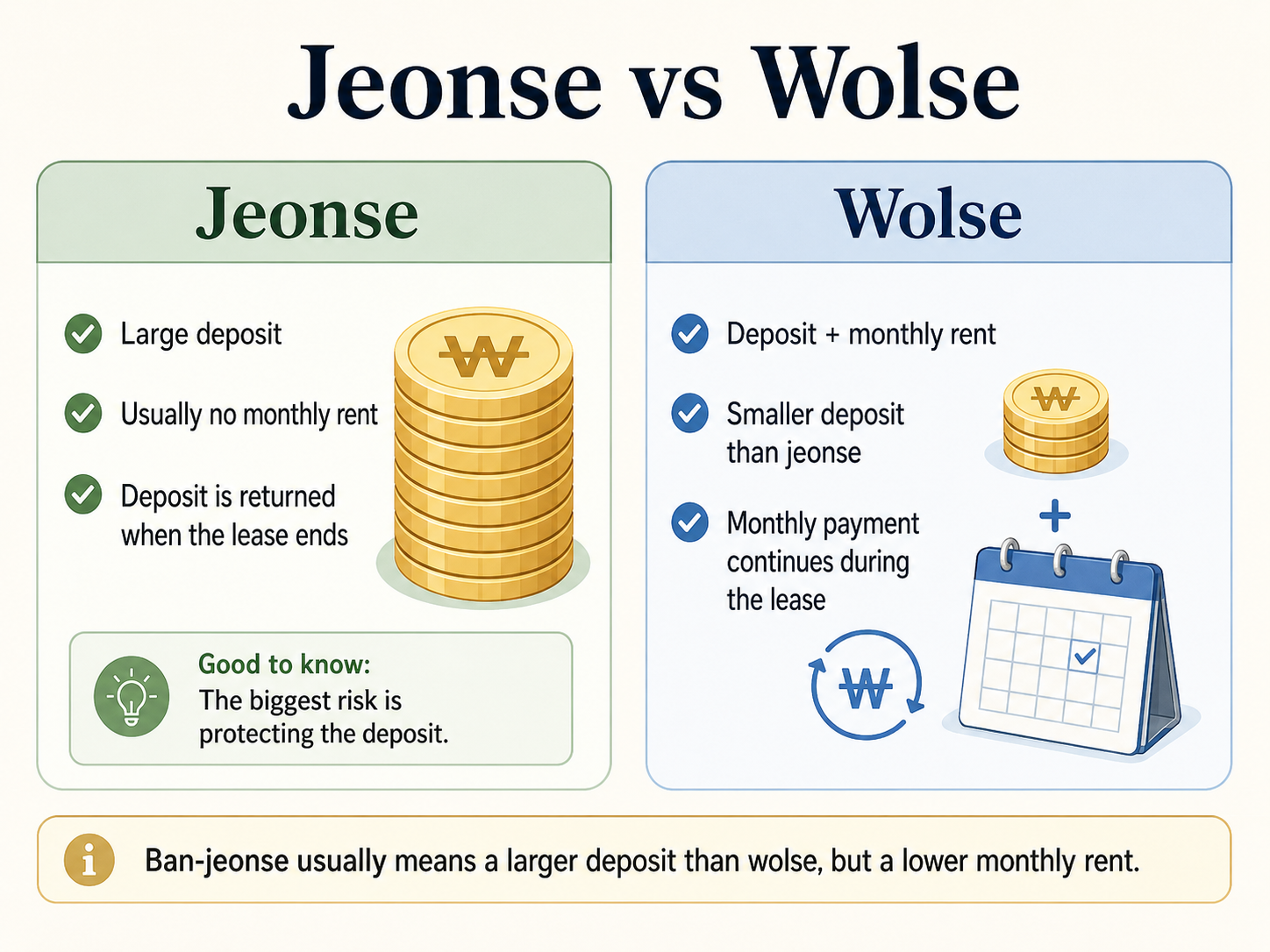
Jeonse: A Large Deposit, Usually No Monthly Rent
In a jeonse contract, the tenant hands the landlord a large lump-sum deposit and usually pays no separate monthly rent for the length of the lease.
Say a jeonse deposit is listed at KRW 300 million. Under the terms of the contract, that’s the amount you hand over up front, and the landlord is expected to return it when the lease ends.
To a foreign renter, “no monthly rent” can look like the cheaper option. It isn’t, at least not in the way that phrase usually sounds. You’re handing a large amount of money to a landlord and expecting to get it back.
The real question with jeonse isn’t whether you’re paying monthly rent. It’s whether your deposit is properly protected, which is what much of the rest of this guide is about.
Wolse: A Deposit Plus Monthly Rent
Wolse combines a deposit with a monthly rent payment. Listings often compress both numbers into a short format, something like:
10,000 / 70
Korean property listings commonly display prices in units of KRW 10,000, or man-won. If that convention is being used, 10,000 / 70 means a KRW 100 million deposit and KRW 700,000 in monthly rent.
Formatting can vary by platform and listing, so don’t guess from two numbers alone. Confirm the deposit and monthly rent as separate figures before you take a listing seriously.
Ban-jeonse Sits Between the Two
Ban-jeonse isn’t a completely separate legal contract type so much as a term used in practice. It usually describes a deposit that’s larger than a typical wolse deposit but smaller than a full jeonse deposit, paired with a lower monthly rent.
What matters for a foreign tenant isn’t the label. It’s the actual deposit and monthly rent written into the contract.
You may also come across a formula involving monthly rent multiplied by 100 or 70. That’s not a way to decode a listing or calculate what the property is “really” worth. It’s used for brokerage-fee calculations, which we’ll get to later.
2. How to Find an Apartment in Korea as a Foreigner, Step by Step
If you’re settling in Korea for the long term rather than staying for a few weeks, it helps to break the search into stages instead of expecting one app to give you the full picture.
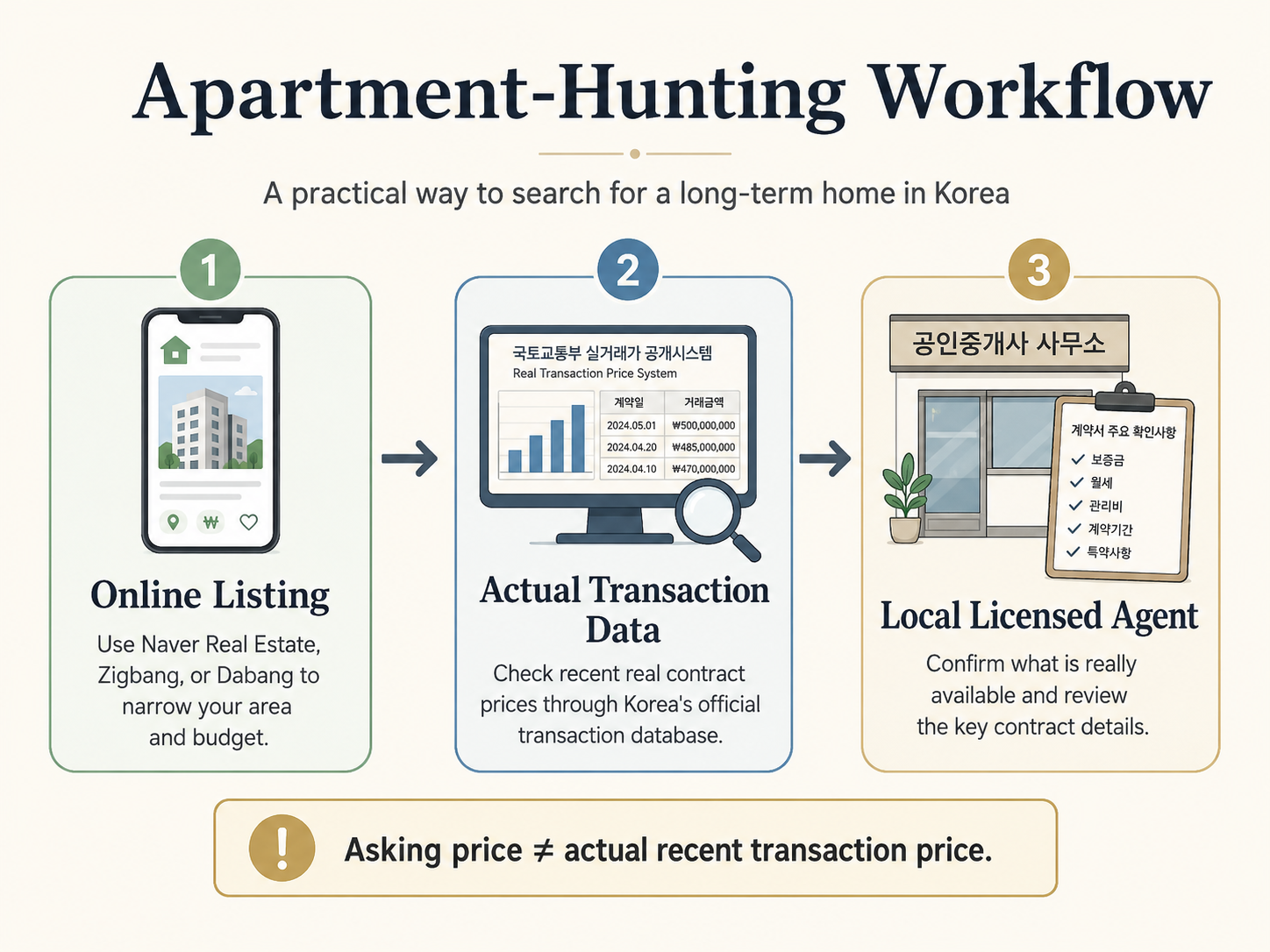
Step 1: Start With Listings, Not a Single “Best” App
Naver Real Estate, Zigbang, and Dabang can all help you get a feel for neighborhoods and price ranges.
There isn’t reliable official data showing that one consistently has the most listings or is always the best choice for foreign tenants.
So don’t spend your first afternoon trying to identify the “right” app. Pick one or two, get a feel for deposit levels, monthly rents, and housing types in the area you want, and use the listings to narrow your search.
The app is a starting point, not the final word on what’s available.
Step 2: Check What People Actually Paid
A listed price is an asking price. What people recently agreed to pay for similar homes in the same area is a separate question.
Korea’s Ministry of Land, Infrastructure and Transport operates an official Real Transaction Price Disclosure System, where you can check actual sales and rental transactions.
The database covers apartments, multiplex and multi-family housing, single and multi-household homes, officetels, and other property types.
A useful sequence looks like this:
online listing → comparable recent transactions → local licensed agent
Don’t take a single asking price as proof of what a neighborhood costs. Compare it with recent transactions for similar housing in the same area.
Step 3: Visit a Local Licensed Real-Estate Agent
Once you’ve narrowed your options online, a licensed local real-estate agent, or gongin-junggaesa, can confirm what is actually available to rent.
Online listing availability can change quickly. A property you saw yesterday may already be under contract, or the terms may have changed.
At minimum, confirm:
- The actual deposit and monthly rent
- Maintenance fees and what they cover
- The available move-in date
- The lease length
- What furniture or appliances are included
- The brokerage fee
- Anything else that should be checked before you commit to the deposit
Checking the property’s official registry, ownership, and existing rights or claims is also part of proper due diligence before signing. The detailed process for reading those records is important enough to deserve its own guide, so it isn’t covered step by step here.
3. If You Need Help in English
If reviewing a lease in Korean feels like too much, Seoul operates a program worth knowing about.
The Seoul Metropolitan Government designates Global Real Estate Agencies that can provide property-related assistance in foreign languages.
According to Seoul’s official guidance, these offices can help foreign residents understand key lease terms, check deposit and property-rights information before signing, and access information intended to prevent jeonse deposit fraud.
That’s a more useful starting point than simply searching “English-speaking realtor near me” and hoping for the best. These are licensed real-estate offices designated by the city government.
4. Know How the Brokerage Fee Is Calculated
Korea sets maximum brokerage-fee rates according to the transaction amount.
For wolse contracts, the brokerage fee isn’t calculated from the monthly rent alone. The law first converts the deposit and rent into a single transaction amount.
The standard calculation is:
deposit + (monthly rent × 100)
If that amount is below KRW 50 million, it is recalculated as:
deposit + (monthly rent × 70)
Korea’s Easy Law service, operated by the Ministry of Government Legislation, gives an official example.
Take a contract with a KRW 5 million deposit and KRW 350,000 monthly rent.
First:
KRW 5 million + (KRW 350,000 × 100) = KRW 40 million
Because that is below the KRW 50 million threshold, the amount is recalculated:
KRW 5 million + (KRW 350,000 × 70) = KRW 29.5 million
The applicable brokerage-fee ceiling rate is then applied to that transaction amount.
Worth repeating: this formula doesn’t tell you what a home is “really” worth, and it doesn’t convert wolse into an equivalent jeonse price. It exists for brokerage-fee calculations.
The legal rate is also a ceiling, not automatically a fixed fee that must be charged in every transaction. Ask the agent what the actual brokerage fee will be before you commit.
5. Foreign Residents Do Not Use the Same Move-In Procedure as Koreans
Here’s where foreign tenants often get confused.
Guides written for Korean renters usually tell tenants to complete a resident move-in registration, or jeon-ip sin-go, after moving.
Registered foreign residents follow a different administrative route. Under Article 36 of Korea’s Immigration Act, a registered foreigner who changes their place of stay must report the new address.
The report can be made through the relevant city, county, district, eup, myeon, or dong office, or through the immigration office responsible for the new address.
You will generally need your Residence Card and documentation showing your new place of stay, typically the lease contract. If you aren’t a direct party to the lease, such as when a company or family member holds the contract, additional proof of accommodation may be required.
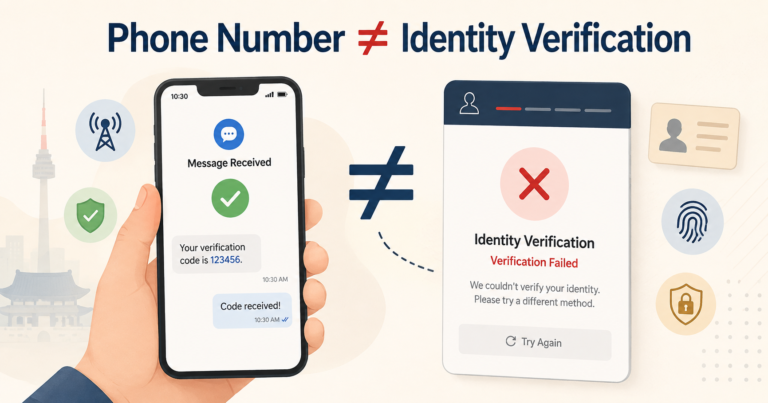
This registration system also matters in other parts of daily life in Korea. If you’ve already run into problems using a Korean phone number for online services, our guide to Korean phone number identity verification explains another common foreign-resident friction point.
Under Article 36 of the Immigration Act, the filing window is 14 days from the date you change address. Some government portals, including Gov.kr, list 15 days instead. Where the statute and an administrative page disagree, confirm the current requirement with HiKorea or your local immigration office before you move.
Don’t treat the address report as routine paperwork you can put off. It can also affect your legal position as a tenant.
6. Does That Still Protect Your Deposit?
If foreign residents don’t complete the same resident move-in registration Korean citizens do, does that mean they lose the tenant protection that registration normally helps establish?
No.
The Supreme Court Has Already Answered This
In its October 13, 2016 ruling in case 2015Da14136, Korea’s Supreme Court held that alien registration or a report of change of place of stay completed under immigration law can have the same legal effect as resident registration for the purpose of establishing opposing power under the Housing Lease Protection Act.
Being a foreign national does not automatically place a tenant outside the protection of Korea’s housing lease law.
That doesn’t mean your deposit is automatically protected just because you have a Residence Card.
A tenant still needs to satisfy the required conditions, including taking possession of the property and properly completing the relevant address-registration procedure.
COMMON MISUNDERSTANDING
Foreigners can’t complete the same resident move-in registration Korean citizens do, so they can’t receive the same protection under the Housing Lease Protection Act.
WHAT THE LAW ACTUALLY DOES
Foreign residents use alien registration or a report of change of place of stay instead. Korea’s Supreme Court has ruled that, when the legal requirements are satisfied, these filings can have the same legal effect as resident registration for establishing tenant protection.
7. How the Protection Actually Works, Step by Step
Now that you know a foreign tenant can qualify for protection under the law, it’s worth understanding how that protection is built.
Signing the lease and getting the keys isn’t the end of the process.
Opposing Power Comes First
Under Korea’s Housing Lease Protection Act, a residential tenant can establish opposing power by taking possession of the home and satisfying the relevant registration requirement.
For a registered foreign tenant, a properly completed alien registration or report of change of place of stay can satisfy the registration element, as confirmed by the Supreme Court ruling above.
Opposing power is what allows a tenant to assert the lease against third parties, including a new owner if the property changes hands.
A Fixed Date Adds Priority Repayment Rights
The other piece is a fixed date, or hwakjeong-ilja, on the lease contract.
Under the Housing Lease Protection Act, a tenant who has the required opposing-power conditions and a fixed date can obtain priority repayment rights.
If the property later goes through an auction or public sale, those rights can affect the tenant’s priority in recovering the deposit relative to other creditors.
The simplified sequence is:
move in → complete the foreign-resident address procedure → obtain a fixed date on the lease
You can also review the current legal provisions on fixed dates through the National Law Information Center.
Signing the lease is the beginning of the protection process, not the end of it.
8. Should You Consider a Deposit-Return Guarantee?
For jeonse contracts, or wolse contracts with a substantial deposit, it is worth checking whether a deposit-return guarantee from HUG, the Korea Housing & Urban Guarantee Corporation, is available for the property and contract you’re considering.
HUG’s Jeonse Deposit Return Guarantee is designed to cover the return of an eligible deposit when a landlord fails to return it after the lease ends, subject to the program’s requirements.
The current basic deposit limit is KRW 700 million in the Seoul metropolitan area and KRW 500 million elsewhere.
But being under that limit doesn’t automatically mean a contract qualifies.
HUG also applies a guarantee ceiling based on the property’s assessed value and existing senior debt. Its current framework uses 90% of the assessed property value, minus senior claims and other applicable amounts.
When the officially published property price, or gongsi-gagyeok, is used as the valuation basis, 140% of that published price is used as the assessed property value. Applying the 90% ratio results in a figure equal to 126% of the published price.
That’s where the often-mentioned “126% rule” comes from.
It does not mean that any deposit below 126% of the published price will automatically be approved.
The valuation method can vary depending on the housing type and available pricing information. HUG also considers senior debt, the contract itself, the application timing, and other eligibility requirements.
If you’re considering a contract with a large deposit, check whether the property is likely to qualify before signing rather than discovering a problem after the money has already changed hands.
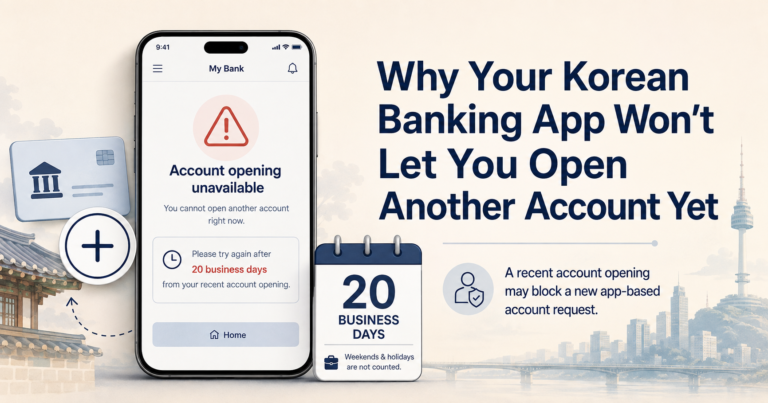
If moving a large deposit also means opening or using a Korean bank account for the first time, our guide to Korea’s 20-business-day bank-account rule explains another issue new foreign residents can run into.
9. The Simple Workflow I’d Recommend
Strip away the detail and finding a long-term apartment in Korea as a foreigner comes down to this:
- Understand jeonse, wolse, and ban-jeonse before you start browsing.
- Browse listings on one or two platforms to narrow down the area and budget.
- Check recent actual transaction prices for that area and housing type.
- Talk to a licensed local real-estate agent about what is actually available.
- Confirm the deposit, monthly rent, maintenance fees, brokerage fee, and contract terms.
- Check the property’s ownership and registry status before signing.
- Sign the lease, move in, and complete the foreign-resident address procedure.
- Obtain a fixed date on the lease contract.
- For a substantial deposit, check whether a HUG deposit-return guarantee is available for the property.
Most foreign renters searching for an apartment in Korea start with, “Which app should I use?”
That’s the easy question.
The one that actually matters is whether you understand the deposit, whether the asking price makes sense compared with recent transactions, what you’re required to do after signing, and whether you’ve completed the steps that protect your money if something goes wrong.
Finding the apartment is where this starts, not where it ends.
Treat the paperwork and deposit protection that come after signing as part of the apartment search itself, not as a separate errand you’ll get to later.