Why Your Korean Phone Number Still Doesn’t Work for Identity Verification
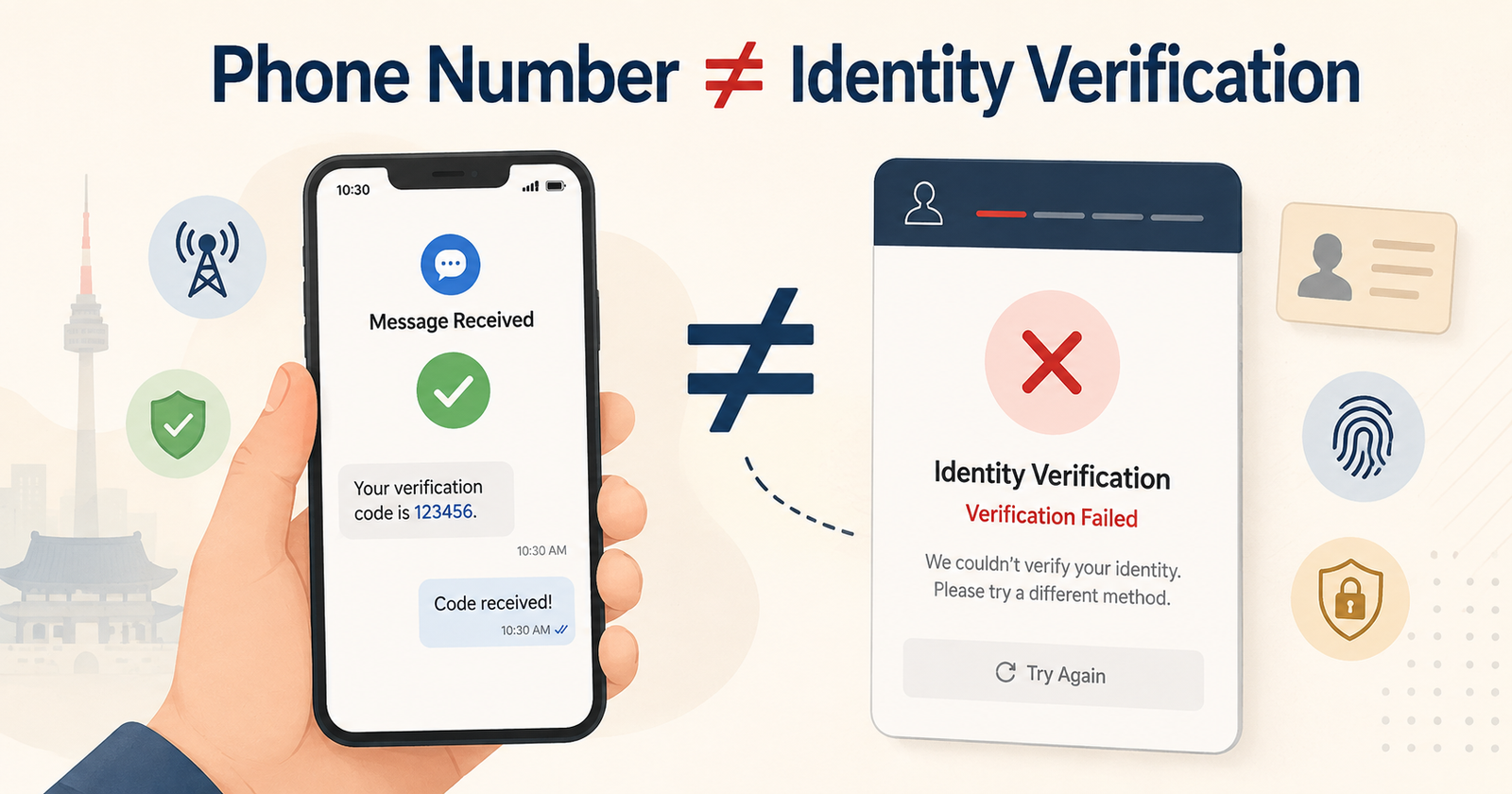
Having a Korean phone number does not automatically mean that number can be used for identity verification. Korean phone number identity verification depends on more than simply having an active number.
You can make calls. You can send texts. You can receive a delivery confirmation code. And you can still watch a bank, a government site, or a shopping app reject your verification attempt, with no explanation beyond a generic error.
The English-language guides we reviewed mostly focus on troubleshooting rather than explaining the system behind it. In many cases, what looks like a bug isn’t one. The system is checking more than whether your phone number works. It’s built to check whether a number is you.
Quick Check Before You Dig Further
- Is the phone line registered in your own legal name, not a family member’s, employer’s, or landlord’s?
- Does your carrier support identity verification — through PASS or SMS-based mobile verification — for your specific line type? This depends on the carrier, not just prepaid vs. postpaid.
- A prepaid line does not automatically fail. Whether it works depends on your carrier and how the line is registered.
- Make sure any name you enter matches the name your carrier has on file, rather than assuming the spelling on your passport or Residence Card is necessarily the version being used.
- If the checks above look correct, ask your carrier to confirm the registered name and whether the line is eligible for mobile identity verification.
First: A Korean Phone Number Is Not the Same as a Verified Identity
Many Korean banks, government portals, shopping platforms, and fintech services use mobile identity verification rather than simply checking whether a phone number is active.
That distinction matters because a working number and a number that can be used for mobile identity verification are not necessarily the same thing.
A number can ring, receive texts, and still fail an identity check if the subscriber information behind the line does not match what the verification system is trying to confirm.
This is also why a tourist SIM with a Korean number should not be confused with a resident mobile line that supports Korean identity verification. We explain that distinction in our Korea eSIM & SIM Card guide.
What PASS Actually Checks
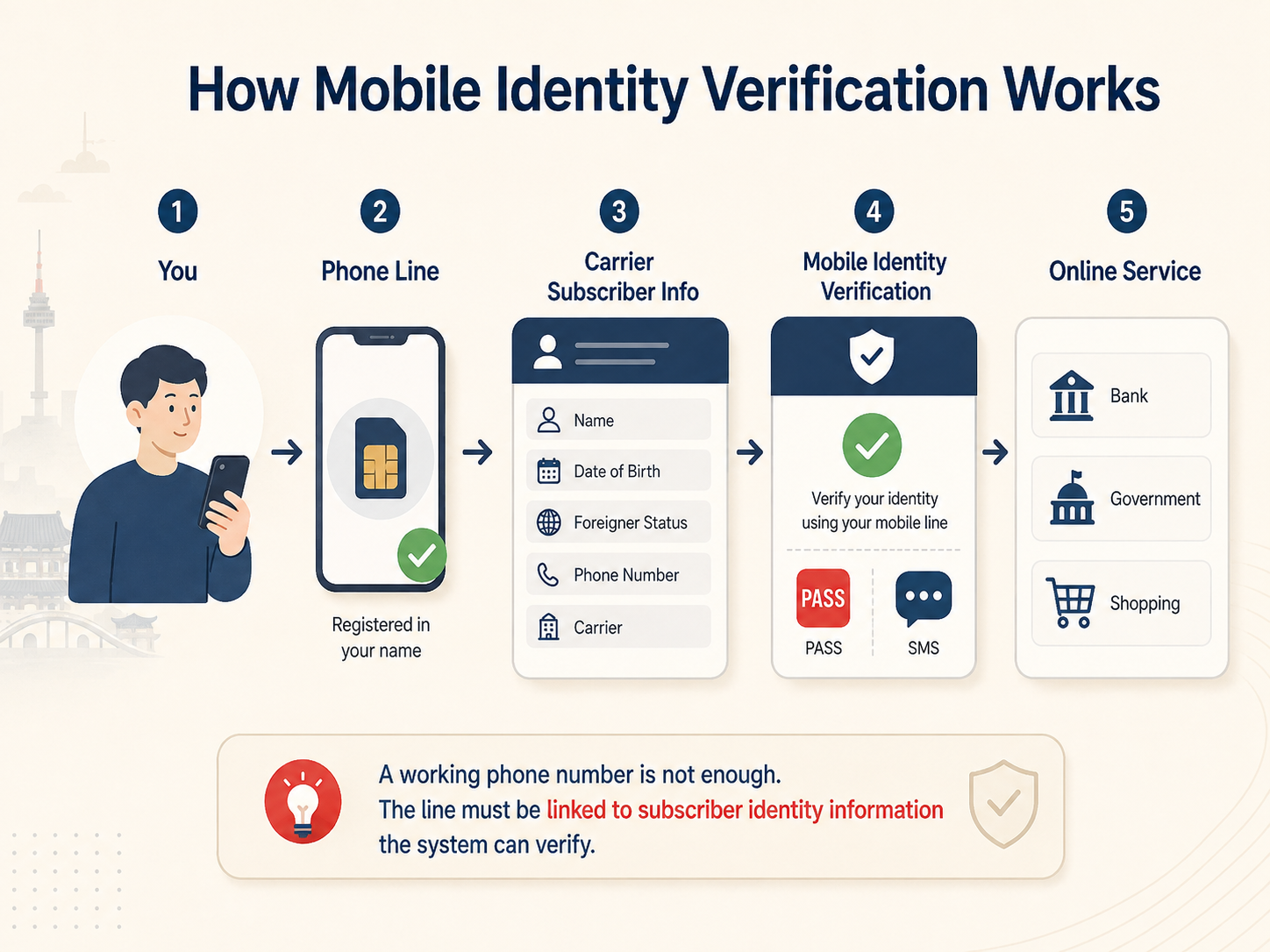
PASS is a mobile identity-verification service provided through Korea’s three major mobile carriers: SK Telecom, KT, and LG U+.
According to KT’s official PASS service terms, the service relies on a mobile line registered in the user’s own name and uses identity information associated with that subscriber.
That can include information such as the user’s name, date of birth, gender, domestic or foreign-national status, mobile number, and carrier.
There are also behind-the-scenes identifiers used within Korea’s identity-verification infrastructure. Most users never need to deal with those directly, but the important point is that PASS is doing more than sending a text message to a working number.
One clarification is especially important: PASS and SMS-based mobile identity verification are not two completely separate identity systems.
The Korea Internet & Security Agency’s identity-verification portal describes SMS general verification and PASS app verification as two methods within Korea’s mobile-phone identity-verification system.
They use different authentication methods, but both ultimately rely on the subscriber identity information associated with the mobile line. That is why Korean phone number identity verification can work differently depending on the carrier and the way the line is registered.
Prepaid vs. Postpaid Is Not the Whole Story
This is where a lot of English-language advice becomes too simple.
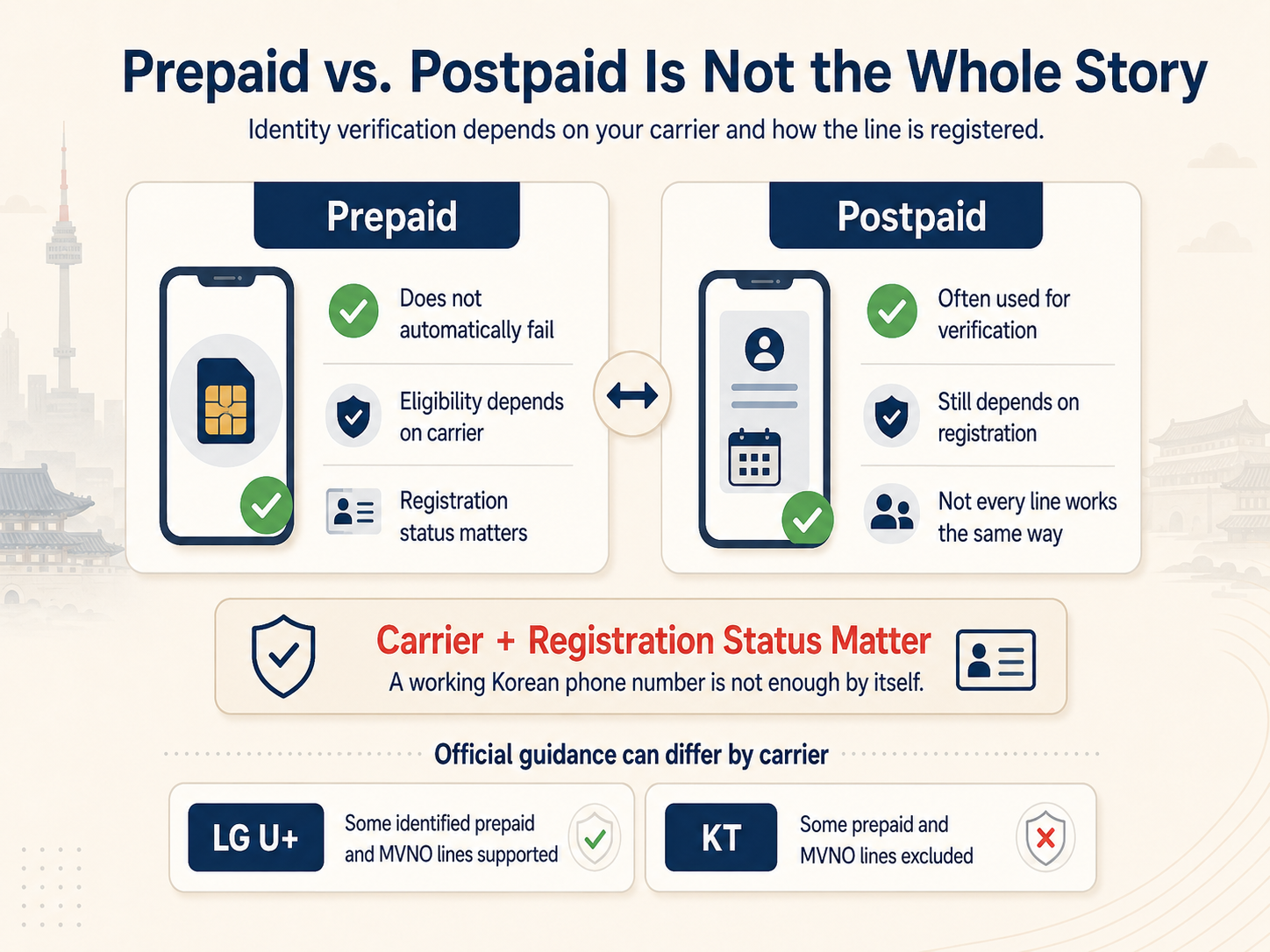
Prepaid does not automatically mean “no PASS.”
Eligibility depends on the carrier and how the line is registered, not simply on whether the plan is prepaid or postpaid.
KT and LG U+ do not even describe eligibility the same way in their official guidance.
- LG U+: Its official PASS service page says corporate lines, prepaid lines, and MVNO (알뜰폰) lines can use PASS when the line is registered to an identified user (기명). Corporate MVNO lines are excluded.
- KT: Its official PASS phone-number login guide states that some prepaid and MVNO users cannot use that PASS phone-number login service.
That means apparently similar mobile plans can have different identity-verification eligibility depending on the carrier and the way the line is registered.
The problem isn’t simply “prepaid or postpaid.” The real question is how your carrier has registered your identity and whether that specific line is eligible for mobile identity verification.
Why Foreign Residents Get Stuck
Foreign residents are not automatically excluded from mobile identity verification.
KT’s official guidance, for example, explicitly includes foreign customers who are eligible for mobile identity verification among PASS users.
But having a Korean number is still not enough by itself. The line has to be registered in a way that the verification system can recognize.
In practice, a failed verification attempt can involve the registration status of the line or identity information associated with it.
Some English-language guides also claim that formatting details in foreign names — such as hyphens, spaces, or the order of first and last names — are themselves common causes of failure.
We did not find carrier rules consistent enough to generalize that claim across Korea’s mobile networks, so we are not going to repeat it as a universal rule.
What matters for troubleshooting is the name your carrier actually has registered for the line. If you are unsure, ask the carrier to confirm the subscriber name on its system rather than repeatedly changing the spelling yourself.
Foreign-resident registration also matters when you move. If you’re preparing for a long-term rental, our guide to finding an apartment in Korea as a foreigner explains how address reporting, deposits, and tenant protection work after you sign a lease.
What About Passport-Based Activation?
Passport-based prepaid activation is available through a number of telecom providers and MVNOs, including options used by foreigners before they receive a Residence Card.
That is separate from a more unusual case reported in August 2026.
Digital Daily reported on August 14, 2026 that SK Telecom had discussed a temporary expansion of passport-based postpaid activation during the international-student arrival season.
According to the report, customers activated under the arrangement would need to update their subscriber information with Residence Card information within three months. The report also included SK Telecom’s response disputing that the distribution-channel expansion was an official company-wide notice.
For that reason, this should not be treated as a general SK Telecom rule.
The useful takeaway is broader: two working Korean phone lines can exist under different registration conditions behind the scenes, and that registration status can affect whether a line works for identity verification later.
If you originally activated your SIM with a passport and have now received your Residence Card, see what to do with your Korean phone plan after getting your Residence Card, including how to check your registration status and whether you may be able to keep your existing number.
Why Does Korea Use Mobile Phones for Identity Verification in the First Place?
Korea’s current identity-verification system is easier to understand once you know what it was designed to replace.
The Korea Internet & Security Agency (KISA) explains that the country’s identity-verification system developed to reduce the direct collection and use of resident registration numbers (주민등록번호) online.
Instead of requiring users to hand over their resident registration number directly, Korea recognizes several alternative identity-verification methods.
According to KISA’s official classification, these currently include:
- i-PIN
- mobile phone verification
- credit card verification
- certificate-based verification
For mobile phone verification, the officially designated identity-verification providers are SK Telecom, KT, and LG U+.
That is why your Korean mobile line can function as something more than a way to receive calls and texts. When the registration conditions are met, it also becomes one of the identity-verification tools used across Korea’s online services.
Why This Feels So Different to Foreigners
Korea’s mobile identity-verification system is tightly connected to telecom subscriber information and identity data.
Foreign residents can use the system, but additional friction can appear when the information attached to a phone line does not line up cleanly with what an online service expects.
That is why the question to ask is not simply:
Do I have a Korean phone number?
It is:
Is this phone line registered in my name and eligible for Korean mobile identity verification?
If Verification Still Doesn’t Work
If your line is in your own name and your carrier says it supports mobile identity verification, contact the carrier and ask them to confirm:
- the name registered on the line
- how the line is currently registered
- whether the line is eligible for mobile identity verification
Do not assume that a prepaid or MVNO rule you read about one carrier automatically applies to another. The official guidance from KT and LG U+ already shows that eligibility rules can differ by carrier, including for prepaid and MVNO lines.
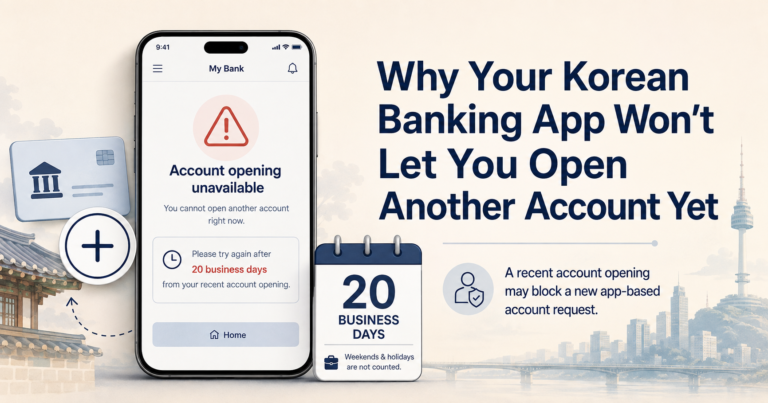
If your banking app is blocking a new account application rather than failing identity verification, that may be a different problem. See our guide to Korea’s 20-business-day bank account opening condition.
What We Verified
The core mechanics of Korea’s mobile identity-verification system were checked against KISA’s official identity-verification portal and KT’s official PASS information.
The difference between KT and LG U+ guidance on prepaid and MVNO PASS eligibility was checked directly against each carrier’s official pages.
The August 2026 SK Telecom passport-activation case is based on Digital Daily’s August 14, 2026 reporting and is presented as a reported, disputed, time-specific case — not as a general SK Telecom policy.
What We Couldn’t Verify Clearly
We did not find sufficiently consistent carrier documentation to state universal rules about foreign-name formatting — including spaces, hyphens, or first-name/last-name order — or to say whether Residence Card and stay-period updates are automatically reflected in every carrier’s subscriber records.
Rather than generalizing from individual experiences or secondary guides, we have left those claims out.