How to Take a Taxi in Korea: Kakao T, k.ride, Fares & Tips (2026)
Taking a taxi in Korea is easy once you know which option fits your situation.
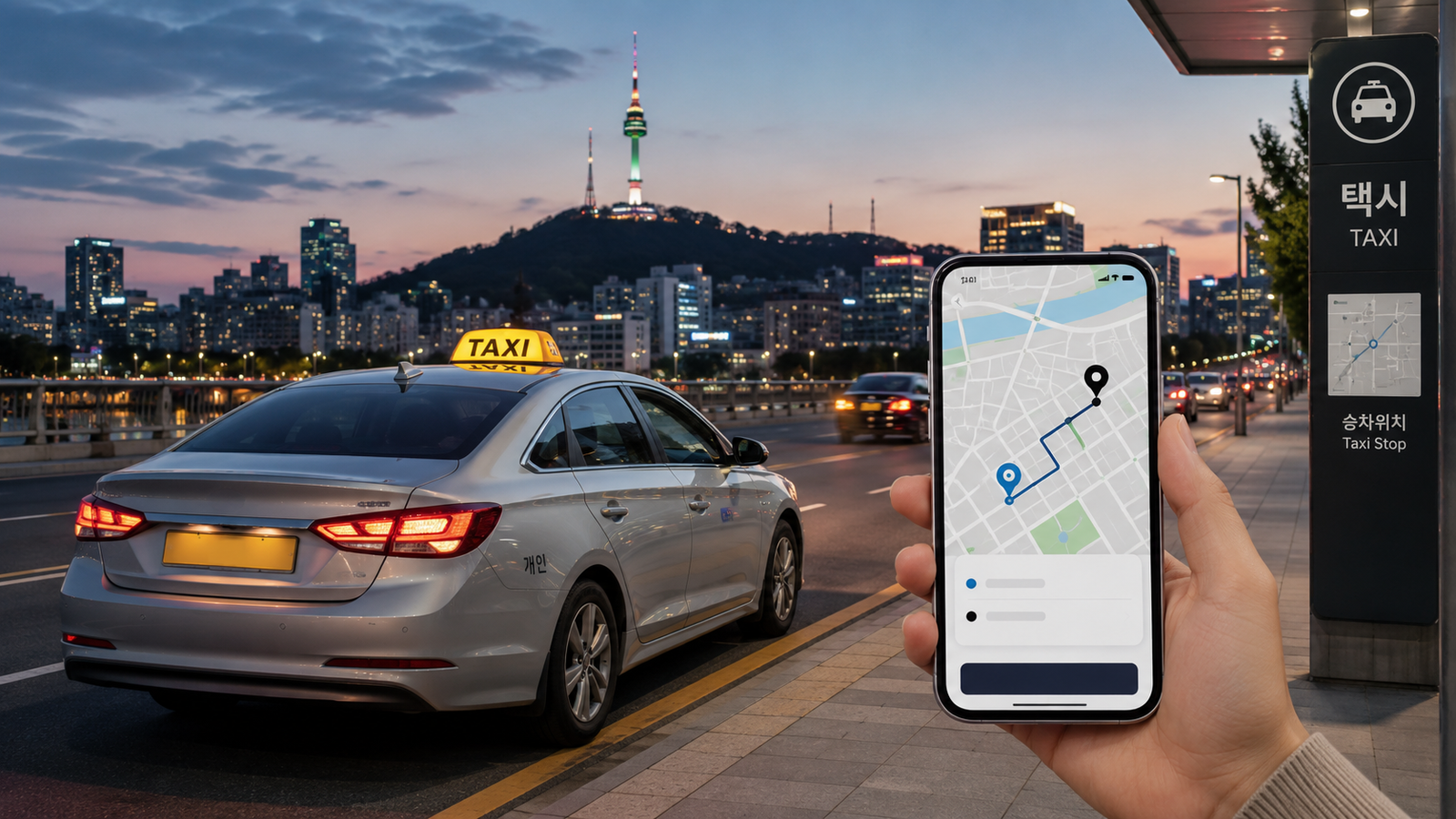
For most first-time visitors, k.ride is the simplest place to start. No Korean phone number required, overseas cards work, and the app searches and chats in your language.
But it is not always the best option.
- Landing with several suitcases or traveling as a group? A Jumbo taxi or International Taxi may be more practical.
- Just need a quick ride nearby? Hailing a regular taxi on the street is still completely normal.
- Traveling late at night? Seoul’s surcharge structure matters more than many tourists realize.
This guide explains which taxi option to use, how payment works, what surcharges to expect, and how to avoid common tourist mistakes.
In this guide
The four taxi types most visitors will see in Seoul
| Type | What it looks like | Fare | Best for |
|---|---|---|---|
| Regular taxi | Commonly orange, white, or silver | Standard metered fare | Most everyday rides |
| Deluxe taxi | Usually black with a gold stripe | Higher base fare | More space and premium service |
| Jumbo taxi | Large vehicle marked “JUMBO” | Same fare system as deluxe taxi | Groups and luggage |
| International Taxi | Official foreign-tourist taxi | Metered or fixed-rate depending on service | Airport transfers, reservations, language support |
Seoul’s official tourism guide lists these four as the main taxi options for visitors.
See Seoul’s official taxi guide
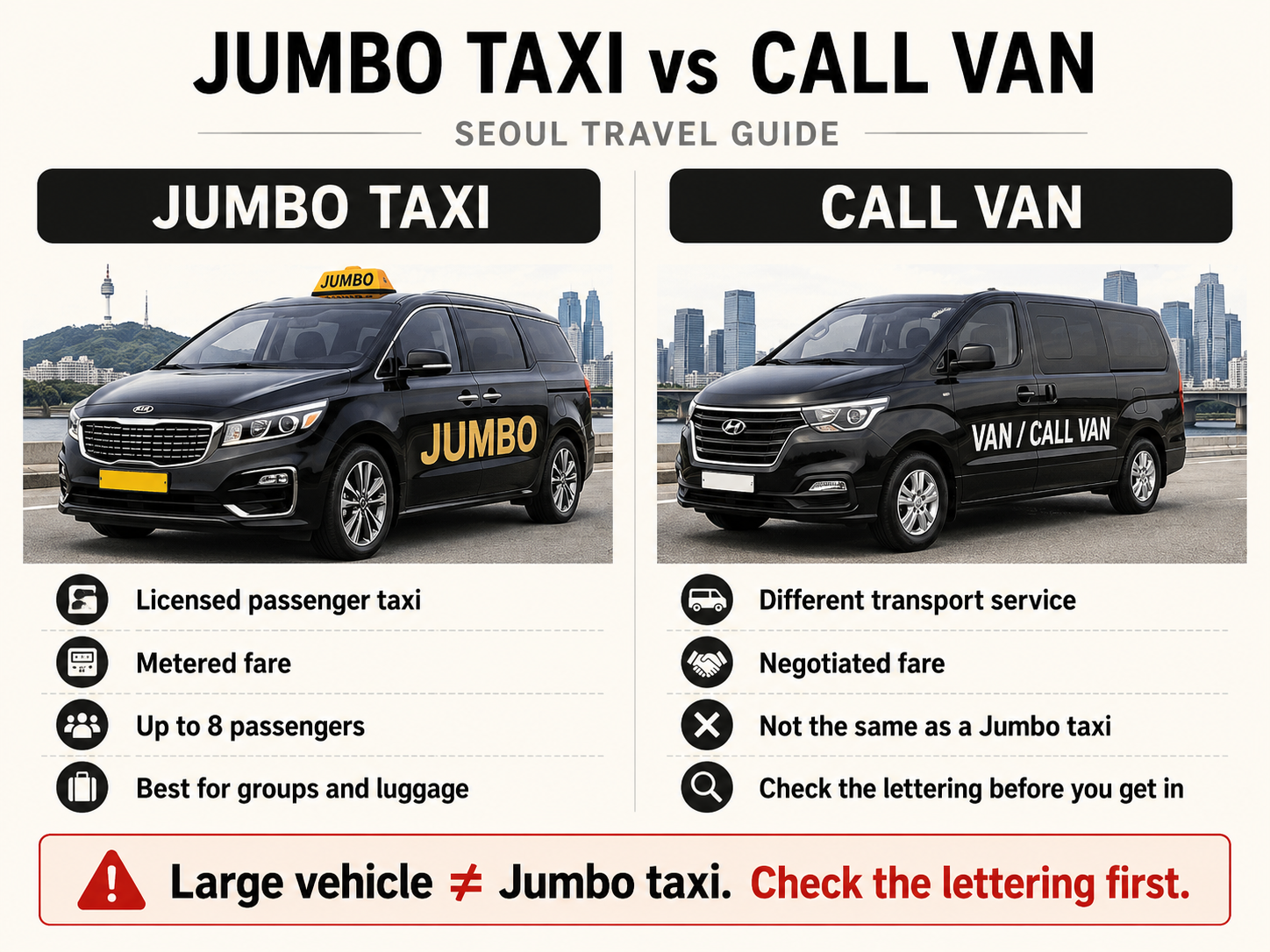
Actually: Jumbo Taxi and Call Van are not the same thing
This is one of the easiest mistakes for a visitor with a lot of luggage to make.
Jumbo taxis are licensed passenger taxis. They can carry up to eight passengers and use the same fare system as deluxe taxis.
Call Vans may look similar because they are also large vehicles. Seoul’s official tourism guide warns travelers not to confuse the two.
Call Vans:
- may be marked “VAN” or “CALL VAN”
- do not operate under the same taxi-meter fare structure
- charge a negotiated rate instead of a metered one
ACTUALLY
Look for the word “JUMBO.”
If the large vehicle says “VAN” or “CALL VAN” instead, do not assume it uses the same regulated taxi fare as a Jumbo taxi.
See the official Jumbo Taxi and Call Van warning
k.ride vs Kakao T: which should a tourist use?
Both apps come from Kakao Mobility, but they’re built for different users.
k.ride
k.ride is Kakao Mobility’s app for international travelers.
According to Kakao Mobility, it offers:
- English, Japanese, Simplified Chinese and Traditional Chinese interface support
- destination search and driver chat translation across 100+ languages
- estimated fares before confirming a ride
- sign-up using Google, Apple or email
- payment using overseas-issued cards
- supported mobile payments including Alipay and GrabPay
- advance reservations at a selected time and place in supported markets
See Kakao Mobility’s official k.ride information
Kakao Mobility’s own pages don’t fully agree on the exact number of supported countries and languages, so we’re not pinning down a specific figure here. Treat those totals as growing rather than fixed.
k.ride is built around what a foreign traveler actually needs: language support, payment that works without a Korean bank account, and sign-up that doesn’t require a Korean number.
Kakao T
Kakao T is the taxi and mobility app most people living in Korea actually use.
You can create a Kakao account with an overseas phone number and SMS verification. What happens after that, especially when registering a payment method, seems to vary by traveler, and we don’t have one clean answer for how well foreign cards work inside Kakao T itself.
So don’t assume Kakao T will work the same way for you as it does for a resident.
For a short-term visitor, k.ride is simply the easier recommendation — its sign-up, language support, and payment options were built with exactly that traveler in mind.
Can you just hail a taxi on the street?
Yes.
You do not need an app for every taxi ride in Seoul.
Street hailing remains a normal way to get a taxi, especially around major roads, hotels, stations and nightlife areas.
- Stand somewhere the taxi can stop safely.
- Raise your hand to signal an available taxi.
- Taxi stands are also available around major stations, hotels and busy districts.
- Availability displays vary between vehicles, so do not rely on one specific light color or dashboard symbol.
If you are boarding a large vehicle, double-check whether it says JUMBO or VAN / CALL VAN.
How taxi payment actually works
If you use k.ride
You can register overseas-issued credit and debit cards, plus supported mobile payment methods, directly in the k.ride app.
The app also shows an estimated fare before you confirm the ride.
If you pay directly in a taxi
Card payment is widely available in Seoul taxis, and cash remains an option.
If you prefer a backup payment method, carrying a small amount of Korean won can still be practical.
What about the meter?
By law, a normal metered taxi ride in Seoul has to be charged by the meter.
Seoul’s rules require taxis to charge the metered fare unless the city has approved a separate fare system for that service. That exception matters, because some services legally use:
- fixed airport fares
- pre-confirmed fares
- flexible platform pricing
- hourly charter rates
So a fixed price is not automatically suspicious.
But if a driver of a normal metered street taxi gives you an unofficial flat price instead of using the meter, treat that as a warning sign.
See Seoul’s official taxi fare rules
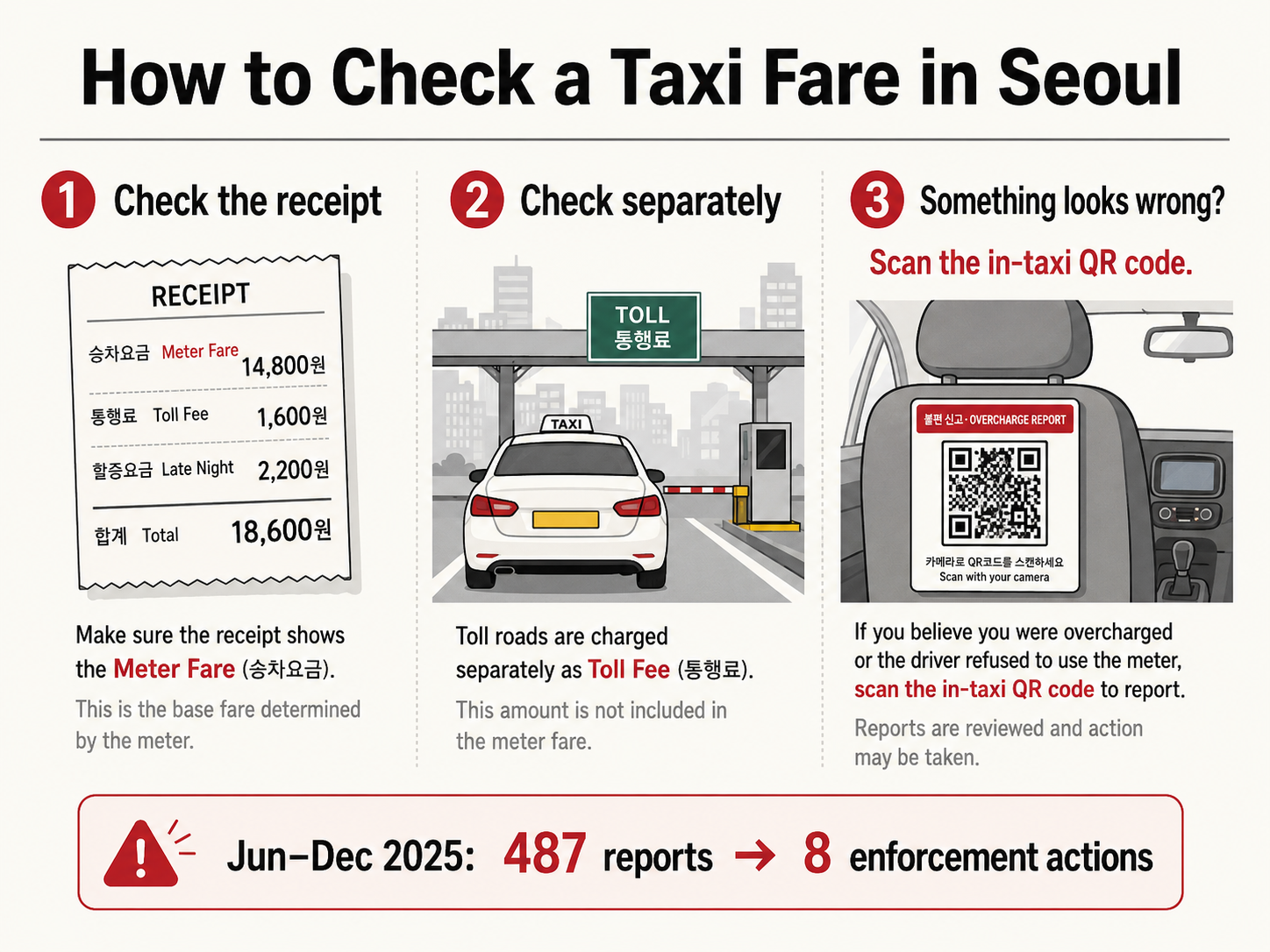
Tolls are separate
If your route uses a toll road, the toll can be added separately from the taxi fare.
This distinction became particularly important in 2026, when Seoul changed how taxi apps and receipts display fares for foreign passengers.
Late-night and out-of-city taxi surcharges in Seoul
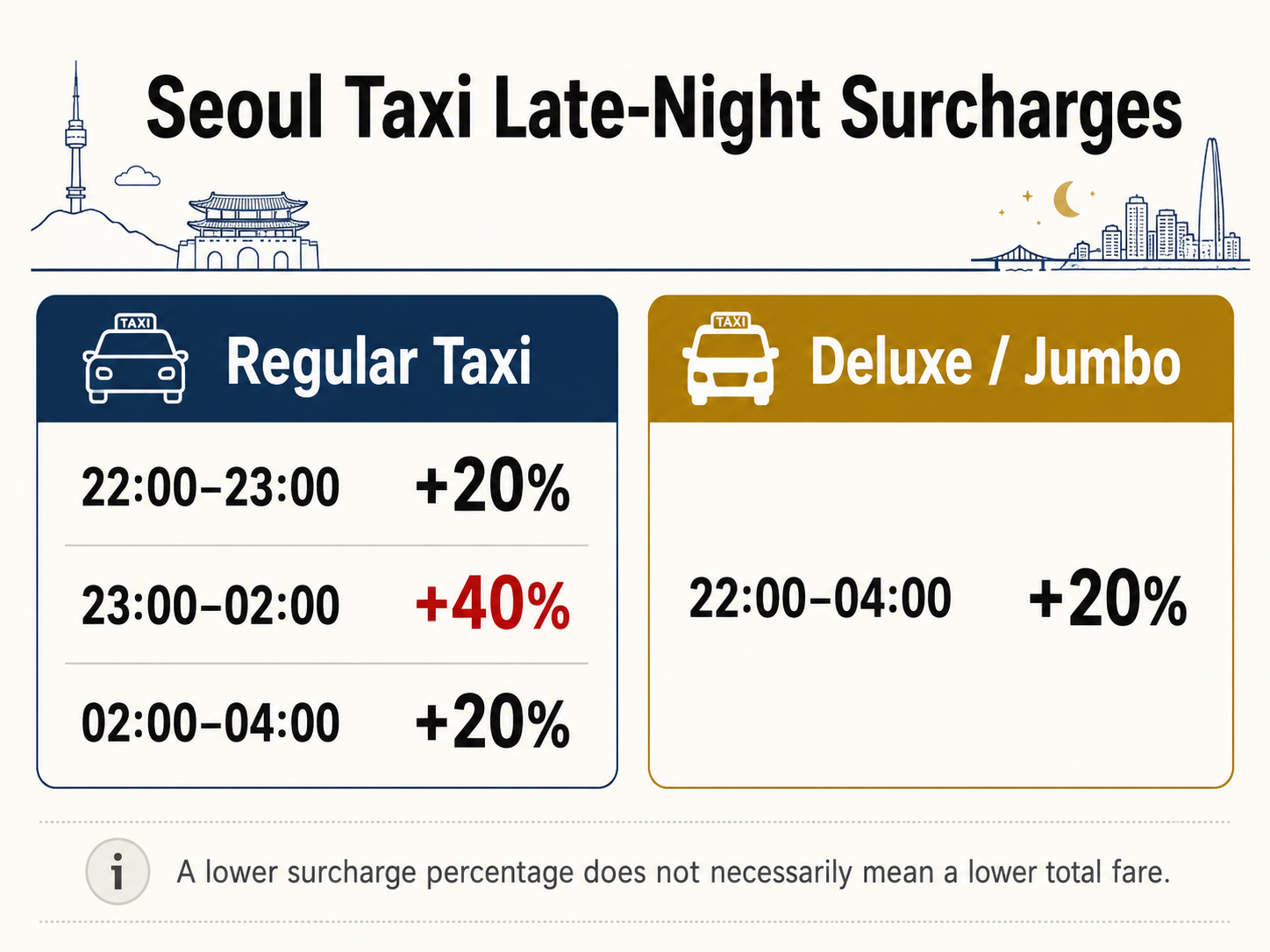
Seoul’s current official taxi fare table lists the following rates.
| Taxi type | Daytime base fare | Late-night surcharge |
|---|---|---|
| Regular taxi | ₩4,800 / first 1.6 km | 22:00–23:00: +20% 23:00–02:00: +40% 02:00–04:00: +20% |
| Deluxe / Jumbo | ₩7,000 / first 3 km | 22:00–04:00: +20% |
Regular taxis also apply a 20% out-of-city surcharge when applicable after leaving Seoul’s designated operating area.
For regular taxis, combined late-night and out-of-city surcharges can reach a maximum of 60%. For deluxe and Jumbo taxis, the maximum combined surcharge is 40%.
Check Seoul’s current official taxi fare table
One useful late-night detail
Between 23:00 and 02:00, a regular taxi carries a 40% late-night surcharge while a deluxe or Jumbo taxi carries 20%.
That doesn’t mean a deluxe taxi ends up cheaper overall, since its base and distance fares start higher to begin with. It just means the percentage on top is smaller during Seoul’s priciest late-night window.
Reality Check: some official English taxi pages are outdated
This is one of the more interesting problems we found while researching this guide.
Some long-standing official English tourism pages still state that deluxe taxis do not have late-night surcharges. That information was once correct. But Seoul changed the fare structure in February 2023.
The city’s current taxi fare table now clearly lists:
- Deluxe / Jumbo daytime base fare: ₩7,000 for the first 3 km
- Late-night surcharge: +20% from 22:00 to 04:00
KOREA REALITY CHECK
“Official” does not always mean “current.”
For fares and regulations, we go with Seoul’s current fare tables and policy notices over older tourism pages that may not have been updated.
Seoul’s 2023 fare reform changed deluxe and large passenger taxis from no late-night surcharge to a 20% surcharge between 22:00 and 04:00.
See Seoul’s official fare-change notice
How Seoul is trying to stop taxi overcharging for foreigners
Taxi overcharging involving foreign visitors is not just an internet rumor.
Seoul Metropolitan Government has documented the complaints and introduced several fixes to make taxi fares easier for international visitors to understand. In January 2026, the city announced the latest round of changes.
English information on taxi receipts
Taxi receipts now display important information such as:
- final fare
- pickup and drop-off times
- whether a late-night or out-of-city surcharge was applied
The city introduced these changes because Korean-only receipts made it difficult for foreign riders to identify incorrect surcharge charges.
“Meter Fare” and “Toll Fee” are shown separately
Seoul standardized the terminology used by participating taxi platforms. The two important items are now:
- Meter Fare
- Toll Fee
This makes it easier to check whether a toll was legitimately added to the final payment.
Taxi apps now separate estimated fare and toll charges
Seoul announced the change for foreigner-oriented apps including k.ride and TABA, as well as services used by both Koreans and foreigners including Tada and Onda.
The goal is to let passengers see the expected driving fare and toll charges separately instead of receiving one unclear total.
The QR complaint system is being used
Seoul introduced an in-taxi QR reporting system for problems such as overcharging and refusal of service.
Between June and December 2025:
- 487 reports were submitted by foreign visitors
- overcharging was the most common complaint
- 8 cases resulted in administrative enforcement after violations were confirmed
Seoul has also installed complaint-system stickers in approximately 71,000 taxis and placed additional information around major tourist areas and taxi stands.
Read Seoul Metropolitan Government’s 2026 announcement
ACTUALLY
If the final fare looks wrong, you now have more ways to check it.
Compare the Meter Fare and Toll Fee, keep the receipt, and use the QR complaint system inside the taxi if necessary.
When International Taxi makes sense
International Taxi is Seoul’s officially designated foreign-tourist taxi service. It’s different from simply finding a taxi driver who happens to speak English.
The official service provides drivers with foreign-language capability in:
- English
- Japanese
- Chinese
It also offers:
- fixed-rate transfers between Incheon/Gimpo Airport and Seoul
- online reservation
- 24/7 booking
- hourly charter service
- tour and business transport services
See the official International Taxi service
International Taxi fare structure
International Taxi can use either a fixed fare or a metered fare depending on the service. For metered service, Seoul’s official rules state that a 20% foreign-passenger surcharge may apply.
The maximum combined surcharge depends on the vehicle type:
- Regular-type International Taxi: up to 60% when applicable surcharges overlap
- Deluxe / large passenger International Taxi: up to 40%
For airport transfers, fixed zone fares are available between Incheon Airport and different areas of Seoul, and tolls are included in those official zone fares.
International Taxi makes the most sense when you want:
- a guaranteed foreign-language-capable driver
- a pre-booked airport pickup
- a known fixed airport fare
- a vehicle reserved for several hours
For an ordinary ride across central Seoul, most visitors will not need it.
If you’re deciding between a taxi, AREX or an airport bus after landing, see our Incheon Airport to Seoul transport guide for a full comparison.
Common taxi mistakes tourists make
Getting into a Call Van thinking it is a Jumbo taxi
Check the lettering on the vehicle. JUMBO and VAN / CALL VAN are not interchangeable.
Assuming Kakao T and k.ride are the same experience
They’re related, but only one of them is built with a foreign traveler in mind.
Assuming every fixed fare is a scam
Some approved services legally use fixed, pre-confirmed or flexible fares.
The red flag is an unofficial flat price from a normal metered taxi.
Ignoring toll charges
Tolls can be legitimate, but they should be distinguishable from the actual taxi fare.
Check the Meter Fare and Toll Fee separately when available.
Assuming older English tourism pages always show current fares
Taxi fares and surcharge rules can change.
For this guide, we use Seoul’s current fare tables and transport-policy notices as the primary source.
Which taxi option should you choose?
Most short-term visitors
→ Start with k.ride.
Quick local ride without using an app
→ Hail a regular street taxi or use a taxi stand.
Large group or several suitcases
→ Look for a Jumbo taxi and make sure it says “JUMBO,” not “VAN.”
Need guaranteed English, Japanese or Chinese support
→ Reserve an International Taxi.
Pre-booked airport transfer with a fixed official fare
→ Consider International Taxi.
Traveling between 23:00 and 02:00
→ Remember that regular taxis have a 40% late-night surcharge, while deluxe/Jumbo taxis use a 20% surcharge. The deluxe fare may still be higher overall because its base and distance rates are higher.
What to read next
If you are preparing for transportation in Korea, these guides fit naturally together: