Reporting Unpaid Wages in Korea: What Filing Actually Does
Payday came and went. Nothing arrived.
Search in English for unpaid wages in Korea and you will find the same first step everywhere: report it to the Ministry of Employment and Labor. That advice is correct. The part that decides how much you actually recover is what happens after the report lands.
Filing a complaint in Korea is a demand for payment. A labor inspector takes your case, calls both sides in, and orders your employer to pay if a violation is confirmed. The case closes once the employer complies with that order.
What filing cannot do on its own is produce the money.
The government does not step in and pay on your employer’s behalf as a matter of course. If your employer still refuses after a correction order, further routes exist, and you have to take them yourself.
This guide covers both halves: how to file, and what happens when filing is not enough.
- Where do I file?
- Online through the Labor Portal, or in person at the labor office with jurisdiction over your workplace.
- What does it cost?
- Nothing.
- How long does it take?
- The stated processing period is 25 days, excluding weekends and public holidays. It can be extended twice.
- Will filing get me paid?
- It can. An inspector can order your employer to pay. If your employer ignores the order, you move to a confirmation letter and an advance payment claim, or to civil court.
- Is there a deadline?
- Yes. Three years for wage claims, and three years for severance pay.
- Can I get help in English?
- Yes. The Ministry’s counseling line offers English and Chinese.
Two different things you can ask for
Korea gives you two separate requests, and they are not the same.
A 진정 (jinjeong) is a demand that your employer pay what is owed. A 고소 (goso) is a criminal complaint asking that your employer be punished. Most people who simply want their money want the first one. You can file a 진정 and never touch the second.
Once your complaint is in, the sequence runs like this.
What happens after you file
Employer pays
The case closes.
Employer does not pay
The inspector refers the case for prosecution.
A prosecution is not a payment. If your employer still has not paid, collecting comes down to the confirmation letter and an advance payment claim, or to civil court. Both are covered below.
That last branch is where the criminal side enters. Under Article 107 of the Labor Standards Act, violations including Articles 36 and 43 carry up to five years in prison or a fine of up to 50 million won.
Those figures went up on October 8, 2026. Some guidance material still in circulation shows the older numbers of three years and 30 million won, so check the statute itself if you see a lower figure quoted.
Nothing in that sequence is a mechanism for the state to collect your wages and hand them to you.
The inspector’s leverage is the correction order and the prosecution behind it. When that leverage works, you get paid. When it does not, you need a different tool.
Before you file: two clocks
Wage claims in Korea expire. Under Article 49 of the Labor Standards Act, the limitation period for a wage claim is three years. Severance pay has its own three-year clock under Article 10 of the Act on the Guarantee of Employees’ Retirement Benefits.
One caution before you read further. The complaint process and that three-year period are not the same clock. Do not assume that getting a complaint in has settled the limitation question for you. If your three years are anywhere close to running out, check your own position with the counseling line on 1350 or with the Korea Legal Aid Corporation straight away, before you rely on the filing alone.
There is a second deadline running the other way, and it works in your favor.
When you leave a job, your employer has to settle everything owed within 14 days of the date the obligation arises, under Article 36 of the Labor Standards Act. Severance pay has a parallel 14-day rule under Article 9 of the retirement benefits act. Both can be extended, but only by agreement between the parties and only where there are special circumstances.
So if you resigned three weeks ago and nothing has been settled, the 14 days have passed and the obligation is already overdue.
Late payment interest
Unpaid wages accrue interest at 20% per year under Article 37 of the Labor Standards Act and Article 17 of its Enforcement Decree.
When the clock starts depends on your situation. For someone who has left the job, interest runs from the day after the 14-day settlement period expires. For regular wages owed to someone still employed, it runs from the day after the scheduled payday.
Two qualifications matter. The rule for current employees applies to payment obligations arising on or after October 23, 2025. And the law sets out circumstances where the interest does not apply. Check your own case against the statute rather than assuming the 20% is automatic.
How to file a complaint for unpaid wages in Korea
Three routes exist: in person, by post, and online. There is no fee for any of them.
In person
Go to the regional labor office with jurisdiction over your workplace, not over where you live. If you have moved or already left the area, the workplace is still what determines the office.
The Ministry’s automated phone line can tell you which office that is, along with its number.
Online
Select Apply on the Labor Portal’s unpaid-wage complaint page. This takes you to its login and identity-verification screen.
The login screen offers several authentication methods. Selecting mobile-phone, financial-certificate, or joint/browser-certificate authentication opens a form labeled for a resident registration number or foreigner registration number. That label does not establish which methods a foreign worker can complete in practice. The portal’s public pages also give different signals about whether this particular complaint requires an individual member account, so check with 1350 if you intend to apply without one.
The complaint page offers an English PDF form called “Declaration of Complaint.” The language of the online entry form has not been confirmed. If online identity verification is a barrier, ask 1350 about your options or visit the labor office responsible for your workplace.
What to bring
The Labor Portal lists the evidence to prepare.
Core documents
- Employment contract
- Pay statements
- Bank records showing salary deposits
- Proof of enrollment in the four major insurances
Depending on what is owed
- Severance pay: pay statements for the three months before you left, before tax deductions
- Overtime, night or holiday pay: attendance logs, messages, any record of hours worked
- Unused annual leave pay: records of leave accrued and used
- Dismissal notice pay: the dismissal notice, or messages and recordings about it
About your employer
- Owner’s name and contact details
- Company contact details
- The address where you actually worked
- Number of employees

If you have none of this, file anyway. The Ministry’s counseling service has addressed this directly: where documentary evidence is unavailable, the facts can be established through the investigation once both parties appear.
While your case is open
Four things about the process are worth knowing before you are in it.
The 25 days are working days.The stated processing period excludes weekends and public holidays, so the calendar time is longer than four weeks.
It can be extended twice, and the second extension needs your consent.The first extension is the inspector’s call. The second one requires you to agree.
Miss two summonses and your case closes.If you fail to appear twice, the case is terminated. You can file again, but the clock and the work start over.
Updates come by messaging app or text.You will be notified at each stage. You can also withdraw the complaint yourself through the “My Complaints” section of the portal.
The correction order came and nothing was paid
Two common routes are an advance payment from a public fund, and a civil suit. Depending on your residence status and the terms of your employment, other mechanisms such as wage guarantee insurance may also apply to you, so it is worth asking about your own case on 1350.
Route 1: Confirmation letter, then advance payment
Once the investigation has confirmed the unpaid wages, you can ask the regional labor office for a 체불 임금등 사업주 확인서, a letter stating the amount owed. That letter is what opens the confirmation-letter route to an advance payment from the Korea Workers’ Compensation and Welfare Service.
If you went to court instead and won, a final judgment can support the claim in place of that letter.
The advance payment scheme covers part of what you are owed, directly from a public fund.
This route has two separate deadlines, and they are easy to confuse. The first is the deadline for taking the action that qualifies you. The second is the deadline for actually claiming the money from the Service.
After leaving a job
Two deadlines for each route
Confirmation letter
Court judgment
If you have left the job
If you are still employed
This route is open to workers whose hourly pay is below 110% of the minimum wage.
Read those two deadlines together. Filing within a year is what opens the door. The confirmation letter then starts a six-month clock of its own, and letting that one run out closes the confirmation-letter route even though you filed in time.
The Korea Workers’ Compensation and Welfare Service handles these claims on 1588-0075.
If your employer has gone under
A separate scheme covers bankruptcy and recognized de facto bankruptcy. It has its own eligibility rules, its own coverage period and its own limits, and those limits changed for qualifying cases from August 20, 2026. Any figure you find in an older guide may be out of date.
Apply to the regional labor office, and confirm the current terms there or with the Korea Workers’ Compensation and Welfare Service on 1588-0075.
Route 2: Civil court
File suit in the district court covering either your workplace or your own address, win, then enforce the judgment.
The Labor Portal’s own guidance is blunt about the weak point here: enforcement needs assets to seize, so identify your employer’s property and secure a provisional attachment in advance.
A judgment against an employer with nothing left is a piece of paper.
Free legal aid is available through the Korea Legal Aid Corporation if your average monthly wage over the final three months at the time of the non-payment was under 4 million won. It covers litigation costs and attorney fees. It does not cover the other side’s costs if you lose. Reach them at your local area code followed by 132, or at klac.or.kr. Workers aged 15 to 34 can also get help from a licensed labor attorney through the Youth Labor Rights Center.
Repeated or deliberate non-payment
Article 43-8 of the Labor Standards Act allows a worker to claim damages of up to three times the unpaid amount.
It applies where one of these is met: the non-payment was clearly deliberate, the unpaid period runs three months or more within a single year, or the unpaid amount equals three months or more of ordinary wages.
Note two limits here. This is a claim you bring in court, and the amount does not automatically triple. The court decides. And severance pay is excluded from the wages covered by this provision.
If your departure date is coming
The two-summons rule is the thing to plan around. An investigation that loses you partway through ends, and refiling from abroad is harder than finishing before you go.
Tell the inspector your departure date early and ask how your appearance can be handled. Do that before you miss a summons rather than after.
Note also that the advance payment route has clocks that keep running after your flight: one year from the day after you left to file, six months from the confirmation letter’s issue to claim.
Where to get help
The counseling line also offers scheduled callbacks, so you can submit your question and a preferred time rather than waiting on hold.
Before you file, check these
- Has it been more than 14 days since you left, or has a scheduled payday passed?
- Are you within three years of when the wages came due, and if that is close, have you checked your position with 1350 or the Korea Legal Aid Corporation?
- Do you know the address where you actually worked, so you can identify the right labor office?
- Which evidence can you produce, and which will have to come out of the investigation?
- Do you have a Korean phone line, bank or certificate in your own name, or should you plan on filing in person?
- Is a departure from Korea going to collide with the investigation schedule?
Filing is the straightforward part. The questions that decide how this ends are whether you file in time, whether your employer pays when ordered to, and which route you take if they do not.
Where these facts come from
- Ministry of Employment and Labor, Labor Portal: how to resolve unpaid wages
- Labor Portal: unpaid wage complaint filing guide
- Labor Portal: login and identity verification
- Ministry of Employment and Labor counseling center (1350)
- Labor Standards Act: Article 36, settlement of payments · Article 37, late payment interest · Article 43-8, damages for unpaid wages · Article 49, limitation period · Article 107, penalties
- Labor Standards Act Enforcement Decree: Article 17, interest rate
- Act on the Guarantee of Employees’ Retirement Benefits: Article 9, payment of severance · Article 10, limitation period
Figures such as advance payment caps and legal aid income requirements change. Check the linked official page for your own case before you rely on a number here.
This article is general information, not legal advice for your situation. The counseling line on 1350 and the Korea Legal Aid Corporation can both review your case.
◆
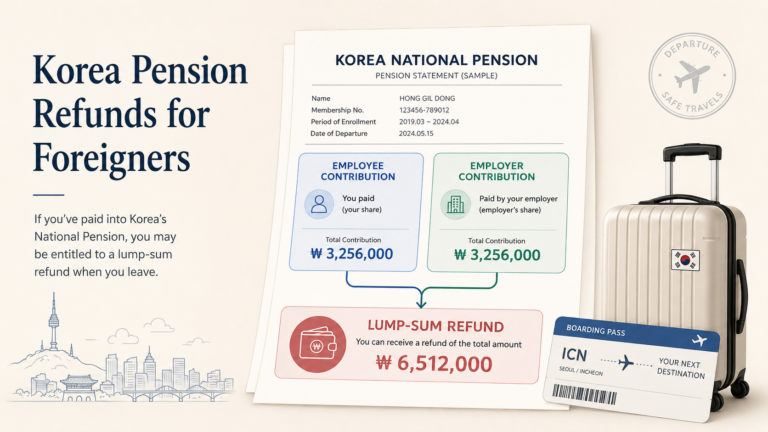
Unpaid wages are not the only thing worth settling before you leave Korea. Our guide to the Korean pension refund for foreigners covers who qualifies, what the refund includes, and why taking it immediately is not always the right call.