What Can You Bring Home From Korea? A Packing and Customs Guide
Liquids and gels in containers over 100 mL go in your checked bag. Power banks go in your carry-on, two per person. Food depends on where you land. Check the capacity printed on the bottle, the Wh rating on the battery and the ingredient list on the packet before you pack.
A half-used 200 mL bottle of toner and a tub of kimchi come under the same carry-on liquids rule at Incheon Airport. In the first half of 2026, cosmetics and everyday essentials accounted for more than half of the non-food items passengers gave up at departure security. Passengers also left behind 5.1 tonnes of kimchi.
So what can you bring home from Korea? Start with two questions. Which bag can it go in? And when you land, do you need to declare it, can you bring it in, or will you owe duty?

Start hereYour Korea Shopping, Sorted
| Item | Where to pack it | What to check |
|---|---|---|
| 200 mL toner | Checked bag | The capacity printed on the bottle. A half-full bottle still counts as 200 mL. |
| Beauty device with a built-in battery | Check whether your airline allows the model in carry-on or checked baggage. If you check it, switch it off completely. | Device type and watt-hours (Wh). Check cordless heat-styling tools by model. |
| Power bank | Carry-on only, up to two per person | The Wh rating. Over 100 Wh and up to 160 Wh requires airline approval. |
| Kimchi or gochujang | Checked bag if the container is over 100 mL | Your destination’s food declaration and import rules. |
| Dry packet of ramyeon | Carry-on or checked bag | Look for 원재료명 on the outside of the packet. Check the noodles, soup base and toppings. |
| Soju | Checked bag for a bottle over 100 mL bought in town, subject to airline rules | The bottle’s alcohol by volume (ABV) and your destination’s duty-free allowance. |
Leaving KoreaWhat Incheon Security Looks At
On an international flight from Incheon, liquids, gels and sprays in your carry-on must be in containers of 100 mL or less. Put them in one clear, resealable 1 L bag per person and seal it. Security goes by the container’s capacity. Even a nearly empty 200 mL bottle is over the limit. Korean domestic flights don’t have this cabin liquid limit.
Incheon’s FAQ lists kimchi as a liquid and gochujang and doenjang as gels. Dried squid and dried anchovies are examples of solid foods you can carry on. The same FAQ allows solid red ginseng and herbal supplements in either bag, though airlines may set quantity limits.

The cabin’s 100 mL rule doesn’t apply to checked baggage. Nonflammable sprays have separate checked-bag limits: 500 mL per container and 2 L per person. For food, check your destination’s import rules whichever bag you use.
The other directionPower Banks and Battery-Powered Beauty Devices
Keep power banks in your carry-on, with a maximum of two per person. Airline approval is required above 100 Wh and up to 160 Wh. Power banks above 160 Wh can’t go on the flight. Check the Wh rating on the casing. If it lists the battery capacity and voltage, divide the mAh by 1,000 and multiply by the voltage. A 15,000 mAh battery rated at 3.7 V comes to 55.5 Wh. Check your airline’s conditions before you pack.

For a beauty device with a built-in battery, check the exact model with the airline. If it can travel in checked baggage, switch it off completely before packing it. Some cordless straighteners and curlers are barred from both bags on flights departing Korea.
After the January 2025 Air Busan fire, South Korea tightened its power bank rules and proposed changes to the International Civil Aviation Organization (ICAO). The revised ICAO instructions took effect on March 27, 2026. They prohibit recharging the power bank on board and advise against using it to charge another device. South Korea implemented its rules on April 20, 2026. On flights departing Korea, both uses are prohibited, and power banks must stay out of the overhead bin.
Sealed bagsDuty-Free Liquids and Connecting Flights
You can carry duty-free liquids bought at Incheon in the shop’s sealed security bag, with the receipt inside or attached. Keep the bag sealed until you board your final flight. If your connection involves another security check, the rules at that airport apply. Check those rules before you buy the bottle.
Arriving homeOne Packet of Ramyeon: What to Check for Each Destination
Turn the packet over in the shop. Look for 원재료명, the ingredient list, and scan the entries for the noodles, soup base and toppings. The soup powder, liquid sauce and dried toppings can have different ingredients. Three terms to look for are 소고기추출물 (beef extract), 돈골농축액 (pork bone concentrate) and 닭고기분말 (chicken powder).

United States. Declare agricultural products and processed plant or animal products, including soups, whether they’re in your carry-on or checked bag. U.S. Customs and Border Protection uses beef broth as an example of a product that’s usually refused if it contains meat from a restricted country. USDA APHIS says you won’t be penalized if you declare all your agricultural products, even if an inspector refuses entry to an item. Failing to declare a prohibited agricultural item in a noncommercial quantity can carry a civil penalty of up to US$1,000 for a first offense.
European Union. If you’re arriving from South Korea, the general rule bars meat and dairy products in personal luggage, including sealed retail packs. Some shelf-stable foods that combine plant and animal ingredients qualify for an exemption from official checks at border control posts. Check the conditions for the specific product before you pack it.
Australia. Declare food covered by Australia’s biosecurity rules even if it’s commercially packaged. For instant noodles containing ingredients derived from cattle, goats, sheep or pigs, the manufacturer’s label must show that the product was made in a country Australia recognizes as free of foot-and-mouth disease. If you declare and present a restricted item, you won’t be penalized under the Biosecurity Act for bringing it. Failing to declare can lead to fines or prosecution, and visa cancellation can prevent you from returning for up to three years.
Great Britain. GOV.UK guide to bringing food into Great Britain.
New Zealand. Ministry for Primary Industries guide to declaring goods on arrival.
AlcoholSoju and Makgeolli: Start With the ABV
For a bottle you bought in town, check the volume and the ABV. A bottle over 100 mL goes in checked baggage if the airline permits it. On Korean Air international flights, drinks over 24% and up to 70% ABV are carried in checked baggage, capped at 5 L per person. For a bottle of soju or makgeolli, read the label to see if that alcohol limit applies.
Next, check the allowance where you land. In the United States, travelers aged 21 and over can generally bring in 1 L of alcohol duty-free. In Australia, travelers aged 18 and over can bring in 2.25 L duty-free. If you go over Australia’s limit, duty and tax apply to all the alcohol you bring.
Before you check inTourist Tax Refunds at Incheon
If your checked bag contains purchases you’re claiming a tourist tax refund on, tell the airline agent at check-in before you hand over the bag. Customs may need to see the items. Keep them accessible until you’ve completed any required checks. The full refund process is covered separately.
Out of spaceIf Your Suitcase Is Full
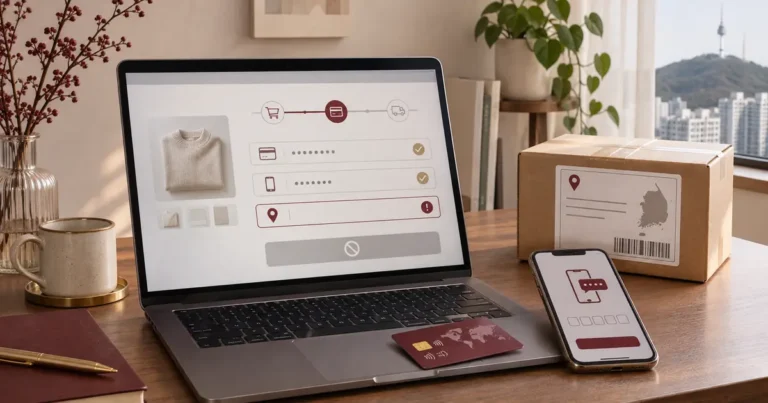
Ordering online or using a forwarding service can save suitcase space. Check whether the carrier accepts the item and whether your destination allows it to enter by post or courier. There are ways to buy from Korean sites that don’t ship abroad.
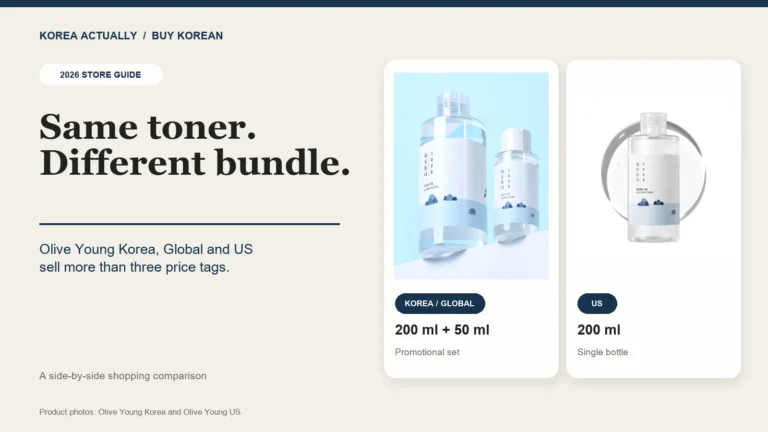
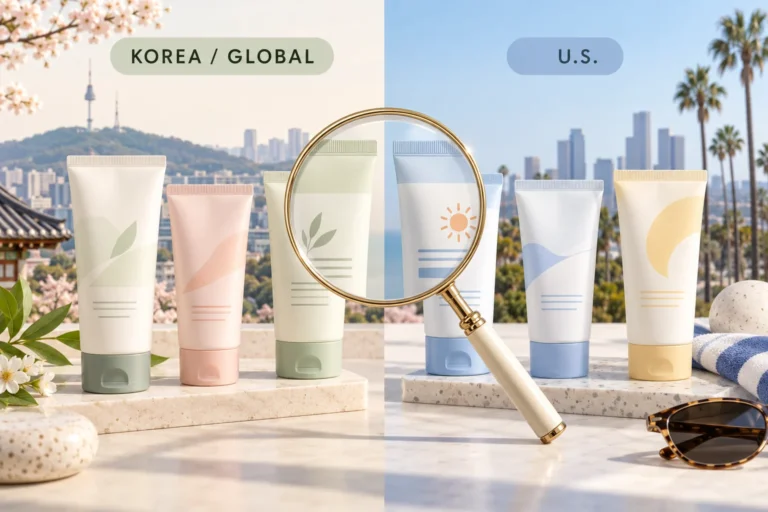
You may also be able to buy the product at home. For skincare, check which version the retailer lists, especially if you want the formula sold in Korea. The same brand can sell a different sunscreen in the US, and the three Olive Young storefronts carry different bundles.
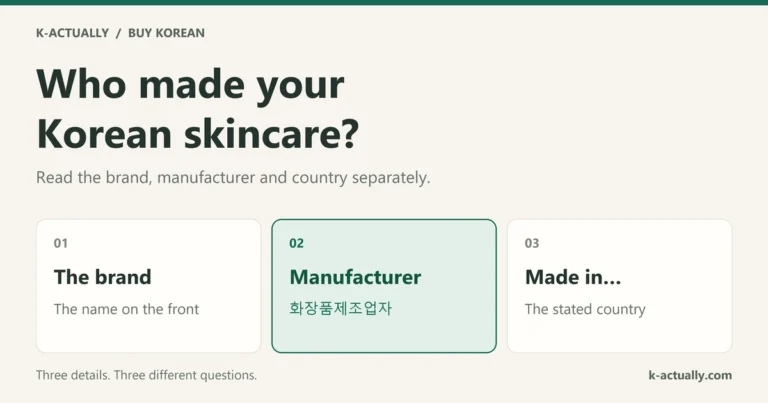
If you would rather buy in Korea for that reason, the package itself tells you some of what you want to know. A Korean-market box names the manufacturer and the responsible distributor, two entries a version made for another market is not required to print. What a Korean skincare label can and can’t tell you about who made it goes through what those entries settle.
Check the volume on the toner, the Wh on the power bank and the ingredients on the ramyeon. For food, look up your destination’s import and declaration rules before you fly, and keep the original packaging so inspectors can read the label.
Rules checked November 16, 2026.
Olive Young Global vs US vs Korea: Which Store Should You Use in 2026?
How to Buy from Korean Websites That Don’t Ship Internationally
Incheon International Airport, restricted items, security and food FAQ and transfer security screening.
Passenger abandoned-item figures for the first half of 2026 from Incheon International Airport Corporation, as reported by Hankook Ilbo.
ICAO power bank restrictions and Technical Instructions (Doc 9284), Addendum No. 1, applicable March 27, 2026. Korean implementation announced by the Ministry of Land, Infrastructure and Transport.
Korean Air restricted items. Airline conditions differ, so check the carrier you are flying.
USDA APHIS traveler guidance and U.S. CBP agricultural products guidance.
Your Europe traveler guidance on animal products, food and plants.
Australian Department of Agriculture, Fisheries and Forestry and Australian Border Force duty-free allowances.
U.S. CBP customs duty information and GOV.UK bringing food into Great Britain.
Rules and allowances change. Check the relevant authority before you travel.