Korea Pension Refund for Foreigners: What You Actually Get
If you search for a Korea pension refund before leaving the country, you’ll often find a simple answer: foreigners can get their National Pension contributions back.
The real rules are more complicated.
Leaving Korea does not automatically make you eligible. Having a social security agreement with Korea does not always mean a refund is available. Even an E-8 visa does not always lead to the same result.
And if you were enrolled in the National Pension Scheme through a Korean employer, there is another point that is easy to miss.
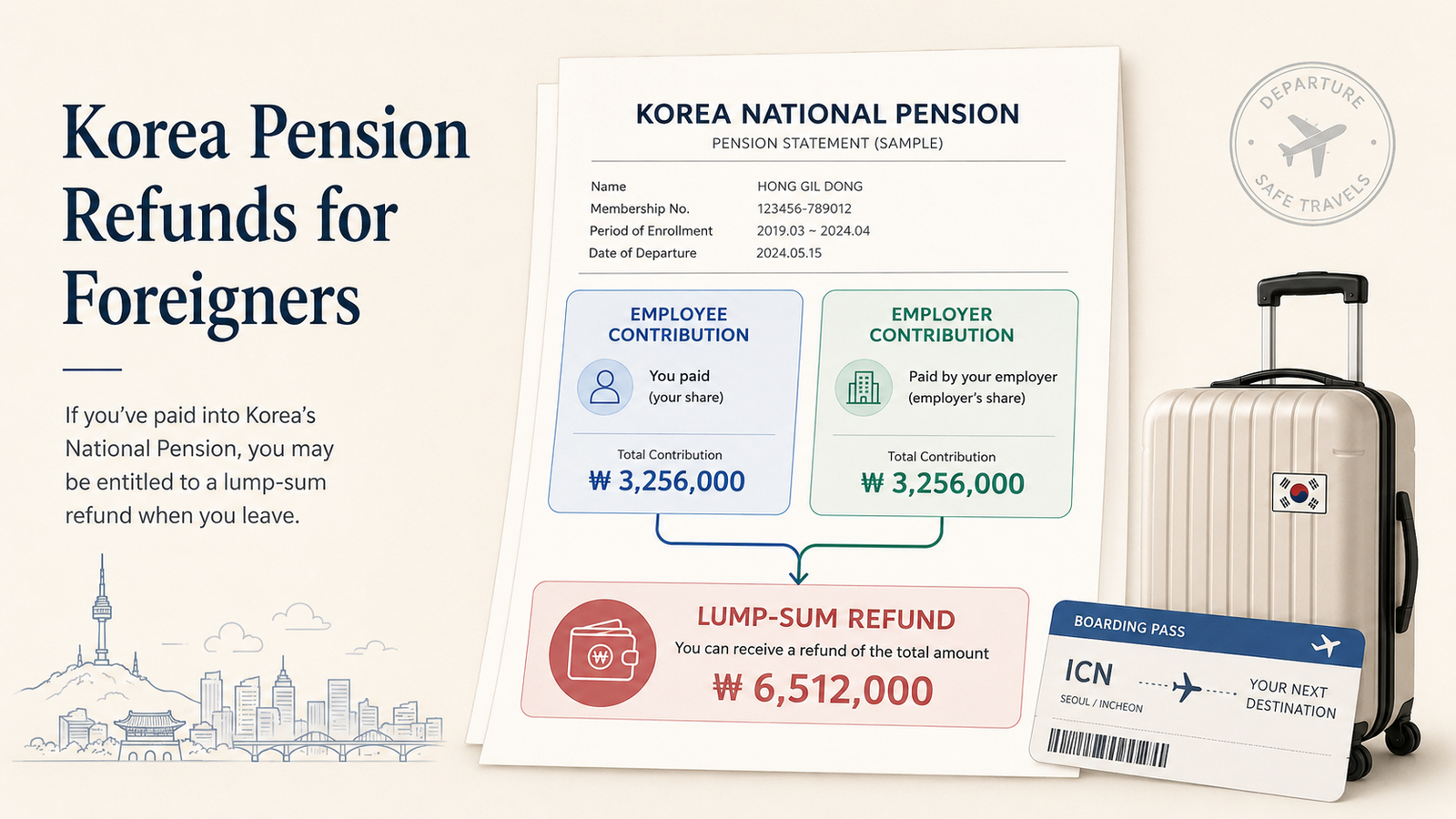
Your lump-sum refund is not limited to the pension contribution deducted from your paycheck.
Under Article 77 of Korea’s National Pension Act, the refund for a workplace-based insured person includes the employer’s contribution as well. Interest is added on top of that.
So if you look at your payslips, add up your own deductions and assume that is what you will get back, you may be underestimating what the refund includes.
This guide explains who can receive a Korean pension refund, what goes into the refund, when a social security agreement matters, and why taking the money immediately is not always the obvious choice.
Quick answer
| Question | Answer |
|---|---|
| Can every foreigner get a pension refund when leaving Korea? | No. It depends on your nationality, the applicable social security agreement, or certain visa categories. |
| Does the refund include the employer’s contribution? | Yes, for workplace-based insured persons. |
| Is leaving Korea enough to qualify? | No. |
| How long do I have to claim it? | Generally five years after the right to the refund arises. A separate 10-year period applies to certain refunds triggered by reaching pension age. |
| Can I receive it in cash at Incheon Airport? | Yes, if you meet the conditions and apply in advance. |
| Should I take the refund just because I can? | Not necessarily. It may affect how your Korean contribution period can be used later. |
Leaving Korea does not automatically qualify you for a refund
Foreigners do not automatically receive a lump-sum refund just because they paid into the Korean National Pension Scheme and are leaving the country.
According to the National Pension Service’s current lump-sum refund guidance for foreigners, a foreign insured person generally needs to qualify through one of three routes:
- The person’s home country gives Korean nationals a benefit corresponding to Korea’s lump-sum refund.
- Korea has a social security agreement with the person’s home country that allows a Korean lump-sum refund.
- The person paid into the NPS while holding an eligible E-8, E-9 or H-2 status.
“I paid National Pension contributions in Korea” and “I can get a lump-sum refund” are not the same thing.
Your nationality, visa status and the rules applying to your country all matter.
Not every E-8 case is treated the same
E-8, E-9 and H-2 are often grouped together in English-language pension refund guides.
There is one important exception.
The NPS states that the E-8 seasonal worker status introduced on December 24, 2019 is not covered by this nationality-independent refund rule. The E-8 category referred to in the rule is the older employment-for-training category. You can check the current eligibility table on the NPS lump-sum refund page.
So saying only “I had an E-8 visa” is not enough to determine eligibility.
You need to know which E-8 status applied to you.
Nationality can also create a separate route to eligibility. Laos, for example, is now included in the current NPS reciprocity table, which is one reason it is worth checking the latest list instead of relying on an older blog post or saved country table.
Does a Korea pension refund include your employer’s contribution?
No, and this is worth understanding before you try to estimate your refund.
If you worked for a Korean employer and were enrolled as a workplace-based insured person, part of the pension contribution came from you and part came from your employer.
Article 77 of the National Pension Act says that, for workplace-based insured persons, the amount used to calculate a lump-sum refund includes the employer’s contribution. Interest is then added according to the rules set by law.
In simple terms, the refund includes:
- your contribution
- your employer’s contribution
- applicable interest
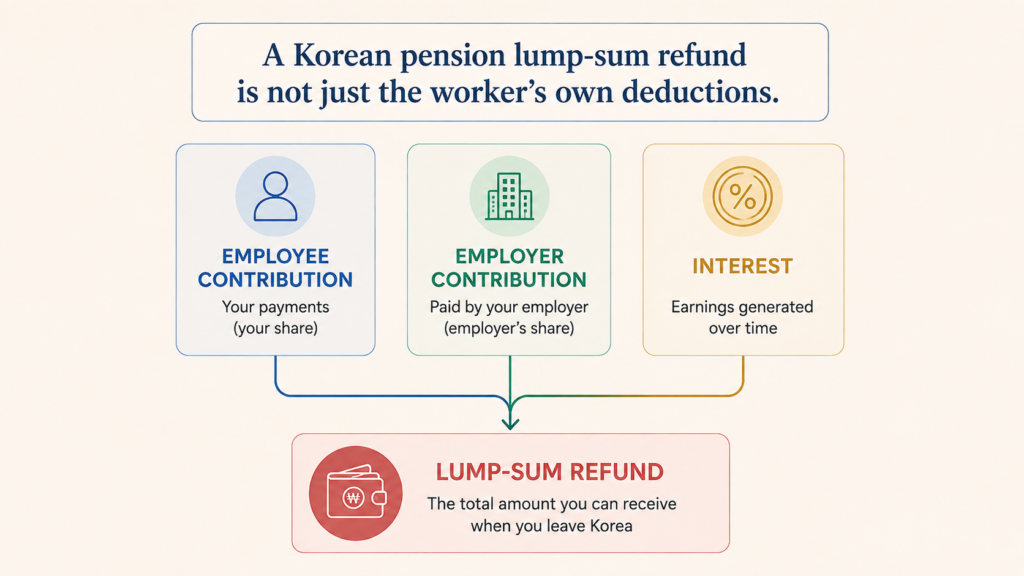
So simply adding up the pension deductions on your payslips can significantly understate what the refund includes.
For individually insured or voluntarily insured people, there is no separate employer contribution to add. But for foreign employees enrolled through a workplace, your own payroll deductions do not show the full refund structure.
A simple example
Suppose an employee had a standard monthly income of KRW 3 million and contributed to the NPS for a period of time.
Looking only at the amount deducted from that person’s salary would not show the full statutory refund calculation. The employer-paid portion is also included, and interest is added.
The NPS refund guidance explains that interest is calculated using the applicable rate for three-year fixed deposits.
ACTUALLY
If you were insured through a Korean workplace, your lump-sum refund is not legally defined as just the amount taken from your paycheck every month. The employer’s contribution is included too.
Your final refund depends on your contribution history, standard monthly income and the applicable interest calculation.
For an exact amount, check directly with the NPS rather than treating a simple online estimate as the amount you will receive.
A social security agreement does not automatically mean a refund
A common shortcut is to ask:
“Does my country have a social security agreement with Korea?”
That is useful, but it is not the whole question.
The more important question is:
What does that particular agreement allow?
24 countries currently covered for lump-sum refunds under social security agreements
There is one wrinkle in the NPS’s own guidance.
The list is presented slightly differently depending on which official NPS page you read.
The general Social Security Agreement guidance lists Quebec separately from Canada and explains Switzerland separately as an exception. The newer NPS page specifically dedicated to lump-sum refunds for foreigners, updated June 15, 2026, includes Switzerland within its 24-country table and does not list Quebec separately.
This guide follows the newer page dedicated specifically to lump-sum refunds.
The 24 entries currently listed there are:
Germany, United States, Canada, Czech Republic, Hungary, Australia, France, Belgium, Bulgaria, Poland, Slovakia, Romania, Austria, India, Türkiye, Switzerland, Brazil, Peru, Luxembourg, Slovenia, Croatia, Uruguay, Philippines and Argentina.
If your case specifically involves Quebec or Switzerland, it is worth confirming the current treatment directly with the NPS before applying.
Switzerland is unusual for another reason.
Its agreement with Korea is an exemption agreement designed mainly to prevent double social insurance coverage, rather than a pension totalization agreement. The NPS explains the difference between exemption and totalization agreements in its Types of Social Security Agreements guide. Even so, Swiss nationals are included in the current lump-sum refund guidance.
The label “social security agreement country” does not tell you everything by itself.
Some agreement countries do not get a Korean lump-sum refund
There are also countries that have social security agreements with Korea but whose nationals are not granted a Korean lump-sum refund under those agreements.
These include:
- Ireland
- Denmark
- Spain
- Sweden
- Finland
- New Zealand
- Norway
The NPS’s country-by-country social security agreement guidance shows that agreements can differ in what they cover.
Vietnam is another special case.
The Korea-Vietnam Social Security Agreement entered into force in January 2024. The NPS explains that, until Vietnam has the domestic pension legislation needed to implement totalization, the agreement operates only to eliminate double pension coverage.
That does not override a refund that may be available separately because of an eligible residence status.
ACTUALLY
The existence of a social security agreement is not the answer. What the agreement actually provides is the answer.
What if your country does not qualify through an agreement?
A country does not necessarily need a social security agreement with Korea for its nationals to receive a refund.
Korea also applies a reciprocity rule.
If another country’s pension system gives Korean nationals a benefit corresponding to Korea’s lump-sum refund, nationals of that country may also qualify for a Korean refund.
The NPS’s dedicated foreigner-refund page, updated June 15, 2026, lists 26 countries recognized through reciprocity.
Some have minimum NPS coverage requirements.
| Minimum NPS coverage | Countries |
|---|---|
| At least 6 months | Belize |
| At least 1 year | Grenada, Jordan, Saint Vincent and the Grenadines, Zimbabwe, Cameroon, Thailand, Bhutan, Laos |
| No minimum insured period listed | Ghana, Sri Lanka, Bermuda, Malaysia, El Salvador, Indonesia, Kenya, Kazakhstan, Hong Kong, Trinidad and Tobago, Sudan, Colombia, Vanuatu, Tunisia, Uganda, Cambodia, Solomon Islands |
The minimum period matters.
If your country requires at least one year of NPS coverage and you leave after 11 months, you fall short of the minimum period.
Country lists can change as pension laws and agreements change, so use this table as a starting point and check the current NPS list again when you are ready to apply.
Should you take the refund just because you can?
Not always.
Being eligible for a refund does not necessarily mean taking it immediately is the best option.
For people covered by a pension totalization agreement, Korean contribution periods may help them qualify for pension benefits later by combining eligible coverage periods from Korea and their home country.
Take the lump-sum refund, and the contribution period covered by it can no longer be used for that totalization.
The NPS explains this in its country-specific agreement guidance, including pages for countries such as the United States and Canada.
That does not mean leaving the money in Korea is always better.
It comes down to a choice:
cash now,
or a Korean contribution period that could matter for a pension later.
Can you restore the refunded period later?
Potentially, yes.
If you receive a lump-sum refund and later become insured under the Korean National Pension Scheme again, Korea has a repayment system.
Under Article 78 of the National Pension Act, you can repay the previous lump-sum refund plus the required interest and have the corresponding insured period restored.
So “once you take the refund, those years are gone forever” is too strong.
A better way to think about it is that the refunded period stops counting toward your Korean pension unless you later rejoin the NPS and restore it through the repayment system.
Think twice before applying if:
- you worked in Korea for a relatively long time
- you may return to Korea to work again
- your home country has a pension totalization agreement with Korea
- your Korean contribution period could help you qualify for retirement benefits later
If you worked in Korea for a short period, are leaving permanently and have little reason to preserve the Korean coverage period for future pension rights, taking the refund may be a much simpler decision.
There is no single answer that is right for everyone.
If you are still figuring out whether you can legally work in Korea and under which status, see our guide to finding a job in Korea as a foreigner.
How long do you have to claim the refund?
There is a time limit.
The NPS lump-sum refund guidance explains that, in general, a lump-sum refund must be claimed within five years after the right to receive it arises.
That does not mean the underlying contribution period simply disappears.
The NPS explains that if the limitation period expires after a refund right arose because of emigration or loss of nationality, the period may still matter if another pension entitlement later arises.
There is a separate limitation period for refunds triggered by reaching pension age.
For refund rights arising from reaching the applicable payment age on or after January 25, 2018, the limitation period is 10 years.
| Reason | General claim period |
|---|---|
| Leaving Korea, loss of nationality and similar refund cases | Generally 5 years from entitlement |
| Reaching the applicable payment age | 10 years for qualifying rights covered by the rule effective from January 25, 2018 |
Can you apply before leaving Korea?
Yes.
The refund generally requires confirmation of departure, but the NPS allows you to submit the claim before leaving if you can show that you are scheduled to depart within one month.
For an application made in Korea before departure, the NPS currently lists:
- lump-sum refund application
- passport
- Residence Card
- proof of a bank account in your name
- evidence that you will leave Korea within one month, such as a flight ticket
The NPS English page still uses the older term “Alien Registration Card.” Korea’s English terminology has since moved to “Residence Card.”
Already left Korea? You can still apply
Leaving Korea without completing the refund process does not necessarily mean you have lost your chance.
According to the NPS overseas application guidance, if you are already overseas, you can generally:
- send the required documents to the NPS by post, or
- appoint an agent in Korea to apply at an NPS office on your behalf.
For an overseas postal claim, the NPS lists documents including the application form, passport, proof of your bank account and an overseas remittance application.
Depending on where the documents are issued, notarization, consular authentication or an Apostille may also be required. Foreign-language documents may need a Korean translation and notarization.
There is also an application route through designated social insurance institutions in several countries under NPS memorandums of understanding.
So if you returned home without finishing the process in Korea, do not assume it is too late.
Can you really receive your pension refund in cash at Incheon Airport?
Yes, but not as a walk-up service.
You have to apply for airport payment in advance.
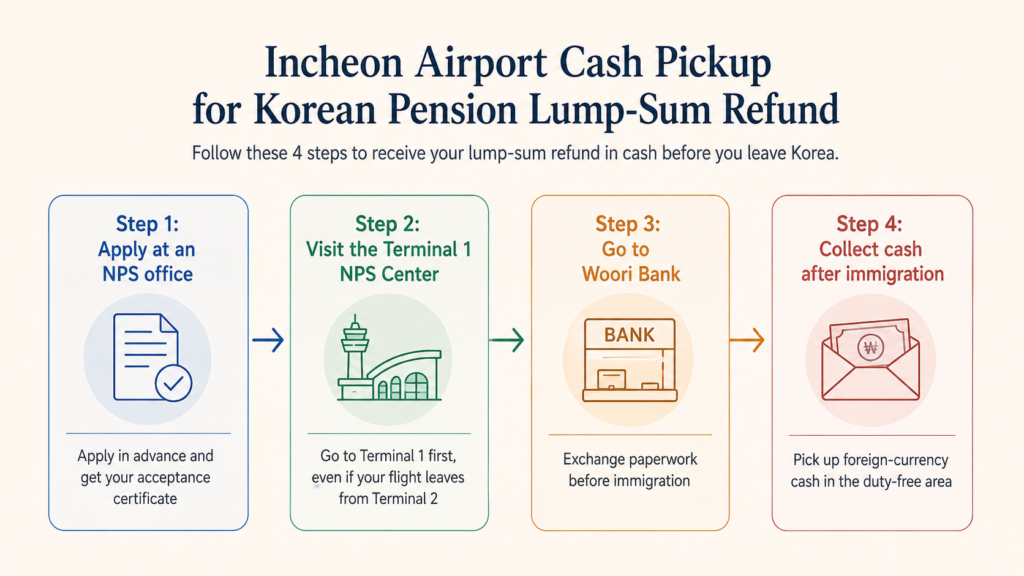
The full procedure is listed on the NPS Foreigners and Lump-sum Refund page.
Airport payment requirements
You must:
- be eligible for a lump-sum refund
- depart through Incheon International Airport within one month of applying
- have your former employer report your loss of workplace coverage to the NPS by the day before departure
- depart on an eligible operating day
Airport payment is unavailable on Saturdays, Sundays, public holidays and the last business day of December.
Your flight also has to fall within the service window:
| Departure terminal | Eligible weekday flight time |
|---|---|
| Terminal 1 | 10:30 to 24:00 |
| Terminal 2 | 11:00 to 24:00 |
Payment is made in foreign currency, not Korean won.
The NPS currently supports 16 currencies, including USD, EUR, JPY and CNY.
Step 1: Apply at an NPS office before departure
Within one month of leaving, visit an NPS office or counseling center other than the Incheon Airport center.
Bring your passport, Residence Card, a flight ticket showing departure within one month and a copy of your bank account information.
Choose “Airport Payment” when filing the claim.
You will receive a Certificate of Application Acceptance.
The NPS also asks for a Korean or overseas bank account as a backup in case airport payment cannot be completed or an adjustment payment is needed later.
Step 2: Visit the NPS center in Terminal 1 on departure day
Even if your flight leaves from Terminal 2, go to the NPS Incheon Airport Center in Terminal 1 first.
Current location:
Terminal 1, 1st floor, between Exits 1 and 2, Booths 7 to 8
Hours:
09:00 to 18:00
Bring your passport and Certificate of Application Acceptance.
The NPS will issue the payment documents you need for the next step.
Step 3: Go to Woori Bank before immigration
The counter depends on the refund amount.
| Refund amount | Terminal 1 | Terminal 2 | Hours |
|---|---|---|---|
| USD 10,000 or more | Woori Bank Airport Financial Center, B1F | Woori Bank T2 Branch, B1F | 09:00 to 16:00 |
| Under USD 10,000 | Woori Bank exchange counter near Counter H, 3F | Woori Bank exchange counter near Counter A, 3F | 09:00 to 21:00 |
Bring your passport and the Direction for Payment issued by the NPS.
You will receive a currency exchange receipt.
Step 4: Collect the cash after immigration
After immigration, take your passport and exchange receipt to the Woori Bank booth in the duty-free area.
Current locations:
- Terminal 1: near Gate 11
- Terminal 2: near Gate 250
Both are currently listed as operating from 09:00 to 21:00.
That is where you collect the cash.
Airport locations, banking counters and operating hours can change. If you are planning your departure around same-day pickup, confirm the current airport-payment details with the NPS before your flight.
Six things to check before applying
Before submitting your Korean pension refund claim, check these six things:
- Is my nationality currently eligible through a social security agreement or reciprocity?
- If my country has an agreement with Korea, does that agreement actually allow a lump-sum refund?
- Does my visa create a separate eligibility rule, particularly if I held E-8 status?
- What is my full contribution history and expected refund amount?
- Could taking the refund affect how I use my Korean contribution period for a future pension?
- Do I want to apply before departure, use airport payment, or apply from overseas?
Applying is the easy part.
The more important questions are whether you qualify, what the refund includes, and what happens to your contribution period once you take it.
If you are also trying to understand other mandatory systems that can suddenly start applying to foreigners in Korea, our guide to Korea’s National Health Insurance for international students explains why NHIS enrollment and bills can appear even when you never signed up yourself.
Where to confirm your case
Rules can change as Korea signs new agreements and other countries change their pension systems.
For your final eligibility and refund amount, use these official sources:
- National Pension Service: Foreigners and Lump-sum Refund
- National Pension Service: Social Security Agreements
- National Pension Service: Types of Social Security Agreements
- National Pension Service: Countries and Agreement Status
- National Pension Act, Article 77: Lump-sum Refund
- National Pension Act, Article 78: Repayment and restoration of insured periods
- NPS: Korea-Vietnam Social Security Agreement
- NPS customer service in Korea: 1355
The NPS foreigner-refund page used for the country tables in this article was updated June 15, 2026.
This article provides general information, not individualized legal, tax or financial advice. Confirm your own eligibility, contribution history and expected payment directly with the National Pension Service before applying.