How to Find a Job in Korea as a Foreigner: Start With Your Visa
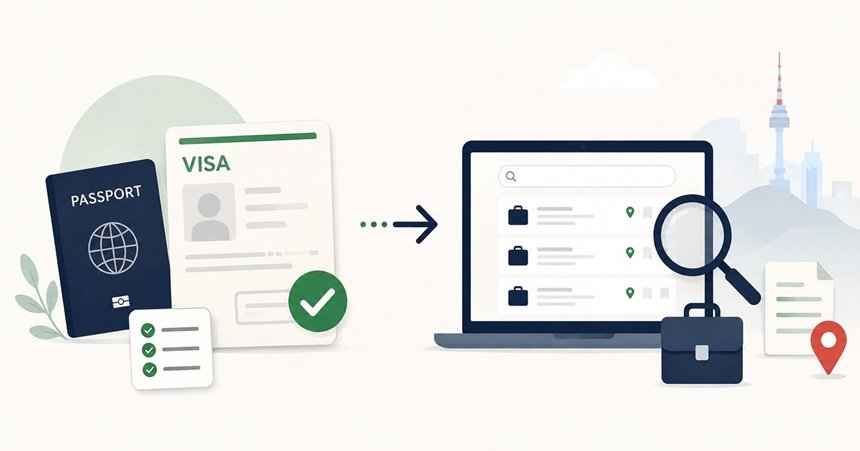
Start with your visa, not the job board.
Search for advice on how to find a job in Korea as a foreigner and you’ll quickly see the same names:
JobKorea.
Saramin.
Wanted.
LinkedIn.
Those platforms can be useful, but for many foreigners, they aren’t the best place to start.
The first question isn’t “Where should I apply?” It’s “What kind of work can I legally and realistically do in Korea, given my situation?”
Under Korean immigration rules, foreigners generally need a status of stay that permits employment, and some statuses also limit the type of work or workplace allowed. That means your nationality, education, professional experience, occupation and current visa status can completely change your job-search strategy.
For some people, an employer has to sign on first. For others, it’s possible to enter Korea and look for work once you’re here. And for some, the type of work they can legally take is restricted from the start.
So before opening a job board, figure out which route you’re actually on.
This article provides general information, not personalized immigration or legal advice. Visa rules can change, and individual cases may differ. Check the latest requirements with HiKorea or a Korean embassy or consulate before making a decision.
The first question isn’t “Where should I apply?”
A common way to imagine moving to Korea is:
Find a company
→ Apply
→ Get hired
→ Sort out the visa
Sometimes that works, but not always.
Korea’s government-run Study in Korea service explains that foreigners seeking employment must first meet the requirements of the relevant employment status. For people changing from D-2 or D-10 into statuses such as E-1 through E-7, the intended work must fit an eligible status, and an employment contract must already be signed.
So before searching for jobs, ask yourself:
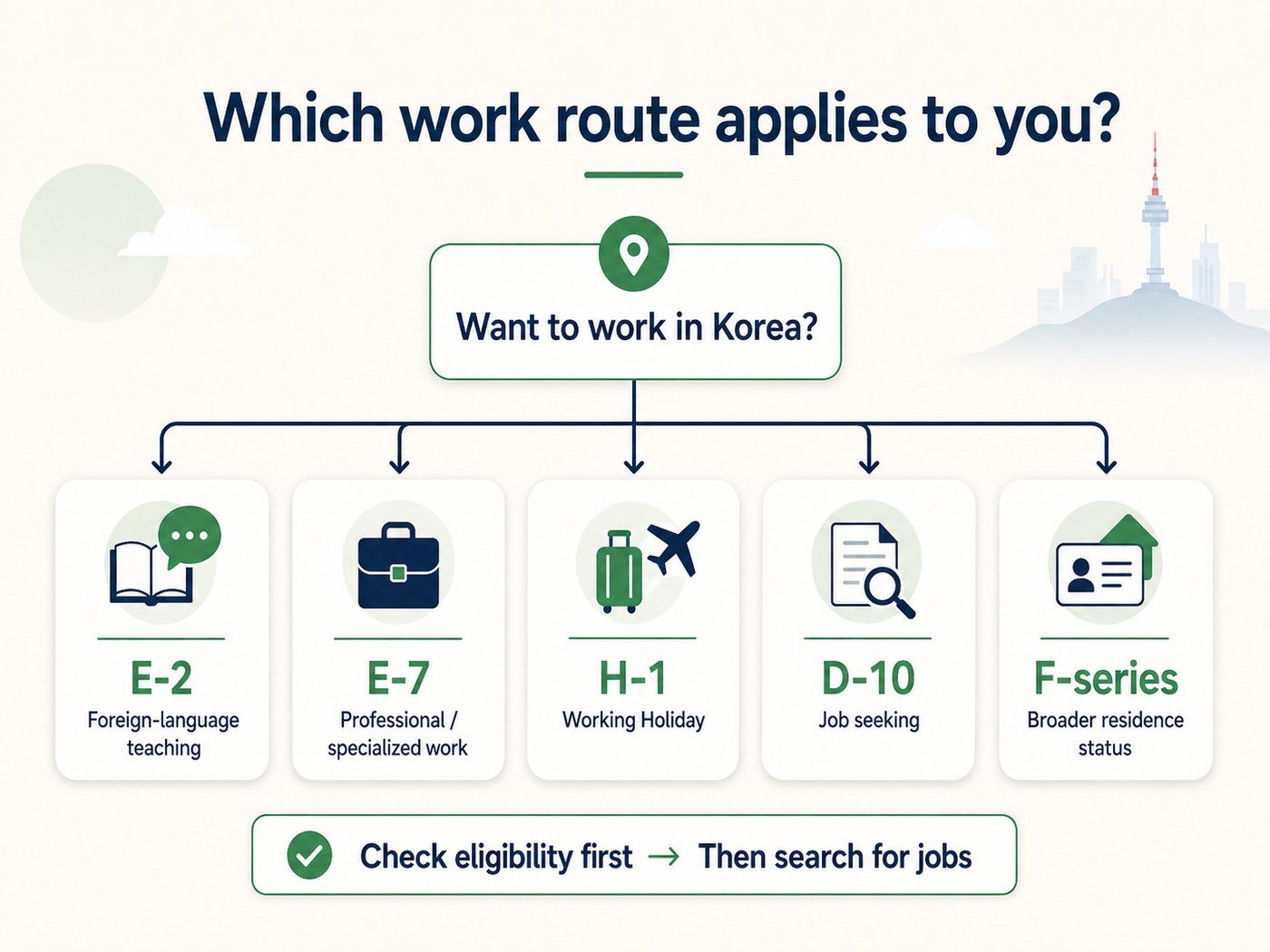
- Am I eligible for foreign-language teaching?
- Do I have professional qualifications or experience that may fit an E-7 occupation?
- Am I eligible for a Working Holiday visa?
- Do I already hold an F-series status with broader employment rights?
- Am I graduating from a Korean university and preparing to job-hunt?
- Or am I simply hoping to move to Korea first and find a regular company job afterward?
Those are very different situations.
If you’re currently studying in Korea on a D-2 or D-4 visa, part-time work follows a separate permission system. Before accepting a job, see our guide to part-time work in Korea for international students for work-hour limits, Korean proficiency requirements, and the permission process.
Official source: Study in Korea, Employment System for Foreigners
Route 1: E-2, foreign-language teaching
The E-2 Conversational Guidance status is one of the best-known employment routes for foreigners in Korea. But it’s specifically intended for eligible foreign-language teaching activities, not a general work visa that lets you take any job after arriving.
The exact qualification requirements depend on the E-2 category and the applicant’s circumstances, so verify your eligibility before treating teaching as your default route. A particularly important point is that E-2 is normally tied to an eligible teaching institution and employment arrangement.
In practical terms, the sequence usually looks like this:
Find an eligible teaching employer
→ Sign the required employment documents
→ Complete the visa process
rather than moving to Korea, getting an E-2, and deciding where to work later. That’s why teaching applicants often need to think about the employer before thinking about general Korean job boards.
Before applying, check the latest E-2 requirements directly through HiKorea or the Korean embassy or consulate responsible for your country.
Route 2: E-7, professional and specialized work
The E-7 Specific Activities status is often described online as Korea’s professional work visa. That’s useful shorthand, but too simple.
E-7 covers designated occupations, and eligibility can depend on several things at once: your occupation, your qualifications and experience, the employer, the employment contract, and the requirements of the specific E-7 category.
Government guidance also notes that some E-7 hiring can be restricted depending on factors such as the employer’s domestic workforce composition, while employment contracts and qualification documents are part of the application process. So the common online explanation that “a Korean company only has to prove that it couldn’t hire a Korean” isn’t a good way to understand E-7 as a whole. The actual system is more complicated.
If you’re aiming for an E-7 position, the useful first question isn’t “Which Korean companies hire foreigners?” It’s “Does my occupation and professional background fit an E-7 route, and can the employer support that route?” Only after that does the general job search become useful.
Official source: Study in Korea, E-7 employment guidance
Route 3: H-1, working holiday
Working Holiday H-1 is structurally different from employer-sponsored work routes. You don’t normally need a specific Korean employer before receiving the visa, which makes it one of the clearer routes for eligible young people who want to enter Korea and look for temporary work after arrival.
Even so, H-1 isn’t unrestricted employment. Official Korean diplomatic mission guidance says total employment cannot exceed 1,300 hours during the year. The guidance gives 25 hours per week over 12 months as one example of how that annual limit can be used.
It also excludes certain professional activities, including occupations such as doctors, lawyers, professors, pilots and foreign-language conversation instructors.
This matters because a Working Holiday visa doesn’t automatically let you take an English-teaching job. If you want to work in an occupation that requires another employment status, check the appropriate immigration route separately.
Nationality-specific conditions can also apply. For example, official Korean guidance specifically notes a six-month same-workplace restriction for Hong Kong nationals, which is a good reminder that not every Working Holiday agreement has identical conditions.
Don’t copy the Working Holiday rules that apply to another nationality. Check the conditions that apply specifically to your citizenship.
Route 4: D-10, job seeking isn’t the same as employment
D-10 is commonly called the “job-seeker visa,” which can create the wrong impression. It doesn’t mean you can work freely in Korea while deciding what job you want.
Korea’s government-run Study in Korea service describes D-10 as a status for job-seeking activities, certain short-term internships, and other employment or start-up preparation activities. That distinction matters. A D-10 holder may be legally staying in Korea while searching for eligible employment, but that doesn’t mean every part-time or regular job automatically becomes permitted. Once an eligible employer is found, changing into an employment status such as E-1 through E-7 requires meeting the requirements of that status.
So think of D-10 less as “I already have unrestricted permission to work” and more as “I have a status that lets me prepare for and search for eligible employment.”
Official source: Study in Korea, D-10 job-seeking guidance
Route 5: F-series, more freedom but not unlimited
F-series statuses can dramatically change the job-search situation. Some provide much broader employment freedom than employer-sponsored statuses such as E-2 or E-7. But don’t treat every F visa as interchangeable.
F-5 permanent residence and F-6 marriage immigration generally provide broad employment freedom. F-2 depends more on the specific subtype. F-4 Overseas Korean status is another important example: it generally provides much broader employment access, but it isn’t unrestricted. A Ministry of Justice notice effective February 12, 2026 still restricts certain simple-labor activities and other specified types of employment for F-4 holders.
So “F-4 means I can take absolutely any job” isn’t accurate. The exact subtype of your F-series status still matters.
What about E-9 jobs?
You may also come across E-9 Non-Professional Employment when researching factory, agriculture, construction or other manual jobs in Korea. This is a different system entirely.
E-9 operates through Korea’s Employment Permit System and is tied to eligible sending countries and designated industries. Seeing an E-9 job listed online doesn’t mean the route is open to your nationality. For many readers from countries such as Australia, the United States, Canada or the UK, E-9 generally isn’t the route through which they’d enter the Korean labor market.
So if you see stories about foreigners working in Korean factories or farms, check first whether the worker entered through EPS, and whether your nationality is actually eligible for that system.
Quick decision table: which route are you on?
| Your situation | Likely route | Job offer needed before visa/status? | Can you job-hunt after arriving? | Important caveat |
|---|---|---|---|---|
| Foreign-language teacher | E-2 | Usually yes | Not as the normal route | E-2 is tied to eligible teaching work and a sponsoring institution. |
| Skilled / professional hire | E-7 | Usually yes | Depends on your current status | Your occupation, qualifications, employer and contract all matter. |
| Working Holiday participant | H-1 | No | Yes | Employment-hour limits and nationality-specific conditions can apply. |
| Job seeker / recent graduate | D-10 | No | Yes, within D-10 rules | D-10 is for job seeking, not unrestricted employment. |
| F-2 holder | F-2 | Usually no sponsorship needed | Generally yes | Some F-2 subtypes have restrictions. |
| Overseas Korean | F-4 | Usually no sponsorship needed | Generally yes | Certain occupations, including restricted simple-labor categories, may be off-limits. |
| Permanent resident | F-5 | Usually no sponsorship needed | Yes | Separate professional licenses may still be required. |
| Marriage migrant | F-6 | Usually no sponsorship needed | Yes | Employment is broadly permitted, subject to limited exceptions. |
This table is a simplified decision guide, not a complete immigration rulebook. Eligibility can vary by nationality, visa subtype, occupation and individual circumstances.
So when should you look at Korean job boards?
Once you know which route applies to you, job boards become much more useful, and the platform you should use may depend on that route.
If you’re eligible for E-2 teaching work, teaching-specific recruiters and academy job listings may matter more than general Korean recruitment sites. If you’re targeting E-7 professional employment, your industry, qualifications and whether an employer can support your status matter more than simply finding a listing marked “foreigner friendly.” If you hold an F-series status with broader employment rights, mainstream Korean recruitment platforms become much more useful, since you may be able to compete for a wider range of regular jobs. And if you’re on a Working Holiday visa, temporary and part-time work channels may be more relevant.
This is also why some recruitment platforms aimed specifically at foreigners organize listings around visa eligibility. For a foreign job seeker in Korea, visa status isn’t a small administrative detail added after the job search. It can define the job market you’re actually able to enter.
Which job sites should foreigners check?
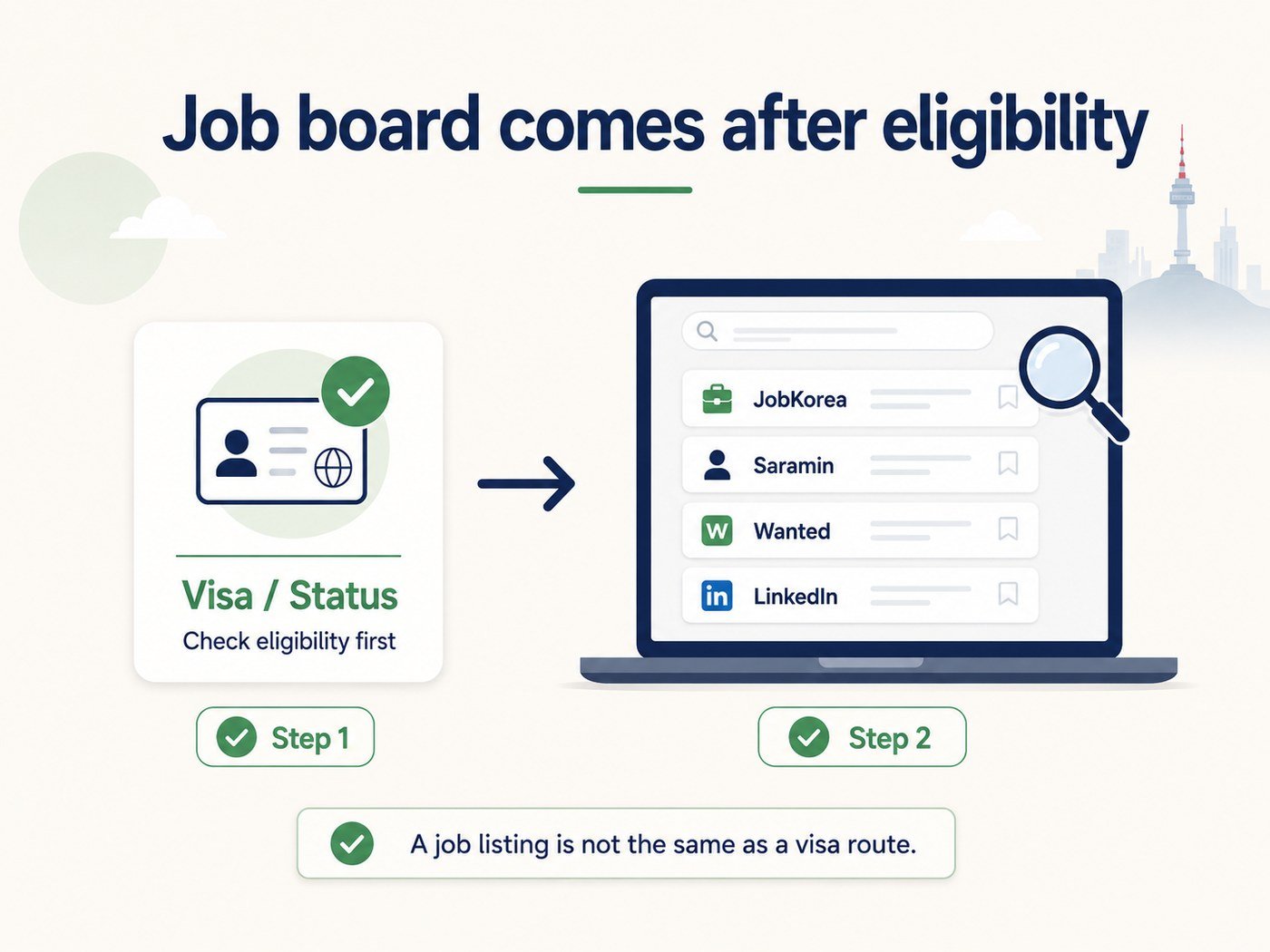
These platforms are useful after you know what kind of employment status you can actually use. A job listing is not the same thing as a viable visa route.
Once your eligibility is clear, these are some of the main places worth checking:
- JobKorea, one of Korea’s major general recruitment platforms
- Saramin, another major Korean job platform
- Wanted, widely used for professional, startup and tech-related roles
- LinkedIn Jobs, particularly useful for multinational companies and internationally oriented roles
Don’t assume a listing written in English means the employer can sponsor your visa. And don’t assume “foreigner welcome” means every foreign applicant has the same legal path to the job. Check the employment conditions before investing heavily in an application.
Do you need to speak Korean?
Visa eligibility is only one side of the problem. The next question is language.
Some jobs are built around a foreign language. Some multinational or internationally focused roles may operate partly or mostly in English. But many Korean workplaces still conduct meetings, internal messages, reporting, customer communication and everyday office life in Korean.
So “Do I need Korean to work in Korea?” doesn’t have one answer. It depends on the occupation, company, team and visa route.
Not every work visa requires TOPIK. Korean-language requirements depend on the specific status, while employers may impose their own language expectations.
The more useful question isn’t simply whether Korean is required. It’s how much Korean you actually need for the type of job you’re targeting.
If improving your Korean is part of your plan before entering the job market, see our guide to Korean language schools in Korea, including D-4-1 visa basics, 2026 tuition, attendance requirements, and university versus private programs.
How to find a job in Korea as a foreigner: check these three things first
Before spending hours on applications, check:
- Which employment or residence status can apply to your nationality and background?
- Does that route require specific education, professional experience or an employer?
- Do you need the employment relationship before changing or receiving your visa or status?
Then start asking which companies to target, which job sites to use, and how much Korean you’ll need. That order matters.
For many foreigners, finding work in Korea isn’t only a job-search problem. It’s an eligibility problem first.
Start with your visa. Then open the job board.
Moving to Korea? These problems often come next
Getting the job and visa is only the beginning of settling in Korea.
But visas and practical systems are only part of the adjustment. Our look at living in Korea as a foreigner separates Korea-specific barriers from the uncertainty and loneliness that can follow anyone living abroad.
Once you have a Korean phone number, you may find that having a working number doesn’t automatically mean Korean online identity verification will work. Our guide explains why a Korean phone number can still fail identity verification.
Banking has its own rules as well. If a Korean banking app blocks you from opening another account, see our explanation of Korea’s 20-business-day bank account rule.
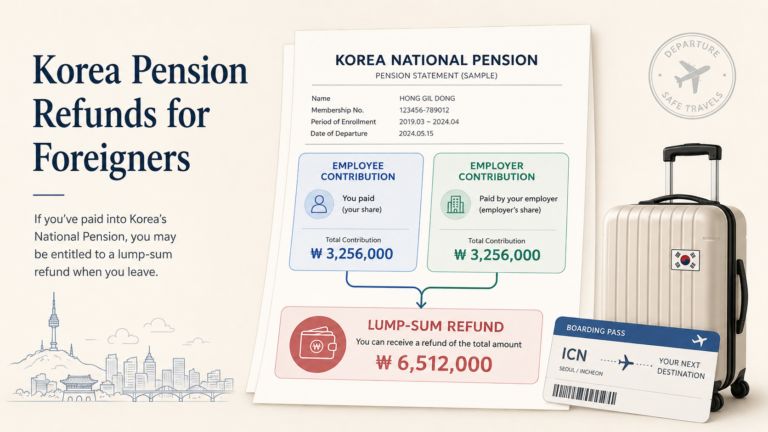
If you later leave Korea after working here, another question may come up: what happens to the National Pension contributions you paid while employed? Our guide explains who can qualify for a Korea pension refund, what the refund includes, and why the employer’s contribution can matter too.
Official sources
- HiKorea, Korea Immigration Service
- Study in Korea, Employment System for Foreigners
- Study in Korea, Employment Regulations and D-10 Guidance
- National Law Information Center, Immigration Act
- National Law Information Center, Enforcement Decree of the Immigration Act
- Ministry of Justice Notice, Restrictions on Employment Activities for F-4 Status, effective February 12, 2026
- Embassy of the Republic of Korea in Japan, Guidance for H-1 Working Holiday Visa Holders
Visa and employment rules can change. Before applying for a job, changing status or making travel plans, verify the latest requirements for your nationality and exact visa subtype through HiKorea or the Korean embassy or consulate responsible for your case.