Templestay in Korea: A Night Inside a Living Temple
The short answer
A templestay in Korea is an overnight or day program at a Korean Buddhist temple, open to anyone regardless of religion. Programs come in three kinds: a few hours, one night following the temple’s schedule, or one night built around rest.
Expect roughly 50,000 to 100,000 won per adult. Before you pay, check three things that a hotel booking never asks of you: whether the program runs in English on your date, whether enough people have booked for it to run at all, and where exactly you check in.
The rooms
The Night Busan Ran Out of Beds
In June 2026, BTS played two nights in Busan. The shows were on the 12th and 13th, and the thing the city argued about first was not the stage. It was the price of a bed.
Rates jumped. Complaints about gouging piled up. Busan had opened a reporting channel for inflated lodging prices five months before the concerts and had been sending inspection teams to hotels, and the argument kept going anyway.
So the city tried something else. It called the program the Fair Lodging Challenge, a public and private effort to collect rooms offered free or at a normal rate. The first places to sign up were not hotels. They were temples.
Beomeosa announced it would host 20 international visitors from June 11 to 14, lodging and meals included, at no charge. Seonamsa in Busanjin-gu, Busan and Hongbeopsa joined. Naewonjeongsa had already put 21 rooms forward, and every one of them was taken.
That was a special measure tied to the concert dates. It is not how booking a templestay works the rest of the year.
It still leaves a question worth asking. Korean temples are places of practice. How did they end up as places that put up foreign travelers?
The origin
Templestay Started by Hosting World Cup Visitors
The answer is 24 years old.
The Ministry of Culture, Sports and Tourism describes templestay as a program that began with the 2002 Korea-Japan World Cup. It lists three aims: easing the shortage of accommodation the country was facing, giving visiting tourists a way to experience Korean culture, and showing that culture to the world. Government records call it a pilot project. Inside the ministry it went by a working name, the Cultural World Cup pilot project.
It opened at 33 temples. Once the tournament ended, the Jogye Order announced the program would become permanent, and in 2004 the Cultural Corps of Korean Buddhism was created to run it. It now runs at around 150 temples.
Many of the temples a traveler sleeps in are more than a thousand years old. Templestay, the program itself, was built in 2002. Temple retreats and training existed long before that. The thing you book today started with the World Cup.
Templestay, the program itself, was built in 2002.
It has grown steadily since. About 349,000 people took part in 2025, the highest annual figure so far, and 55,515 of them were foreign visitors. Foreign participation has more than doubled since 2022, when the figure was 26,587.
One note on the numbers. This article uses participant headcount rather than the separate count that multiplies participants by nights stayed. If another source puts 2025 closer to 620,000, check which basis it is using before comparing.
The choice
Which Kind of Templestay Fits Your Trip
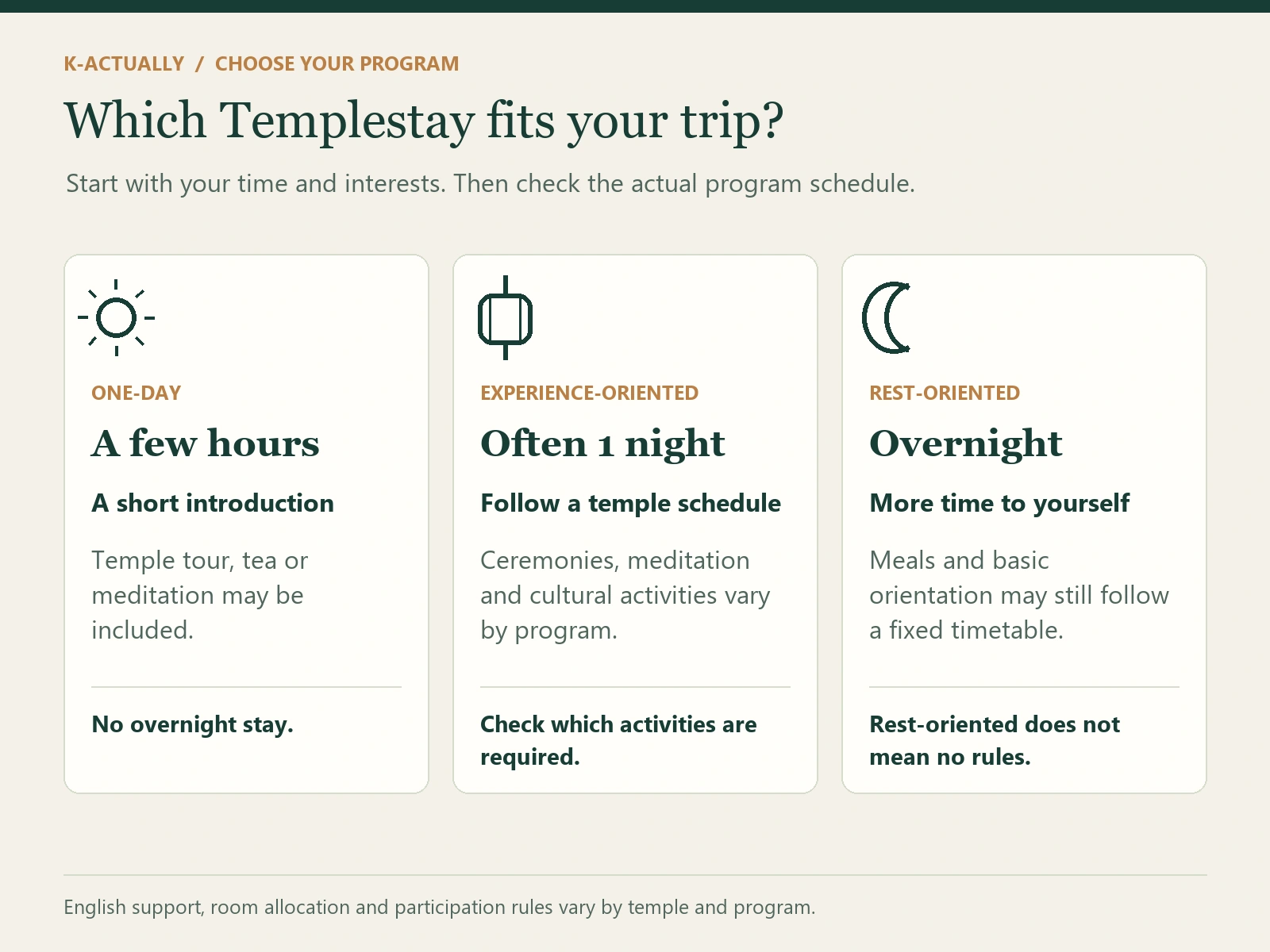
The official site sorts programs into three kinds, and it is worth using its own labels when you search.
One-day Templestay usually runs two to three hours. It covers a temple tour, meditation and a tea ceremony. The official guidance points foreign travelers short on time toward this one.
Experience-oriented Templestay means following the schedule the temple has prepared. Chanting, meditation, 108 prostrations and a craft activity may all appear. Whether a program includes Balwoogongyang, the formal monastic meal, and which activities are required varies from temple to temple.
Rest-oriented Templestay is built around rest. You keep to meal times and a basic schedule, and the hours in between are mostly yours.
A fourth category, group programs, sits on the booking site for parties above a certain size.
After you pick a type, there is one more thing to settle: what language your program runs in.
On the English booking site, look under a temple’s name for the tag Temple for foreigner. Temples carrying it have staff able to work in English, and the Cultural Corps’ 2026 plan put the number at 31. A temple inscribed on the UNESCO World Heritage List carries a second tag, Unesco Temple. Daeheungsa in Haenam shows both.
Read the tag as a starting point rather than a guarantee. A temple’s designation and the working language of one particular program on one particular date are different things, so check the program description too, then confirm with the temple if your date matters.
There is a discount route as well. The Cultural Corps runs a special templestay for foreign visitors most years at 30,000 won for one night and two days. The terms change each time. The 2025 round ran for three months from August through October at 47 temples, first come first served, capped at 1,500 people. The 2026 round ran for the single month of September at 19 temples, and it was open to foreign residents of Korea as well as visitors. If you want to build a trip around it, read the current notice first.
The history
This Quiet Place Has a War in Its Past
Most people come away from a templestay with a similar impression. Quiet, slow, set apart from the world. The impression is accurate as far as it goes.
The quiet a traveler meets at a temple today does not tell you the whole of what these places and their monks have done in Korean history.
The quiet a traveler meets at a temple today does not tell you the whole of what these places and their monks have done in Korean history.
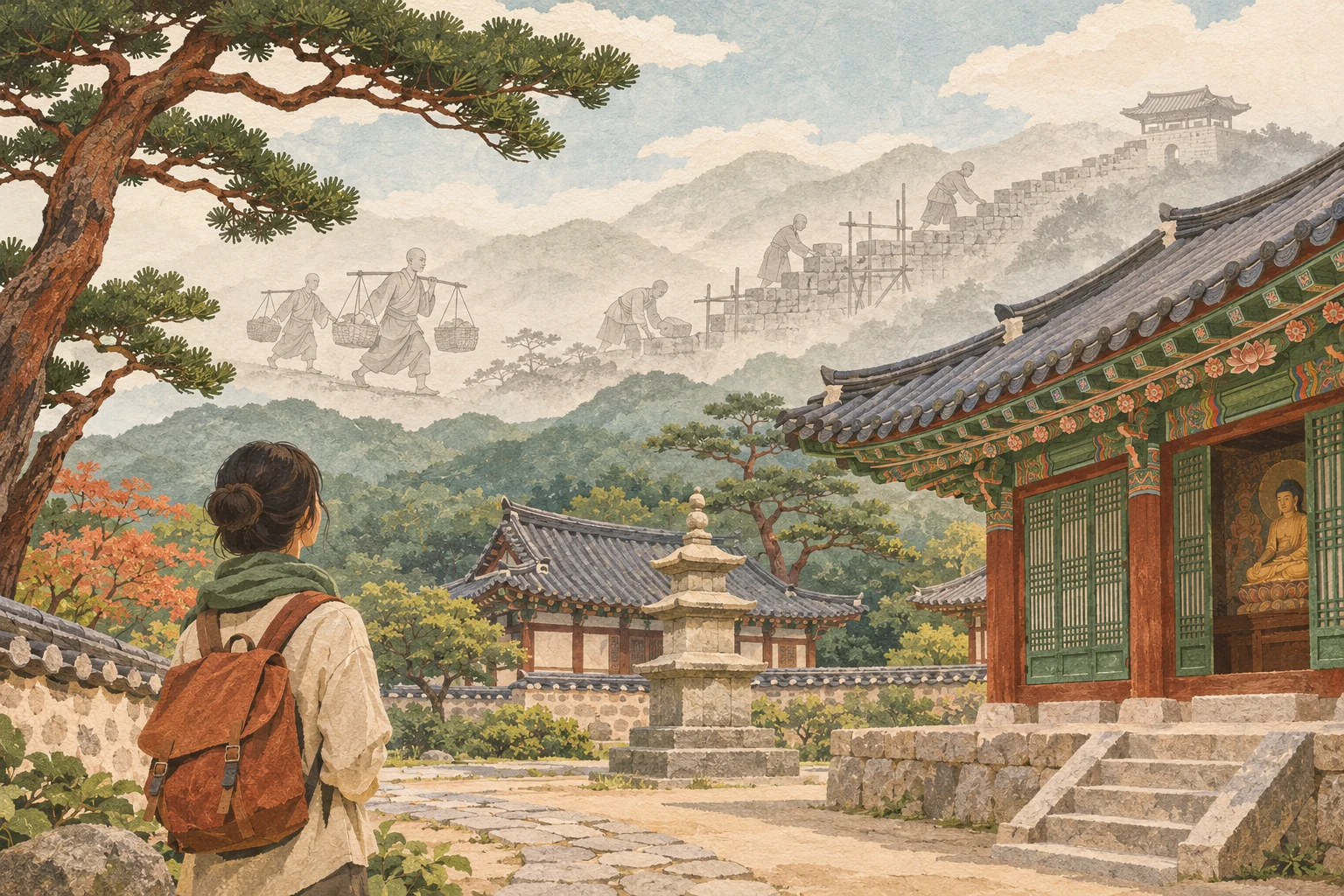
When the Japanese invasions began in 1592, King Seonjo gave the monk Hyujeong, known as Seosan Daesa, authority to raise monastic forces. Hyujeong sent a call to arms to temples across the country, and the monk soldiers who gathered under him and other monastic commanders retook Pyongyang alongside Ming forces.
Fighting was not the whole of their work. They built mountain fortresses and held them. They moved military grain. They knew mountain terrain, so after Pyongyang they were sent to scout enemy movements. Hyujeong’s disciple Yujeong, known as Samyeong Daesa, took his teacher’s place in the field and directed both grain supply and fortress construction.
It would be too simple to tell all of this as a story of volunteers. Royal command and court organisation ran through the monks’ participation. Monk soldiers fought and carried grain during the war, and after it they went on repairing and garrisoning mountain fortresses. The relationship between temples and the Korean state was one where suppression, mobilisation and cooperation overlapped.
The places where that history sits are still places you can visit.
Seven mountain monasteries were inscribed in 2018 as Sansa, Buddhist Mountain Monasteries in Korea: Tongdosa, Buseoksa, Bongjeongsa, Beopjusa, Magoksa, Seonamsa in Suncheon, and Daeheungsa in Haenam. UNESCO describes them as “living centres of faith and daily religious practice” that have continued to the present. Six of the seven run templestay programs, Buseoksa in Yeongju being the exception, and four of them are designated for international participants: Tongdosa, Beopjusa, Magoksa and Daeheungsa.
Inside Daeheungsa’s grounds stands Pyochungsa, a shrine to Seosan Daesa and his disciples Samyeong Daesa and Cheoyeong Daesa. A petition to build it was filed in 1788, King Jeongjo granted the name it carries, and the building went up the following year, in 1789. A Confucian-style shrine inside a Buddhist temple is an unusual arrangement, and rites are still held there every year.
At Daeheungsa you can spend a night at a mountain monastery whose grounds hold the shrine to the monks who raised that army.
The history of the monk soldiers is still kept here. Daeheungsa runs its rest and experience programs in English and Korean, so this is a night you can book without a language barrier.
If you would rather see the traces without staying overnight, Namhansanseong sits about 25 km southeast of Seoul. It was designed as an emergency capital for the Joseon dynasty, and the UNESCO inscription describes it as “Built and defended by Buddhist monk-soldiers”.
The monk soldiers and the concert-week lodging offer came out of different circumstances and served different ends. Put together, the two show how temples have related to the society around them in different centuries.
Before you book
What to Check Before Booking a Templestay in Korea
A templestay does not work like a hotel booking. These are the things to settle before you pay.
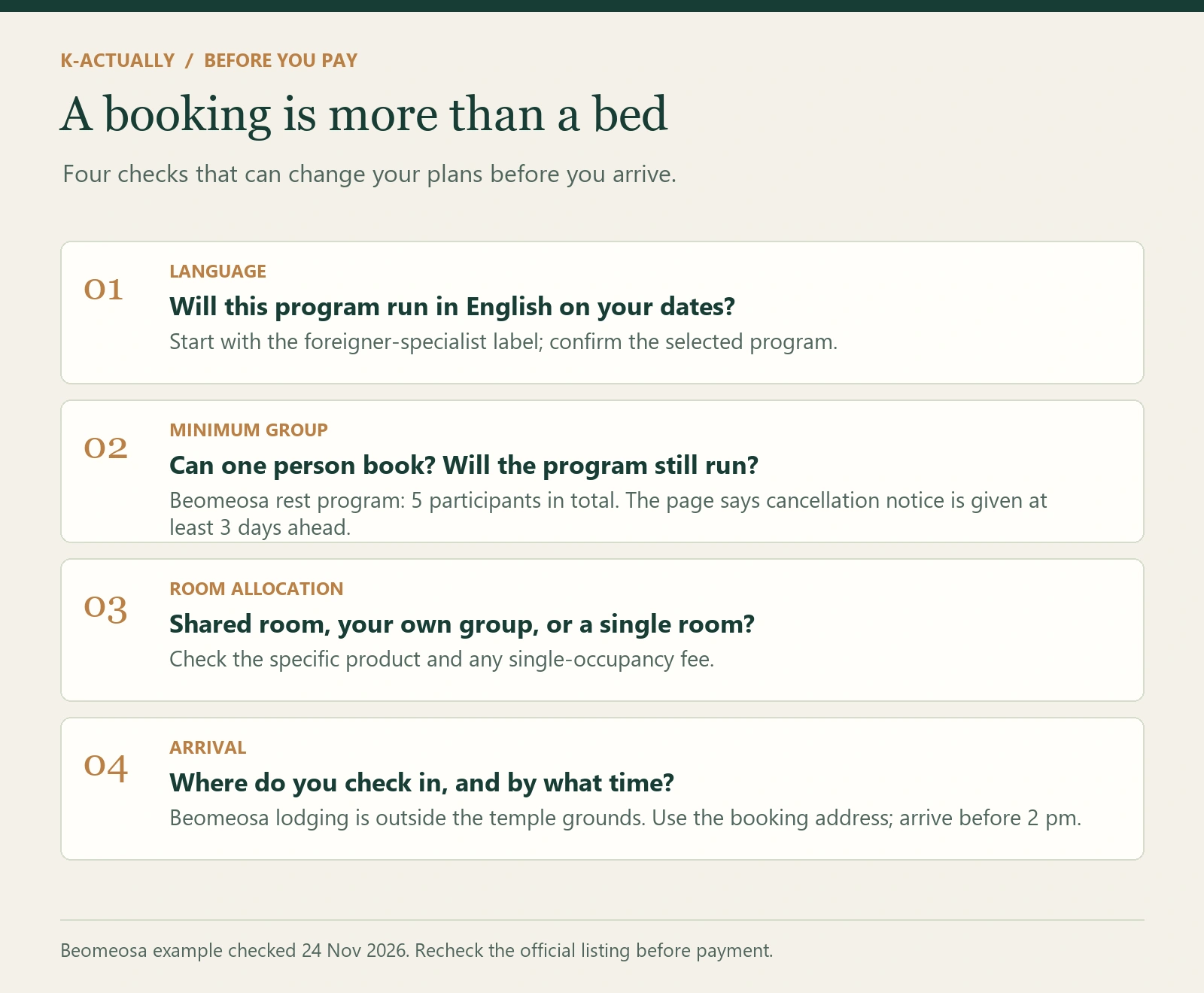
- The working language. Look for the Temple for foreigner tag on the booking page, read the program description, then confirm that English guidance is available on your date. Those are three separate pieces of information.
- The minimum headcount. Being able to book alone and the program actually running on your date are not the same thing. Beomeosa’s rest-oriented program needs five or more participants in total, counting everyone else who has booked. The official notice says that if a program is cancelled for low numbers, the temple will contact you at least three days before. If you are stacking onward transport and hotels around the night, check this one first.
- Room assignment. Every temple starts from a different assumption. Woljeongsa assigns rooms by the number of guests, so booking its 1 to 2 person product alone gets you a room to yourself. Beomeosa assigns a small room for 2 to 3 or a large room for 4 to 8, separated by gender, and when checked its page said single rooms were not being offered for the time being. Daeheungsa’s English program has you share with your own party, with a surcharge to take the room alone.
- Required versus optional. A rest program does not mean every hour is free. Beomeosa’s rest-oriented program still includes temple etiquette training, while the same program lists the predawn service as optional. If bowing or sitting on the floor is difficult for you, check whether those activities are required before you book.
- Where you actually sleep. Do not assume the lodging is inside the temple grounds. Beomeosa’s templestay building is outside them. The official program notice puts it about 800 m from the grounds, roughly a 20-minute walk. Go to the address on your booking confirmation rather than to the temple gate.
- Check-in time. It closes early, and the window can be narrow. Beomeosa’s rest-oriented program asks you to be in by 2 p.m. Woljeongsa checks guests in between 3:00 and 3:30 p.m. and will not take anyone after 4:30 p.m. Worth doing the arithmetic if you are coming straight from an airport.
- Length of stay and the refund rules. Long stays are often not an option. Beomeosa takes bookings up to two nights and three days. Its refund terms are 100 percent three days before, 70 percent two days before, 50 percent the day before, and nothing on the day itself.
- Meals. Meal times are fixed, and keeping to them is usually part of the basic rules. For vegan dishes, places to eat and ingredients to check in temple food, see our vegan Korean food guide.
Four temples compared
| Temple | What it suits | Program | Price per adult | Room terms |
|---|---|---|---|---|
| Jogyesa, central Seoul | A few hours, no overnight | Seon of Tea, day tea ceremony | 50,000 won | No lodging. Tea ceremony and temple tour |
| Jogyesa, central Seoul | One night in the city | Regular Templestay Program (1 night, 2 days) | 80,000 won for 1 night | Shared room |
| Woljeongsa, Pyeongchang | A mountain monastery reachable from Seoul | Rest-oriented Templestay, 1 to 2 person room (Korean booking page) | 100,000 won per night | Per person, not per room. Book alone and the room is yours; book as two and you share |
| Beomeosa, Busan | Fitting a temple night into Busan | Relaxation Templestay | 70,000 won per night | Shared, 2 to 3 or 4 to 8. Runs with five or more in total |
| Daeheungsa, Haenam | Staying where the history is | [Rest] English/Korean Templestay Program (All Days) | 80,000 won per night | Share with your own party. 20,000 won more to use the room alone |
Prices are per adult, as shown on the official program pages on November 24, 2026. They vary by program, room type and date, so open the page again before you pay. All four temples carry the Temple for foreigner tag, and Daeheungsa carries the Unesco Temple tag as well.
Find the four temples
Explore each location on Google Maps. These pins show the temple grounds; use the check-in address supplied with your booking when you travel.
Seoul · Jongno
Jogyesa
A central Seoul option for one-day and overnight programs.
55 Ujeongguk-ro, Jongno-gu, Seoul
Pyeongchang · Odaesan
Woljeongsa
A mountain-temple stay in the Odaesan area.
374-8 Odaesan-ro, Jinbu-myeon, Pyeongchang
Busan · Geumjeong-gu
Beomeosa
Temple grounds. The templestay lodging has a separate address below.
250 Beomeosa-ro, Geumjeong-gu, Busan
Haenam · Duryunsan
Daeheungsa
The Haenam temple with Pyochungsa Shrine in its grounds.
400 Daeheungsa-gil, Samsan-myeon, Haenam
The fit
Who This Suits
If you have no spare day. Take a one-day program. Jogyesa sits in the middle of Jongno, which makes it easy to slot between other plans, and two to three hours covers it.
If you want a day of temple life. Start with the experience-oriented programs, such as Jogyesa’s overnight experience program. If bowing or floor sitting is hard for you, ask before booking whether those parts are required and whether there is another way to join in.
If you are going to rest. The rest-oriented programs are built for it, and Beomeosa’s is the one to look at if Busan is already on your route. Check the minimum headcount and the room terms first, and if the point is quiet time alone, Woljeongsa’s 1 to 2 person product gives a solo traveler the room.
If you are going for the history. Daeheungsa is the option where the history in this article and a night’s stay meet in one place. It is a UNESCO-inscribed mountain monastery, and the shrine to the monk who raised the monastic army stands inside its grounds. Factor in the distance from a Seoul or Busan route.
One thing holds whichever type you pick. Templestay was built as a program in 2002, and the places it runs in are still where people practise and live. That is the reason a visitor keeps to the hours and the rules of the house.
◆
Read next
- Where to Stay in Busan, if Beomeosa is going into a Busan trip
- Seoul to Busan: KTX, SRT, Bus or Flight?
- Vegan Korean food, for what to expect from temple meals
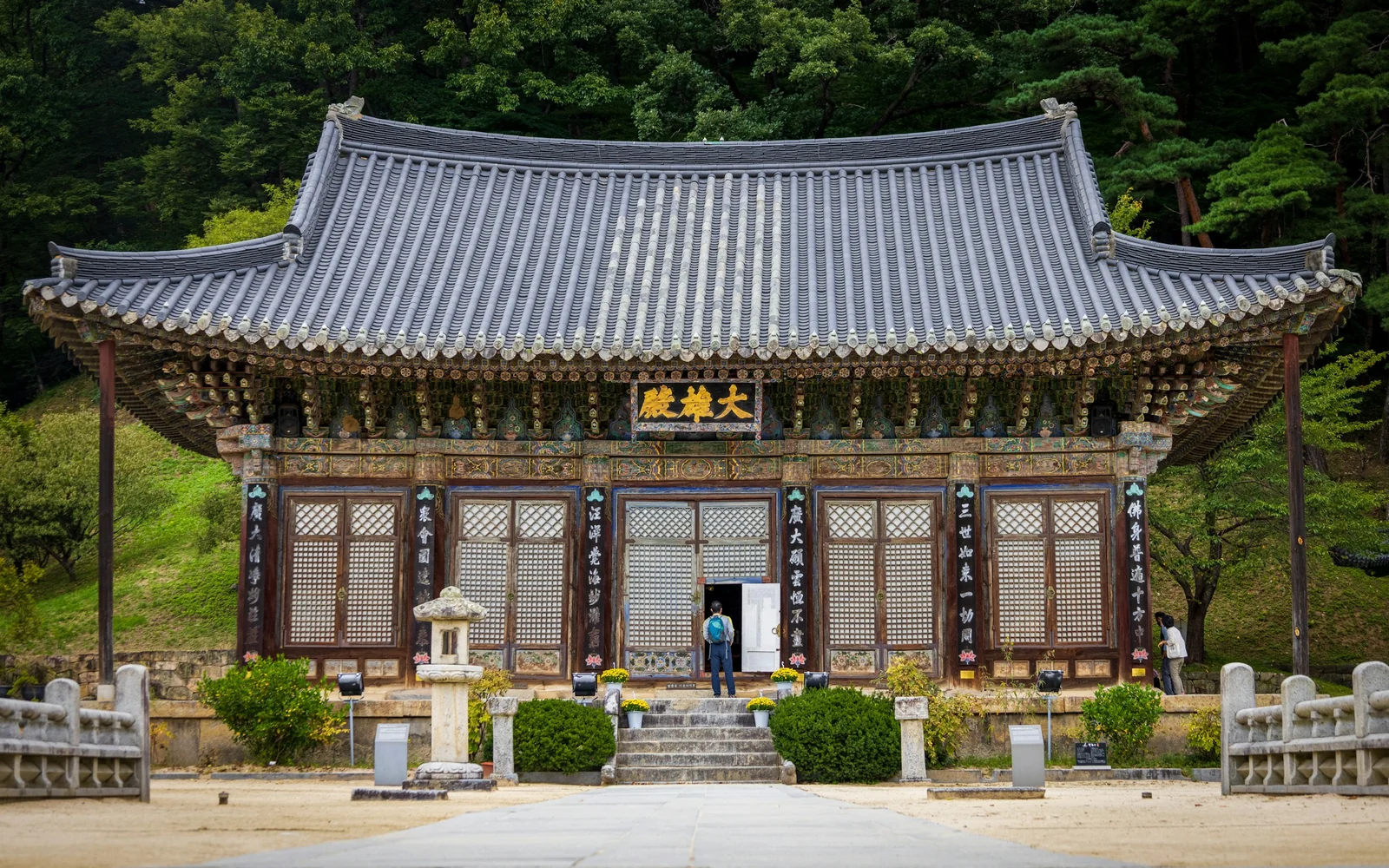
Featured photograph: Jikjisa Temple in Gimcheon. Photo: Photos of Korea / Unsplash.