Kimchi Is a Timeline, Not a Recipe
A first-time kimchi eater may think the jar has gone bad. A Korean cook may see the beginning of dinner.
The lid opens with a soft release of pressure. The cabbage smells sharper than it did before, and its fresh flavor has become distinctly acidic. For someone unfamiliar with fermentation, sour kimchi can look like food that has reached the end of its useful life. In a Korean kitchen, the same change may mean that the kimchi is ready for stew, fried rice, pancakes, or a braise.
Quick Answer
Sourness alone does not mean kimchi is spoiled. As kimchi continues to ferment, it becomes more acidic and its culinary role changes. However, mold, an odor clearly different from normal fermentation, or an unusual texture are reasons to discard it.
Kimchi is not simply made, finished, and eaten in one fixed state. It keeps changing inside the container. Korean cooking responds by giving it different jobs.
The useful question is not only, “Is this kimchi still good?” It is also, “What is this kimchi ready for?”
The Clock
Kimchi Does Not Have One Finish Line
Kimchi continues to change after the recipe ends. Microorganisms break down sugars in the vegetables and produce acids and gases, altering the flavor, aroma, and texture.
The speed is not universal. Temperature matters, but so do salt concentration, ingredients, the type of vegetable, and the way the kimchi was prepared. The University of Georgia’s consumer guide to homemade kimchi says that fermentation depends on ingredients, salt, temperature, and time, and that time and salt concentration work together to keep kimchi safe. UGA Extension
A calendar alone therefore cannot tell you what a batch has become. Two containers made at the same time may develop differently. A water-rich kimchi will not behave exactly like napa cabbage kimchi, and a family recipe may not follow the same path as a commercial product.
Korean cooking often evaluates kimchi through its current taste and intended use.
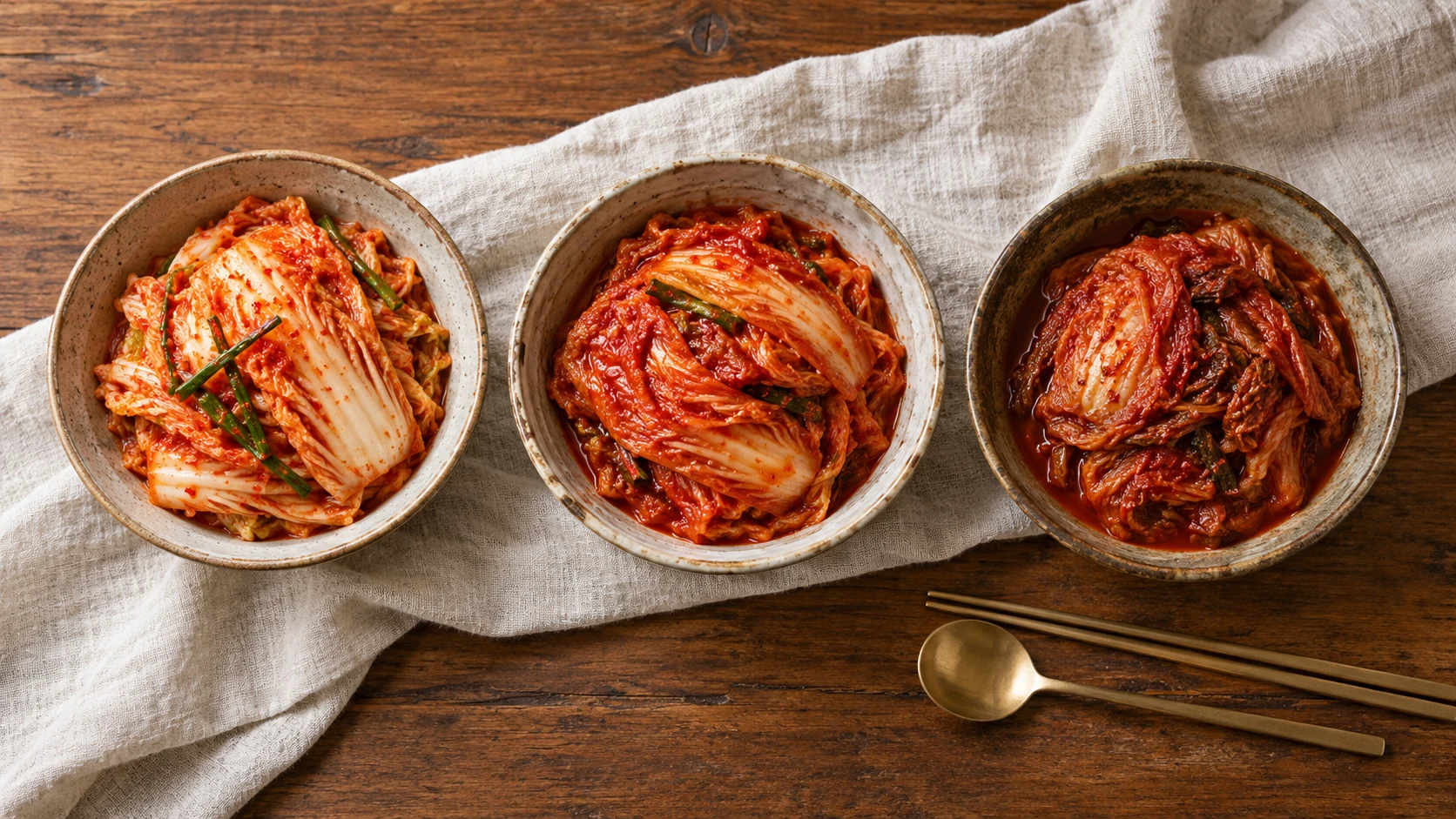
Freshness, ripeness, and sourness are not a simple ranking from good to bad. They describe different culinary possibilities.
A separate fresh branch
Geotjeori (겉절이)
Taste and textureCrisp, vegetable-forward, freshly seasoned
Typical useEaten promptly with rice, noodles, or boiled pork
Regular kimchi, as it ripens
Less ripe
Taste and textureFirm, fresh-tasting, lightly acidic
Typical useEaten as a side dish or allowed to ripen further
Well ripened
Taste and textureBalanced acidity and developed aroma
Typical useServed as an everyday side dish
Sour, or sin kimchi (신김치)
Taste and textureSharper acidity, stronger aroma, softer leaves
Typical useUsed in stew, fried rice, pancakes, stir-fries, or dumpling fillings
Made for long aging
Mukeunji (묵은지)
Taste and textureDeeply fermented, savory, sour, and soft
Typical useUsed in braises, stews, and hot pots
This is a map of culinary uses, not a single universal batch moving through five fixed stages. Geotjeori is normally prepared as a fresh style, while mukeunji may be made specifically for long aging.
These categories are more deliberate than a single line suggests. Preparation method and intended use matter alongside fermentation.
The Check
How to Tell Sour Kimchi From Spoiled Kimchi
A strong sour taste is not, by itself, proof that kimchi has spoiled. Acidity is an expected result of fermentation. Bubbling or pressure can also occur as microorganisms produce gas.
This does not mean that every old container is safe. Fermentation is not permission to ignore warning signs.
The University of Georgia’s food-safety guidance identifies three practical signs of spoilage:
- visible mold
- an off-putting odor clearly different from kimchi’s normal fermented aroma
- an unusual texture, which can signal that the fermentation environment has been compromised
If any of these signs appear, the guidance is to discard the kimchi rather than treating the problem as a matter of taste alone. UGA Extension

The distinction should be made carefully. A clean, sharp sourness may indicate continued fermentation. A rotten or distinctly abnormal odor is a warning. Softer cabbage can result from aging, but a texture that seems genuinely unusual for the product should not be dismissed.
If you are genuinely unsure, do not taste the kimchi to investigate. Discard it.
The Long Age
Mukeunji Is Not Just Forgotten Kimchi
Mukeunji is not simply any forgotten jar of old kimchi. Kimchi intended for long aging may be prepared differently from ordinary kimchi, although methods vary by household and region.
The World Institute of Kimchi explains that mukeunji commonly uses relatively more salt and less seasoning than ordinary kimchi. It may also be drained for longer to reduce excess liquid. World Institute of Kimchi
These are not universal rules. Regional traditions differ, and households develop their own methods. The important point is intention: mukeunji can be prepared for long aging from the beginning.
That makes it different from a half-empty container overlooked in the back of a refrigerator. Ordinary kimchi can become old, sour, and useful for cooking. It does not automatically become the same product as kimchi prepared specifically for extended aging.
This helps explain why mukeunji has a distinct place in Korean cooking. Its acidity and softened texture can become part of a dish’s structure. Fatty pork, broth, tofu, and longer cooking can balance the acidity while drawing out a deeper fermented flavor.
Time does not merely preserve mukeunji. Time is one of its ingredients.
The Machine
Why Korea Built a Refrigerator to Control Kimchi Time
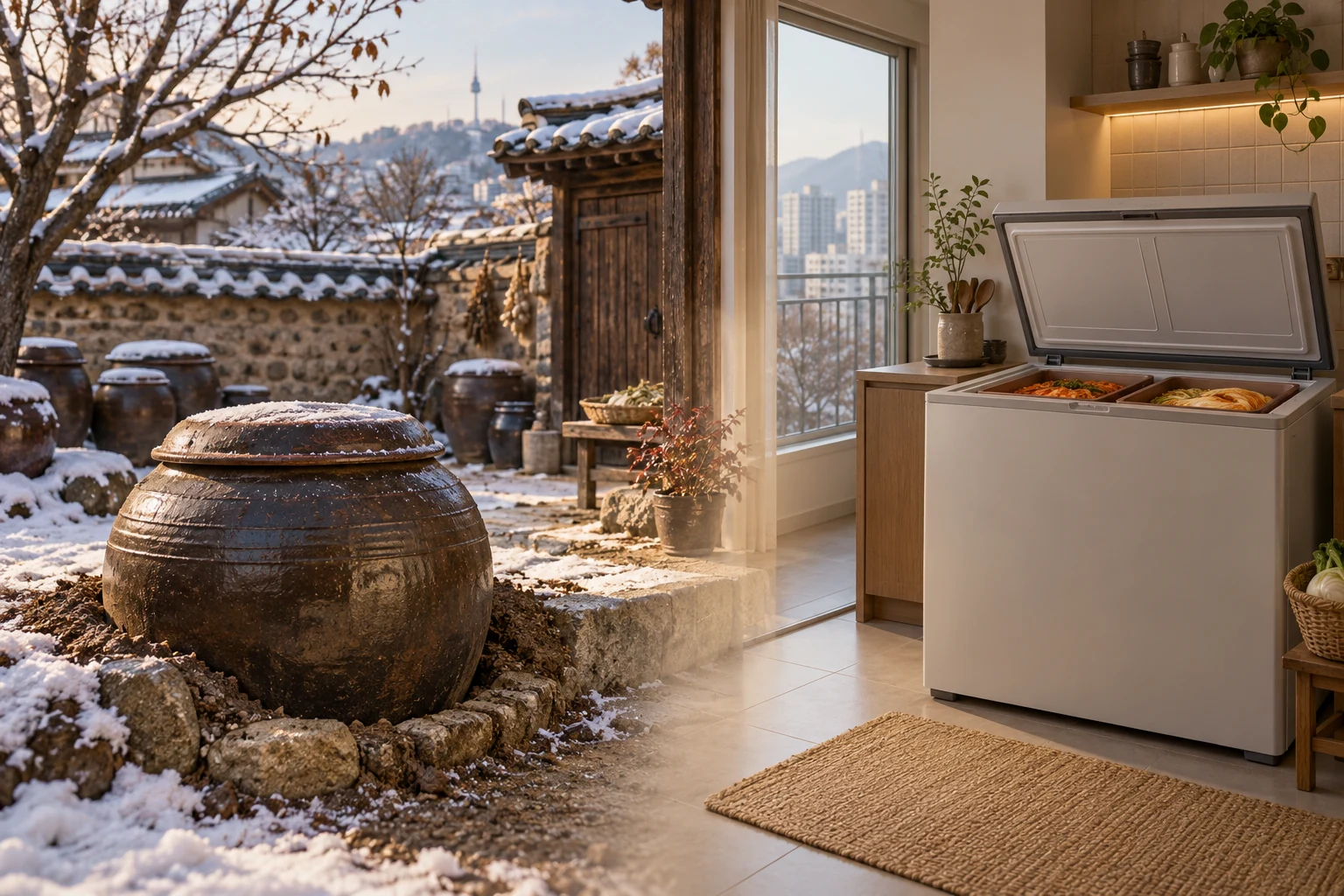
Before the kimchi refrigerator, Korean households traditionally stored large quantities of kimchi in earthenware jars. During the winter kimjang (김장) season, when families made kimchi in bulk, jars could be placed partly underground and kept in steadier ground temperatures.
That system required outdoor space. As cities expanded and apartment living became more common, many households no longer had a yard for a kimchi jar. The food remained important, but the storage environment that supported it was disappearing.
In 1984, GoldStar, which later became LG Electronics, introduced what it describes as Korea’s first dedicated kimchi refrigerator. LG’s history says the product addressed concerns about odor spreading through a regular refrigerator and kept a temperature suited to ripening and storage. LG Electronics Daewoo Electronics followed with a similar product in 1985.
A design-history table in a recent study of Dimchae, however, lists odor removal and simple cold storage as the main aims of the 1984 and 1985 models, with ripening control arriving later. The study also describes a 1992 Samsung model that attempted to sense the fermentation process, but none of these early products established a major category. Journal of Mechanism Management
The market changed in November 1995, when Mando Machinery launched Dimchae under its Winia home-appliance brand. Dimchae used a top-opening lid, a design the study links to limiting cold-air loss and to the idea of a modern kimjang jar.
Several thousand units were sold by the end of the launch year. Sales then expanded rapidly, helping turn the kimchi refrigerator from a niche product into an independent appliance category. Journal of Mechanism Management
Kimchi refrigerators are common in Korea, but not universal. Manufacturers now also sell compact models aimed at single-person households, which suggests the appliance is adapting to smaller homes and smaller batches. Financial News
The appliance is not merely a separate box for a strong-smelling food. The early products addressed odor and storage, while later models increasingly managed ripening as well.
This is a manufacturer’s description, not independent proof that machine-aged kimchi is identical to traditionally aged mukeunji. It still captures what makes the appliance culturally interesting. A kimchi refrigerator is designed to preserve, delay, or accelerate kimchi’s movement through time.
The Decision
What Should You Do With Your Kimchi Now?
The most practical approach is to combine the kimchi’s present condition with what you want to make.
This framework is more useful than asking whether kimchi has passed one imaginary point of completion. Less-ripe kimchi may suit someone who values crunch. Well-ripened kimchi can be an everyday side dish. Sour kimchi may be better for cooking because its acidity can support broth, rice, flour, fat, and heat.
Mukeunji shows that aging can be an intended destination rather than an accident. The kimchi refrigerator shows how far Korea has gone in trying to manage that destination.
Kimchi changes, and Korean cooking changes its response. Sour kimchi that seems too sharp for one purpose may be exactly right for another.
Kimchi is judged not by whether it is finished, but by what it is ready for.
◆
Read next
Can Makgeolli Go Global? The Problem Is What Makes It Special
Another Korean fermented food that keeps changing after it is made, and what that does when it has to cross a border.
Sources: University of Georgia Extension; World Institute of Kimchi; LG Electronics; Journal of Mechanism Management; Financial News; NewDaily.