Korea Does Not Shut Down for Suneung. It Rewrites the Day.
At 1:10 p.m. on November 19, 2026, students in 1,312 test sites across South Korea will begin the listening section of their English exam. For the next 25 minutes, the country will try not to interrupt them.
Aircraft takeoffs and landings will be adjusted. Artillery fire and tank movements will pause. Buses and trains passing test sites will be asked to slow down and stay off their horns. Construction sites and event venues nearby will be told to keep quiet.
This is the moment behind the familiar headline that Korea “shuts down” for its college entrance exam.
That headline is not quite right.
Suneung day is not a public holiday, and the country does not stop for a whole day. It does something more precise. The government, transport operators, police, the military, schools and workplaces temporarily rewrite their schedules around one national deadline. That coordinated timetable tells you more about how Korea works than the grounded planes alone.
Suneung (수능) is the common name for Korea’s College Scholastic Ability Test, or CSAT. The formal Korean name is Daehak Suhak Neungnyeok Siheom (대학수학능력시험). The 2026 test is officially called the 2027 academic year Suneung because the scores are used for admission the following academic year. It takes place on Thursday, November 19, 2026.
Korea does not close for it. It reschedules around it.
What Actually ChangesKorea is not closed. It is rescheduled.
“The whole country shuts down” makes a good headline. It also paints the wrong picture. Shops stay open. Public transport keeps running. Most people still go to work. Flights are not cancelled for the day. The government asks offices and companies to start later, but no rule forces every private employer to comply.
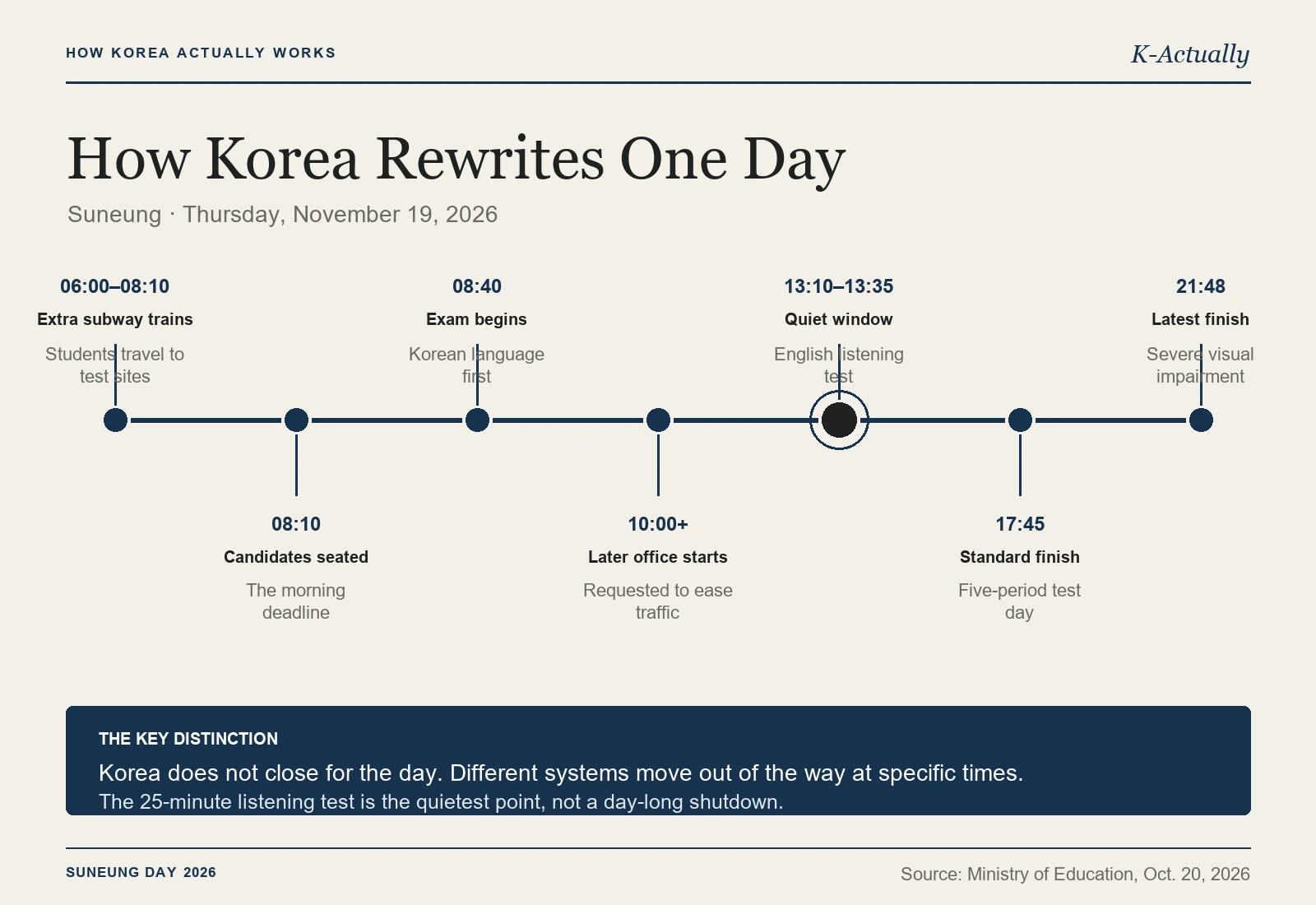
What actually happens is a series of targeted changes tied to the exam timetable. Here is what the government has confirmed for this year.
| Time or measure | What changes |
|---|---|
| 6:00–8:10 a.m. | Extra trains run on the Seoul metropolitan subway network while students travel to their test sites. |
| By 8:10 a.m. | Test takers must be inside their assigned exam rooms. |
| 10:00 a.m. or later | Public offices and private companies are asked to delay their normal start time to ease morning traffic. |
| Around test sites | Cars are stopped from entering within 200 meters of the school. |
| 8:40 a.m.–5:45 p.m. | The standard test day runs across five periods. For test takers with severe visual impairments, the official end time extends to 9:48 p.m. |
| 1:10–1:35 p.m. | During the English listening test, aircraft movements and noisy military training are adjusted, and nearby traffic and sites are asked to stay quiet. |
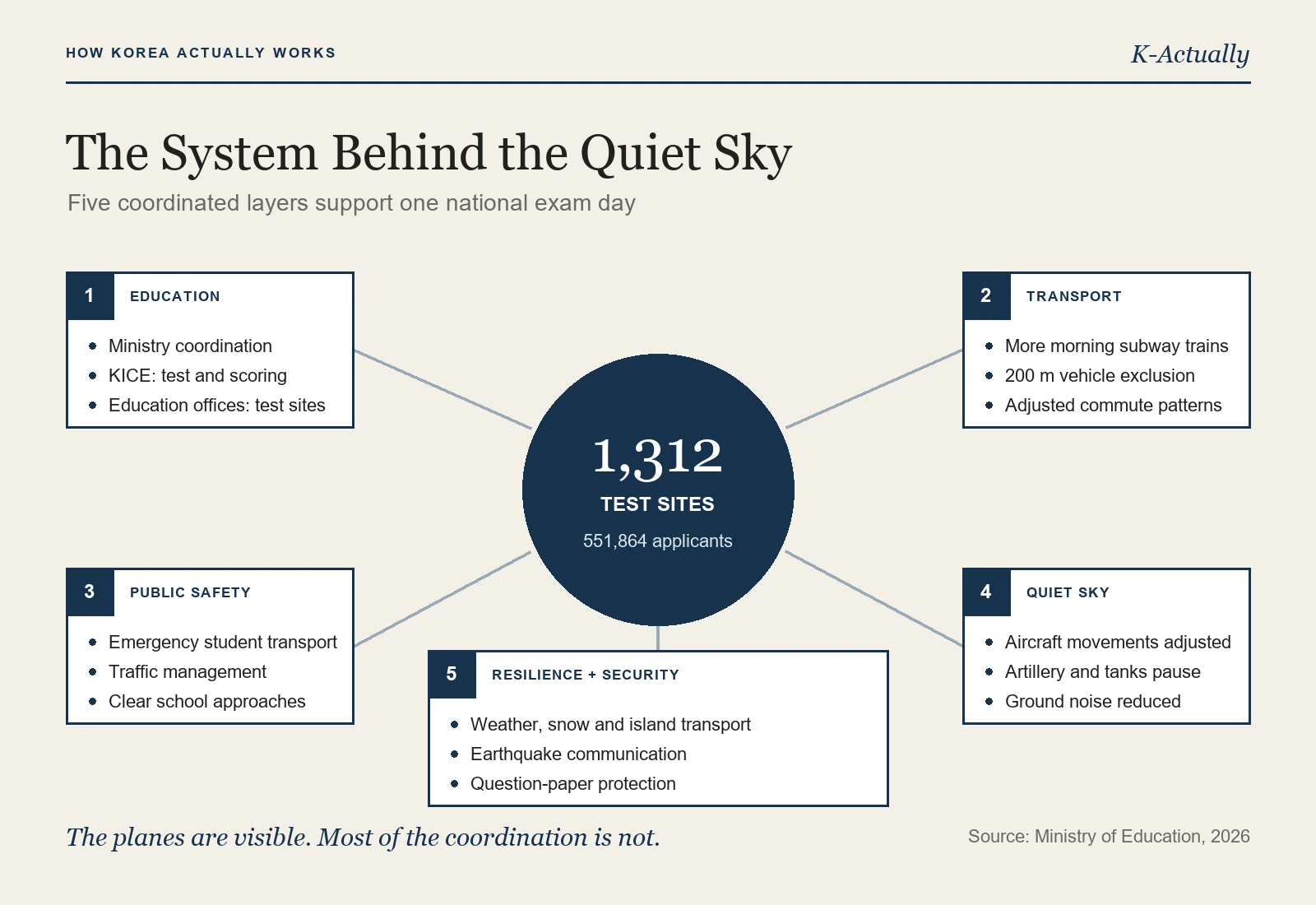
About 551,864 people have applied to take the test at 1,312 sites in 85 test districts. The plan is not only about keeping an exam room quiet. It is about getting more than half a million people to the correct room before the doors close.
The morning is about access. Students must be seated by 8:10 a.m., so the Seoul subway adds trains between 6:00 and 8:10. Police stations and other public agencies position emergency vehicles along student routes. Roads right around test sites are kept clear, and anyone arriving by car walks the final 200 meters.
The early afternoon is about sound. The English listening section starts at the same time nationwide, so the country creates a temporary quiet zone around more than a thousand schools. That is how aircraft, military exercises, construction work, events, buses, trains and car horns all become part of an education policy.
The system does not freeze ordinary life. It moves ordinary life out of the way at specific moments.
The ScaleA national exam creates a national coordination problem
The unusual thing about Suneung day is not simply that the exam matters. Plenty of countries have high-stakes examinations. The unusual thing is the combination of scale, timing and consequence.
Hundreds of thousands of people sit the same national test on the same day. They have to reach assigned sites before a fixed entry time. The listening test has to play under comparable conditions across the country. The question papers have to reach every test district securely. A weather event, a traffic jam, a local construction project or a preventable noise problem can affect an exam with real consequences for university admission.
That turns a school event into a whole-of-government operation. The Ministry of Education coordinates the main support plan. The Korea Institute for Curriculum and Evaluation, or KICE, develops and scores the test, while metropolitan and provincial education offices manage the sites and local logistics. Transit operators adjust the morning schedule. Police and other agencies position vehicles to help stranded students. Local governments plan for traffic, snow and students in remote or island areas. The military and aviation authorities manage noise. Security teams protect the exam papers, and an information network stands ready in case an earthquake affects a site.
What reads as a cultural ritual from the outside is also a very large logistics exercise.
The MorningClearing a path to 1,312 schools
The first risk is simple. A student arrives late.
Suneung candidates do not always test at their own school. They are assigned to a site and have to confirm the location in advance. On the morning of the exam, hundreds of thousands of students move toward school gates inside the same narrow window.
The government’s answer is to change the traffic pattern around them. Offices and companies are asked to shift their start time to 10:00 a.m. or later. This is a request to reduce overlap between the normal commute and the student journey, not a nationwide day off. More subway trains run during the travel window. Emergency vehicles wait along likely routes. Cars are kept away from the final approach to each site.
The police car carrying a late student is the image that makes the evening news. The larger story is the planning built to make that rescue unnecessary.
The AfternoonWhy the sky goes quiet
The most dramatic adjustment happens during a small slice of the exam.
The full English period runs from 1:10 to 2:20 p.m. The listening test takes only its first 25 minutes, from 1:10 to 1:35. The special noise measures apply to that listening window, not to the whole 70-minute period. During those minutes, the government says aircraft and helicopter takeoff and landing times will be adjusted, and noisy military activity such as artillery firing and tank movement will pause.
The Ministry of Land, Infrastructure and Transport usually releases a more detailed aviation notice closer to the test. That notice sets the exact control window, the rules for aircraft already in the air, and the number of flights whose schedules are affected. Those figures for November 19 should be checked against the ministry’s own notice rather than assumed from last year.
The quiet zone also exists at ground level. Buses and trains near schools are asked to slow down and skip their horns. Construction sites and event venues are asked to hold the noise down. The measures are temporary, but they show how many separate systems can be pulled into one synchronized task.
The Invisible LayerThe part people do not see
Grounded planes are visible. Exam security and contingency planning are not.
The government also prepares for bad weather, natural disasters and the secure handling of question and answer papers. Local authorities need transport plans for students on islands and in remote areas, snow-removal plans, and backup transport when severe weather is possible. From November 13, candidates can check the forecast for their specific test site on the Korea Meteorological Administration website. Every site goes through a safety inspection. On exam day, earthquake conditions are monitored, and a communication network links the sites so instructions can move quickly if something goes wrong.
The Ministry of Education, the police and local education offices also run a security system for the exam papers, with central liaison officers sent to every test district to support their handling.
The quiet sky is only the most visible edge of the system. It works by preparing for many small failures before they happen.
These measures draw less international attention because they do not produce an image as striking as aircraft circling above an airport. They are closer to the real reason the day holds together.
The StakesWhy Suneung carries this much weight
Suneung is not the only way into a Korean university. There is also an early-admission route, susi (수시), which can weigh school records and other requirements, alongside the regular-admission route, jeongsi (정시), which leans far more heavily on Suneung scores. Some early-admission offers still require applicants to clear a minimum Suneung grade.
So it would be wrong to say one score single-handedly decides every Korean student’s future. It would be just as wrong to treat the exam as an ordinary school test. A Suneung result can still shape which universities and programs stay open to an applicant, and the exam’s weight reaches well beyond the students using it for regular admission. Families, schools and public agencies plan around it for months.
The national response reflects both the stakes and a fairness problem. If the test runs everywhere at once, a student should not lose concentration because a plane, a construction drill or a traffic jam happened near one site and not another. The measures cannot remove the pressure attached to Suneung. They try to remove the avoidable disruptions on the day itself.
For VisitorsWhat to expect if you are in Korea that day
If you are in Korea on November 19, most of the day will feel normal. A few practical differences are worth knowing.
- Check whether your workplace is starting later. Private companies make their own call.
- Avoid driving near high schools in the early morning, especially before 8:10 a.m.
- Do not assume a taxi can drop you at a school gate. The final 200 meters around a test site is closed to cars.
- If you have a flight around lunchtime or early afternoon, check the airline’s updated schedule once the aviation authority issues its final notice.
- Keep noise down if you are near a test site, particularly from 1:10 to 1:35 p.m.
- Do not expect a public holiday. Shops, restaurants and most services keep operating.
For most visitors the change is subtle. A different commute, police near a school, fewer car horns, a flight time that moves. The system is built so the disruption to everyone else stays small while the path for test takers stays clear.
The TakeawayWhat Suneung day actually reveals about Korea
The easy conclusion is that Korea cares intensely about education. True, but incomplete. The less visible planning, the paper security, the weather contingencies, the site inspections and the earthquake communication, shows that Suneung day is as much an exercise in coordinated public administration as it is a cultural event.
It also shows how Korea responds to a fixed national deadline. Ministries, local governments, transport systems, schools, police, the military, aviation authorities and private workplaces do not all do the same job. They make many small adjustments that line up with the same clock.
That coordination has a cost. It also exists because the exam carries a level of social pressure the country keeps debating. The delayed commute and the quiet sky can be read as public support for students. They are also evidence of how much has been loaded onto one day.
Both things can be true.
Korea does not literally stop for Suneung. For a few carefully chosen hours, it reorganizes itself so that more than half a million people can take the same test under conditions that are as equal, and as quiet, as the country can make them.
Quick AnswersSuneung day, in brief
When is Suneung day in 2026?
Thursday, November 19, 2026. Its official name is the 2027 academic year College Scholastic Ability Test, because the results are used for admission the following academic year.
Is Suneung day a public holiday in Korea?
No. The government asks public offices and companies to start at 10:00 a.m. or later, but Korea stays open and private employers decide how they respond.
Does Korea stop all flights for Suneung?
Not for the whole day. Aircraft movements are adjusted around the English listening test. The transport ministry publishes the exact control window and affected-flight details closer to the exam.
Why do police drive students to the test?
Emergency vehicles are positioned along student routes so officials can get candidates delayed by traffic, a wrong destination or another urgent problem to the correct site before entry closes.
When is the English listening test?
For the November 19, 2026 exam, it begins at 1:10 p.m. and runs up to 25 minutes, ending by 1:35 p.m.
Sources
Ministry of Education, 2027 CSAT support measures (October 20, 2026) · Korea Policy Briefing, work-hour, transport and noise measures · Korea Institute for Curriculum and Evaluation (KICE) implementation notice No. 2026-91 · Ministry of Education, 2027 CSAT date and score-release schedule.