Why Do Koreans Drink Iced Americanos Even in Winter?
Inside eoljuka, the slang and everyday habit that made iced Americano feel like Korea’s default coffee.
Koreans are not ignoring the cold. At MegaMGC Coffee, cold coffee still accounted for more than 60% of coffee orders in the depths of winter. At Starbucks Korea, more than 70% of the Americanos sold in each year from 2023 to 2025 were iced. The most useful interpretation is that the iced Americano functions less like a seasonal drink and more like an ordinary way to order coffee in Korea. That is an editorial reading of the evidence, not an official statistic.
On a winter morning in Seoul, a clear plastic cup full of ice can look more ordinary than a steaming paper one. Padded coat, gloves, a straw, and cubes that rattle with every step.
Nobody seems to be making a point.
Koreans have a name for the habit: eoljuka (얼죽아), short for eoreo jugeodo aiseu amerikano (얼어 죽어도 아이스 아메리카노), or “iced Americano even if I freeze to death.” The joke makes the commitment sound extreme. The more interesting question is whether it is really extreme at all.
THE READINGCloser to normal
No national survey officially labels iced Americano Korea’s default coffee. The phrase is an interpretation, and it should be treated as one. Still, recent sales data from major chains point in the same direction: for a large share of Korean coffee drinkers, ice is not something reserved for summer.
An iced Americano is only espresso, water, and ice. Yet in Korea it has acquired nicknames, loyal year-round drinkers, and real commercial weight.
THE NUMBERSThe numbers behind the joke
MegaMGC Coffee, Korea’s largest coffee chain by store count, analyzed about 400 million coffee orders placed at more than 4,000 stores in 2025. According to the company’s data, cold coffee remained above 60% of coffee orders even during the coldest part of winter. Hot coffee rose to nearly 40% around the winter solstice but never took the lead. Around Daeseo, the traditional marker for the hottest part of summer, cold coffee reached 97%.
Hot coffee rose to nearly 40% around the winter solstice but never took the lead.
Two limits matter. These figures cover all coffee, not just Americanos, and they come from one budget chain. What they show is that, across a very large set of everyday purchases, winter did not make hot coffee the majority choice.
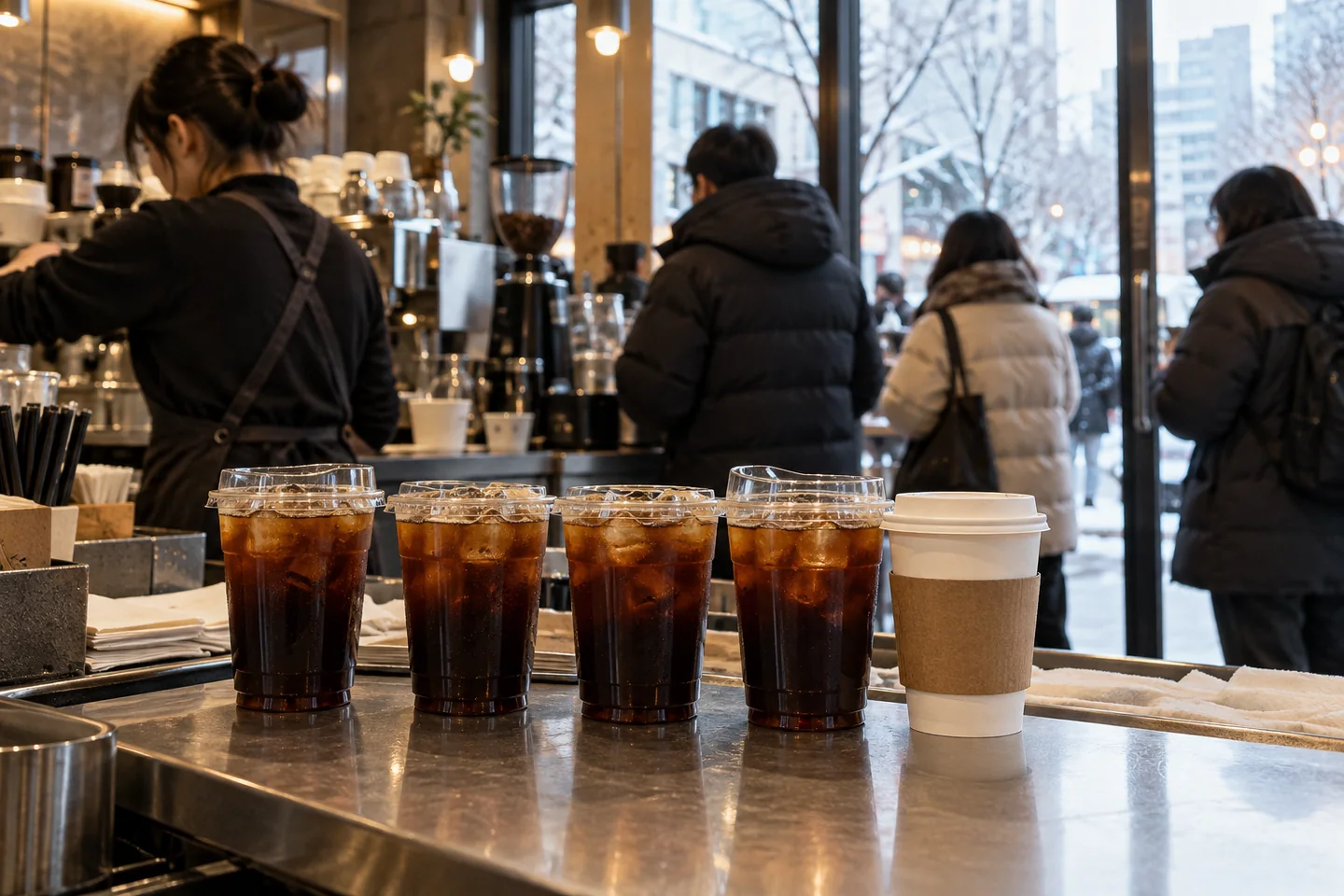
Starbucks Korea provides a narrower measure. The company reported that iced drinks accounted for more than 70% of the Americanos it sold in every year from 2023 through 2025. This figure is specifically about Americanos, although it still represents one company’s customers rather than the whole country.
Other chains have reported a similar winter pattern. Starbucks, Paul Bassett, and Hollys have all released figures showing substantial cold-drink or iced-Americano demand during colder months. Their percentages should not be compared directly because some use all orders as the denominator while others count iced Americanos.
THE SURVEYWhat the government survey adds
A government health survey adds useful context, but it does not settle the hot-versus-iced question. The Korea Disease Control and Prevention Agency reported that unsweetened coffee, including Americano, was the most-consumed beverage category in 2023. The age-standardized average for people aged one and older was 112.1 grams per person per day, ahead of carbonated drinks at 48.9 grams.
The survey measures beverages by weight and does not record serving temperature. It therefore cannot tell us how many of those drinks were iced. Its value here is more modest: plain, unsweetened coffee is firmly embedded in everyday Korean drinking habits.
THE SLANGA drink familiar enough to earn two nicknames
Language offers another clue. An iced Americano is commonly shortened to ah-ah (아아), using the first syllables of aiseu amerikano. Year-round devotees are called eoljuka.
Nobody has established exactly who coined the second term. What can be documented is that Korean media were already using it by January 2019. A February 2019 report, originally published by The Chosun Ilbo and syndicated by Nate, described the expression as a new winter buzzword.
The slang does not explain why people choose the drink. It reveals something else: the behavior was already familiar enough to be compressed into four Korean syllables and understood as a shared joke.
THE COMPARISONItaly has cold coffee too. So does the United States
The easiest version of this story casts Koreans as ice-loving outliers and Italians as horrified traditionalists. That version is tidy, but it is wrong.
Italy has its own cold-coffee traditions. The Istituto Espresso Italiano describes cold coffee as a small national summer ritual with regional forms, including caffe con ghiaccio, caffe shakerato, and the almond-flavored caffe leccese. At the same time, the institute’s certified Italian espresso standard describes a serving of about 25 milliliters. The contrast is not that Italy lacks cold coffee. It is that the familiar Italian forms remain rooted in a different espresso culture and often appear as regional or seasonal variations.

The United States is not a hot-coffee holdout either. In the April–June quarter of 2024, Starbucks’ fiscal third quarter, cold beverages represented roughly three quarters of the company’s beverage mix. That April–June figure includes the entire cold menu, not Americanos alone, so it cannot support a claim that Koreans drink more iced Americano than Americans do.
Cold coffee, then, is not uniquely Korean. What stands out is the role one particular cold coffee plays in Korea: a plain, repeatable order that feels normal across seasons.
THE FITWhy iced Americano may fit Korean daily life so well
No study has proved a single cause, and the popular explanation about Korea’s fast-paced culture is too convenient on its own. A better question is why this particular drink fits so easily into an ordinary day.
A better question is why this particular drink fits so easily into an ordinary day.
Several possibilities overlap. It can be drunk immediately without waiting for it to cool. Its basic version requires no decision about milk, syrup, or toppings. Its large takeaway format can be carried on a commute and sipped over time. Korea’s dense mix of premium and budget coffee chains also makes the order easy to find and predictable from one neighborhood to the next.
Indoor environments may matter as well. In interviews with AFP, an accountant said he drinks iced Americano quickly to wake up and start work, and a café owner suggested that overheated indoor workspaces may help explain the preference. These are individual observations, not proof of a national cause. But they point to one plausible pattern: once the drink is consumed in a heated indoor space, the outdoor temperature may matter less.

Habit may be the final piece. Once the same order works in July, October, and January, choosing it can stop feeling like a choice. The ice is no longer a statement. It is simply part of the usual order.
THE PRODUCTFrom meme to product strategy
In February 2026, Starbucks turned that habit into a market decision. It chose Korea as the first Starbucks market for Aerocano, an iced Americano with air incorporated to create a creamy foam. The company said Korea’s year-round iced-coffee culture influenced the decision to launch the drink there before any other Starbucks market.
Starbucks did not claim to have invented the underlying idea. Its own announcement said Aerocano had already circulated among some coffee enthusiasts and that the company reinterpreted it in its own style.
The response was substantial. Starbucks Korea said the drink reached one million sales in seven days and passed 5.5 million cups within five months. By then, it had also expanded to India, Malaysia, Singapore, Taiwan, and Vietnam.

This does not make Korea the world’s definitive coffee test market. It does show a global chain treating eoljuka as more than a meme. A year-round habit had become a reason to choose Korea for a product debut and then take the product abroad.
A year-round habit had become a reason to choose Korea for a product debut and then take the product abroad.
THE CLOSEThe usual order
Eoljuka sounds like an extreme vow. In practice, it describes something far less dramatic: ordering the usual.
The story is not that Koreans fail to notice winter. It is that iced Americano has become so ordinary that winter no longer gets a veto.