Why Koreans Say 밥 So Often — Even When They Aren’t Talking About Rice
How one ordinary Korean word connects food, care, relationships, work and belonging, even as the way Koreans eat keeps changing.
The Word You Keep Hearing
Spend a day in Korea and you will hear this word again and again: 밥 (bap, cooked rice or a meal).
Bap meaning in Korean goes far beyond a bowl of rice.
A friend texts 밥 먹었어? (bap meogeosseo?, did you eat?) — Did you eat? A colleague suggests lunch with 밥 먹자 (bap meokja, let’s eat) — Let’s eat. An older relative you have not seen in a while asks, 밥은 먹고 다니냐? (babeun meokgo daninya?, are you eating properly these days?) — Are you eating properly these days?
Then the same word turns up somewhere completely different.
Someone at work says 밥값은 해야지 (bapgapseun haeyaji, you should earn your keep) — roughly, You should at least earn your keep. A news headline says workers could lose their 밥줄 (bapjul, livelihood) — their livelihood. People who have spent years in the same team or organization might describe themselves as having eaten 한솥밥 (hansotbap, rice from the same pot) — rice from the same pot.
All of these use the same word: 밥 (bap, cooked rice or a meal).
Sometimes it really means rice. Sometimes it means a meal. But then there is 밥벌이 (bapbeori, earning a living), 밥값 (bapgap, one’s keep), 밥줄 (bapjul, livelihood) and 한솥밥 (hansotbap, rice from the same pot). Even the simple question “Did you eat?” can carry much more than a question about food.
How did one ordinary Korean word come to do so much?
This is not a list of expressions to memorize. It is a map of the territory 밥 (bap, cooked rice or a meal) occupies in Korean life, and a look at why those meanings are still recognizable even as the way Koreans eat keeps changing.
First, What 밥 (bap, cooked rice or a meal) Literally Means
Before anything else, 밥 (bap, cooked rice or a meal) really is food.
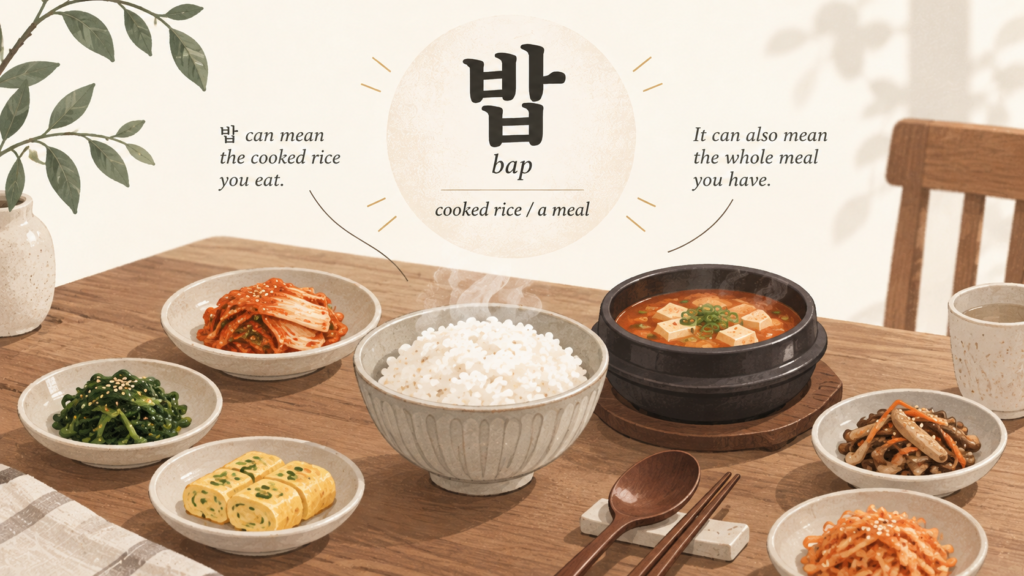
At its most basic, 밥 (bap, cooked rice or a meal) refers to cooked grains. In everyday modern Korean, that usually means cooked rice, although 밥 (bap, cooked rice or a meal) can also be made with barley or other grains. The Encyclopedia of Korean Culture describes it as one of the most basic staples of Korean food.
So when a parent tells a child 밥 먹어 (bap meogeo, eat your rice or meal), the sentence can quite literally mean eat your rice or simply eat your meal.
That is because 밥 (bap, cooked rice or a meal) also means a meal more broadly.
아침밥 (achimbap, breakfast) is breakfast. 저녁밥 (jeonyeokbap, dinner) is dinner. When someone says 밥때가 됐다 (bapttaega dwaetda, it’s mealtime), they mean it’s mealtime, not specifically it’s time to eat rice. Pasta, a sandwich or a burger can all count as 밥 (bap, a meal) if what matters is that it was your meal.
So even before we get to metaphor, the word is already doing two jobs: naming a staple food and standing in for the meal itself.
But that is only the beginning. From there, 밥 (bap, cooked rice or a meal) reaches into parts of Korean life that have very little to do with what is actually in the bowl.
The Map: What 밥 (bap, cooked rice or a meal) Actually Covers in Korean
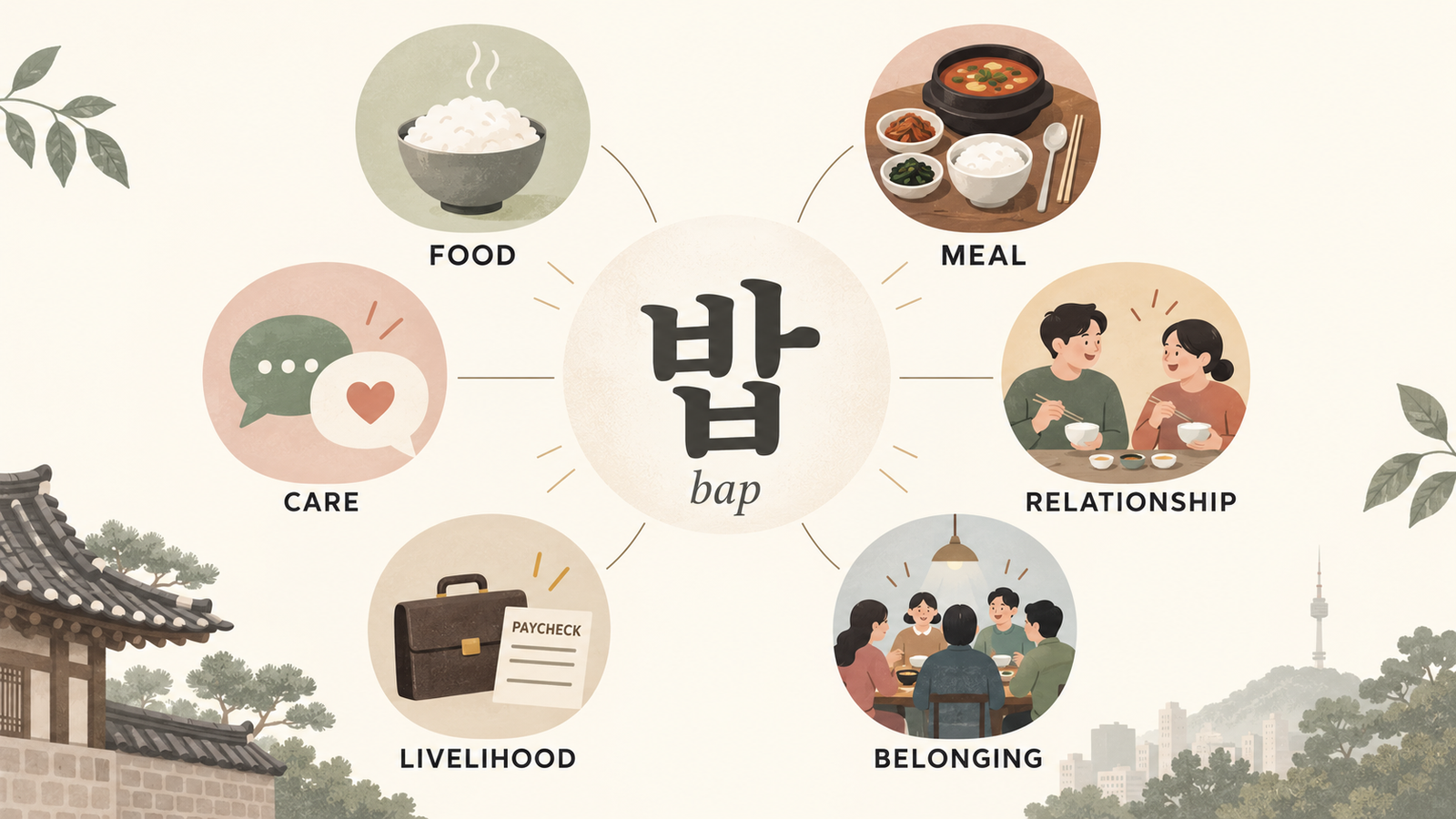
The easiest way to see what 밥 (bap, cooked rice or a meal) does is to look at the different territories it occupies. These are not simply different translations of the same word. They are different social jobs that 밥 (bap, cooked rice or a meal) can do.
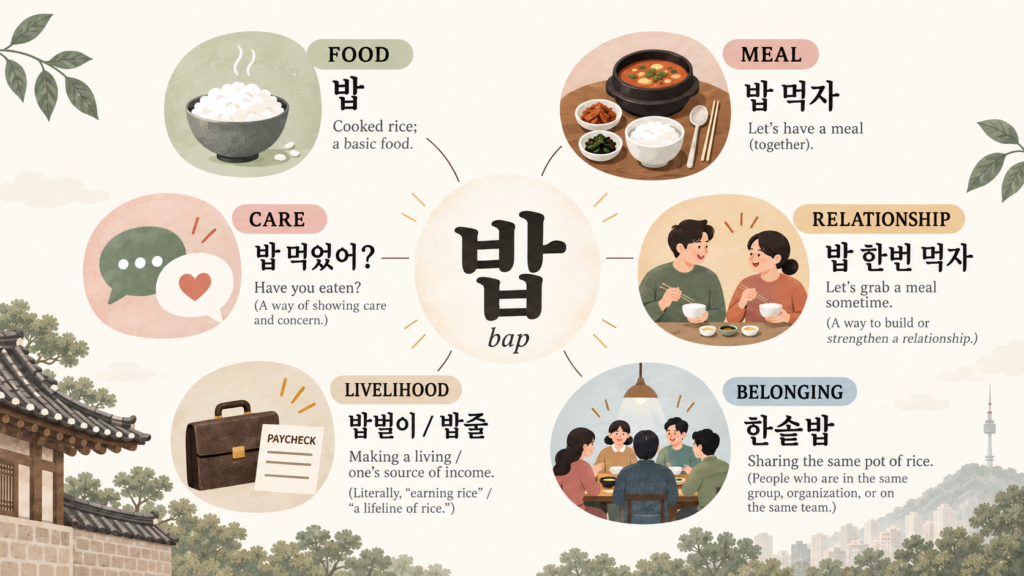
| Territory | Expression | Literal sense | What it does socially |
|---|---|---|---|
| Food | 밥bap — cooked rice or grains | cooked rice / grains | Names the actual food in the bowl |
| Meal | 밥 먹자bap meokja — let’s eat | Let’s eat | Suggests eating together, whatever the food |
| Care | 밥 먹었어?bap meogeosseo? — did you eat? | Did you eat? | Can work as a check-in on someone’s wellbeing |
| Relationship | 밥 한번 먹자bap hanbeon meokja — let’s have a meal sometime | Let’s have a meal sometime | Can open, maintain or renew a relationship |
| Livelihood | 밥벌이 / 밥줄bapbeori — earning a living / bapjul — livelihood | earning one’s meals / “rice line” | Work, income and the means of making a living |
| Belonging | 한솥밥hansotbap — rice from the same pot | rice from the same pot | Shared group identity |
Read down the last column and a pattern starts to appear.
밥 (bap, cooked rice or a meal) is not simply a food word that picked up a few metaphors. It reaches into everyday questions about whether someone is okay, who you spend time with, how you make a living and which group you belong to.
Take 밥벌이 (bapbeori, earning a living). Literally, the image is earning the food you eat. In ordinary use, though, it means earning a living. 밥벌이가 힘들다 (bapbeoriga himdeulda, making a living is hard) is not a complaint about food. It is about the difficulty of making enough money to live.
밥줄 (bapjul, livelihood) is sharper. Literally, it combines 밥 (bap, cooked rice or a meal) with 줄 (jul, line or cord). In use, it refers to the source of someone’s livelihood. Losing your 밥줄 (bapjul, livelihood) means losing the work or income that supports you. That is why the word often appears in conversations and headlines about jobs being threatened.
한솥밥 (hansotbap, rice from the same pot) moves in another direction. To have eaten rice from the same pot is to have belonged to the same group and shared the same life for a period of time. The expression can describe people who worked, served or lived closely together.
And then there is 밥 한번 먹자 (bap hanbeon meokja, let’s have a meal sometime), meaning let’s have a meal sometime.
Sometimes it is a real invitation. Sometimes it is looser than that: a way of keeping a relationship open and saying that the connection should continue, even if no date has been set.
The meal is doing social work.
Food, meal, care, relationship, livelihood, belonging. Six territories, one word.
But a map still does not tell you exactly how these expressions feel when someone actually says them.
So, Are They Actually Asking About Food?
A common English explanation of 밥 먹었어? (bap meogeosseo?, did you eat?) is that it is the Korean version of How are you?
That helps, but it is too neat.
In practice, the literal question about food and the social gesture of care can overlap. How much of each you hear depends on the time, the situation and the relationship between the people speaking.
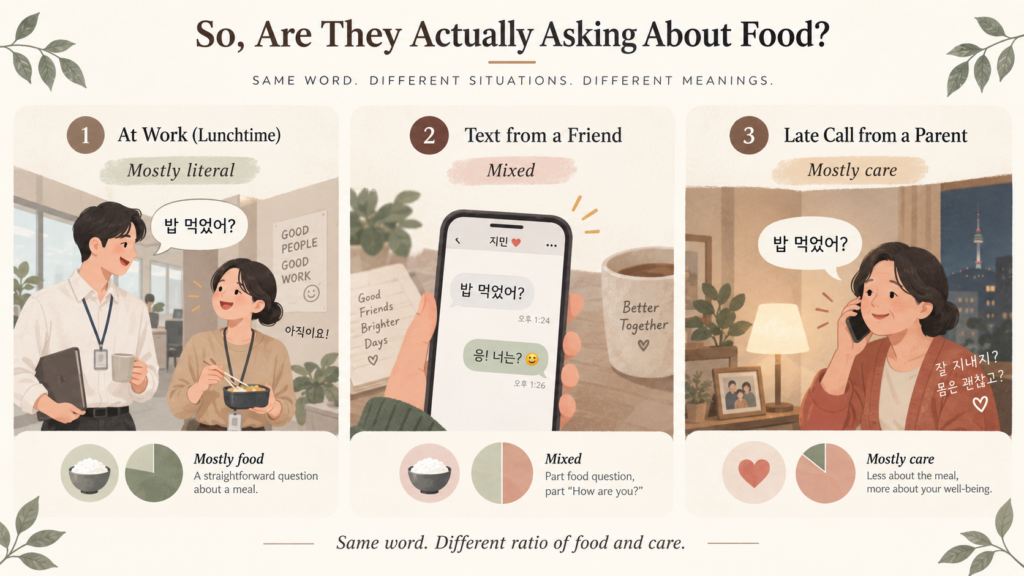
Consider three versions of the same basic question.
Lunchtime, a coworker in the hallway: 밥 먹었어요? (bap meogeosseoyo?, did you eat?)
Here, the question may be almost completely literal. It is lunchtime. Your coworker wants to know whether you have eaten, perhaps because they are about to go out themselves. If you say not yet, that can easily turn into an invitation to eat together.
A casual text from a friend: 밥 먹었어? (bap meogeosseo?, did you eat?)
Now the balance can shift. The friend may genuinely be asking whether you ate, but the question can also work as an easy way to check in. If the answer is not yet, go eat something may be the whole response. The food matters, but so does the fact that someone thought to ask.
A late call from a parent: 밥 먹었어? (bap meogeosseo?, did you eat?)
Here, both meanings can be present at once. The parent may really want to know whether you ate. At the same time, the question can carry something broader: Are you looking after yourself? Was your day okay?
The answer yes, I ate can satisfy both questions without either person needing to spell them out.
In all three cases, the question is doing two things at once: asking about food and checking on someone. What changes is the proportions.
Same word. Different ratio of food and care.
The same layering appears elsewhere.
When someone says 밥 한번 먹자 (bap hanbeon meokja, let’s have a meal sometime), context tells you whether a real plan is being proposed or whether the person is simply leaving the door open for another meeting. 밥값은 해야지 (bapgapseun haeyaji, I should at least earn my keep) can sound lightly self-deprecating when someone says it about themselves, closer to I should at least earn my keep. Aimed at somebody else, it can be much harsher.
That is where the How are you? comparison starts to flatten the nuance.
In many uses of 밥 먹었어? (bap meogeosseo?, did you eat?), the original question about food has not disappeared completely. It is still faintly there, glowing behind the greeting.
Why 밥 (bap, cooked rice or a meal) Came to Carry So Much
To understand how 밥 (bap, cooked rice or a meal) could stretch this far, it helps to look at where rice and 밥 (bap, cooked rice or a meal) sat in Korean meals for centuries.
Rice was not always Korea’s only important grain. Korean historical sources note that millet and barley were major grains through much of the Three Kingdoms period. Rice cultivation developed earlier and more strongly in the southern kingdoms, especially Baekje and Silla, and by the Unified Silla period rice had taken a leading place among grains in Silla.
The same historical source notes that the distinction between a staple and accompanying side dishes became established in Korea over time. It even points out something directly relevant to this article: in Korean, the meal itself came to be called 밥 (bap, cooked rice or a meal).
The Encyclopedia of Korean Culture describes 밥 (bap, cooked rice or a meal) as the most basic staple of the Korean meal and explains that Korea’s separation of 주식 (jusik, staple food) and 부식 (busik, side dishes) developed into the distinctive 반상 (bansang, traditional Korean table setting) during the Joseon dynasty.
That staple-and-side-dish structure also helps explain why foods like gim made so much sense beside rice long before they were sold overseas as standalone snacks. We looked at that shift in Korean Seaweed Explained: How Gim Became a Global Food.
What matters here is that 밥 (bap, cooked rice or a meal) sat at the center of everyday Korean meals for a very long time. Individual meals varied by region, class and season, but that central place did not.
That helps explain how the word came to stand for the meal itself as well as for the food. The same central place also opens up wider expressions about care, work and belonging.
If providing food was expressed through 밥 (bap, cooked rice or a meal), then work that kept food on the table could be talked about through words such as 밥벌이 (bapbeori, earning a living) and 밥줄 (bapjul, livelihood). If eating from the same pot represented a shared household or shared life, 한솥밥 (hansotbap, rice from the same pot) became a natural image of belonging. And if asking whether someone had eaten was a way of checking on their condition, 밥 먹었어? (bap meogeosseo?, did you eat?) could carry both food and care at once.
That is not a neat historical proof of how every expression developed. Language rarely gives us one.
But it does give the wider meanings of 밥 (bap, cooked rice or a meal) a social setting. They did not emerge around just any food word. They emerged around something that sat near the center of Korean everyday meals for centuries.
And that makes what is happening now especially interesting.
Korea Is Eating Differently Now
The way Koreans eat has changed substantially.
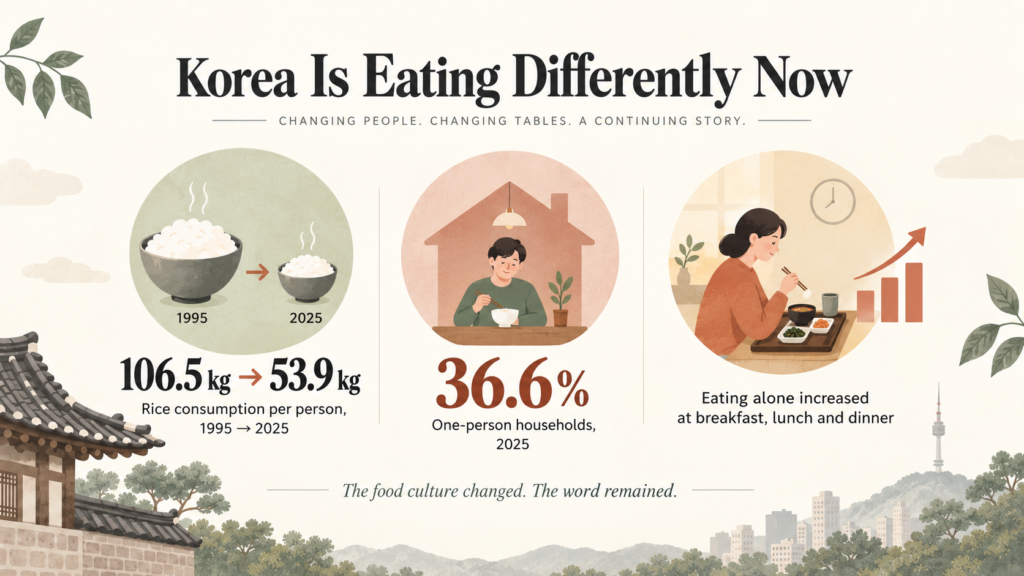
According to Korea’s national statistics agency, per-capita annual rice consumption was 53.9 kilograms in 2025. In 1995, it was 106.5 kilograms.
That is roughly half the level of thirty years earlier.
Households are changing too. According to the 2025 Population and Housing Census, South Korea had 8.24 million single-person households, accounting for 36.6 percent of general households. One-person households have been the most common household size since 2015.
Eating itself is becoming more solitary as well.
Korea’s 2024 Time Use Survey found that on weekdays, compared with five years earlier, the share of people who ate breakfast, lunch and dinner declined for all three meals. Among people who did eat those meals, the share eating alone increased for breakfast, lunch and dinner.
Rice consumption has fallen by half over a generation, single-person households have become the largest household group, and more Koreans are eating alone at every meal.
Seen against the history of 밥 (bap, cooked rice or a meal), that creates an interesting tension.
You might expect a word so closely tied to repeated meals and shared tables to start feeling old-fashioned as those habits change. Yet the wider meanings of 밥 (bap, cooked rice or a meal) have not disappeared with them.
And Yet: 밥 (bap, cooked rice or a meal) Is Still Everywhere
밥 먹었어? (bap meogeosseo?, did you eat?) still works as an everyday check-in. Parents ask adult children. Friends ask one another. 밥 한번 먹자 (bap hanbeon meokja, let’s have a meal sometime) still does work that goes beyond making a lunch plan. And 밥줄 (bapjul, livelihood) remains an ordinary way to talk about jobs and livelihoods.
Why do these meanings remain recognizable when the habits underneath them are changing?
There is probably no single answer.
Language often changes more slowly than daily routines. Words and expressions can outlive the physical habits that originally made them feel obvious. English speakers still hang up a phone even though most phones have nothing to hang.
And 밥 (bap, cooked rice or a meal) has long carried meanings beyond the food itself: care, connection, livelihood and belonging. Those meanings can still make sense even when the actual meal is a triangle kimbap eaten alone at a desk rather than rice shared around a family table.
For many people eating alone, someone may still ask whether they have eaten. It might be a parent, a sibling, an old friend from school. The question can travel through a phone across a city and land in a one-person apartment where the rice cooker may not have been used that day.
The bowl may be gone. The question is not.
That does not mean the meanings of 밥 (bap, cooked rice or a meal) will remain unchanged forever. Language changes too.
For now, though, the word still carries far more than food.
Koreans may be eating less rice. But 밥 (bap, cooked rice or a meal) still means much more than what is in the bowl.