Korean PDRN Skincare Is Everywhere. But What Do the Numbers Actually Mean?
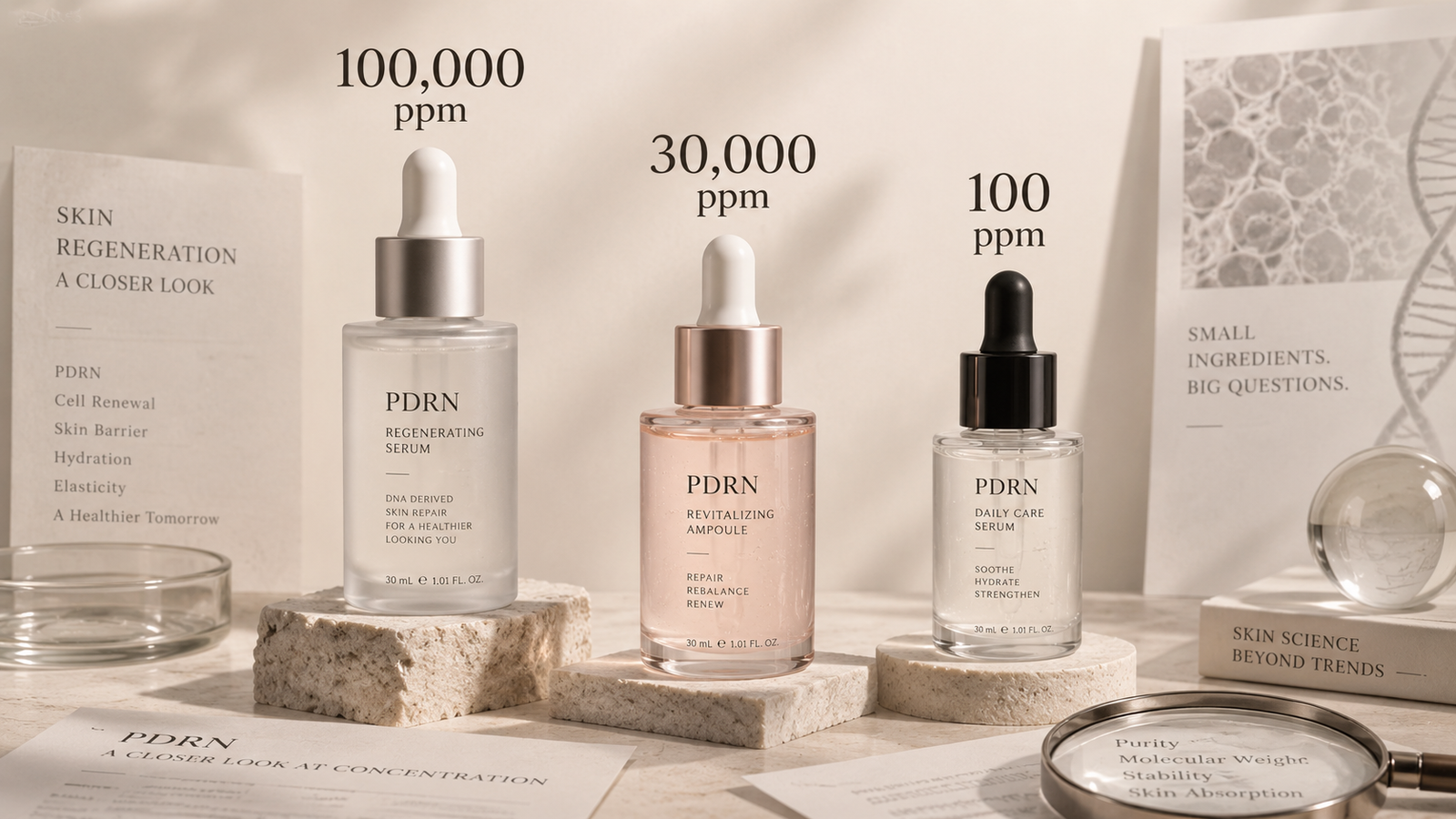
Korean PDRN skincare is suddenly full of big numbers.
One PDRN serum says 100,000 ppm.
Another says 30,000 ppm.
Another says just 100 ppm.
Standing in front of a Korean skincare shelf, the obvious conclusion would be simple: 100,000 must be stronger than 30,000, and 30,000 must be a lot stronger than 100.
That’s not what those numbers actually mean.
Why 100,000 ppm may not mean more PDRN than 30,000 ppm
VT’s PDRN Essence 100 is probably the clearest example.
VT markets it with 100,000 ppm of PHYTO PDRN® Panax, its plant-derived PDRN ingredient. But the full ingredient list uses the name Sodium DNA, and in a response on its Korean website, VT separately stated that the product contains 0.5 ppm of Sodium DNA. VT PDRN Essence 100 official page VT’s Korean Q&A on the 100,000 ppm and 0.5 ppm figures
At first, that sounds like a contradiction. It isn’t.
VT describes PHYTO PDRN® Panax as a ginseng-derived ingredient containing Sodium DNA and Panax ginseng root extract. More importantly, Korean biotech company Biosolution lists “PhytoPDRN® Panax VT” among the raw materials it supplies. VT’s ingredient explanation Biosolution 2026 IR material
So the 100,000 ppm PDRN claim and the separately disclosed 0.5 ppm Sodium DNA figure are not two interchangeable measurements of the same thing.
Now compare that with Genabelle. Its PDRN 3% Hyper Boost Ampoule lists Sodium DNA at 30,000 ppm directly in the finished product’s ingredient information. The brand also describes the material as “95% high-purity PDRN,” although we could not independently verify the supplier or documentation behind that purity figure. Genabelle PDRN 3% Hyper Boost Ampoule official page
Arencia goes in the opposite direction. Its PDRN Booster Shot lists Sodium DNA at 100 ppm, a much smaller number, but one whose meaning is unusually clear because the concentration appears directly in the ingredient disclosure. Arencia PDRN Booster Shot official page
So these three numbers, 100,000 ppm, 30,000 ppm and 100 ppm, may look like the same measurement. They don’t measure the same thing.
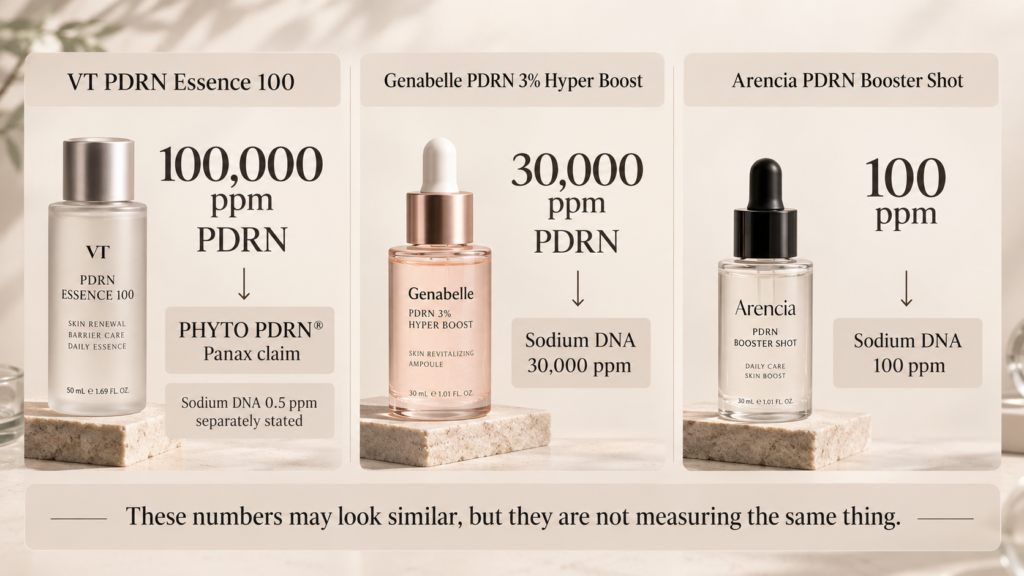
Ranking PDRN skincare by the biggest number can be misleading before you even start asking whether PDRN works.
So why does the ingredient list say Sodium DNA instead of PDRN?
This is another place where PDRN skincare gets confusing.
Turn the bottle around and you may not see the word PDRN anywhere. Instead, you might see Sodium DNA. Or Hydrolyzed DNA.
That does not automatically mean the brand is hiding something or that the product contains “fake PDRN.”
Korea’s cosmetic ingredient system uses standardized ingredient names. The Korea Cosmetic Association’s ingredient database lists a whole family of commercial PDRN raw materials, including names such as PhytoPDRN and Plant Cell PDRN, under the standardized ingredient name Sodium DNA. Korea Cosmetic Association: Sodium DNA ingredient record
The same database lists other PDRN-branded raw materials under Hydrolyzed DNA. Korea Cosmetic Association: Hydrolyzed DNA ingredient record
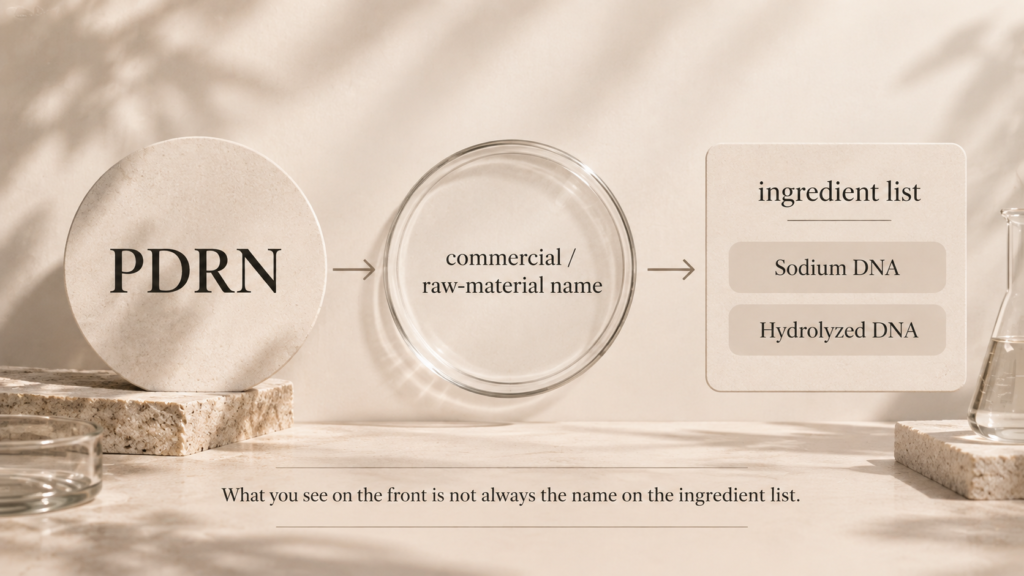
In other words, PDRN can be the name used for a commercial raw material or product story, while the ingredient list uses a standardized cosmetic name.
That changes the question. Instead of asking why a PDRN serum “actually contains Sodium DNA,” the more useful question is what kind of PDRN-related material sits behind that ingredient name, and what the number being advertised actually refers to.
That’s much harder to answer from the front of a bottle.
Does PDRN skincare actually work?
This is where the story gets messier.
This is also where Korean PDRN skincare gets much of its scientific appeal.
PDRN and the related material PN didn’t begin as TikTok skincare ingredients. They have been studied in medical and injectable settings, and that history gives PDRN skincare a powerful scientific halo.
That rapid shift from clinic-adjacent ingredients to everyday skincare is part of the bigger story of how the Korean beauty industry turns new technologies and formulations into consumer products.
The evidence is real, but it is not unlimited. A 2026 review of randomized clinical trials found promising results for PN and PDRN across skin rejuvenation, scars and wound healing, while also pointing out that the studies were generally small and used very different products and treatment methods. 2026 systematic review of PN and PDRN clinical trials
Take Rejuran. PharmaResearch’s official product information lists Rejuran injections as PN (polynucleotide), not PDRN. The same company also makes Rejuran Cosmetics using its proprietary c-PDRN technology. These are related technologies from the same company, but they are not the same product delivered in the same way. PharmaResearch: Rejuran medical product information PharmaResearch on cosmetic-grade c-PDRN
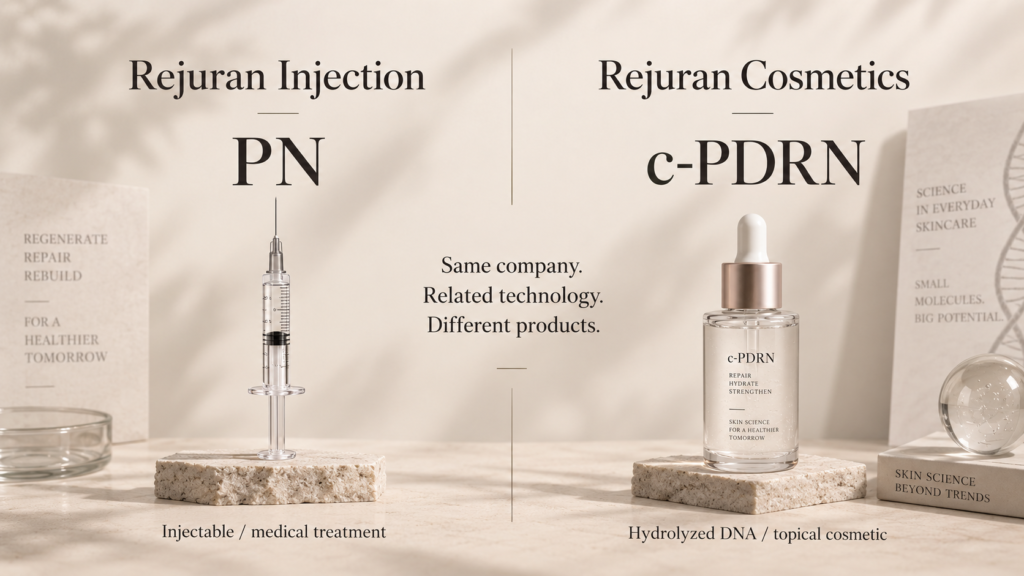
The science behind PDRN and PN injections is not the same thing as evidence for the PDRN serum in your bathroom.
That doesn’t mean topical PDRN has no research behind it.
A 2026 study, for example, tested a specific salmon-derived PDRN material in a 0.1% eye cream. The researchers found encouraging results over 28 days and also looked at how the material moved into the upper layers of the skin. 2026 PLOS ONE study on topical PDRN-850K
But that study tested one defined PDRN material, with a particular molecular size, in a particular formula. It did not test “PDRN skincare” as a category.
That distinction matters because skin delivery is part of the problem. The same paper notes that the way topical PDRN reaches viable skin is still not fully understood. Evidence that one carefully formulated cream can deliver a specific PDRN material does not automatically transfer to every serum carrying the same four letters.
There’s another layer to this: where the PDRN comes from.
VT, for example, uses plant-derived PDRN rather than the salmon-derived materials traditionally associated with this category.
Plant-derived PDRN is an interesting new area, but it shouldn’t automatically be treated as a vegan version of exactly the same clinically studied material. A recent review found that most evidence for plant-derived PN and PDRN is still preclinical, and direct comparisons with conventional animal-derived PDRN remain limited. 2026 review of plant-derived PN and PDRN
Its source is different. Its processing may be different. And its evidence base is still developing separately.
One more label that can be easy to misread
Some Korean PDRN products also carry a “functional cosmetic” claim for brightening, wrinkle care or both.
For an overseas shopper, that can sound like official confirmation that PDRN itself was approved for those effects.
That’s not necessarily what the label means.
Korea has a specific regulatory category for functional cosmetics, including products intended to aid brightening or improve wrinkles. Korean Ministry of Food and Drug Safety: functional cosmetics overview
Korean regulations also recognize formulations using ingredients such as niacinamide and adenosine for brightening and wrinkle-care functions. Korean functional-cosmetic standard for niacinamide and adenosine
Arencia’s PDRN Booster Shot, for example, is labeled as a dual-functional cosmetic for brightening and wrinkle care. Its ingredient list also contains niacinamide and adenosine, alongside Sodium DNA at 100 ppm. Arencia official product disclosure
That doesn’t tell us which route Arencia used for its regulatory filing, and we shouldn’t pretend it does. But it does tell us something important about how to read the label:
A Korean functional-cosmetic designation is a statement about the product’s registered function. It is not automatically proof that PDRN itself was the ingredient approved for that function.
It sounds like a small distinction. But if you’re comparing products by their labels, it matters.
Five Korean PDRN products, compared differently
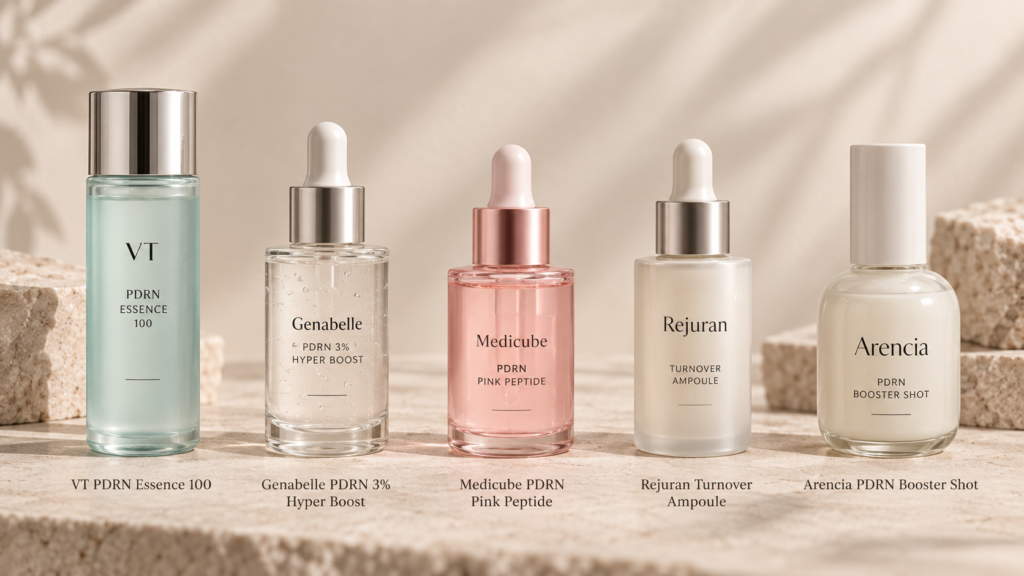
Here are the five products side by side, with both the marketing claim and what we could actually verify.
| Product | PDRN claim | Ingredient disclosure | What the number appears to mean | What we could verify | Best if you… |
|---|---|---|---|---|---|
| VT PDRN Essence 100 | 100,000 ppm PDRN | Sodium DNA; VT separately states 0.5 ppm | Brand claim for PHYTO PDRN® Panax; not directly comparable with its separate Sodium DNA figure | Biosolution lists PhytoPDRN® Panax VT among supplied raw materials | specifically want a plant-derived PDRN option |
| Genabelle PDRN 3% Hyper Boost Ampoule | 30,000 ppm PDRN; “95% high-purity” | Sodium DNA 30,000 ppm | Sodium DNA amount disclosed in the finished formula | 30,000 ppm confirmed; basis of the 95% purity claim not independently verified | value a clearly disclosed finished-formula amount |
| Medicube PDRN Pink Peptide | 10,000 ppm PDRN | Sodium DNA; no ppm shown in the ingredient list | Official brand PDRN claim | Korean official page states 10,000 ppm; Sodium DNA appears in the formula | want a mainstream Korean option with easy overseas access |
| Rejuran Turnover Ampoule | c-PDRN | Hydrolyzed DNA | Proprietary cosmetic PDRN technology rather than a simple ppm comparison | Rejuran Cosmetics uses c-PDRN; PharmaResearch lists injectable Rejuran separately as PN | care about the Rejuran technology lineage |
| Arencia PDRN Booster Shot | PDRN Booster | Sodium DNA 100 ppm | Sodium DNA amount in the finished formula | 100 ppm confirmed; manufactured in Korea by Cosmecca Korea | want PDRN as one part of a broader serum formula |
Product sources: VT · Genabelle · Medicube Korea · Medicube US · Rejuran Cosmetics · Arencia
A bigger PDRN number on the bottle does not necessarily mean you’re getting more of the same thing. Before comparing ppm, you have to ask what that number is actually measuring.
Once you do that, these five products stop looking like different strengths of the same serum. They start looking like five different approaches to the same trend.
So which PDRN product makes sense for you?
There’s no useful way to rank these from strongest to weakest. The numbers don’t support that kind of comparison.
A better way to choose is to decide what you actually care about.
If you want a product where the finished-formula Sodium DNA amount is clearly disclosed, Genabelle is one of the easier products to read. Its 30,000 ppm figure appears directly next to Sodium DNA in the ingredient information.
The separate “95% high-purity” claim is less transparent. We could confirm that Genabelle makes the claim, but we could not independently verify the supplier or documentation behind that purity figure. Genabelle official product page
Arencia takes almost the opposite approach.
Its Sodium DNA amount is just 100 ppm, which looks tiny beside Genabelle. But you know exactly what the number refers to. The formula also contains niacinamide, adenosine, peptides, hyaluronic-acid ingredients and other components, so PDRN does not have to be the sole reason to consider the serum. Arencia official ingredient list
VT is the most interesting of the five if the plant-based angle matters to you.
Just don’t read its 100,000 ppm claim as though it were the same measurement as Genabelle’s Sodium DNA 30,000 ppm. VT markets PHYTO PDRN® Panax at 100,000 ppm, while Sodium DNA appears separately in the formula and VT has separately stated a 0.5 ppm figure for it. VT official product page VT Korean Q&A
Medicube is the easiest of these products to understand as a mainstream K-beauty option. Its Korean official store states 10,000 ppm PDRN, while its ingredient list includes Sodium DNA. Medicube also now offers both salmon DNA PDRN and a Rose PDRN version on its U.S. site, which shows how quickly the commercial meaning of “PDRN” is expanding beyond its original salmon-based image. Medicube Korea official product page Medicube US PDRN Pink Peptide Serum
Rejuran Cosmetics makes the most sense if the Rejuran name itself is what led you to PDRN.
Its Turnover Ampoule markets c-PDRN and lists Hydrolyzed DNA in the formula. But keep the distinction clear: PharmaResearch lists Rejuran injectable products as PN, while its cosmetics use c-PDRN technology. Buying the cosmetic does not mean you’re buying a topical version of the injectable treatment. Rejuran Turnover Ampoule PharmaResearch Rejuran PN product information
That’s the most useful thing to remember about this whole category.
PDRN skincare isn’t necessarily meaningless marketing. But “PDRN” on the front of a bottle isn’t enough information to compare two products.
The next time you see 100,000 ppm, 30,000 ppm or another impressive number, don’t start by asking which is biggest.
Ask what the number is measuring.
Ask what name the ingredient uses on the actual formula.
And ask whether the evidence you’re hearing about belongs to that skincare product, or to a very different medical treatment.
Once you know how to read those three things, PDRN skincare becomes a lot easier to shop.
Buying Korean skincare during your trip? Our Korea tax refund for tourists guide explains when the tax is removed at checkout and when you need to keep a refund slip for the airport.