How Korea Became a Beauty Superpower — and What Comes Next
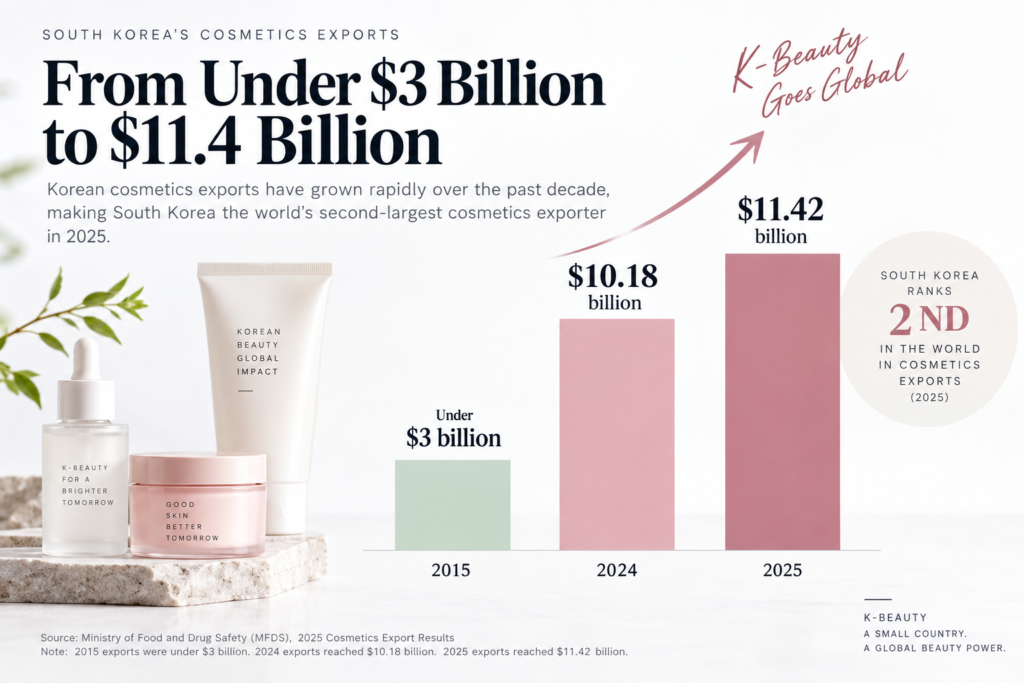
In 2015, South Korea’s cosmetics exports were still under $3 billion. A decade later, they had reached $11.4 billion, making Korea the world’s second-largest cosmetics exporter. Korea Ministry of Food and Drug Safety — 2025 cosmetics export results
In 2024, exports crossed $10 billion for the first time. In 2025, they climbed again to a record $11.4 billion. Korea Ministry of Food and Drug Safety — 2024 exports surpass $10 billion
Ten years ago, Korea was already known for skincare. It was nowhere near this big. So what changed?
K-pop helped. So did K-dramas and TikTok. None of that fully explains how Korea kept producing new brands and new products fast enough to keep up with global demand, year after year.
This isn’t a story about why people like Korean skincare. It’s a story about how Korea built the K-beauty industry into a system that could keep making it.
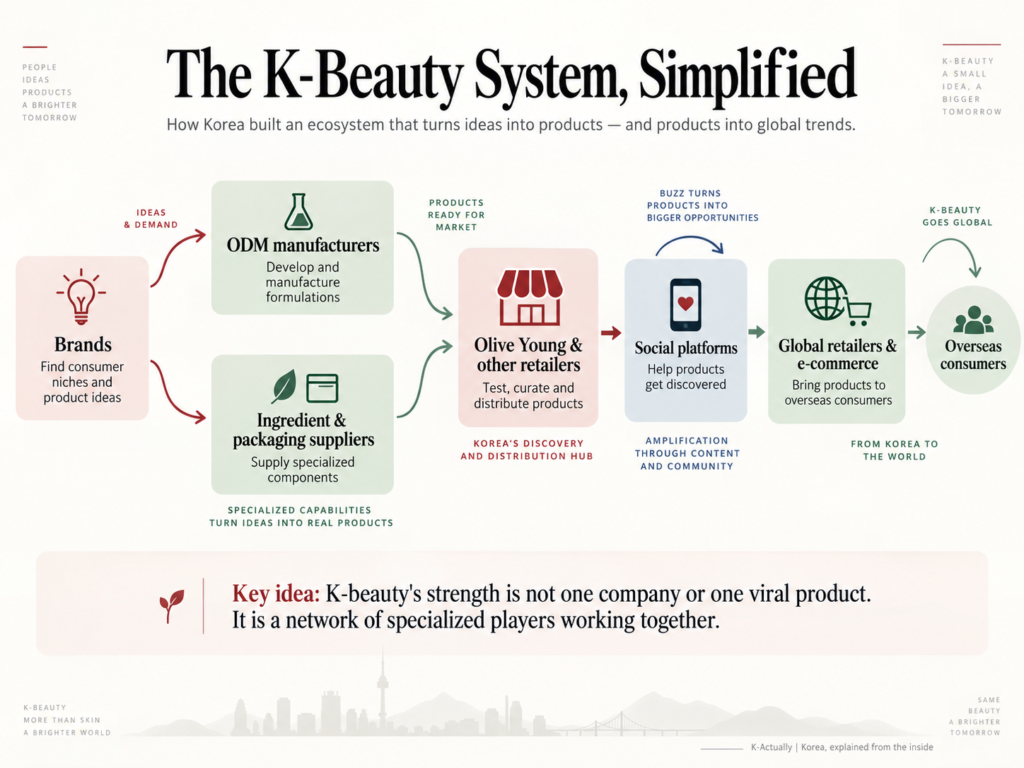
K-beauty did not become a global industry because of one breakthrough brand, one viral ingredient, or K-pop alone. Korea built an ecosystem in which specialized manufacturers, brands, retailers and digital platforms could repeatedly turn ideas into products, and products into global trends.
K-Beauty Wasn’t Born on TikTok
It’s tempting to draw a straight line from a viral video to a sold-out serum. The timing doesn’t really hold up.
By the time international audiences discovered Korean skincare in bulk, Korea already had a functioning cosmetics industry: companies, research and development, manufacturers, ingredient suppliers, packaging vendors and distribution networks.
Social media didn’t build that. It found it.
The machine existed before the global audience arrived.
The Factory Behind K-Beauty
Most people assume a cosmetics brand needs its own lab, its own factory, its own production line. Come up with an idea, build the infrastructure, make the product.
In Korea, one model became especially important: ODM, or original design manufacturing.
A brand can go to a company like Korea Kolmar or Cosmax with a concept and get far more than manufacturing back. These companies can help develop the formula, test it and produce it at scale.
An ODM isn’t simply a factory following a finished recipe. It can help develop the recipe.
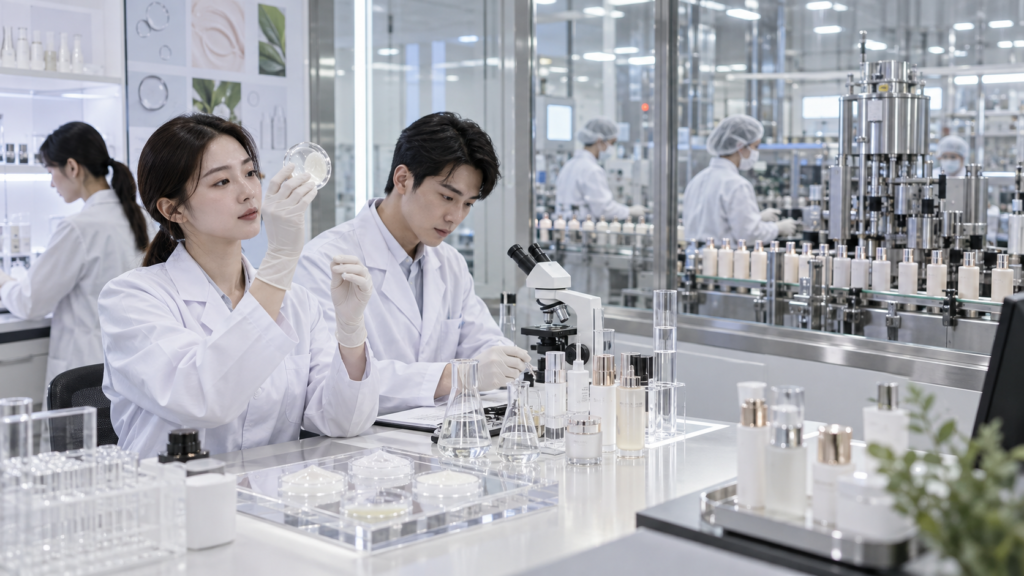
Based on their latest reported revenues, Cosmax and Korea Kolmar now rank first and second among the world’s major cosmetics ODM manufacturers, ahead of established European players like Italy’s Intercos. Yonhap — Cosmax and Korea Kolmar rank first and second in cosmetics ODM revenue
Their work covers far more than filling bottles. Korea Kolmar, for example, describes its ODM service as spanning market research and trend analysis, product planning, development, manufacturing, management and shipment. Kolmar Korea — ODM Total Consulting
The relationship is beginning to extend beyond manufacturing, too.
In 2025, Cosmax and Korea Kolmar joined the Korean government in backing a 40 billion won K-Beauty Fund aimed at promising beauty brands and beauty-tech startups. Ministry of SMEs and Startups — K-Beauty Fund launch
None of this replaces the brand’s job. Concept, positioning and reaching the customer are still the brand’s responsibility. The ODM model just means a small team doesn’t have to build a factory to compete.
That lowered one of the biggest barriers to entering the cosmetics business: having to own the entire production system yourself.
ODM became one piece of an unusually specialized beauty ecosystem, not the whole explanation for it.
Korea Turned Beauty Into a Network
The Korean government’s own account of the industry’s growth points to something broader than any single company: specialized firms handling planning, production and distribution as separate, interlocking functions. Ministry of SMEs and Startups — K-Beauty export strategy
A Korean beauty brand doesn’t need every capability under one roof.
It can lean on a network: an ODM for formulation and manufacturing, ingredient suppliers, packaging vendors, retail partners and digital marketing specialists, each doing one part well.
Korea’s advantage wasn’t just having good beauty companies. It was having many companies that could specialize in different parts of making a beauty product, connected in a way that let new brands enter the market without building every capability from scratch.
Then Hallyu and Social Media Found the Products
K-pop, K-dramas and TikTok belong in this story too, just not where people usually put them.
They’re the amplifier, not the cause.
Korea had already built the production system. Hallyu gave it visibility. Korean dramas and idols put Korean faces, and Korean beauty routines, in front of huge international audiences.
That helped build awareness of “Korean skincare” as a category worth paying attention to, well before most of today’s biggest indie brands existed.
The Korean government itself now points to the combination of specialized production, manufacturing capability and overseas marketing tied to the spread of Korean culture as important parts of K-beauty’s export growth. Korea’s official K-Beauty export strategy
Social media did something more specific: it lowered the cost of discovery.
A small Korean brand no longer needed a department-store counter or a traditional distribution deal just to be seen by customers in another country. A single video could put an unknown product in front of millions of potential customers.
That gave smaller brands a route to international visibility that previous generations did not have in the same form.
The First Boom Was Heavily About China. The Next One Isn’t.
In 2025, the United States overtook China as Korea’s largest cosmetics export market for the first time: about $2.2 billion, against roughly $2.0 billion for China and $1.1 billion for Japan. Korea Ministry of Food and Drug Safety — 2025 export markets
That single fact matters more than it looks.
For years, K-beauty’s growth story was heavily tied to China. Now Korean cosmetics reach roughly 200 countries and territories, with demand spread much more widely across the United States, Japan, Europe, Southeast Asia and the Middle East.
The important shift isn’t just that Korean cosmetics exports are growing.
It’s that the geography of that growth has changed.
The New K-Beauty Boom Looks Different
The brand names carrying this growth aren’t always the ones that carried the last one.
A decade ago, K-beauty’s global image was closely associated with the country’s largest cosmetics groups: Amorepacific, LG Household & Health Care, and brands like Innisfree and Laneige.
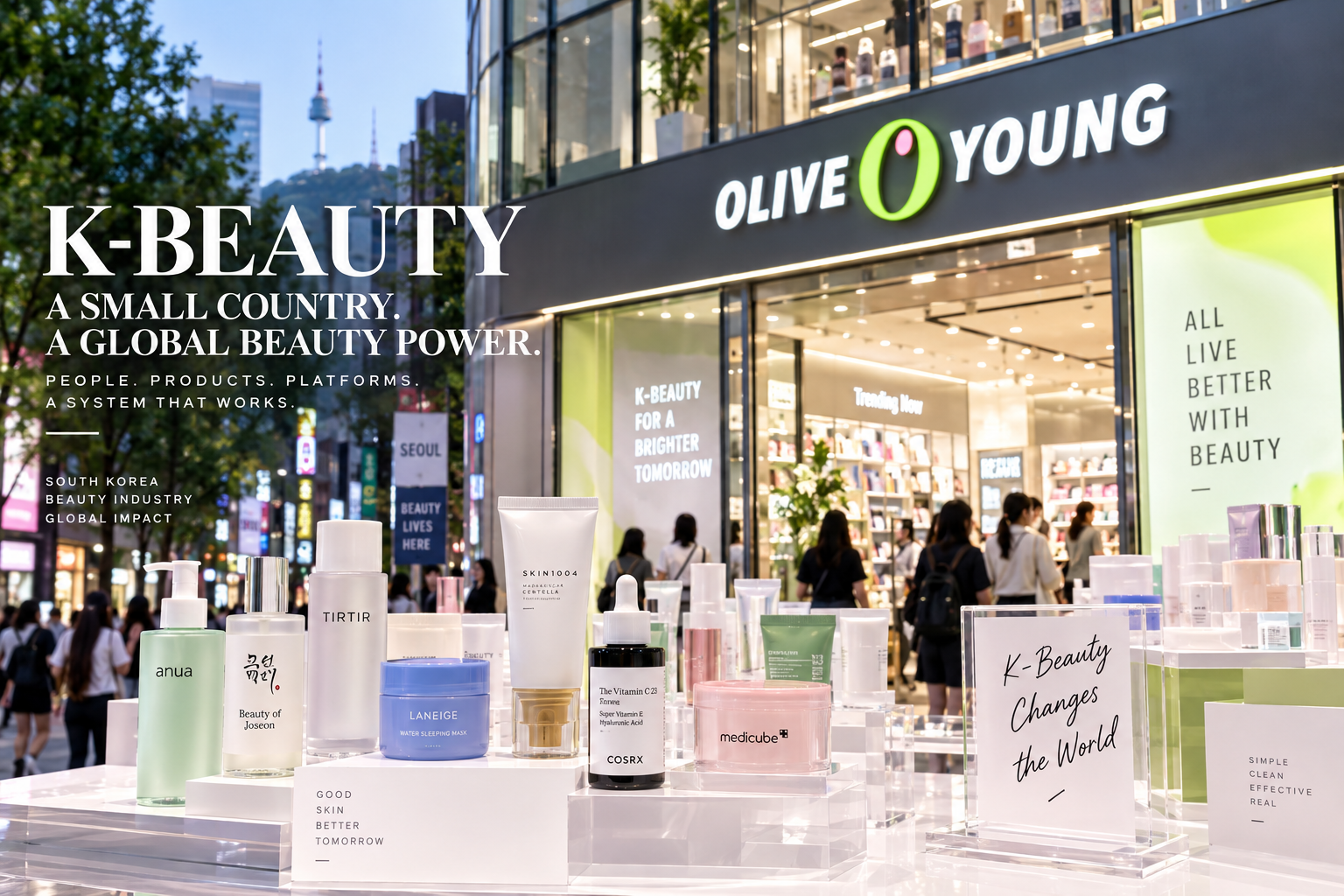
Today, international shoppers are just as likely to be talking about Beauty of Joseon, Anua, SKIN1004, TIRTIR or Round Lab — brands that didn’t need a Korean cosmetics conglomerate behind them to reach global customers.
Korea’s own trade data shows how important smaller exporters have become in aggregate.
In the first half of 2026, cosmetics were the single largest export category among Korean small and medium-sized exporters, worth $5.07 billion — up 30.7% from a year earlier and a record for the category. Ministry of SMEs and Startups — H1 2026 SME export data
Small and medium-sized exporters are no longer a side story in Korean cosmetics exports.
Olive Young Became Part of the Infrastructure
Calling Olive Young simply a beauty retailer undersells what it increasingly does for the industry.
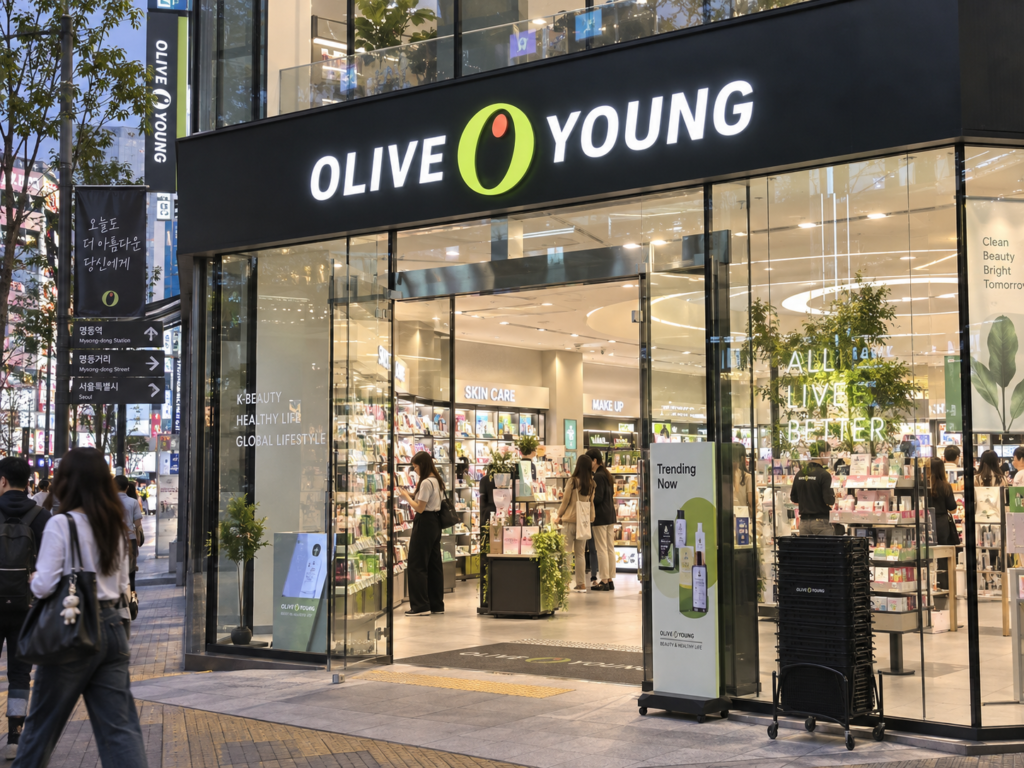
Inside Korea, Olive Young functions as a discovery layer: a place where a small brand can get shelf space, get tested by real customers and build visibility.
That domestic discovery process increasingly feeds a second one abroad through Olive Young’s overseas platform, Global Mall.
In the first half of 2025, Global Mall’s sales grew 70% year over year, with orders up 60% and membership passing 3.3 million. CJ Olive Young — Global Mall H1 2025 results
In 2026, that reach extended further.
Olive Young signed a partnership with Sephora, and on August 20, 2026, launched a curated “K-Beauty Edit” across roughly 580 Sephora stores in the United States and Sephora’s online store.
The initial lineup included 19 Korean brands and around 150 products. CJ Olive Young — K-Beauty Edit launch at Sephora U.S.
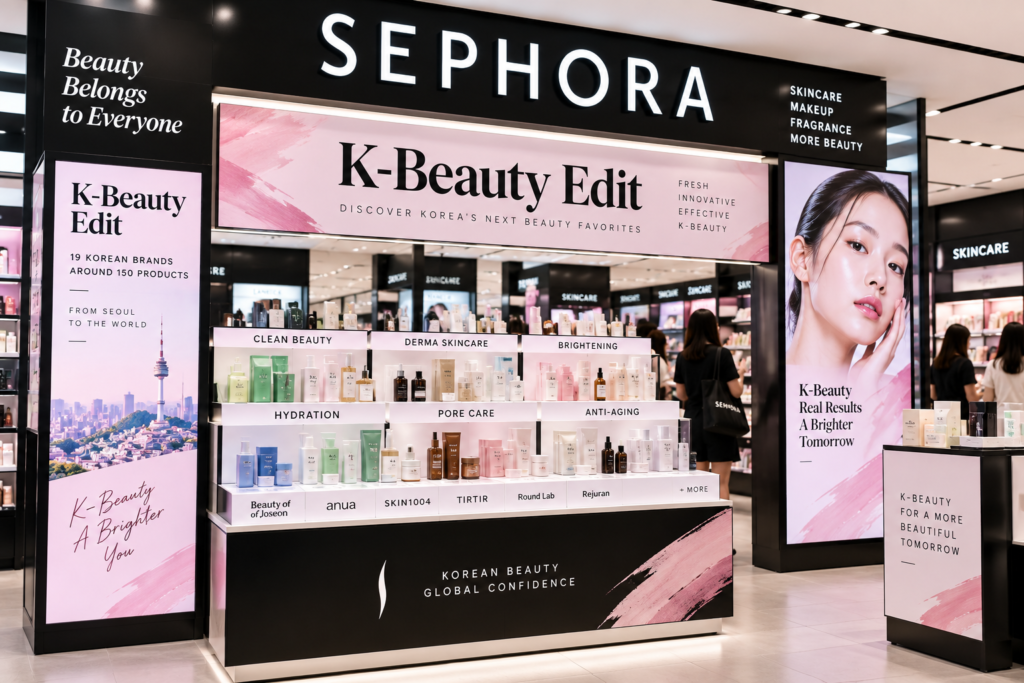
If ODM is part of the production infrastructure behind K-beauty, Olive Young has become one of the increasingly important layers connecting Korea’s crowded beauty market with shoppers overseas, alongside Amazon, TikTok Shop, brand-direct sales and other retailers doing the same job through different channels.
What Comes Next for K-Beauty?
Two things already stand out. Neither requires much prediction.
The first is that growth hasn’t leveled off.
In August 2026 alone, cosmetics exports hit $1.31 billion, up 52.1% from a year earlier and an all-time high for the month. Ministry of Trade, Industry and Resources — August 2026 export results
Whatever phase K-beauty is in, it isn’t a slowdown.
The second is that discovery is starting to run through specific ingredients as much as the “Korean” label itself.
Rejuran, whose skincare products use PDRN, is one of the brands included in Olive Young’s Sephora lineup. CJ Olive Young — Sephora K-Beauty Edit lineup
It’s a small but concrete sign of how the conversation is changing. Some international shoppers are no longer just asking which Korean skincare product to buy.
They’re asking what PDRN actually is, and whether it’s worth the hype.
That’s not proof that ingredient science is K-beauty’s future.
If you want to see how complicated that question gets in practice, we broke down what the numbers on Korean PDRN skincare actually mean.
K-Beauty’s Hardest Test May Be Starting Now
Ten years ago, the question was whether Korean beauty could become a genuinely global category.
That question has been answered.
The harder one is just starting: can hundreds of fast-moving Korean brands turn global visibility into companies that last?
Korea has already proved it can build a system capable of producing the next beauty trend.
Whether that same system can produce the next generation of durable global beauty companies is still an open question.
And probably the more interesting one.