Makgeolli Is Changing. But What Exactly Is Makgeolli?
There is a familiar picture of makgeolli in Korea.
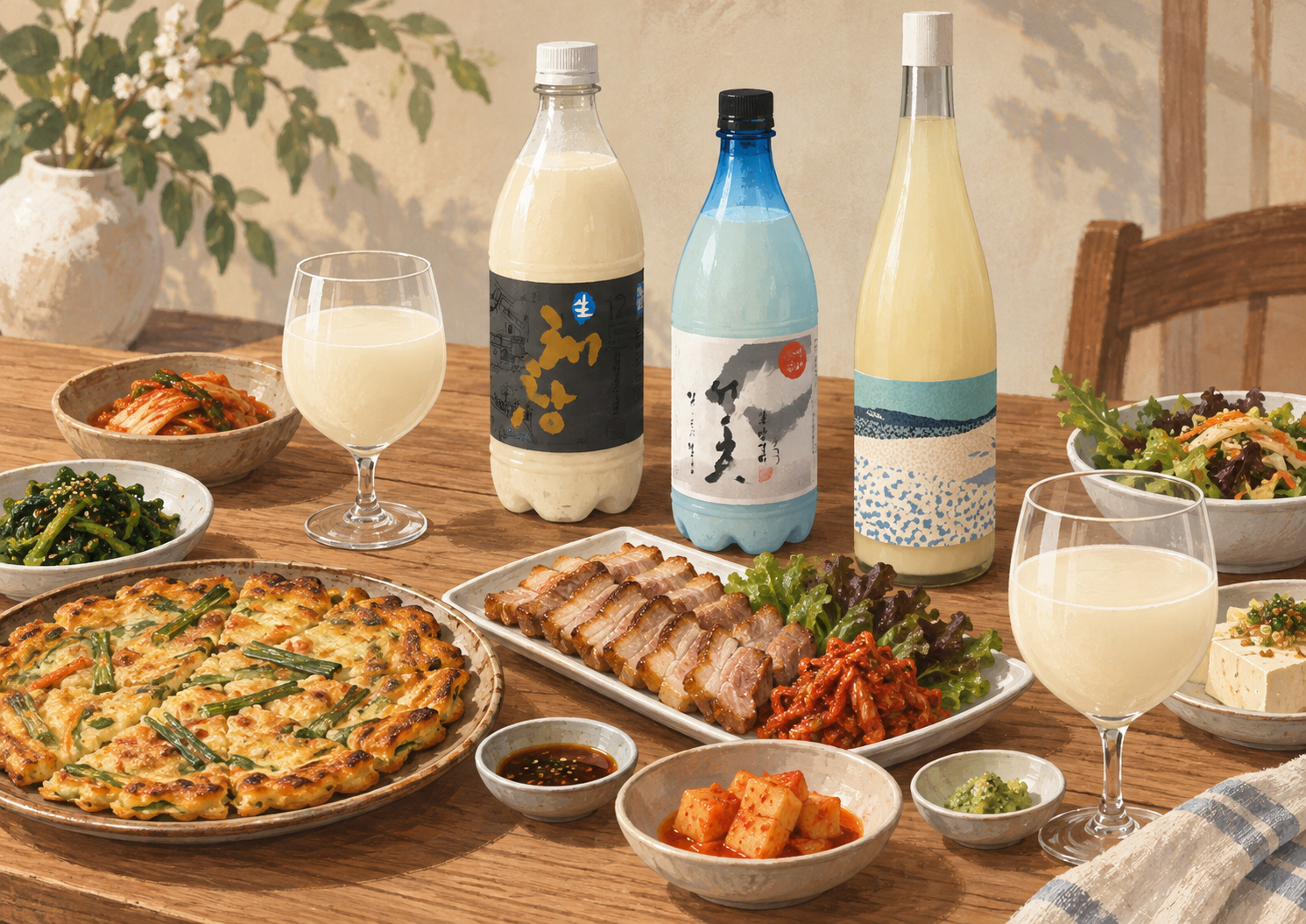
It is raining outside. A pajeon, a savory Korean pancake, is sizzling on the table. Next to it is a plastic bottle filled with cloudy white makgeolli.
The drink is slightly sweet, a little sour, gently fizzy, and often somewhere around 5 to 6% alcohol.
For a long time, this has been one of the most recognizable images of makgeolli in Korea.
And it is not wrong.
It is just one version of the drink.
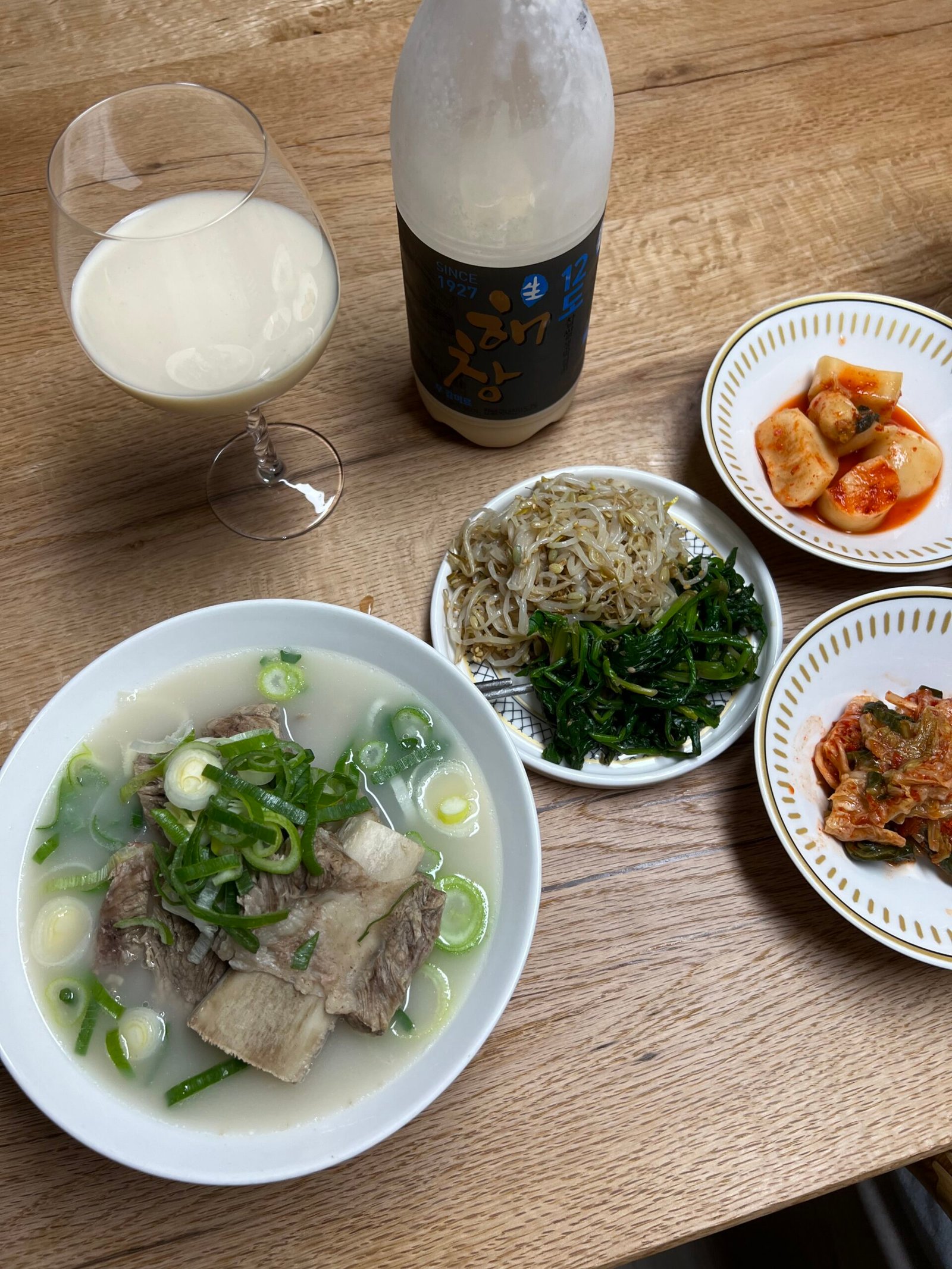
Look beyond the most familiar bottles and makgeolli becomes much harder to define by taste alone.
Some are barely sweet. Some have almost no carbonation. Others are thick and creamy, sharply acidic, noticeably dry, or well above 10% ABV. Some are made to be drunk young and fresh. Others spend time maturing before release.
They can all sit within the world people call makgeolli.
So why can two bottles taste almost nothing alike?
To answer that, it helps to start with the basics: what is makgeolli, exactly?
What Is Makgeolli, Exactly?
Makgeolli is often introduced in English as “Korean rice wine.” It is a convenient shorthand. Rice is commonly the main grain, and fermentation is central to how the drink is made.
But thinking of it simply as wine misses something important.
Grapes already contain sugars that yeast can use. Rice mostly contains starch, so before that starch can become alcohol, it first has to be converted into sugar.
That is where nuruk comes in.
Nuruk is a traditional Korean fermentation starter that contains saccharifying enzymes and a range of microorganisms. In makgeolli brewing, starch is converted into sugar while yeast turns those sugars into alcohol, with the two processes happening alongside each other, what researchers call simultaneous saccharification and fermentation.
The legal terminology is slightly more complicated. Under Korea’s current Liquor Tax Act, takju is one category of fermented alcoholic beverage, with its legal definition set out in the Act and its attached table. “Makgeolli” is the everyday term people use, and it does not always map perfectly onto that tax classification.
You do not need to know Korean liquor law to order a bottle.
What matters is that makgeolli is better understood as a broad family of fermented drinks than as one fixed recipe with one fixed flavor.
Rice creates sugar. Fermentation consumes it.
That relationship explains a surprising amount. Using the same grain does not guarantee the same sweetness. Fermenting for the same number of days does not guarantee the same result. The fermentation starter, the ratio of grain to water, temperature and time can all change what ends up in the glass.
Makgeolli gives a brewer a lot of variables to work with.
Distilled soju sits in a different legal category altogether, and its own recent evolution follows a similar pattern of reinterpretation.
Why Can Makgeolli Taste So Different?
Starch in the grain is converted into sugar. Yeast consumes that sugar and produces alcohol. How much sugar remains depends partly on how the fermentation is managed.
Then more decisions come into play.
How much grain is used relative to water? How much of the solids remain in the drink? Is the fermented base diluted? Is sweetness adjusted? Is it sold unpasteurized and still biologically active, or pasteurized for stability? Is it released young, or given time to mature?
Change those variables and the result changes with them.
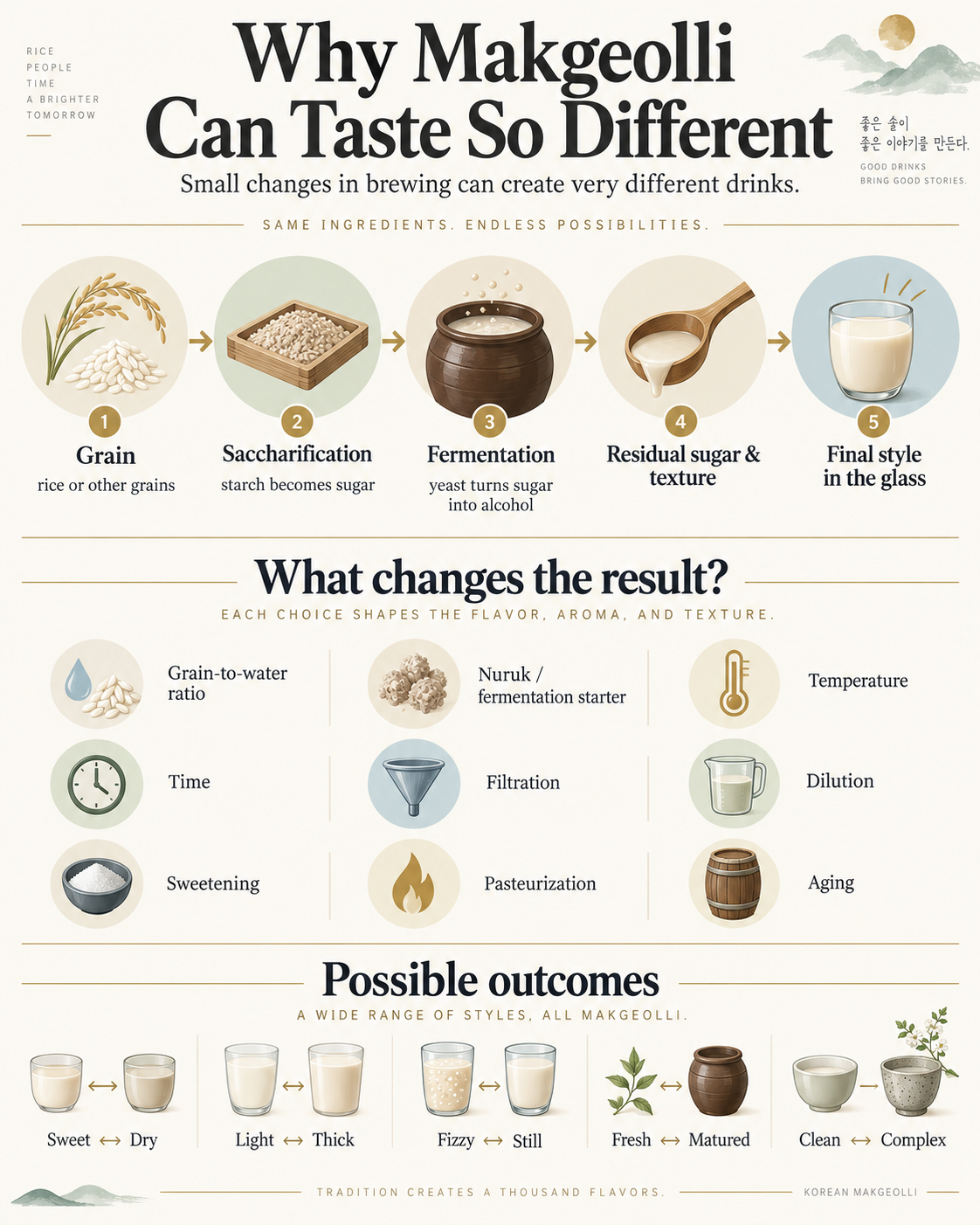
One makgeolli can be sweet while another is distinctly dry. One can be light and easy to drink while another is almost creamy in texture. One can have noticeable carbonation while another is nearly still. Some taste fresh and immediate. Others develop different aromas and textures with time.
A 2023 study comparing four makgeolli production methods found substantial differences in alcohol, sugars, organic acids and sensory characteristics depending on how the drink is brewed.
Makgeolli, in other words, does not simply taste like rice.
Rice creates the potential for sweetness.
Fermentation takes that sweetness away.
Much of makgeolli brewing happens somewhere between those two processes.
Fresh and Pasteurized Makgeolli Can Be Different Experiences
Walk into a Korean store and you will often see the word saeng, meaning “fresh” or “unpasteurized,” on bottles of makgeolli.
Unpasteurized makgeolli can continue changing after bottling because active microorganisms remain in the drink. That is one reason refrigeration matters. Flavor and carbonation can change with time, and some bottles can build pressure as fermentation continues.
Pasteurization makes makgeolli more stable and easier to distribute over longer distances.
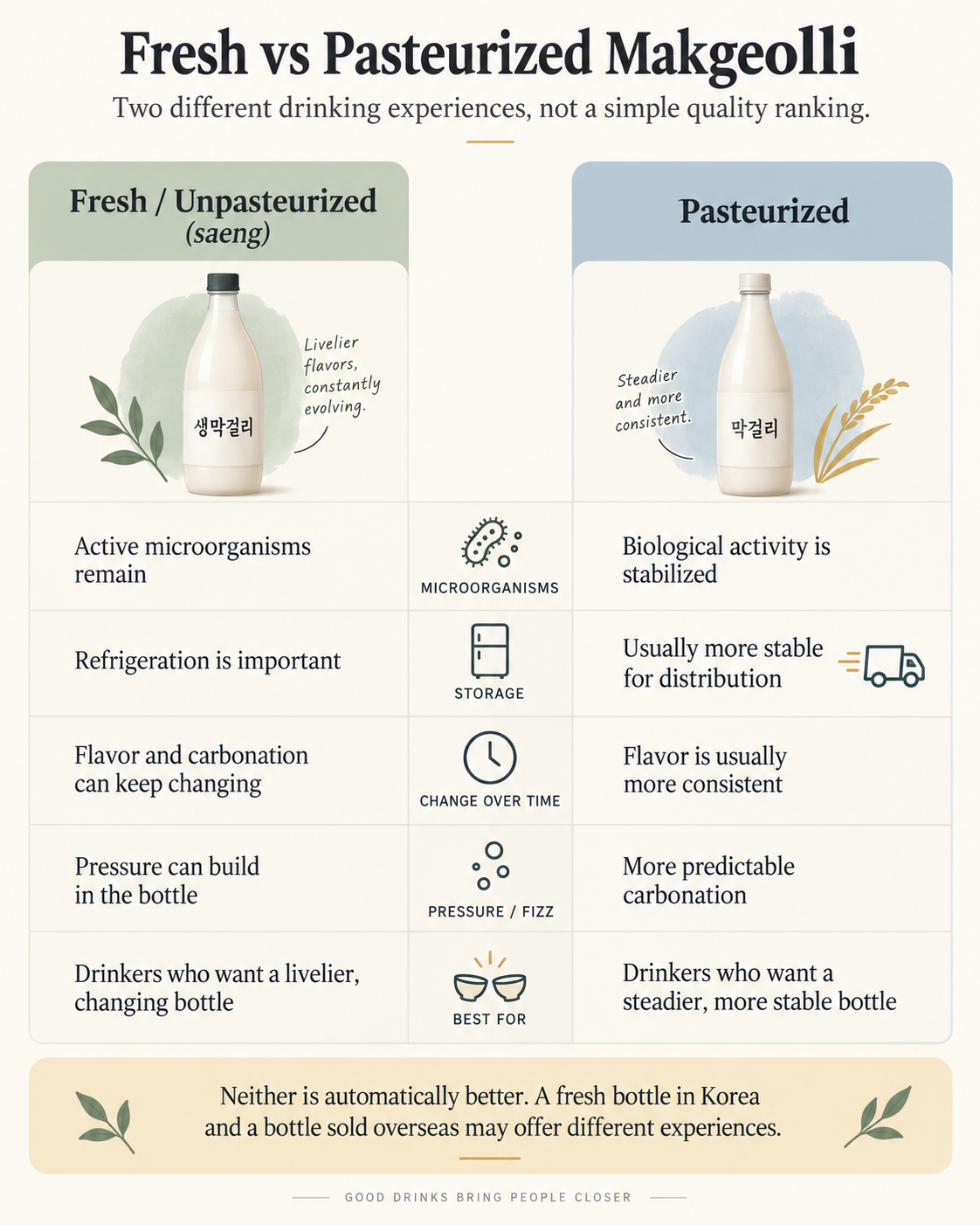
This becomes particularly relevant outside Korea. A bottle available overseas may not provide exactly the same experience as an unpasteurized bottle bought from a refrigerated shelf in Korea.
That does not automatically make one better than the other.
It simply means that production, storage and distribution are also part of what determines how makgeolli tastes when it reaches your glass.
Does Makgeolli Have to Be Sweet?
One of the most common reactions to makgeolli is simple:
“I didn’t expect it to be this sweet.”
And many popular bottles are sweet.
But sweetness is not what defines makgeolli.
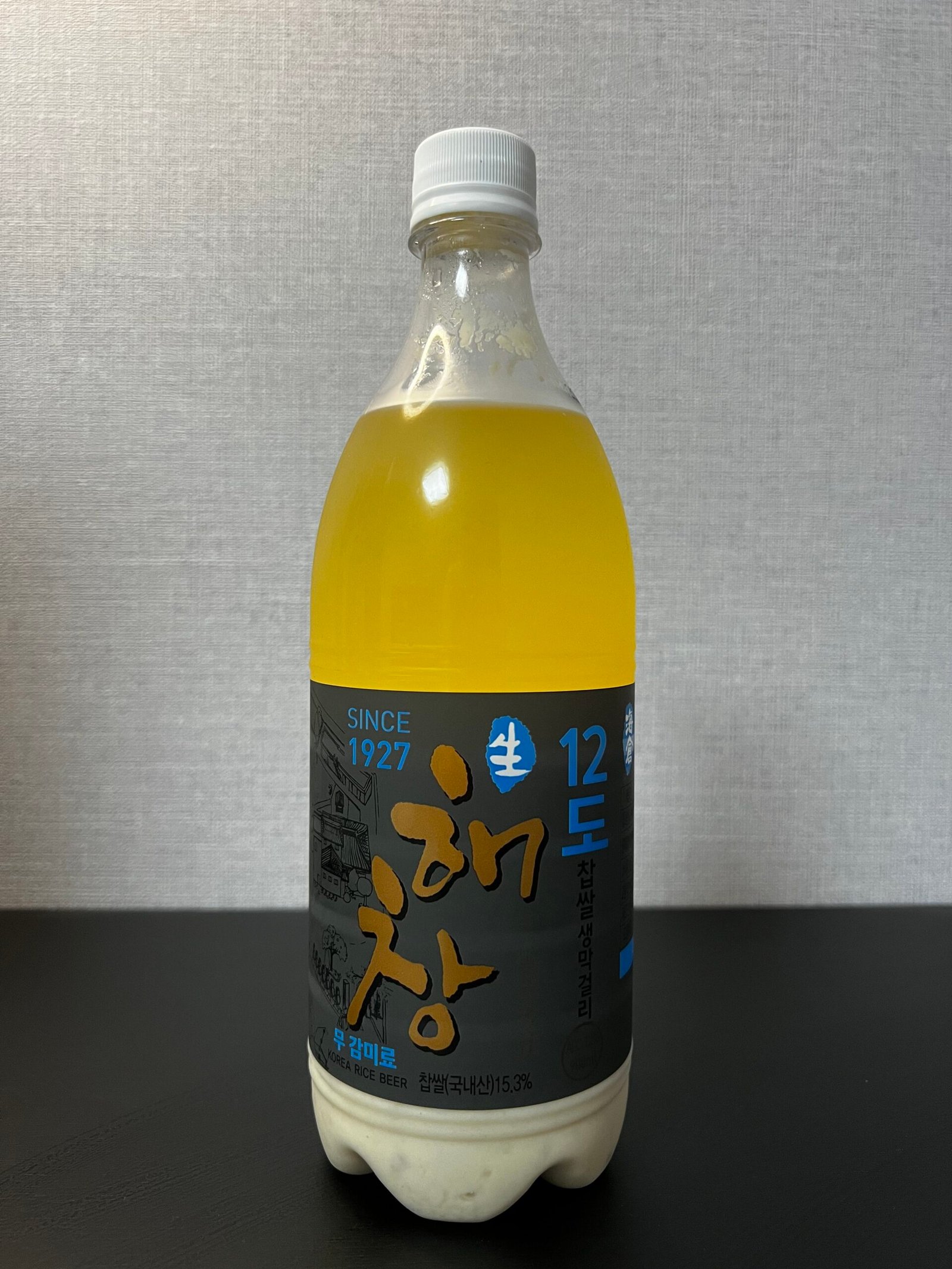
Without added sweeteners, sweetness has to come from the brewing itself. Brewers can change the grain-to-water ratio, manage saccharification and fermentation differently, or leave more residual sugar in the finished drink.
Allow yeast to consume more of those sugars and the result can become drier.
This is not just theoretical. Researchers at Korea’s National Institute of Agricultural Sciences have tested fermentation control as a way to retain sweetness in makgeolli without artificial sweeteners, showing how the balance between continuing saccharification and yeast activity can change residual sugar.
This is also why added sweeteners should not automatically be treated as a simple test of quality.
For a widely distributed product that needs predictable sweetness, price and consistency, a non-fermentable sweetener can be a practical production tool. A brewer trying to create sweetness entirely through brewing faces a different set of choices involving grain, water, saccharification, fermentation and residual sugar.
Those are different approaches to making a drink.
They are not, by themselves, a ranking of good makgeolli and bad makgeolli.
Korean alcohol law adds another wrinkle. The Liquor Tax Act’s classification table specifies the basic materials and the additional ingredients allowed within the takju category. A product made outside that permitted framework can fall outside the legal takju classification, even if consumers might casually think of it as makgeolli.
It is another reminder that everyday language and legal categories do not always line up perfectly.
The same gap shows up with the word jeontongju itself. We explain why in our guide to what actually counts as traditional Korean liquor.
Makgeolli Is Being Reinterpreted
Once you understand how many variables exist inside makgeolli, its current evolution starts to make more sense.
The grain can change. The fermentation starter can change. The ratio of water to grain can change. Fermentation temperature and time can change. A brewer can decide how much sweetness, acidity, texture or carbonation to retain. The drink can be filtered differently, matured for longer, or made with additional ingredients.
None of these possibilities appeared yesterday.
What feels different now is how deliberately some brewers are exploring them.
Instead of treating makgeolli as a drink with one expected flavor, they are asking another question:
What else can it express?
One example is Sangsunjujo, a small Korean craft makgeolli brewery in Sangju. Its INNER PEACE line combines organic rice, blended nuruk, herbs and low-temperature aging around an idea the brewery calls “meditation sool.”
There is a useful parallel in Korean food.
Ask someone unfamiliar with Korea to picture kimchi and they will probably imagine red napa cabbage.
But kimchi has never been one recipe.
There is baechu kimchi made with napa cabbage, kkakdugi made with cubed radish, chonggak kimchi made with young radish, mild white baek kimchi, watery mul kimchi, and many more variations.
Newer cooks and producers also experiment with ingredients outside the versions most people immediately picture.
Those variations do not make traditional kimchi disappear. They add another expression to an already broad tradition.
Makgeolli increasingly feels similar.
The point is not to make makgeolli less traditional.
It is to discover how many different things can be expressed within that tradition.
As Makgeolli Changes, So Does the Food Beside It
One pairing still occupies a special place in Korea: makgeolli and jeon.
Especially on a rainy day.
Pajeon and makgeolli are such a familiar combination that they function almost like chimaek, Korea’s well-known pairing of fried chicken and beer.
And there is no reason to retire it.
A savory, oily jeon works remarkably well beside a sweet, tangy and lightly carbonated makgeolli.
But when the drink changes, the possibilities around it change too.
A drier makgeolli with clear acidity behaves differently at the table. A richer, higher-alcohol takju can stand beside stronger dishes. A more aromatic or delicately textured bottle creates another set of possibilities.
This is not hypothetical.
In 2022, Jipyeong Brewery opened Punju in Seoul, serving three of its makgeolli products alongside a seasonal Korean tasting menu. Jipyeong said it wanted to broaden perceptions of pairing Korean alcohol with food.
A few years later, the idea had become even more deliberate.
In 2025, Sool052 introduced GAIA, developed with Ggulgguk House in Busan. Head sommelier Jaehyun Shim described “pairing potential with food” as one of the considerations built into the drink from the development stage.
The same restaurant later held a separate Hana Makgeolli pairing project, matching six different Hana drinks with its own dishes to mark the Korean launch of Hana Takju 16.
This wider approach to pairing is not limited to fine dining either. The Korean Food Promotion Institute has published makgeolli pairings including Gapyeong Pine Nut Makgeolli Black with dorajimuchim, a spicy bellflower-root salad.
None of this means makgeolli has “graduated” from pajeon.
That would miss the point.
Makgeolli is not leaving the pajeon table.
It is simply finding more tables to sit at.
So Which Makgeolli Should You Try First?
If you are new to makgeolli, you do not necessarily need a ranked list of the “best” bottles.
Start by looking at the bottle itself: the alcohol percentage, whether it is labeled saeng or pasteurized, the storage instructions, which grains are used, and whether sweeteners appear on the ingredient list.
Small details like these can tell you much more than the word makgeolli alone.
And if your first bottle is too sweet, do not assume you dislike makgeolli.
Too sour? Too fizzy? Too thick or too thin?
Try another style.
There is far more variation inside this category than the most familiar bottles might suggest.
What Else Can Makgeolli Become?
For much of its history, makgeolli did not need to explain itself in Korea.
It was simply there: at markets, restaurants and everyday drinking tables, next to jeon, shared without anyone needing to debate what style it belonged to.
That familiarity has not disappeared.
But a growing number of brewers are now looking at this very familiar drink and asking new questions.
Does makgeolli have to be sweet?
Does it have to be fizzy?
Does it have to be drunk fresh?
Does it always belong beside the same foods?
How much aroma, texture and character can still be found in grain, nuruk, fermentation and time?
Different breweries are already arriving at different answers, and some of the most interesting ones are only just getting started.
Maybe that is the more interesting question about makgeolli in Korea today: not what it is, but what it can become next.