Can International Students Work Part-Time in Korea?
The Short Answer
Yes, international students can work part-time in Korea.
International student part-time work in Korea depends on your visa, your course, your Korean proficiency, and your enrollment status.
Having a student visa does not automatically give you permission to work in Korea.
First, Check Your Visa
D-2 is not one single rule. The conditions change depending on which D-2 subtype you hold.
| Visa | Who it’s for |
|---|---|
| D-2-1 | Associate degree |
| D-2-2 | Bachelor’s degree |
| D-2-3 | Master’s degree |
| D-2-4 | Doctoral degree |
| D-2-6 | Exchange student |
| D-2-7 | Work-learning linked study |
| D-2-8 | Visiting student |
| D-4-1 / D-4-7 | Language training / trainee |
D-2-1 through D-2-4, D-2-6, and D-2-7 are listed as eligible statuses for part-time work permission. But when you can actually apply and how many hours you’re allowed to work depend on your specific status and circumstances.
One category worth flagging separately is D-2-5 research status. It is a distinct D-2 category, but it is not included in the government’s general part-time work eligibility list covered in this guide.
When Can You Start?
- D-2-1 to D-2-4: There is no separate six-month waiting period. The government’s current detailed table lists these degree programs as immediately available for part-time work applications. That means eligible to apply, not free to start working the day you arrive.
- D-4-1 / D-4-7: You become eligible after six months. The six-month period is counted from the date your status changed, or from your entry date if you entered Korea holding the visa.
- D-2-8 visiting students: The same six-month condition applies.
- D-2-6 exchange students and D-2-7 work-learning linked students: The government lists both as eligible statuses, but its public hours table does not provide a separate row for either category. Rather than assume another D-2 limit applies to you, check your specific case with your university’s international student office or immigration.
If you’re still deciding where to study Korean, our guide to Korean language schools in Korea compares D-4-1 visa basics, 2026 tuition, attendance rules, dorm options, and university programs versus private academies.
How Many Hours Can You Work?
One of the most common shortcuts you’ll see online is that international students can work up to 30 hours a week.
That’s too simple.
Your limit depends on your course level and whether you meet the Korean proficiency benchmark that applies to your course.
Another important detail: if you have not met that benchmark, your weekend and vacation hours are limited too. The unlimited weekend and vacation allowance shown in the government’s detailed table applies only to students who meet the relevant proficiency requirement.
The following limits are based on the current detailed part-time employment table published by Study in Korea.
| Course | Korean proficiency | Weekday | Weekend / vacation | Higher weekday limit |
|---|---|---|---|---|
| D-4 language training | Not met | 10 hrs | 10 hrs | — |
| D-4 language training | Met | 20 hrs | 25 hrs | — |
| Associate degree | Not met | 10 hrs | 10 hrs | — |
| Associate degree | Met | 25 hrs | Unlimited | Up to 30 hrs |
| Bachelor’s degree | Not met | 10 hrs | 10 hrs | — |
| Bachelor’s degree | Met | 25 hrs | Unlimited | Up to 30 hrs |
| Master’s / Doctoral | Not met | 15 hrs | 15 hrs | — |
| Master’s / Doctoral | Met | 30 hrs | Unlimited | Up to 35 hrs |
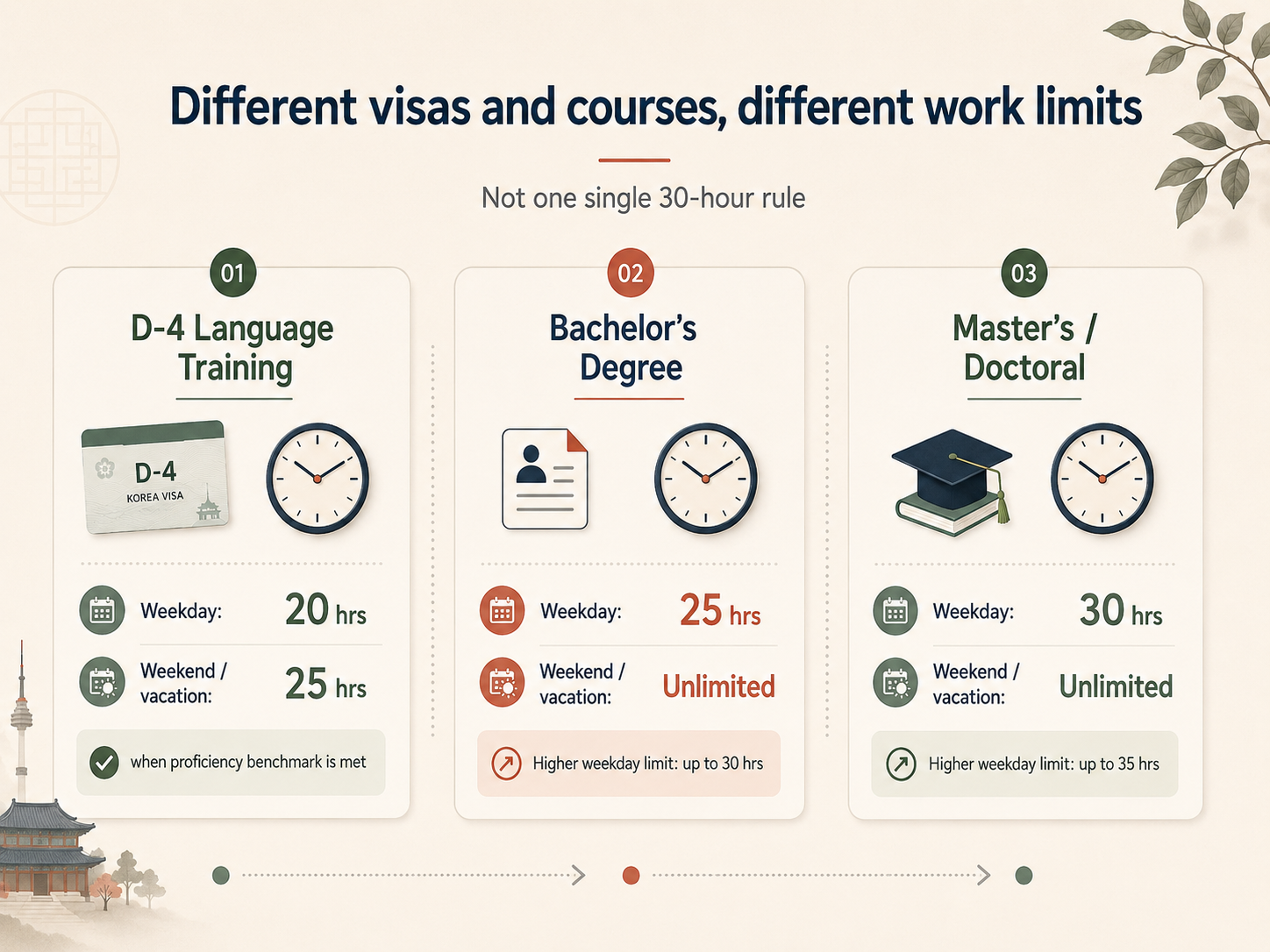
The higher weekday limits in the final column apply only when additional preferential conditions are met, such as qualifying university, academic-performance, or Korean-proficiency criteria. Ask your university’s international student office whether those conditions apply to you.
There is no single weekly work limit for every international student.
Does TOPIK Matter?
Yes, but not quite in the way it’s sometimes explained online.
Not meeting the Korean proficiency benchmark does not automatically mean zero work hours. The government’s detailed table lists reduced limits for students who have not met the benchmark.
| Course | Korean proficiency benchmark |
|---|---|
| D-4 language training | TOPIK level 2 or a recognized equivalent |
| Associate degree | TOPIK level 3 or a recognized equivalent |
| Bachelor’s, years 1–2 | TOPIK level 3 or a recognized equivalent |
| Bachelor’s, years 3–4 | TOPIK level 4 or a recognized equivalent |
| Master’s / Doctoral | TOPIK level 4 or a recognized equivalent |
A recognized equivalent can include the relevant level of the Korea Immigration and Integration Program (KIIP), a qualifying KIIP pre-assessment score, or the corresponding King Sejong Institute level.
Because these requirements matter when you apply, check the current standard for your course rather than relying on an old screenshot or forum post.
What Jobs Can International Students Do?
The government’s guidance says student part-time work is generally limited to activities that students would normally perform, such as simple work.
Examples listed by the government include:
- Restaurant support work
- General office support work
- Tourism guide support work
- Duty-free shop sales support work
That does not mean every job offered to a student is automatically permitted.
Eligibility can depend on the specific role and workplace. If you’re unsure about a particular job, check with your university’s international student office or immigration before accepting it.
Private Tutoring Is Treated Differently
Private tutoring is regulated separately from ordinary student part-time work and is subject to stricter rules.
So don’t assume that getting an English tutoring offer means it is covered by the same permission used for ordinary student part-time employment.
How to Get Part-Time Work Permission
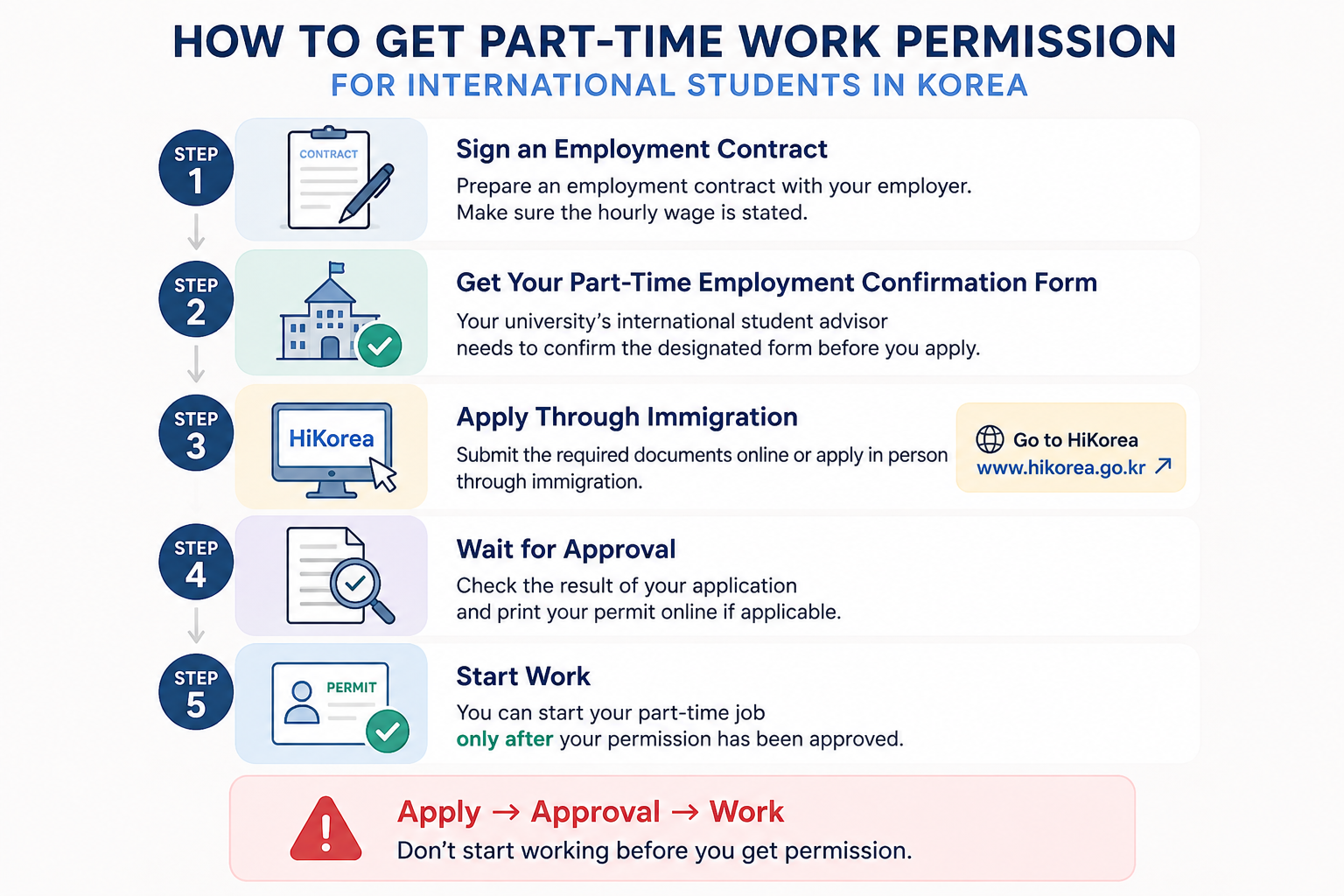
Step 1: Sign an Employment Contract
Prepare an employment contract with your employer. The hourly wage needs to be stated.
Step 2: Get Your Part-Time Employment Confirmation Form
Your university’s international student advisor needs to confirm the designated form before you apply.
Step 3: Apply Through Immigration
You can submit the required documents online or apply in person through immigration.
Step 4: Wait for Approval
Check the result of your application and print your permit online if applicable.
Do not start work just because the application has been submitted.
Documents You May Need
The government’s current guidance lists documents including:
- Passport
- Alien Registration Card
- Application form
- Part-Time Employment Confirmation Form for International Students
- Academic transcript or certificate of attendance
- Proof of Korean proficiency, where applicable
- Copy of the employer’s business registration certificate
- Standard employment contract
- Part-Time Employment Compliance Confirmation Form, where applicable
Your university or immigration office may request additional documents depending on your individual case.
Can You Work While Your Application Is Pending?
No. Don’t start working first and apply afterward.
Submitting an application is not the same as receiving permission. Wait for approval before your first shift.
Working without permission, or working outside the conditions of your permission, can result in penalties under Korean law.
Construction Work Is Different
Unauthorized employment in the construction sector is treated particularly seriously.
According to the government’s current guidance, a deportation order is issued regardless of the number of violations, although an entry restriction may be deferred.
Don’t assume a construction-site job is just another student part-time job.
Before You Accept a Part-Time Job
Before your first shift, run through these four questions:
- Is my visa status already eligible to apply?
- Does my Korean proficiency affect my permitted hours?
- Is this type of work actually permitted?
- Have I received permission before my first shift?
If you cannot answer all four confidently, check with your university’s international student office or immigration before starting work.
Income from part-time work can also affect the student reduction on your NHIS premium. Our guide to Korea health insurance for international students explains the 2026 premium and the income and property thresholds used for the reduction.
FAQ
Can I Work Part-Time on a D-4 Visa Right After I Arrive?
No. D-4 students become eligible after six months. The six-month period is counted from the date your status changed, or from your entry date if you entered Korea holding the visa.
Does My TOPIK Level Determine Whether I Can Work at All?
Not necessarily. The government’s detailed table lists reduced work-hour limits for students who have not met the Korean proficiency benchmark.
Your exact eligibility should still be confirmed with your university or immigration before you apply.
Can I Do Private Tutoring as a Part-Time Job?
Treat private tutoring as a separate question from ordinary part-time work. It is regulated more strictly, so you should not assume standard student part-time work permission covers it.
What Happens If I Start Working Before I Get Permission?
That can count as unauthorized employment and may lead to penalties. Wait until permission has been approved before your first shift, not simply until your application has been submitted.
Is There One Weekly Work-Hour Limit for Every International Student?
No. Your permitted hours depend on your course level, Korean proficiency, and in some cases additional preferential conditions.
A graduate student who meets the relevant benchmark and a D-4 language student who does not are working under very different limits.
Thinking About Working in Korea After Graduation?
Student part-time work permission and full-time employment after graduation are different issues. If you’re thinking beyond student work, start with your visa status and eligibility before looking at job boards.
How to Find a Job in Korea as a Foreigner: Visa First →