Korea National Health Insurance for International Students: Why You Got the Bill
You did not apply for Korean health insurance. You never logged into a website, signed a form, or ticked a box. So why did a bill from the National Health Insurance Service (NHIS) show up at your dorm or officetel?
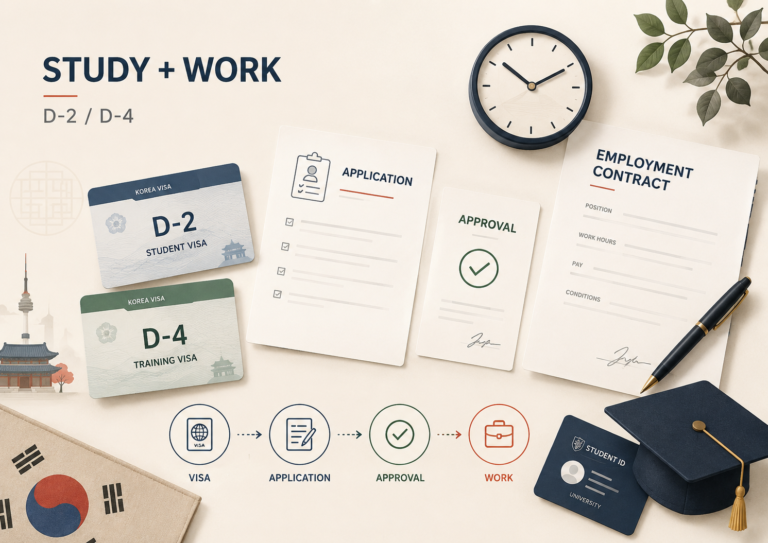
It is probably not a mistake. Since March 2021, international students on D-2 and D-4 visas have been required to join Korea’s national health insurance system according to a visa-specific enrollment schedule.
There is no opt-in process. NHIS uses your immigration and foreigner registration records to enroll you automatically and then sends the bill.
That surprises a lot of students. It also leads to more questions. When did your coverage actually start? How much should you pay? Can private insurance exempt you? What happens if you ignore the bill?
This guide explains Korea health insurance for international students using guidance from Study in Korea, the National Health Insurance Service and Korea’s Ministry of Justice.
Is Health Insurance Mandatory for International Students?
Yes.
D-2 students and D-4-3 students, meaning minors attending a Korean elementary, middle or high school, enter the system based on their foreigner registration or re-entry date.
General D-4 students, including students enrolled in a Korean language school in Korea, enter the system later. Their mandatory enrollment generally begins six months after entering Korea.
There is no separate application. NHIS handles enrollment in the background using information shared through Korea’s immigration and registration systems.
When Does Coverage Start? D-2 vs D-4
Much of the confusion comes from the different enrollment dates. D-2 students and general D-4 students do not necessarily enter the NHIS system at the same time.
| Visa status | Enrollment starts |
|---|---|
| D-2, first-time entry | Date of foreigner registration |
| D-2, re-entering after registration | Date of re-entry |
| D-4-3, minor attending a Korean school | Same rule as D-2 |
| General D-4, including language or general training | Six months after entry |
A D-2 graduate student and a D-4 language student who arrive in Korea on the same day can receive their first NHIS bills at very different times.
Your friend on a D-2 visa may receive a bill while you are still waiting on a general D-4 visa. That is usually expected because the two visas follow different enrollment schedules.
How Much Do International Students Pay in 2026?
In 2026, an eligible D-2 or D-4 student receiving the student reduction pays KRW 79,320 per month, including long-term care insurance.
The monthly amount consists of:
- KRW 70,110 for national health insurance
- KRW 9,210 for long-term care insurance
This is not a universal flat fee for every international student.
To qualify for the 50% student reduction, you must meet both of the following conditions:
- Annual assessed income of KRW 3.6 million or less
- Property tax base of KRW 135 million or less
These thresholds matter particularly if you work part-time. Once your assessed income exceeds KRW 3.6 million a year, you may no longer receive the full student reduction.
If you have a part-time job, it also helps to understand the separate part-time work rules for international students in Korea. The amount you earn can affect more than your insurance premium, and you usually need permission before starting work.

Why Is Your Bill Higher Than KRW 79,320?
If your bill is higher than your classmate’s or higher than what you paid previously, there are two likely explanations.
First, the student reduction has changed since international students entered the mandatory system:
| Period | Student reduction |
|---|---|
| March 2021–February 2022 | 70% |
| March 2022–February 2023 | 60% |
| March 2023–present | 50% |
This history helps explain why student premiums increased during the first few years of mandatory enrollment.
However, the reduction has remained at 50% since March 2023. An increase in 2026 is therefore not caused by another reduction-rate cut. The underlying average regional premium and long-term care contribution can also be adjusted from year to year.
Second, your premium can increase if the income or property information used by NHIS puts you above the reduction thresholds.
If neither explanation seems to fit, contact NHIS and ask which income, property and eligibility records were used to calculate your bill.
Do You Need to Apply?
No. Enrollment happens automatically.
You do not submit an application to trigger your coverage, and there is no consent form confirming that you want to join the system.
You can still choose how to receive the bill.
Paper notices generally arrive at your registered address around the 13th to 15th of the month. Electronic or mobile notices may arrive around the 10th. Registering for electronic billing may also provide a KRW 200 monthly discount.
Foreign residents generally pay regional health insurance premiums in advance. Your premium for the following month is due by the 25th of the current month.
For example, the premium for April would normally be due by March 25.
Changing how you receive the notice does not affect your enrollment. It only changes how and when you receive the billing information.
Can Foreign or Private Insurance Exempt You?
Sometimes, but simply having private insurance is not enough.
Private or travel insurance does not automatically cancel your NHIS enrollment. Exclusion requires an application, evidence of equivalent medical coverage and approval from NHIS.
According to NHIS guidance for foreign residents, exclusion may be available when medical coverage equivalent to NHIS benefits is provided through:
- A foreign law or national insurance system
- A foreign insurance policy
- An employment contract
You may need to submit the full insurance policy or coverage certificate, along with a Korean translation if requested. NHIS then decides whether the coverage is sufficiently equivalent.
An exclusion based on foreign insurance or an employment contract may only be approved for up to one year at a time, so renewal can require another application.
Until NHIS approves the exclusion, your existing bill remains valid. A pending application is not the same as an approved exemption.
What Happens If You Do Not Pay?
Unpaid NHIS premiums can restrict your health insurance benefits and affect an application to extend your stay.
One missed payment does not automatically cancel your visa. However, unpaid premiums can accumulate late charges, and your access to insurance benefits may be restricted while the debt remains unresolved.
Immigration authorities may also check for unpaid health insurance premiums when reviewing a stay-extension application.
According to the Ministry of Justice’s official guidance, foreign residents with unpaid premiums may be asked to settle the debt during the extension process. If it remains unpaid, a normal extension may be restricted. A limited extension, generally six months or less, may be granted instead until the debt is resolved.
If the bill looks wrong or you are unable to pay it by the deadline, contacting NHIS is safer than leaving it unpaid.
What Does Korean National Health Insurance Cover?
International residents enrolled in NHIS receive the same national health insurance benefit structure as Korean nationals.
According to the NHIS introduction to national health insurance benefits, this includes coverage for eligible inpatient care, outpatient treatment and treatment for serious illnesses.
Not every hospital visit is free. You still pay the applicable patient contribution, and some treatments, medicines or services may fall outside the covered benefit package.
The unexpected bill can be frustrating, but international students receive the same NHIS benefit structure used for Korean nationals. It is not a separate, reduced insurance plan for foreigners.
What to Check If the Bill Looks Wrong
Before assuming the bill is incorrect, check the following points.

1. Check Your Registered Address
Confirm that the address NHIS has on file matches where you currently live, including your dormitory building and room number or your officetel unit.
An incomplete or outdated address can prevent the bill from reaching you. Not receiving the notice does not stop the monthly premium from being charged.
2. Check Your Enrollment Date
D-2 students usually enter the system from their foreigner registration date, while general D-4 students normally wait six months after entering Korea.
If the bill includes months before your expected enrollment date, ask NHIS to explain the eligibility period used in the calculation.
3. Check Your Income and Property Records
If your premium is higher than the reduced student amount, ask whether NHIS has recorded income or property above the student-reduction thresholds.
4. Check What Happened During an Overseas Stay
A continuous stay outside Korea for one month or longer can end your regional insurance eligibility. Shorter trips generally do not interrupt enrollment or premium liability.
D-2 students returning with valid status generally re-enter the system from their date of re-entry.
The position for general D-4 students after a long absence is less straightforward. Older student guidance and more recent NHIS materials describe the new eligibility date differently. General D-4 students should therefore confirm their new eligibility date with NHIS instead of assuming which rule applies after re-entry.
Quick D-2/D-4 Decision Table
| Question | D-2 | General D-4 |
|---|---|---|
| When does coverage start? | Foreigner registration date, or re-entry date when applicable | Six months after entry |
| Is enrollment automatic? | Yes | Yes |
| 2026 monthly premium if the reduction applies | KRW 79,320 | KRW 79,320 |
| Do income and property limits apply? | Yes | Yes |
| What happens after a long absence? | Coverage generally resumes from the re-entry date | Confirm the new eligibility date with NHIS |
Who to Contact
- NHIS general line: 1577-1000
- NHIS foreign-language support: 033-811-2000
- NHIS overseas number: +82-33-811-2001
- Immigration and stay-related questions: 1345
- Billing address, enrollment or premium questions: NHIS
- Questions about unpaid premiums and stay extensions: 1345 or your local immigration office
NHIS provides foreign-language consultation in English, Chinese, Uzbek and Vietnamese. Current contact information is available on the NHIS English contact page.
Official Sources and References
- Study in Korea: National Health Insurance Guidance for International Students
- Easy-to-Find Life Law Information: Health Insurance for International Students
- National Health Insurance Service: Guidance for Foreign Residents
- National Health Insurance Service: NHI Benefits for Foreign Residents
- Ministry of Justice: Unpaid Taxes and Health Insurance Premiums During Stay Extensions
- National Health Insurance Service: Contact and Foreign-Language Support