Who Made Your Korean Skincare? What the Label Can and Can’t Tell You
A Korean skincare label names the company in the manufacturer role and the company in the responsible-distributor role, separately. Two different names is the normal structure, not a warning sign. The label also states the country of manufacture, which is a different fact from the brand’s nationality. What it cannot tell you is who developed the formula, whether a brand owns a factory, or whether two products from one maker are the same inside.
Turn over a Korean skincare package and look for the manufacturer and responsible-distributor entries. The company names may differ from each other and from the brand on the front.
Korean labelling rules put both entries there on purpose. Once you know what each one means, you can read the manufacturing role and the distribution role as separate facts.
The label also has limits, and those matter just as much.
Start hereThree Questions a Label Answers
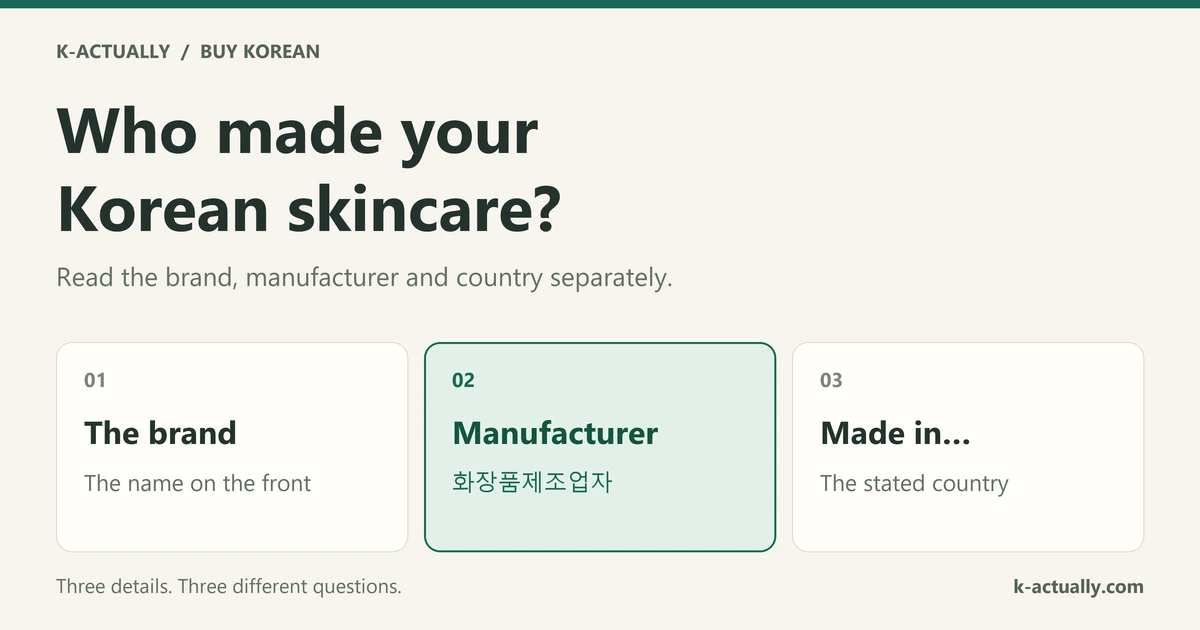
A label settles three things that are easy to confuse. Which brand is this? Which company is named as the manufacturer? Where does the product say it was made?
A Korean brand name answers only the first. A Seoul address answers none of them.
Two namesWhat Those Two Lines Actually Mean
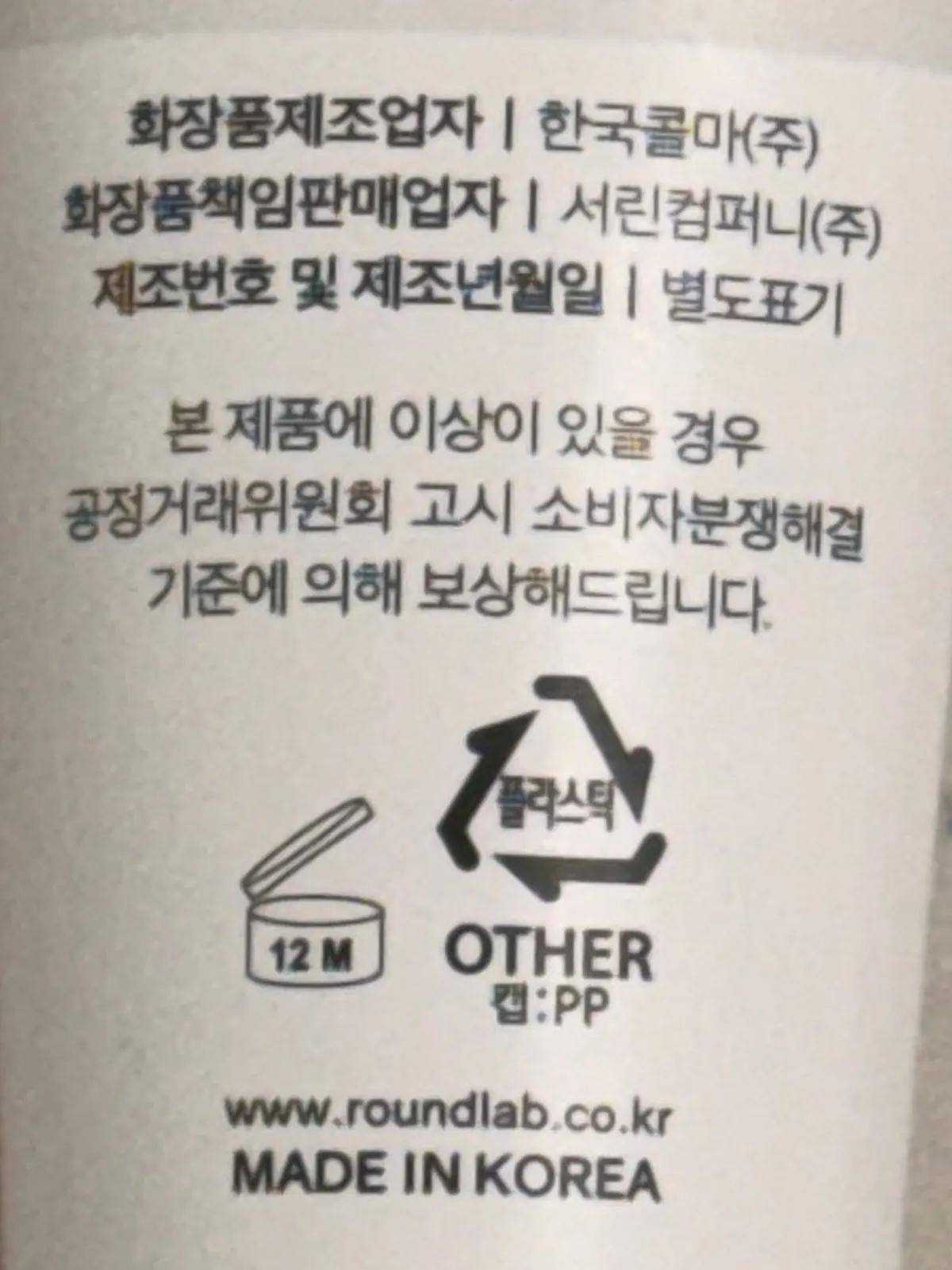
This is the back of a Round Lab sunscreen. Two lines sit together.
화장품제조업자 (hwajangpum jejo-eopja), the cosmetics manufacturer, is 한국콜마㈜ — Kolmar Korea. 화장품책임판매업자 (chaegim panmae-eopja), the responsible distributor, is 서린컴퍼니㈜ — Seorin Company.
Round Lab is the brand on the front. Seorin Company holds the responsible-distributor role. Kolmar Korea is named in the manufacturing role, and it is one of Korea’s large contract manufacturers. If you have bought Korean skincare, you have probably used its products without knowing the name.
It establishes that two different companies are listed for those two roles, and that the product states it was made in Korea.
It does not establish who proposed the formula, who owns it, how the work was divided, or whether another brand’s sunscreen from the same manufacturer is equivalent.
That second point deserves emphasis. The label describes this product. A different product from the same brand may name a different manufacturer entirely.
Not an exceptionThe Same Pattern, a Pharmaceutical Brand
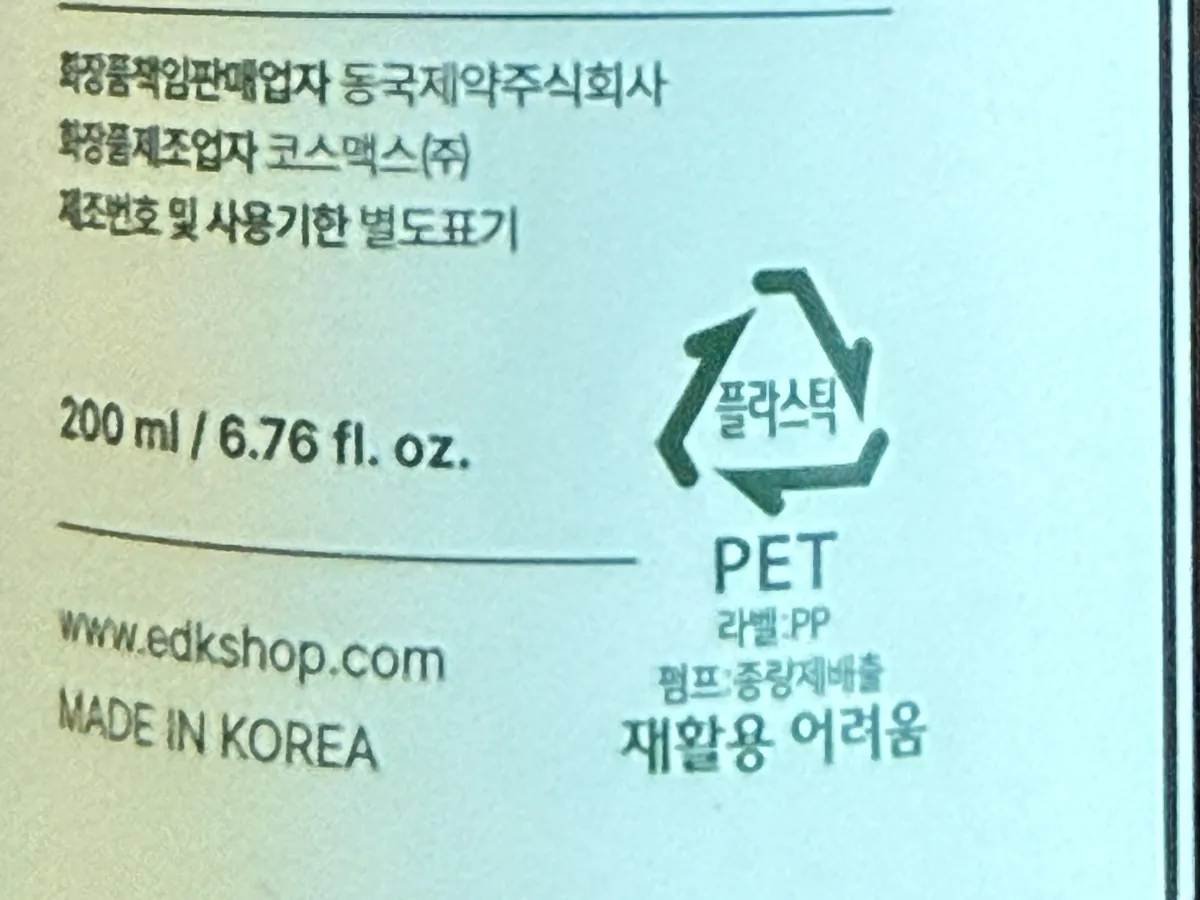
This toner carries the same two lines. The manufacturer is 코스맥스㈜ — Cosmax, another of Korea’s major contract manufacturers. The responsible distributor is 동국제약주식회사 — Dongkook Pharmaceutical, a pharmaceutical company with a skincare line.
Two names on a label is not a sign of a small brand or a cut corner. It is the ordinary structure of a large part of the Korean cosmetics industry, and the labelling rules make it visible. Our K-beauty industry explainer covers how that system developed.

One nameWhen a Brand Holds Both Roles
Now compare that with this body wash. One line, not two: 화장품 제조원 및 책임판매원 | ㈜엘지생활건강 — LG Household & Health Care. When the same business holds both roles, the rules allow them to be written together.
This label does something else useful. It gives two addresses and labels them. (공장), the factory, is in Cheongju, North Chungcheong Province. (본사), the head office, is in Jongno-gu, Seoul.
A company address on a Korean label is not necessarily a factory address. The rules permit a registered business address, or an address that handles returns and exchanges. This label marks which address is which, so there is nothing to infer.
One combined entry also does not prove that a brand performs every production step itself. Counting company names is not a test of factory ownership.
The other directionA French Brand, Made in Korea
Everything so far has been about Korean brands. This one runs the other way.
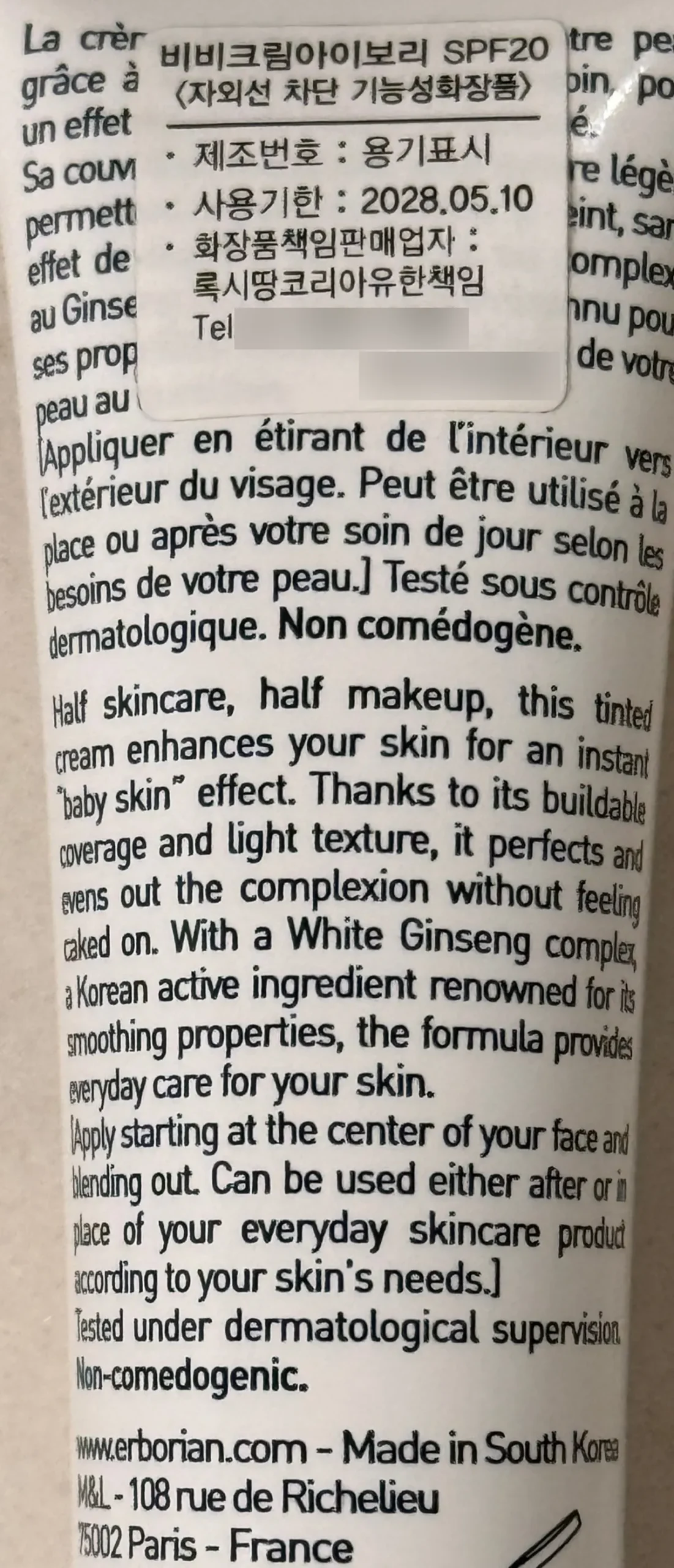
The printed tube reads www.erborian.com — Made in South Korea, above a Paris address for M&L at 108 rue de Richelieu. A French company. A product manufactured in South Korea. A Korean-language sticker added for the Korean market, naming 록시땅코리아 (L’Occitane Korea) as the responsible distributor.
“Korean brand” and “made in Korea” are independent facts. Either can be true without the other.
If where a product was made matters to your purchase, look for an explicit statement on the packaging for the exact product you are buying. Do not infer it from Hangul on the front, a Seoul address, or where the parcel ships from.
ImportedWhen the Product Wasn’t Made in Korea
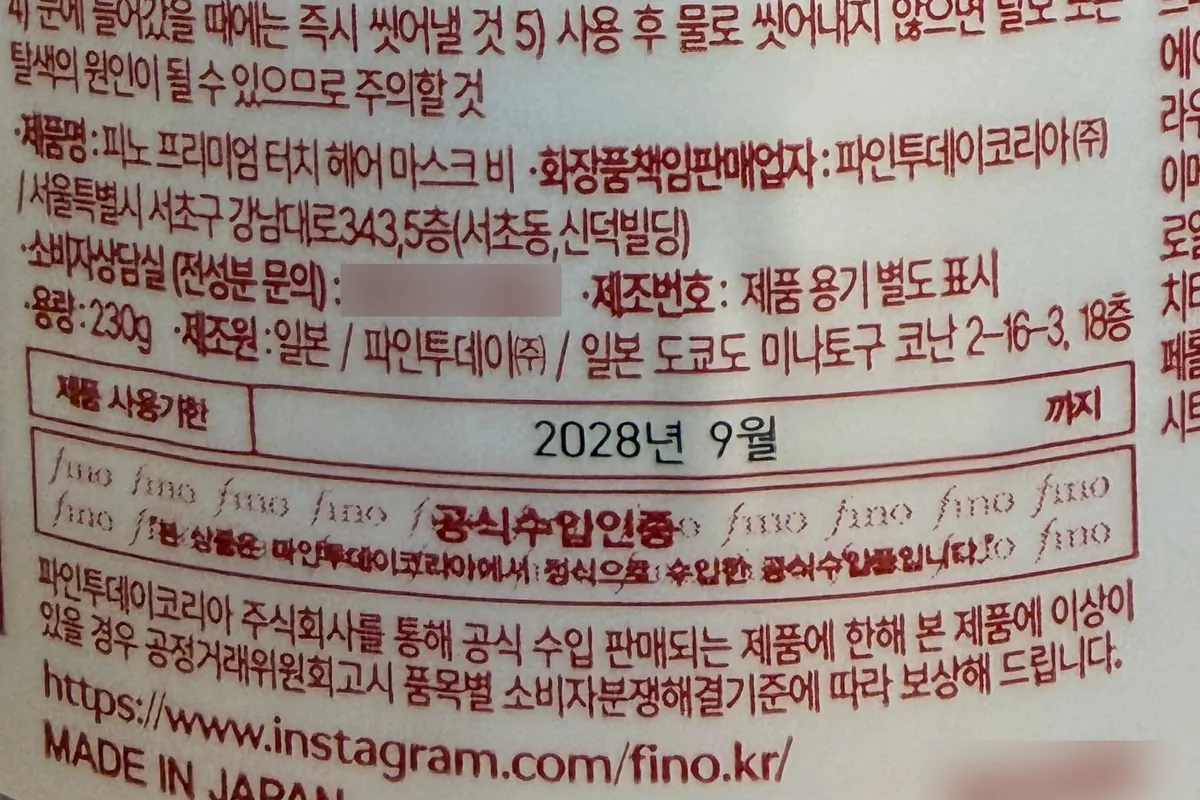
This hair mask is sold in Korea but was not made there. The responsible distributor is 파인투데이코리아㈜ — Fine Today Korea, in Seoul. Below it, 제조원, the manufacturing source, reads 일본 / 파인투데이㈜ / Tokyo. At the bottom of the label: MADE IN JAPAN.
For imported cosmetics sold in Korea, the rules call for the manufacturing country, the manufacturing company and its address, kept separate from the domestic entries. The Enforcement Rule also permits the manufacturing-country name to be omitted when origin is stated under the Foreign Trade Act.
Sitting on a shelf in Seoul is not evidence of Korean manufacture. The label will usually tell you, if you look for the country line rather than the company line.
The wording variesThe Same Role, Six Different Labels
The statutory terms are 화장품제조업자 and 화장품책임판매업자. The wording varies across real packages, which can make the relevant entry harder to find.
| On the label | What it refers to |
|---|---|
| 화장품제조업자 / 제조업자 | The manufacturer role |
| 제조원 | Manufacturing source, common on imported products |
| 해외제조원 | Overseas manufacturing source |
| 화장품책임판매업자 / 책임판매업자 | The responsible-distributor role |
| 제조원 및 책임판매원 | Both roles, same company |
| Dist. by | English rendering some brands use for the responsible distributor |
Searching for the exact string 화장품제조업자 will miss products that print 제조원 instead. Look for the pattern — two company names, or one — rather than one fixed phrase.
That last row is worth flagging. Some labels print the Korean role name and translate it into English as “Dist. by,” which reads to an English speaker like an ordinary distributor. The Korean term carries specific regulatory duties that the English shorthand does not convey.
LimitsWhat the Label Cannot Settle
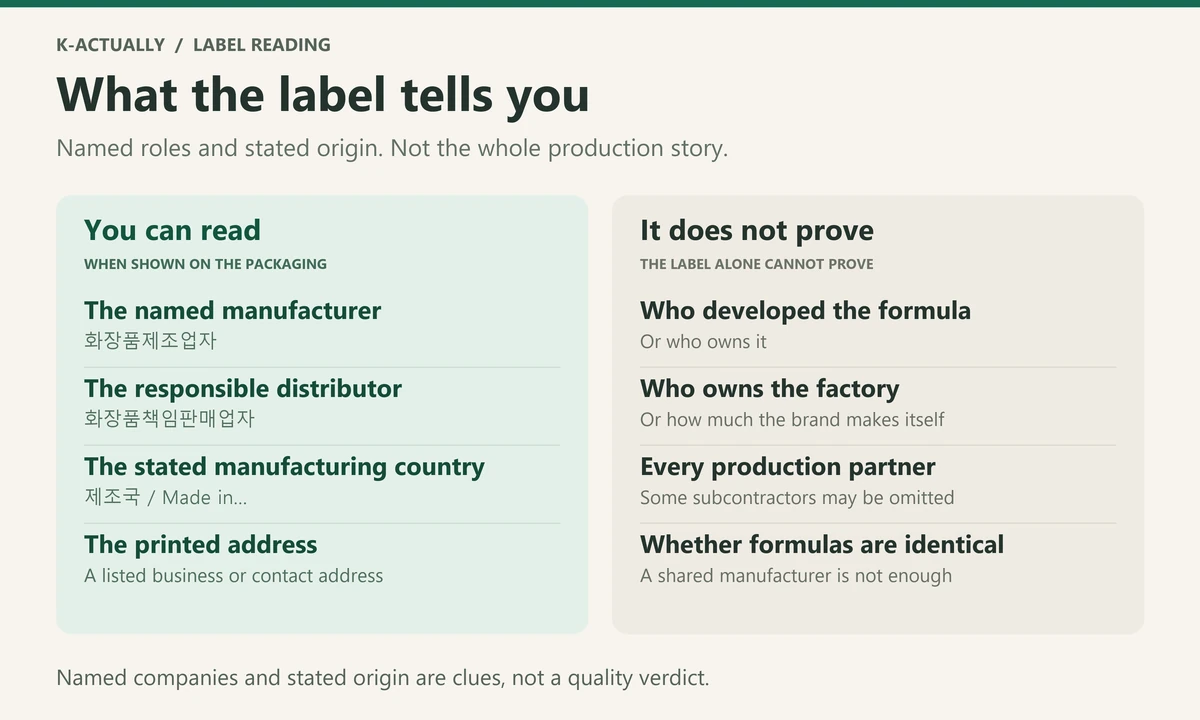
Finding the same manufacturer on two products gives you a thread to pull. It does not establish that the products share a formula.
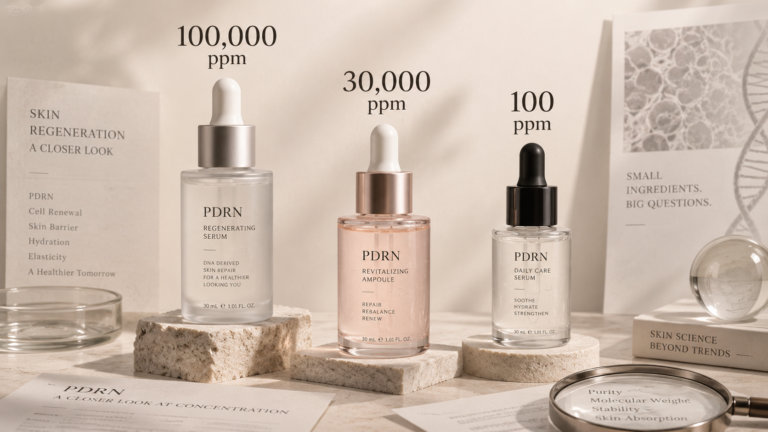
The label cannot answer whether two products use the same ingredient specifications, the same concentrations, the same testing, or whether either will suit your skin. Those need product-specific evidence. Our guide to PDRN products shows why even similar-looking numbers on two labels need closer inspection.
The same limit applies to the terms OEM and ODM. They describe different development and manufacturing arrangements. The company names on a label do not tell you which arrangement produced that particular product.
There is one more gap. Where manufacturing is split across sites, the rules allow certain subcontracted manufacturers’ names and addresses to be omitted. Read the named manufacturer as a disclosed participant, not a complete map of every company and facility involved.
Different marketWhy Your Overseas Package Looks Different
This guide describes cosmetics sold in the Korean market. Products sold elsewhere are not required to carry the same information.
Korea’s Cosmetics Act allows products made solely for export, and not sold domestically, to follow the importing country’s rules instead of specified Korean provisions, labelling among them. Separate exceptions apply to small packs and samples.
You may also see the reverse: a Korean-market product that carries foreign requirements too. If a package also names an EU or UK Responsible Person, read that as another regulatory role, not evidence of where it was made.
A package sold overseas without the two Korean company entries is not, on that basis alone, evidence of a counterfeit. It may simply be a different market version. If the information is unclear, ask the brand which version you have.
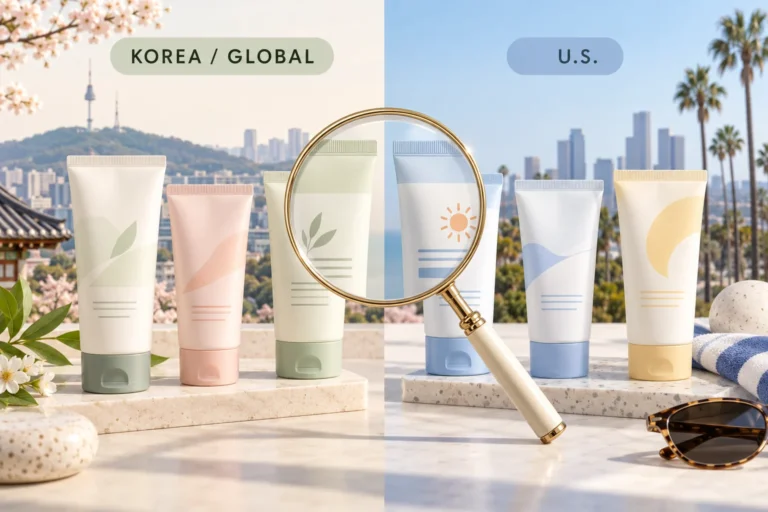
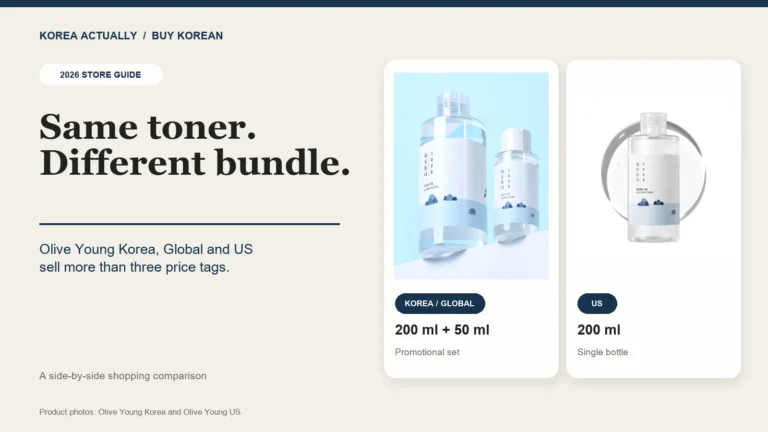
Different market versions are not only a labelling matter. The formula can differ too. The same brand can sell a different sunscreen in the US, and the three Olive Young storefronts carry different line-ups. When you are carrying products out of Korea yourself, our guide to bringing purchases home covers that side.
In the shopHow to Check Your Own Product
Identify the version. Match the full product name, size and intended market. Similar packaging is not enough.
Read the outer box as well as the container. Some entries appear on only one of them.
Look for two company names, or one. The role names vary; the pattern does not.
Find the country statement separately. Look for 제조국, 제조원, “Made in” or “Country of origin.” A company address answers a different question.
Treat an address as an address. Unless the label says 공장 (factory), you cannot assume it is one.
Ask a precise question. “Which company is listed as the manufacturer?” and “Where was this product manufactured?” get answers. “Is this really Korean?” does not.
If you are ordering directly from Korean retailers, our guide to buying from Korean websites covers the payment and delivery barriers separately.
The useful partThree Facts, Read Separately
The company names alone do not tell you how much the brand contributed or whether another product uses the same formula.
What they do tell you is that brand, manufacturing role and production location are three separate facts, and that a Korean label lists each of them. Read each for what it settles. Then use product-specific evidence for the decision you are actually making.
The same question — who made this, and how — is the one behind everything we cover in Korean Made, whether that is a Korean whisky distillery, a craft makgeolli brewery, or a traditional wrapping cloth.
Labels photographed and provisions checked November 19, 2026.
How Korea Built the K-Beauty Industry
Korean Sunscreen vs the US Version: What Actually Changes
How to Buy from Korean Websites That Don’t Ship Internationally
The separate listing of the cosmetics manufacturer and the responsible distributor, the treatment of addresses, and the omission permitted for subcontracted manufacturers in split production: Annex 4 to the Enforcement Rule of Korea’s Cosmetics Act (화장품법 시행규칙 별표4), issued under Article 19(7) of the Enforcement Rule and linked from that page.
The entries required for imported cosmetics — manufacturing country, manufacturing company and its address — and the permission to omit the country name where origin is stated under the Foreign Trade Act: Enforcement Rule Article 19(4)6. The exceptions for packages of 10 ml or 10 g and under, and for tester and sample packaging, are in Article 19(1) of the same rule.
Products made solely for export: Cosmetics Act Article 30 (화장품법 제30조), which allows products not sold domestically to follow the importing country’s rules instead of Articles 8 through 12, labelling among them.
Product labels photographed by K-Actually: Round Lab Birch Juice Mild-Up Sunscreen, Madeca 21 Teca Solution Soothing Mist Toner, LG Household & Health Care 46cm Body Odor Solution Body Wash, Erborian BB Cream Ivory SPF20, Fino Premium Touch Hair Mask.
Company names are reproduced as printed on the packaging. Statute links go to Korea’s National Law Information Center and are in Korean. Labelling rules and product versions change. Check the packaging of the product in front of you.