Same K-Beauty Brand, Different Sunscreen: How to Tell Which Version You’re Buying
You may not be buying the same sunscreen at all.
Korean sunscreen vs US version sounds like a simple comparison until you try it. You find a Korean sunscreen online, search for the brand, and land on what looks like the same product. The name is familiar, the packaging is close, and the SPF number is similar.
The one in your cart may still not be the one you saw in Korea.
This article started with a July 2026 test from Consumer Reports. The results looked fairly clear. Then the current product pages made things more complicated.
The more useful question stopped being which sunscreen performed better and became something more basic:
What exactly am I buying?
What Consumer Reports Tested
On July 10, 2026, Consumer Reports compared six facial sunscreens from Beauty of Joseon, Innisfree, and Round Lab.
For each brand, CR bought one Korean-market formula and one U.S.-market product.
Products tested by Consumer Reports in July 2026
| Brand | Market | Product tested | UVA | UVB | CR’s Average Tested SPF |
|---|---|---|---|---|---|
| Beauty of Joseon | Korea | Relief Sun: Rice + Probiotics SPF 50+ PA++++ | 5 | 5 | 36 |
| Beauty of Joseon | U.S. | Day Dew Sunscreen SPF 50 | 5 | 2 | 19 |
| Innisfree | Korea | Intensive Long Lasting Sunscreen EX SPF 50+ PA++++ | 5 | 5 | 48 |
| Innisfree | U.S. | Daily UV Defense SPF 36 | 5 | 2 | 16 |
| Round Lab | Korea | Birch Juice Moisturizing Sunscreen SPF 50+ PA++++ | 5 | 5 | 46 |
| Round Lab | U.S. | Birch Juice Mild-Up Sunscreen UVLock SPF 50+ Broad Spectrum | 3 | 2 | 16 |
These results apply to the six products CR tested in July 2026, not to everything these brands sell. Source: Consumer Reports. Recheck the linked page for current figures.
The clearest gap was in UVB protection. All three Korean formulas scored a 5, while all three U.S. products scored a 2.
There is another detail in the table that matters, though.
Every one of the six products measured below its labeled SPF in CR’s test. The three Korean products were labeled SPF 50+ and tested at 36, 48, and 46. The U.S. products tested at 19, 16, and 16.
So this is not a case where every Korean product perfectly matched its label and every American product did not.
CR also explains the limits of the comparison. Its SPF procedure uses three people, fewer than the full FDA protocol calls for, although CR says it uses statistical analysis to verify the results.
CR itself describes this as a small comparison test, not a definitive study of Korean sunscreen as a category.
This Does Not Make Korean Sunscreen Better by Default
The table invites an easy headline:
Korean sunscreen beats American sunscreen.
CR does not make that claim.
It tested six products from three brands and says the comparison does not provide a definitive answer about Korean sunscreens as a whole. It also points out that well-performing sunscreens are available in the U.S.
There is another reason the Korean formulas sit outside CR’s official sunscreen ratings. The Korean products CR tested use active ingredients that do not comply with current U.S. sunscreen rules, so they cannot legally be sold as sunscreens in the U.S.
CR notes that individuals may still order them from overseas, although imported packages can run into problems at the border.
CR’s broader sunscreen guidance is much less dramatic: choose a broad-spectrum sunscreen with SPF 30 or higher and reapply it about every two hours, including after swimming or heavy sweating. Read CR’s broader sunscreen guidance
So instead of asking which country makes the better sunscreen, there is a more practical question.
When the same K-beauty brand sells different products in different markets, how do you know which one you are looking at?
Beauty of Joseon: The Easy Case
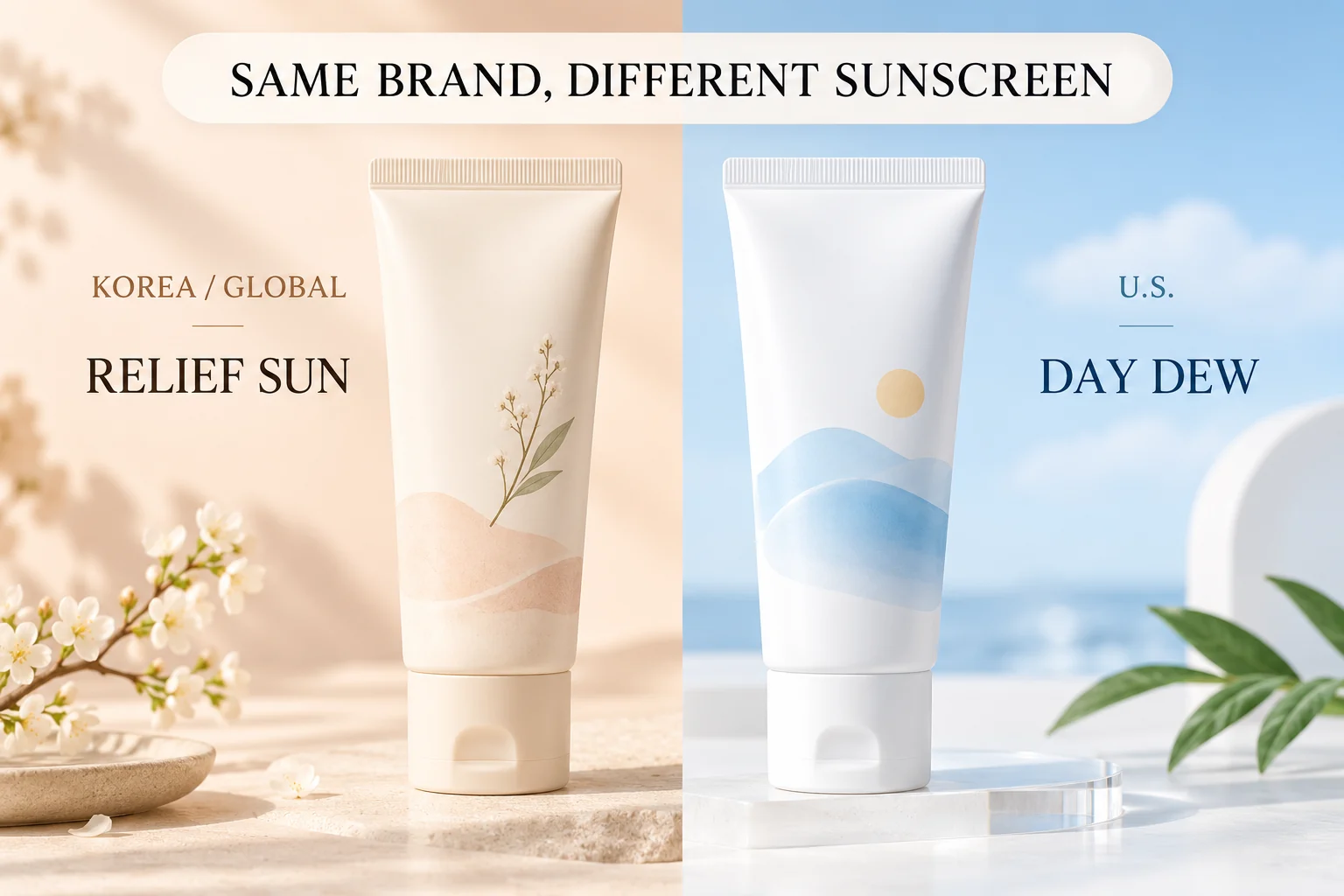
Beauty of Joseon is the simplest example because the two products have different names.
In Korea and many international markets, the familiar sunscreen is Relief Sun.
In the U.S., Beauty of Joseon sells Day Dew Sunscreen.
Beauty of Joseon says Day Dew was developed specifically for the U.S. market using sunscreen active ingredients permitted under U.S. FDA rules. Its active ingredients are Avobenzone 3.0%, Homosalate 7.0%, Octisalate 5.0%, and Octocrylene 5.0%. Beauty of Joseon Day Dew official page
Relief Sun uses a different set of UV filters:
Ethylhexyl Triazone, Diethylamino Hydroxybenzoyl Hexyl Benzoate, Diethylhexyl Butamido Triazone, and Methylene Bis-benzotriazolyl Tetramethylbutylphenol.
Those filters are listed directly by Beauty of Joseon on its Relief Sun product page. Beauty of Joseon Relief Sun official page
So far, this is fairly easy.
Then the name changed.
Beauty of Joseon is renaming Relief Sun: Rice + Probiotics to Relief Sun: Rice + Niacinamide.
The company says the formula, ingredients, and size have not changed. Only the full product name and packaging are being updated, which means both names can appear while older packaging is phased out.
And the transition is not happening everywhere at the same speed.
Olive Young Global’s product page still lists it as Relief Sun: Rice + Probiotics 50mL. Olive Young Global Relief Sun listing
That gives us the first useful lesson:
A different name does not always mean a different formula. And the same brand name does not always mean the same sunscreen.
Beauty of Joseon also publishes SPF results from its own laboratory testing that differ substantially from CR’s results. Because the methods and testing conditions are different, this article does not use those numbers to decide which result is “correct.”
Innisfree: Even the Same Product Line Changes
Innisfree makes the problem harder.
The U.S. product Consumer Reports tested was Daily UV Defense SPF 36.
The product currently sold on Innisfree’s U.S. website under that line is Daily UV Defense Sunscreen Broad Spectrum SPF 50+ PA++++.
Innisfree describes the current SPF 50 product as its new and improved Daily UV sunscreen and specifically compares it with the previous SPF 36 lotion. Innisfree U.S. Daily UV Defense SPF 50+
Its current active ingredients are:
Avobenzone 2.5%, Homosalate 7.0%, and Octisalate 4.3%.
The older SPF 36 label lists the same three sunscreen active ingredients at the same percentages. DailyMed label for Innisfree Daily UV Defense SPF 36
That does not tell us why the labeled SPF changed, and there is no reason to guess.
What matters for this article is simpler.
CR’s tested SPF of 16 belongs to the SPF 36 product CR actually bought.
It should not be treated as a test result for the SPF 50+ version currently being sold.
This is where older reviews, comparison posts, and videos can become misleading even when they were accurate when they were published.
Someone can write “Innisfree Daily UV Defense” and still be describing a different version from the one sitting on the website today.
The brand name may match.
Even the product-line name may match.
The bottle can still be different.
Round Lab: Where It Gets Messy
Round Lab is the clearest example of why the exact product name matters.
Consumer Reports tested the Korean Birch Juice Moisturizing Sunscreen SPF 50+ PA++++.
For the U.S. product, CR tested Birch Juice Mild-Up Sunscreen UVLock SPF 50+ Broad Spectrum.
The Mild-Up product is a mineral sunscreen built around zinc oxide. Its official U.S. drug label lists Zinc Oxide 17% as the sunscreen active ingredient. DailyMed label for Round Lab Mild-Up UVLock
Round Lab also sells a separate U.S. product called Birch Juice Moisturizing UVLock.
This one uses Avobenzone 2.7%, Homosalate 13.5%, and Octisalate 4.5%. Olive Young US Birch Juice Moisturizing UVLock
The naming gets even more confusing.
Olive Young US currently lists the product simply as Birch Juice Moisturizing UVlock, without an SPF number in the product title. Its page lists the three active ingredients above.
Round Lab’s own U.S. site, meanwhile, calls the product Birch Moisturizing Sunscreen UVLock SPF 45+ Broad Spectrum. Round Lab U.S. Moisturizing UVLock page
And the U.S. National Library of Medicine’s DailyMed database has an updated April 2026 label for Birch Juice Moisturizing UVLock Sunscreen SPF 50 Broad Spectrum, using the same active-ingredient percentages. DailyMed SPF 50 label
You do not need to memorize any of this.
That is the point.
A search for Round Lab Birch sunscreen can lead you to several products with very similar names.
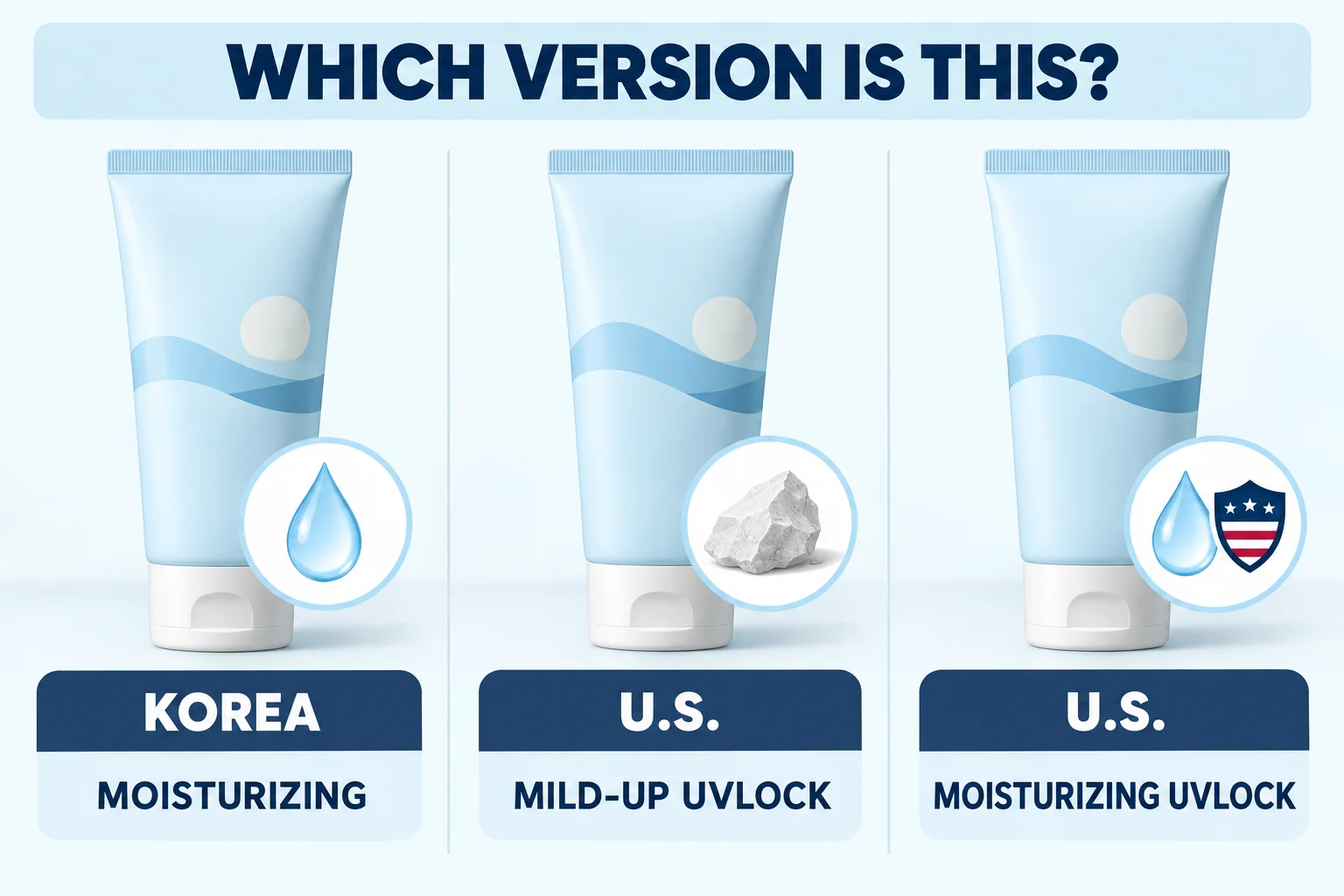
- Birch Juice Moisturizing SunscreenThe Korean-market product tested by CR.
- Birch Juice Mild-Up UVLockA U.S. mineral sunscreen using zinc oxide.
- Birch Juice Moisturizing UVLockA separate U.S. formula using avobenzone, homosalate, and octisalate.
None of this means one product is the “real” Round Lab.
It means a familiar brand name is not enough to identify the formula.
Why Korean and U.S. Versions Differ
Part of the answer is regulation.
In the U.S., over-the-counter sunscreens are regulated under the FDA’s sunscreen OTC monograph. Products sold under that system have to meet its conditions, including the active ingredients permitted for use and applicable labeling requirements. FDA sunscreen OTC monograph Q&A
Korea uses a different framework.
Products that claim UV protection are regulated as functional cosmetics, and the Ministry of Food and Drug Safety reviews them under Korea’s functional-cosmetics rules. The framework includes substantiation requirements connected to SPF and PA claims. MFDS Functional Cosmetics Review Regulation, Notice No. 2025-88
Different regulatory systems mean brands do not necessarily have the same UV-filter options in both markets.
That is one reason a company may create a separate U.S. product instead of simply putting its Korean formula into a different box.
Regulation is only one part of why Korean beauty products can develop differently for different markets. We looked at the broader industry behind this in our guide to how Korea built the K-beauty industry.
What Changed in the U.S. in 2026?
There was one major change this year.
In June 2026, the FDA added bemotrizinol to the OTC sunscreen monograph through Final Administrative Order OTC000039.
The FDA described bemotrizinol as the first new sunscreen active ingredient added to the OTC monograph since the late 1990s, and the order permits concentrations of up to 6 percent. FDA announcement on bemotrizinol
The current FDA monograph reflects that change. FDA OTC Monograph M020 for sunscreen drug products
That is a meaningful update, but it does not instantly make the products on U.S. shelves identical to Korean formulas.
Brands still have to decide whether, when, and how they will use newly permitted ingredients.
The U.S. sunscreen system is changing. The products will change with it.
How to Tell Which Sunscreen You Are Actually Buying
Before relying on a review, a viral post, or an old product page, check the product in front of you.
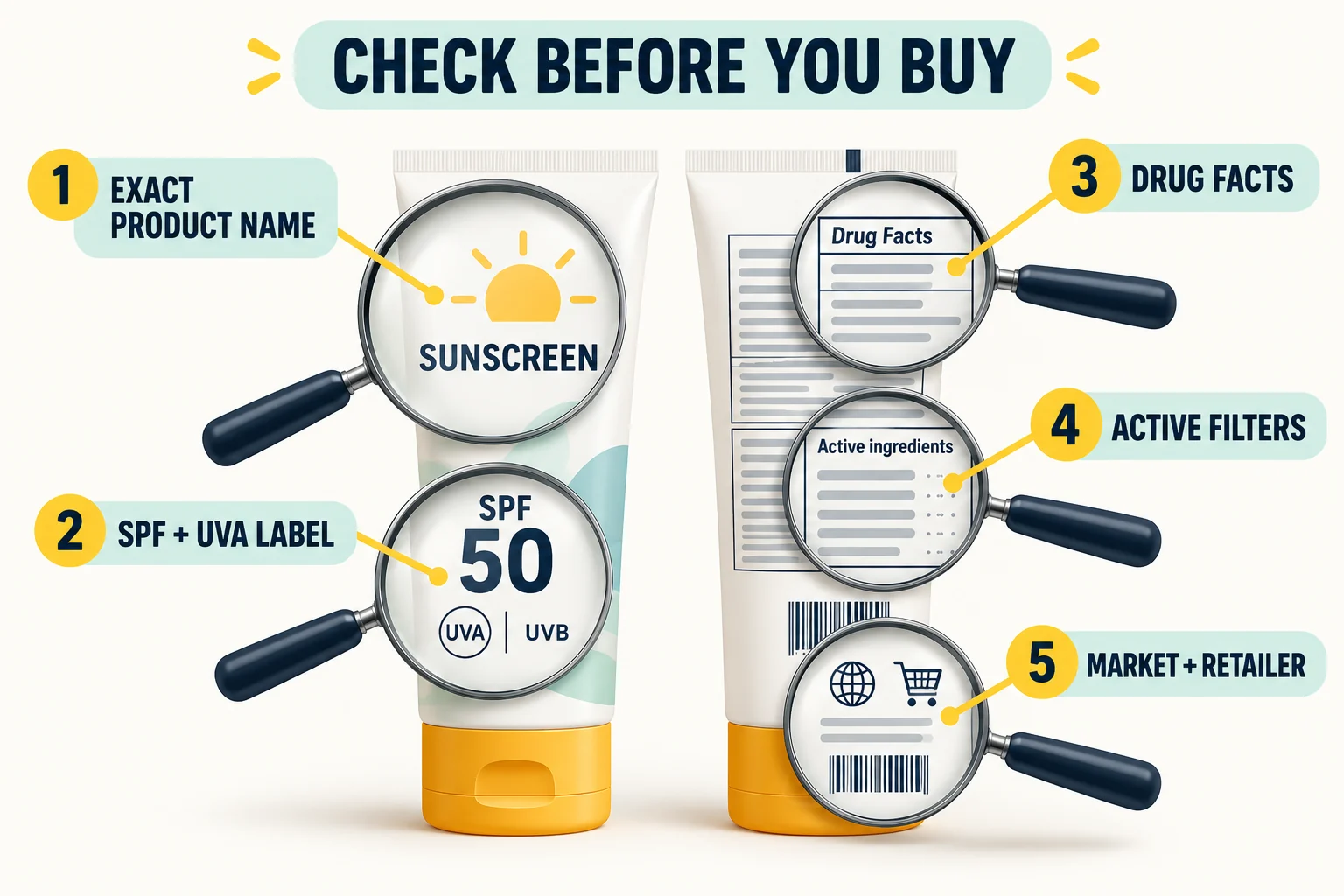
Read the exact product name.
Small words matter. Moisturizing, Mild-Up, UVLock, Mineral, and Serum can identify completely different products. “Round Lab Birch” or “Innisfree Daily UV” is not specific enough.
Check the SPF and UVA labeling.
Korean-market products commonly show SPF together with a PA grade. U.S. OTC sunscreens commonly emphasize SPF and Broad Spectrum labeling. Use this as a clue, not a rule. Innisfree’s current U.S. Daily UV Defense is sold as SPF 50+ PA++++, so seeing PA++++ does not automatically mean you have the Korean-market version.
Look for the Drug Facts panel.
U.S. OTC sunscreens list their sunscreen active ingredients and percentages in Drug Facts. Round Lab’s U.S. Moisturizing UVLock, for example, lists Avobenzone 2.7%, Homosalate 13.5%, and Octisalate 4.5%.
For a Korean-market cosmetic, you will usually need to check the full ingredient list and product information instead.
Check the active filters.
Round Lab’s U.S. Mild-Up UVLock uses zinc oxide. The U.S. Moisturizing UVLock uses avobenzone, homosalate, and octisalate.
Very similar product family. Very different sunscreen formulas.
Check the market and retailer.
A Korean retailer, a brand’s U.S. website, Olive Young Global, Olive Young US, Sephora, and a third-party marketplace may not all be selling the same version.
The retailer is useful evidence, but it should not be your only evidence. Cross-border stores, parallel imports, and marketplace sellers can blur the picture.
Check the exact product name and the label too.
Check whether the packaging or version changed.
Beauty of Joseon is renaming Relief Sun without changing the formula. Innisfree’s U.S. Daily UV Defense moved from an SPF 36 version to a current SPF 50+ version. Round Lab’s U.S. pages and drug labels show different SPF numbers around its Moisturizing UVLock line.
So when you read a review, check when it was published and which exact version the reviewer used.
An old review can be completely honest and still describe a bottle that is no longer the one you are buying.
Counterfeit products are a separate issue. Once you identify the version you actually want, buying from the brand or a trustworthy authorized retailer still matters.
Start With the Exact Product Name
Consumer Reports’ July 2026 test is useful because it shows how differently regional products from the same K-beauty brands can perform.
It is also a snapshot of six specific products at one moment.
By October 2026, some current product pages already differed from the versions CR tested in July.
So the conclusion is not that Korean sunscreen is always better.
It is not that every U.S. version is bad either.
Before comparing reviews, SPF tests, ingredients, or prices, first make sure you are comparing the same product.
Start with the exact name on the bottle.
◆
Sources and Verification
- Consumer Reports: Does Korean Sunscreen Work Better?
- Consumer Reports: Sunscreen application and reapplication guidance
- FDA: Regulatory actions on OTC sunscreen
- FDA: Bemotrizinol announcement
- MFDS: Functional Cosmetics Review Regulation No. 2025-88
- Beauty of Joseon: Day Dew Sunscreen
- Beauty of Joseon: Relief Sun and renaming FAQ
- Innisfree U.S.: Daily UV Defense SPF 50+
- DailyMed: Innisfree Daily UV Defense SPF 36 label
- DailyMed: Round Lab Mild-Up UVLock label
- Olive Young US: Round Lab Birch Juice Moisturizing UVLock
- Round Lab U.S.: Birch Moisturizing Sunscreen UVLock SPF 45+
- DailyMed: Round Lab Moisturizing UVLock SPF 50 label